
Automotive & Heavy Equipment — Application Focus
A technical reference for tire manufacturing engineers covering single speed reducer selection, drum drive architecture, speed uniformity requirements, and maintenance practices in radial and bias tire building machine installations worldwide.
Ply Laydown Precision and the Drive System Behind It
In a tire building machine, the accuracy of ply laydown — the process of applying successive layers of rubber-coated fabric or steel belt cord to the rotating building drum — determines the uniformity and structural integrity of every tire produced. A radial passenger car tire built on a first-stage drum may receive two or more carcass plies, inner liner, and apex components in sequential application steps, with each layer applied while the drum rotates at a precisely controlled speed. If the drum speed fluctuates during ply application, the resulting tension variation in the cord material produces circumferential non-uniformity in the finished tire carcass, which manifests as force variation and vibration in the end product on the vehicle.
The single speed reducer in the drum drive system is the mechanical element that converts the drive motor’s output speed to the specific drum rotation speed required for each build stage. Tire building machines at facilities in Japan, Germany, the United States, South Korea, and India operate at drum speeds typically between 15 and 80 RPM for the fabric and steel belt ply application stages, and up to 300 RPM during the finishing and shaping phase. The single stage speed reducer provides the fixed gear ratio that maps the motor’s rated speed to the application-stage drum speed, while the variable-frequency drive on the motor input handles speed adjustment between stages. The combination of a fixed-ratio single speed worm reducer and a VFD input is the most common drum drive architecture in modern tire building equipment.
Manufacturing Structure & Material System for Tire Building Duty
Housing: Dimensional Stability for Low-Vibration Drum Drive
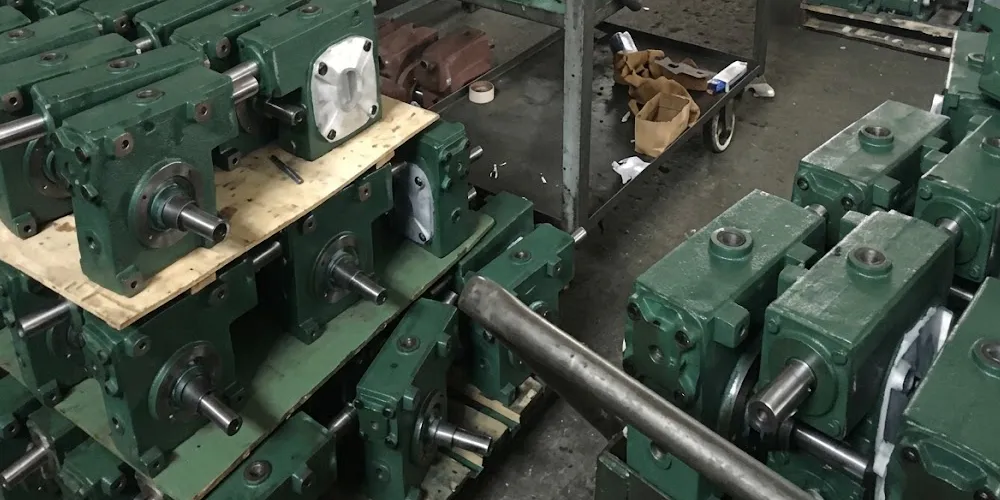
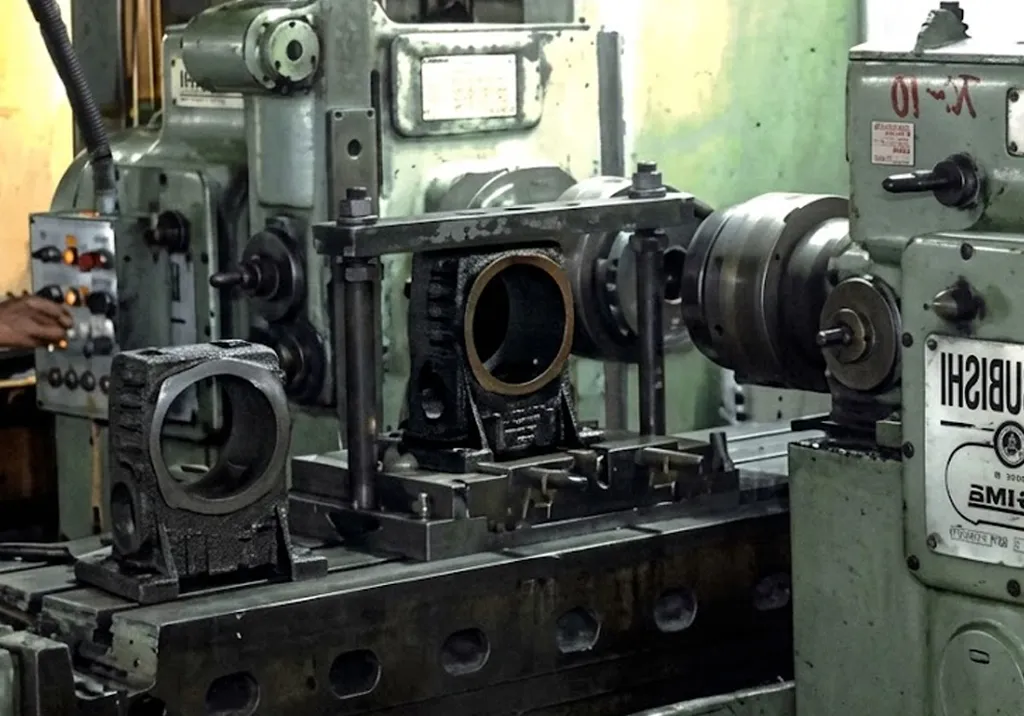
Tire building machine drum drives operate in an environment where rubber tackiness and chemical exposure from tire compound materials are constant factors. The single speed reducer housing must resist both the physical contamination risks of a tire factory floor and the vibration transmitted through the machine frame during drum acceleration and deceleration between build stages. HT250 grey cast iron provides the combination of rigidity and vibration damping that keeps the worm mesh geometry stable across the full drum speed range. All bearing bores are finish-machined in a single datum setup to maintain shaft alignment within the tight tolerances that prevent periodic velocity variation — the primary quality concern in ply laydown drum drives in tire plants across Japan, South Korea, and the United States.
Worm Shaft: Ground Profile for Velocity Uniformity
The transmission error of the worm gear set directly affects drum speed uniformity during ply application. In a single speed reducer with a poorly ground worm thread, the output shaft velocity oscillates with a periodic pattern at the frequency of one revolution of the worm — this creates a cyclic speed variation that appears as a slight waviness in the applied ply material when examined under ultraviolet inspection after cure. For tire building machine drives, the worm shaft must be CNC-ground post-carburising on the thread flanks to achieve the lowest possible transmission error. 20CrMnTi steel carburised to 0.8–1.2 mm case depth, hardened to HRC 58–62, and finish-ground on the thread profile is the standard specification for this application across the major tire equipment OEMs in Germany and Japan.
Worm Wheel: Bronze Specification for Quiet Running
The worm wheel material in a tire building drum drive single speed gear reducer must balance wear life against mesh noise — a factor that is more important in a tire plant than in most industrial settings because operators work close to the machine for extended periods during manual ply application steps. ZCuSn10P1 tin-phosphor bronze, centrifugally cast and precision hobbed, provides the low friction coefficient against the hardened worm shaft that generates the minimal mesh noise characteristic of a well-made worm speed reducer. The bronze hobbing is performed after the rim is fixed to the ductile iron wheel body, ensuring the final tooth geometry is concentric with the assembly’s running axis rather than with the bronze casting’s as-cast centreline.
Seal System for Rubber Compound Environments
Tire building machine environments expose shaft seals to tackifiers, release agents, and rubber processing oils that are more aggressive than standard industrial lubricants. NBR lip seals degrade in contact with aromatic process oils used in compound mixing areas; FKM seals are the recommended specification for all rotating shaft exits on single speed reducer units installed in tire building rooms. A secondary wiper or labyrinth shield on the output shaft protects the primary seal lip from direct contact with rubber fragments and tacky compound residue that accumulates on all surfaces within the building machine envelope during a production shift.
Drum Drive System Architecture in Modern Tire Building Machines
A modern radial tire building machine — such as the type used at passenger car tire plants in Germany, India, and the United States — typically has three to five driven drum positions: the first-stage carcass drum, the transfer ring, the second-stage shaping drum, and in some configurations an additional belt drum. Each drum drive is an independent drive unit consisting of a servo or VFD-controlled induction motor, a single speed reducer providing the fixed ratio between the motor and the drum shaft, and a tachometer or encoder on the drum shaft providing feedback to the machine control system for closed-loop speed regulation.
The single speed reducer ratio selection for each drum drive position is determined by the drum diameter and the required surface speed during ply application. Surface speed at the drum periphery — rather than rotational speed — is the process variable that controls ply application quality, because the cord tension in the ply material is proportional to the peripheral velocity of the drum relative to the applicator guide speed. A wider drum running at the same RPM as a narrower drum has a higher peripheral velocity, so the ratio selection must be recalculated when the machine is retooled for a different tire size range. For tire building machines in India and Southeast Asia that produce a wide range of tire sizes on the same platform, the single stage speed reducer ratio is often selected to cover the widest size range with VFD adjustment handling the within-range speed variation, avoiding the need to change the gearbox ratio during product changeovers.
Single Speed Reducer Ratio Selection by Tire Building Stage
Reference parameters for ratio selection across the main drum drive positions in a two-stage radial passenger car tire building machine. Motor speed assumed at 1,450 RPM (50 Hz four-pole) or 1,750 RPM (60 Hz four-pole) with VFD adjustment capability of ±30%.
| Drive Position | Drum Speed — Ply Apply (RPM) | Drum Speed — Finishing (RPM) | Typical Reducer Ratio | Input Power Range (kW) | Recommended Series |
|---|---|---|---|---|---|
| First-stage carcass drum | 15 – 40 | 80 – 150 | 1/20 – 1/40 | 0.75 – 3.0 | WPDS / WPKA |
| Second-stage shaping drum | 20 – 50 | 100 – 200 | 1/15 – 1/30 | 1.1 – 4.0 | WPDS / WPKA |
| Belt drum | 15 – 35 | 60 – 120 | 1/25 – 1/50 | 0.75 – 2.2 | WPDS / WPZ |
| Transfer ring drive | Axial traverse only | 20 – 60 | 1/30 – 1/60 | 0.37 – 1.5 | WPDS / WPKZ |
| Truck / OTR carcass drum | 8 – 25 | 40 – 100 | 1/40 – 1/60 | 2.2 – 7.5 | WPKA / WPKS |
Speed Control, Ply Tension, and Why Transmission Accuracy Matters
The connection between drive transmission accuracy and ply quality is more direct in tire building than in most other worm gear reducer applications, because the product being made is a safety-critical component tested to precise uniformity standards. A tire with circumferential ply non-uniformity causes periodic force variation at the wheel that vehicle manufacturers measure in Newtons and specify to very tight limits — as low as ±20 N peak-to-valley on passenger car tire first harmonic force variation tests at high-speed uniformity test machines used in Germany and the United States for vehicle homologation.
The worm gear reducer’s contribution to ply non-uniformity comes primarily from two sources: first, the transmission error of the gear mesh (the cyclic output velocity variation per worm revolution described in the manufacturing section); and second, the backlash at direction reversal when the drum momentarily decelerates before changing direction during ply splice positioning. Both effects are managed by the same manufacturing controls — CNC-ground worm thread profile, tight bronze hobbing conjugacy, and pre-set bearing preload on the output shaft — which is why the precision of the single speed reducer manufacturing process is directly traceable to the tire uniformity outcomes at the end of the production line. For the complete range of housing sizes and ratio options, visit the single speed reducer catalogue.
Compatible Components for Complete Drum Drive Packages
Tire building machine drum drives require coordinated specification across the motor, single speed reducer, and any ancillary gearboxes on the machine. Sourcing matched components from a common technical base simplifies the procurement process and provides a unified maintenance documentation set for tire plant engineering teams.
Электр қозғалтқыштары
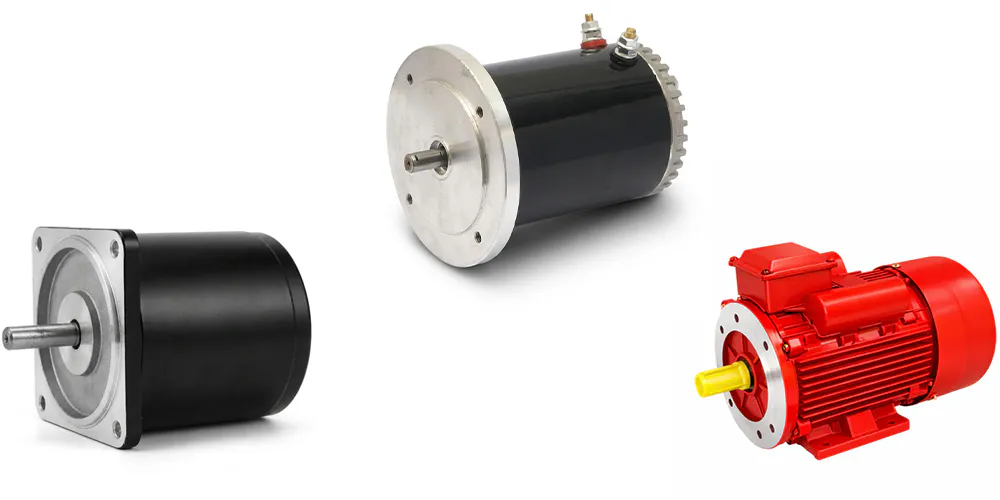
IEC B5 flange motors from IE3 efficiency class, matched to the WPDS and WPKA input flange dimensions for direct mount on tire building machine drum drive stations. For servo-controlled tire building machines used by North American and European tire OEMs, the motor specification must include encoder feedback provision and thermal class F or H insulation to handle the elevated winding temperatures that arise during the frequent start-stop-reverse drum cycles of a ply application build sequence.
Құрт беріліс қорабы
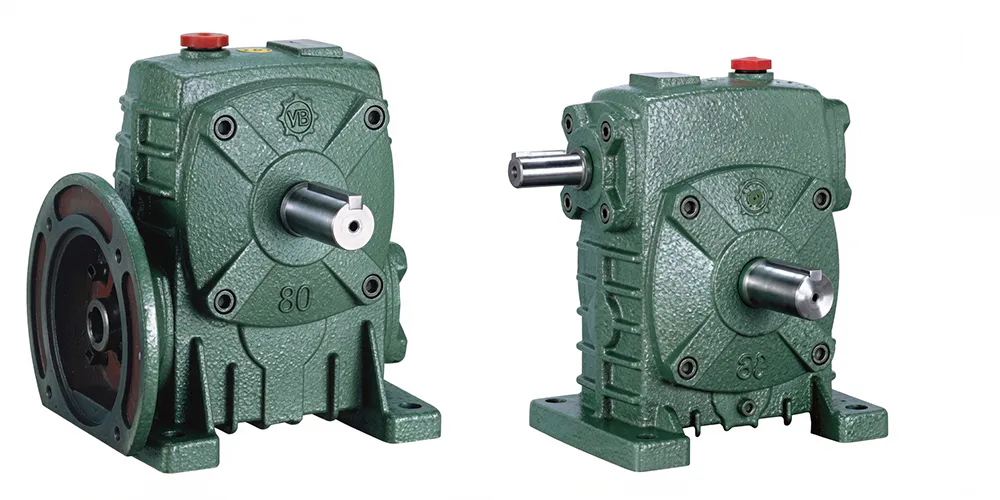
The full worm gearbox product range provides complementary options for the ply servicer drives, bead setter drives, and tire press loader drives that surround the tire building machine in a complete tire manufacturing cell. Sourcing these secondary drive positions from the same product family simplifies lubricant rationalisation and spare parts management at tire plants in India and Southeast Asia where maintenance resource is shared across multiple machine types.
Өндірістік қуат
Our production range includes worm gear reducers, industrial gearboxes, planetary drives, power take-off shafts, hydraulic cylinders, gear and sprocket components, roller chains, and motors — engineered to support complete drive system specification from a single production facility. The facility holds ISO 9001:2015 certification, with gear cutting, heat treatment, CNC tooth grinding, and assembly all performed in-house under documented quality controls that provide full production traceability.
We design and manufacture standard and custom gearboxes and assemblies in ductile iron, grey cast iron, cast steel, precision investment cast steel, and cast aluminium. The component catalogue extends to gears, sprockets, worm gears, pulleys, worm shafts, and non-standard mechanical parts produced to buyer drawings. For tire equipment OEM and tire plant maintenance procurement teams, full documentation packages — ISO 9001 certificates, material test records, gear inspection data, factory run-test records — are available on request.
Шеберхана

Жиі қойылатын сұрақтар
Q1. How do I select the correct single speed reducer ratio for a first-stage carcass drum drive on a radial passenger car tire building machine in a German tire manufacturing plant?
Ratio selection for a passenger car carcass drum drive starts with the required drum surface speed during carcass ply application — typically 10 to 20 metres per minute for nylon or polyester carcass ply at German OEM tire plants operating to quality grade specifications. Divide this surface speed by the drum circumference to get the required drum RPM. For a 550 mm diameter carcass drum running at 15 metres per minute, the drum speed is 15,000 mm/min ÷ (550 mm × π) = approximately 8.7 RPM at the ply laydown stage. With a VFD-controlled 4-pole motor at base speed of 1,450 RPM, the required ratio is 1,450 ÷ 8.7 = approximately 1/167, which is well beyond single-stage range. In practice, the VFD would be set to run the motor at 20–30% of base speed during ply apply, reducing the effective ratio requirement to the 1/30–1/50 range available from the WPDS series. Confirm the full speed range across all build stages to verify the VFD range can cover all operating points without exceeding motor rated slip at minimum frequency.
Q2. What single speed worm gear reducer specification reduces transmission error to the level required for high-uniformity tire building at a Japanese passenger car tire plant?
Minimising transmission error in a worm gear speed reducer for tire building service requires three coordinated manufacturing controls. The worm thread must be CNC-ground post-hardening to an accuracy equivalent to ISO 6336 Grade 5 or better on lead, profile, and pitch. The worm wheel must be hobbed on the assembled wheel body (rim plus hub) to ensure the tooth geometry is centred on the running axis. And the output shaft bearings must be set to a positive axial preload — not clearance — so shaft deflection under drum weight does not shift the mesh contact pattern during rotation. Japanese tire equipment OEM specifications from manufacturers such as Mitsubishi Heavy Industries Machinery Systems and Sumitomo Rubber’s internal equipment standards typically require that the drum drive single speed reducer demonstrate a peak transmission error of less than 20 arc-seconds at rated load, which these three manufacturing controls achieve when executed correctly.
Q3. Which single speed reducer series is most suitable for the drum drive on an OTR tire building machine in an Indian tire manufacturing facility producing large mining tire sizes?
OTR tire carcass drums at Indian tire plants producing sizes such as 40.00R57 or 53/80R63 (used on large haul trucks in mining applications) can reach 1,800 mm in diameter and carry green tire assemblies weighing 500 kg or more. The drum shaft loading in these applications is substantially higher than a passenger car application — the output shaft of the single speed reducer must sustain a static radial load from the drum weight plus a dynamic torque load from the heavy steel belt and carcass ply application. The WPKA series, with its reinforced output shaft bearing arrangement and unit weights up to 260 kg, is the appropriate selection for drive powers up to 7.5 kW at ratios of 1/40 to 1/60. For larger OTR building machines requiring input powers above this range, the WPDKA series provides the next tier of output torque capacity, and its dual-shaft output option can be used to drive both ends of a very wide OTR building drum from a single gearbox unit.
Q4. How often should the gear oil in a tire building machine drum drive single speed gear reducer be changed at a passenger car tire plant in South Korea running continuous three-shift production?
Three-shift operation at a South Korean passenger car tire plant accumulates approximately 7,000 to 8,000 operating hours per year per drum drive. The drum drive single speed reducer typically operates at relatively low continuous power — the drum is rotating, but ply application torque is modest between splice events — so oil temperatures are generally lower than in a heavily loaded pump or conveyor drive of equivalent size. For ISO VG 220 mineral worm gear oil, a drain at 500 hours from commissioning followed by 4,000-hour intervals for ongoing operation is appropriate for this duty profile, subject to annual oil sampling to confirm lubricant condition. FKM seals should be inspected at each oil change and replaced if any cracking or lip hardening is observed — tire compound chemical exposure degrades seal elastomers faster than a standard industrial environment, and a leaking seal in a tire building room creates both a production quality risk (oil contamination of rubber compound) and a slip hazard.
Q5. Where can tire equipment rebuilders in the United States source a customised single speed reducer with modified shaft dimensions to replace a worn drum drive gearbox on a legacy tire building machine?
Replacement single speed reducer units for legacy tire building machine drum drives — where the original manufacturer may have used non-catalogue shaft diameters or flange patterns — are available as OEM-modified units within the WPDS and WPKA series. US-based tire equipment rebuilders and maintenance shops should provide the original gearbox’s output shaft diameter, shaft length from the housing face, keyway width and depth, and the flange bolt pattern and pilot diameter if the motor mount is a flange type. From these dimensions, the replacement unit can be produced with matching shaft and flange geometry, allowing direct swap-out without modification of the drum hub or motor bracket. Lead time for modified replacement units is typically 3 to 5 weeks from drawing approval. Requesting a dimensional verification step before full production — where the supplier confirms the critical dimensions against the buyer’s drawing before cutting the housing — is worthwhile for legacy machine applications where the original drawings may not be available and the worn parts are the only dimensional reference.
Редактор: PXY