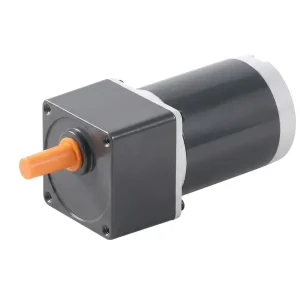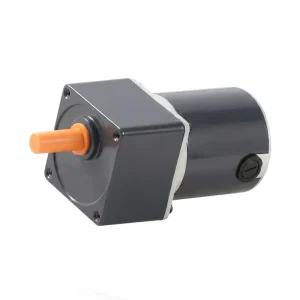
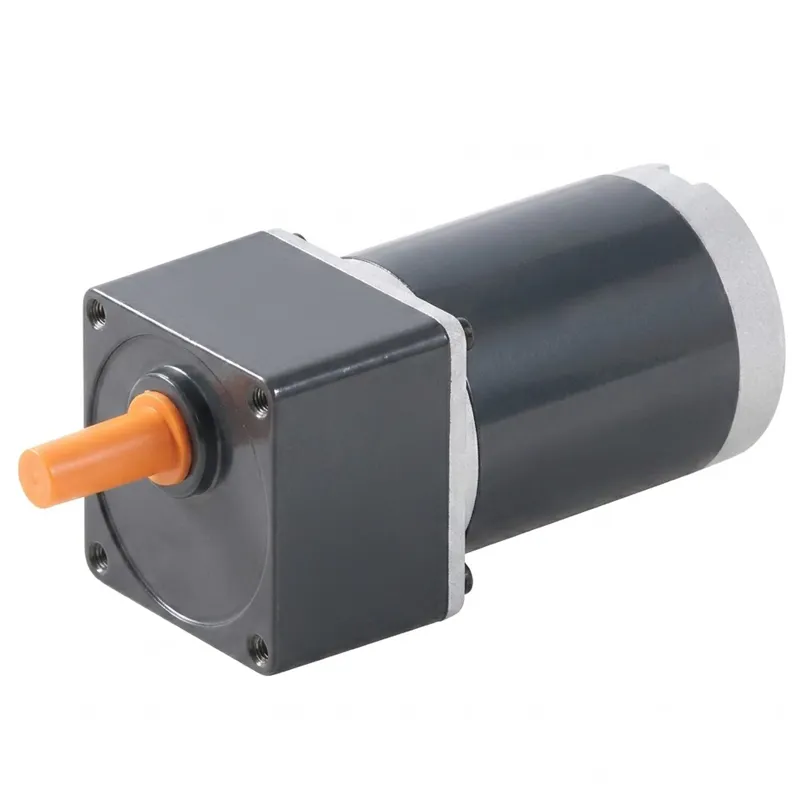
EP-15W DC Motor K2D6 Series — 12V / 24V / 90V
The EP-15W dc motor belongs to the K2D6 product series — a permanent magnet, brush-commutated motor family optimised for continuous low-power drive applications where compact dimensions and multi-voltage availability are the dominant selection criteria. The 15 W power rating is maintained across all three voltage variants (12 V, 24 V, and 90 V), with the motor’s internal winding adjusted in each case to deliver equivalent mechanical output at the rated voltage level.
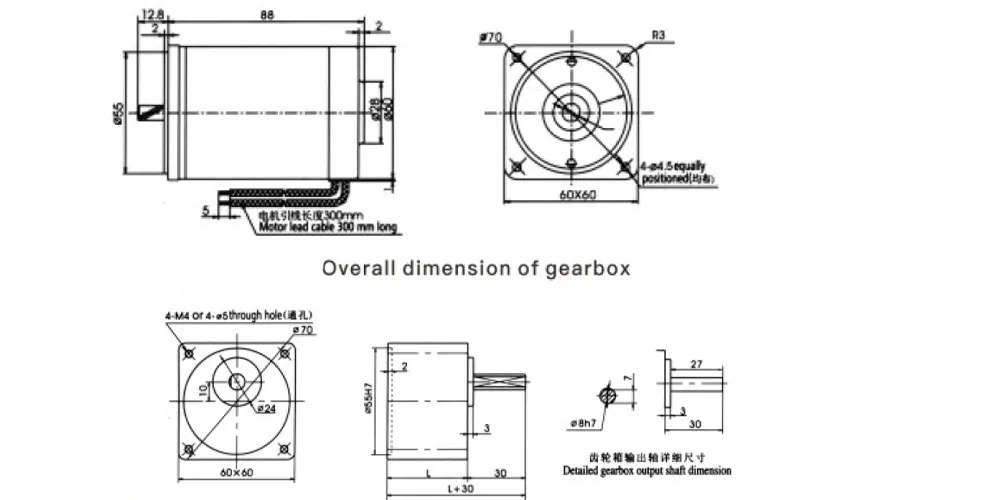
The motor body is 60×60 mm in cross-section, with a φ24 mm output shaft and four M4 or φ5 through-hole mounting points arranged on a standard pitch circle. The integral gearbox option — 2GN□K series — mounts to the dc motor output face, extending overall assembly length by 32 mm (small ratio gearboxes) or 42 mm (larger ratio gearboxes). The gearbox model designation encodes the ratio: 2GN3K is ratio 3, 2GN200K is ratio 200, with the full range covering every standard step between those endpoints. Output shaft of the gearbox is φ8h7, a tolerance that accepts standard shaft-locking collars and spur-pinion bores without additional grinding.
Permanent Magnet Brush-Type Drive
EP-15W DC Motor
K2D6 Series — 12V / 24V / 90V
A compact, permanent magnet dc motor delivering 15 W continuous output across three voltage ratings, engineered for quiet precision drives in industrial automation, medical equipment, and consumer appliance applications worldwide.
Technical Specifications
K2D6 Series — Motor Performance Parameters & Gearbox Data
Motor Performance Parameters
| Model | Voltage (V) | Power (W) | No-load Speed (RPM) | No-load Current (A) | Load Speed (RPM) | Load Torque (kg·cm) | Load Current (A) | Brush Life (H) | Motor Weight (kg) |
|---|---|---|---|---|---|---|---|---|---|
| K2D6-12□ | 12 | 15 | 3200 | 0.8 | 2950 | 0.5 | 2.0 | 3000 | 0.9 |
| K2D6-24□ | 24 | 15 | 3200 | 0.4 | 3000 | 0.5 | 1.0 | 3000 | 0.9 |
| K2D6-90□ | 90 | 15 | 3000 | 0.2 | 3000 | 0.5 | 0.4 | 3000 | 0.9 |
Gearbox Dimensions — 2GN□K Series
| Gearbox Model | Reduction Ratio Range | Length L (mm) | Weight (kg) |
|---|---|---|---|
| 2GN3K–2GN18K | 3 – 18 | 32 | 0.24 |
| 2GN20K–2GN50K | 20 – 50 | 42 | 0.30 |
| 2GN60K–2GN200K | 60 – 200 | 42 | 0.33 |
Allowable Torque on Gearbox — K2D10-24□ / Gearbox Model: 2GN□K (Ratios 3–60)
| Reduction Ratio | 3 | 3.6 | 5 | 6 | 7.5 | 9 | 10 | 12.5 | 15 | 18 | 20 | 25 | 30 | 36 | 40 | 50 | 60 |
|---|---|---|---|---|---|---|---|---|---|---|---|---|---|---|---|---|---|
| Output Speed (r/min) | 1100 | 917 | 660 | 550 | 440 | 367 | 330 | 264 | 220 | 183 | 165 | 132 | 110 | 92 | 83 | 66 | 55 |
| Allowable Torque (N·m) | 0.11 | 0.13 | 0.176 | 0.21 | 0.26 | 0.32 | 0.35 | 0.44 | 0.53 | 0.63 | 0.63 | 0.73 | 0.95 | 1.14 | 1.27 | 1.59 | 1.72 |
| Allowable Torque (kgf·cm) | 1.08 | 1.29 | 1.79 | 2.15 | 2.69 | 3.23 | 3.59 | 4.48 | 5.38 | 6.46 | 6.47 | 8.08 | 9.70 | 11.64 | 12.93 | 16.17 | 17.54 |
Allowable Torque on Gearbox — K2D10-24□ / Gearbox Model: 2GN□K (Ratios 75–200)
| Reduction Ratio | 75 | 90 | 100 | 120 | 150 | 180 | 200 |
|---|---|---|---|---|---|---|---|
| Output Speed (r/min) | 44 | 37 | 33 | 28 | 22 | 18 | 17 |
| Allowable Torque (N·m) | 2.15 | 2.58 | 2.87 | 2.94 | 2.94 | 2.94 | 2.94 |
| Allowable Torque (kgf·cm) | 21.93 | 26.31 | 29.23 | 30.0 | 30.0 | 30.0 | 30.0 |
Five Key Product Advantages
Engineering strengths that make the EP-15W the preferred small dc motor for global OEM projects
① Three Voltage Options in One Platform
The K2D6 series covers 12 V, 24 V, and 90 V ratings from the same 60×60 mm motor body. Engineers designing for battery-operated equipment, 24 V industrial control panels, or 90 V rectified mains supplies can specify a single dc motor platform across their product range rather than maintaining three separate motor part numbers. This simplifies approved-supplier documentation, incoming inspection, and field spare-part inventory — a practical advantage for OEM procurement teams in the UK, Germany, and Australia.
② High No-Load Speed: Up to 3,200 RPM
The 12 V and 24 V variants reach 3,200 RPM at no load, while the 90 V unit runs to 3,000 RPM. Paired with the 2GN range of integral gearboxes — reduction ratios from 3 to 200 — these dc motor speeds translate into output shaft speeds from approximately 16 RPM to 1,100 RPM, covering the range demanded by conveyor drives, valve actuators, and medical dispensing equipment without requiring an external speed control stage in many applications.
③ Integral Gearbox Compatibility
The 2GN□K series gearboxes — available in 32 mm (2GN3K–2GN18K) and 42 mm (2GN20K–2GN200K) output lengths — mount directly to the dc motor face without an adapter plate. This motor-gearbox integration keeps the combined length compact, which matters in applications like automated laboratory instruments and small conveyor heads where the drivetrain must fit inside a defined cabinet depth. Allowable output torque scales from 0.11 N·m at ratio 3 up to 2.94 N·m at ratios 75–200.
④ Extended Brush Life: 3,000 Hours
Rated brush life of 3,000 hours at rated load conditions meets the service interval requirements of most industrial automation and medical equipment duty cycles. For a machine running two shifts per day (approximately 16 hours), this translates to roughly 6 months before brush inspection — acceptable for most planned maintenance schedules in North American and European manufacturing environments. The carbon brush grade and spring pressure are matched to the dc motor's commutator diameter to maintain consistent contact force across the full wear life.
⑤ Low-Weight, High-Torque Density
At 0.9 kg, the EP-15W permanent magnet dc motor delivers a power-to-weight ratio that sits well above what an equivalent AC induction motor of the same frame size can achieve. This high torque electric motor characteristic makes it the first choice for weight-sensitive applications in handheld equipment, mobile platforms, and medical devices where every additional gram affects product certification and user comfort. The small dc motor footprint — 60×60 mm faceplate — is compatible with standard sub-panel mounting across a wide range of enclosure standards.
DC Motor Working Principle
Understanding dc motor working principle begins with the Lorentz force: a current-carrying conductor placed in a magnetic field experiences a force perpendicular to both the current direction and the field direction. In the EP-15W, the permanent magnets mounted to the stator housing create a static radial field. The armature windings wound on the rotor carry the supply current, and the interaction of that current with the static field generates a tangential force on each armature conductor — summing across all active conductors to produce the continuous shaft torque.
The commutator and carbon brush assembly perform the essential function of reversing armature winding current as each conductor rotates through the field, ensuring that the tangential force on every conductor always acts in the same rotational direction. Red terminal connected to positive supply drives the shaft clockwise (CW); swapping polarity — connecting black to positive — reverses the rotation to counter-clockwise (CCW). This simple polarity reversal for direction control is one of the practical advantages that makes the dc electric motors format enduringly popular in applications where forward and reverse operation is needed without a dedicated reversing contactor or inverter.
Speed is regulated by varying the supply voltage — the dc motor speed is approximately proportional to terminal voltage for a given load. At rated voltage the motor runs at its rated no-load speed; reducing voltage via a PWM dc motor drive proportionally reduces speed while the torque capacity remains relatively constant. This makes the EP-15W suitable for applications where variable-speed output is required from a fixed battery or power supply, such as automated laboratory plate handlers or small pump drives in medical equipment across North America and Europe.
Materials & Construction
The EP-15W dc motor stator housing is fabricated from a cold-rolled steel shell, providing a rigid, low-reluctance flux return path for the permanent magnet field circuit. The stator permanent magnets are sintered ferrite blocks, bonded and mechanically retained against the housing bore. Ferrite offers adequate energy product for the 15 W motor's flux requirement while remaining cost-effective and resistant to demagnetisation at the operating temperatures the motor encounters — an important consideration in applications where the motor is enclosed in a tight cabinet without forced cooling in warm climates like Australia and Southeast Asia.
The armature core is laminated silicon steel, die-stamped and stacked to minimise eddy current losses at the 3,000–3,200 RPM operating speed. Armature windings are wound from enamelled copper wire with Class B (130 °C) insulation rating. The commutator segments are hard-drawn copper, silver-burnished to provide a smooth running surface for the carbon brushes. Carbon brush grade is a high-density, self-lubricating formulation selected for the 3,000-hour rated life target — the same brush life specification used in dc electric motors for industrial automation where unscheduled maintenance is costly.
The integral 2GN□K gearbox housing is precision die-cast aluminium alloy, providing a lightweight, dimensionally stable enclosure for the spur gear train. Gear blanks are case-hardened steel, hobbed to AGMA quality 8 and deburred before assembly. The output shaft is φ8h7 ground to h7 tolerance, compatible with standard shaft couplings and spur pinion bores without additional finishing. The gearbox is pre-lubricated with a long-life lithium-complex grease at the factory, requiring no re-lubrication over the service life under normal duty conditions — a sealed dc motor kit approach that simplifies installation on production lines worldwide.
Application Scenarios
Industries and equipment types where the EP-15W dc motor delivers proven, reliable performance
Medical & Laboratory Equipment
Syringe pumps, peristaltic dispensers, and automated sample handlers in North American and European healthcare facilities specify the 24 V K2D6-24□ variant for its low electrical noise and consistent low-speed torque when paired with high-ratio 2GN gearboxes. The compact 60×60 mm footprint fits inside standard instrument enclosures, and the sealed dc motor construction meets typical laboratory equipment IP requirements without additional motor housing modifications.
Office Automation & Vending
Paper transport mechanisms, card dispensers, and vending machine actuators across Japan, Europe, and North America use the 24 V dc motor for its smooth, controllable torque output at the low speeds needed by paper-handling mechanisms. The low no-load current (0.4 A at 24 V) is important in battery-backed vending systems where standby power consumption directly affects battery replacement intervals and operating cost.
Industrial Automation & Conveyor Drives
Small conveyor heads, shuttle drives, and rotary index tables in German and UK automated assembly lines use the 90 V K2D6-90□ variant, which operates directly from a standard 90 V DC rectified supply without a step-down converter. The dc motor drive stage is therefore simpler and less expensive, and the lower operating current (0.4 A at 90 V) reduces wiring and contactor sizing requirements in high-density panel builds.
Agricultural & Outdoor Equipment
Seed dispensers, fertiliser metering units, and irrigation valve actuators on Australian and North American farms use the 12 V K2D6-12□ variant powered directly from the tractor or utility vehicle battery. The high no-load speed (3,200 RPM) combined with a 2GN high-ratio gearbox at ratios 75–200 delivers the slow, high-torque output needed for metering valve and gate drives without requiring any dc motor speed controller in simple on/off duty applications.
Robotics & Light Actuators
Educational and light service robots in research institutions across Europe and North America specify the 24 V variant as a joint actuator, using the integral 2GN gearbox at medium ratios (20–50) to provide the output speed and torque range needed for articulated arm movements. The total motor-gearbox assembly weight of approximately 1.2 kg keeps the joint inertia low, which simplifies servo loop tuning when the motor is operated from a small dc motor drive controller.
About the Manufacturer
Over a decade of hands-on production experience in mechanical power transmission and electric motor manufacturing backs every EP-15W dc motor that leaves our facility. Our product range spans agricultural gearboxes, worm gear reducers, planetary gear drives, power take-off shafts, hydraulic cylinders, gears, chains, and motors — a breadth that gives us system-level understanding of how a dc motor integrates with its gearbox, its drive controller, and the machine it powers, rather than treating the motor as an isolated component.
The facility holds ISO 9001:2015 certification across the full production process — raw material incoming inspection, winding and commutator assembly, brush-spring setting, gearbox gear-cut and assembly, and final performance testing. Gearbox and motor housings are produced in ductile iron, cast iron, cast steel, precision cast steel, and cast aluminium depending on the application, all machined to dimensional tolerances that ensure interchangeability across production batches. Gear cutting, case-hardening, and assembly are performed in-house, eliminating sub-supplier variation from the quality chain.
Standard dc motor kit combinations — motor plus gearbox, factory-assembled and performance-tested — are available for all three voltage ratings across the full 2GN□K ratio range. OEM customers in the UK, Germany, Australia, Canada, and across Southeast Asia regularly request custom winding voltages, shaft modifications, or special brush grades for extended-life duty; our engineering team handles these requirements within the standard ISO quality framework.
ورشة عمل

Related Products
Build a complete drive system — motor, gearbox, and reducer — from one supply source
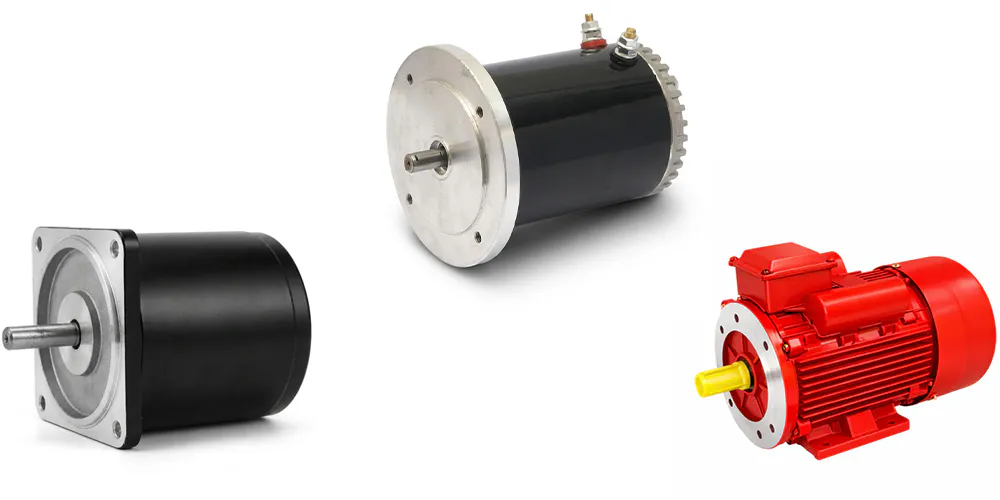
DC Electric Motors
The EP-15W sits within a broader dc motor catalogue that extends from sub-watt fractional-power drives up to multi-kilowatt permanent magnet dc motor and brushless dc motor designs. If your application needs higher power, a different voltage rating, a brushless dc motor for maintenance-free operation, or a high torque dc motor for direct-drive applications, the full range covers every requirement. All models maintain the same mounting standard as the K2D6 series, simplifying motor replacement and system upgrades.
علبة تروس دودة
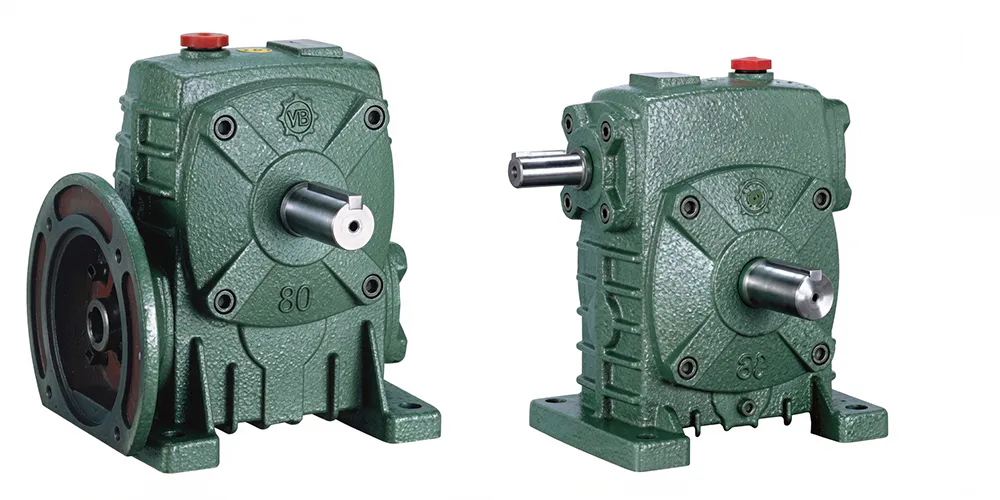
For applications needing higher output torque than the 2GN inline gearbox provides, our worm gearbox range — covering single-stage reductions from 1/5 to 1/60 in cast iron and aluminium housings — pairs directly with the EP-15W via a motor flange adaptor. The worm gear output's self-locking property at high ratios adds a position-holding function without a separate brake, which complements the dc motor's inherent speed controllability in valve actuator and gate drive applications across the UK, Australia, and North America.
الأسئلة الشائعة
Q1. What is a DC motor and how does it work in a 24V battery-powered medical dispenser used in North American healthcare facilities?
A dc motor is an electric motor that converts direct current electrical energy into mechanical rotation using the interaction between a magnetic field and current-carrying armature conductors. In a 24 V battery-powered medical dispenser, the K2D6-24□ permanent magnet dc motor draws 0.4 A at no load and approximately 1.0 A at rated load, making it compatible with small lithium or lead-acid packs without excessive discharge. The PWM dc motor drive adjusts the average voltage applied to the motor, controlling dispenser speed precisely. The integral 2GN gearbox at ratios 75–150 reduces shaft speed to the 20–45 RPM range that syringe and peristaltic pump mechanisms require, while multiplying torque to overcome the higher resistance of viscous fluids.
Q2. Which dc motor voltage — 12V, 24V, or 90V — should I choose for a small conveyor drive running from a panel-mount power supply in a German automated assembly line?
For a panel-mount supply in a German industrial environment, the 24 V K2D6-24□ is the most practical choice. Standard 24 V DC industrial power supplies are widely available at low cost, the 1.0 A load current is easily handled by standard 2 A DIN-rail supplies, and 24 V is the dominant control voltage in European industrial automation panels — meaning no additional isolation transformer is needed. The 90 V variant is better suited to mains-rectified supplies, and the 12 V variant is optimised for battery applications. All three deliver the same 15 W output power, so the dc motor drive controller can be sized the same way regardless of voltage choice once the supply voltage is determined.
Q3. How do I select the right 2GN gearbox reduction ratio for an EP-15W dc motor driving a valve actuator at 20 RPM in an Australian water treatment plant?
At rated load the K2D6-24□ runs at approximately 3,000 RPM. Dividing 3,000 by the target 20 RPM gives a required ratio of 150. The 2GN150K gearbox (within the 2GN60K–2GN200K bracket, L=42 mm) provides exactly this ratio with a gearbox output speed of 22 r/min and an allowable torque of 2.94 N·m. Confirm that the valve's required actuation torque — including seat friction, packing friction, and any differential pressure torque — falls below 2.94 N·m. For outdoor installation in the Australian climate, verify that the motor's operating temperature range covers summer ambient conditions at the plant site and consider a sealed IP65 motor enclosure if the dc motor will be exposed to water spray or dust.
Q4. What type of DC motor is the EP-15W, and why would you use it instead of a brushless dc motor or AC motor for a light robotics joint actuator in a UK research laboratory?
The EP-15W is a permanent magnet brushed dc motor — what type of dc motor uses carbon brushes on a copper commutator to switch armature winding current. Compared with a brushless dc motor (BLDC motor), it requires a simpler, lower-cost controller (no Hall sensor wiring, no three-phase inverter), making it the preferred choice in cost-sensitive research budgets and rapid-prototype applications. Compared with an AC motor, its torque-speed curve is linear and predictable down to very low speeds, which simplifies the joint velocity control loop. The trade-off is the 3,000-hour brush life — in a research environment with intermittent duty this typically translates to several years, making brush replacement a minor maintenance event rather than a production constraint.
Q5. Where can I source a customised EP-15W dc motor with a non-standard winding voltage for OEM integration into agricultural metering equipment distributed in Canada?
Custom winding voltages outside the standard 12 V / 24 V / 90 V options — for example 36 V or 48 V for compatibility with specific lithium battery packs used in Canadian precision agriculture equipment — are available through our OEM programme. Provide the required supply voltage, the maximum no-load speed, and the rated load point (torque and current), and our engineering team will confirm whether the target operating point is achievable within the K2D6 frame or whether a higher-power dc motor frame is needed. Custom motor plus gearbox assemblies are supplied as factory-tested dc motor kit combinations with full ISO documentation.
Q6. How does a dc motor high speed characteristic affect the gearbox ratio selection when I need very slow, high-torque output for a vending machine actuator in Southeast Asia?
The dc motor high speed at no load (3,200 RPM for the 12 V and 24 V variants) is actually an advantage for gearbox selection: a higher motor speed means the gearbox is doing more of the speed reduction work, which allows it to multiply torque more effectively. For a vending machine actuator needing 17–22 RPM output at up to 2.94 N·m, the 2GN180K or 2GN200K gearbox delivers exactly this combination from a 24 V dc motor drawing 1.0 A at load. The 60×60 mm motor plus 42 mm gearbox keeps the total assembly length under 100 mm, which typically fits inside the standard vending column depth used across the Southeast Asian market without mechanical modification.
المحرر: PXY