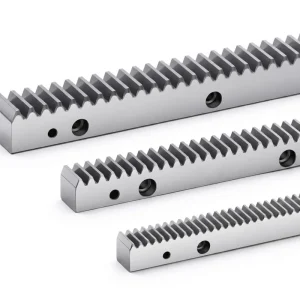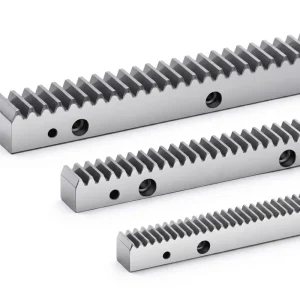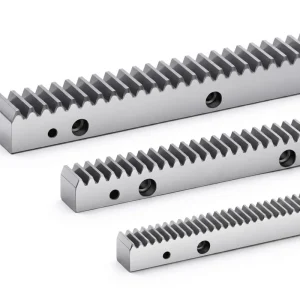

ईपी-एस45सी/42सीआरएमओ वी-टाइप ग्राउंड स्ट्रेट गियर रैक
The EP-S45C/42CrMo V-Type Ground Straight गियर रैक is an industrial-grade linear motion component engineered for applications where dimensional precision, surface hardness, and geometric accuracy must coexist. Unlike standard milled or hobbed straight gear rack profiles, this product undergoes a full four-side grinding sequence — covering the tooth flank surfaces, mounting datum faces, and the precision V-rail surface simultaneously — so every geometric reference is established from a single, coherent production process. The result is a rack tooth form that holds its specified involute geometry without the parasitic errors that accumulate when grinding operations are separated across different machine setups.
The V-groove profile machined along the underside of the bar is the defining feature of this series. It serves as the primary rolling or sliding contact surface with a matching V-rail guide, constraining lateral and vertical movement of a carriage to a single controlled linear axis. This integrated guiding geometry eliminates the need for separate linear guide rail sub-assemblies in many machine configurations, reducing total installed component count and alignment setup time on the production floor. Engineers working on rack and pinion linear slide systems, precision grinding machine tables, or metrology-grade coordinate stages will recognise the value of having the rack body itself double as the guiding member.
Conforming to DIN6e25 accuracy class with a guaranteed total pitch error below GTF/1000 < 0.036 mm per metre, this linear gear rack belongs to the precision tier of the market. Available in module sizes from 1.5 to 3 and standard lengths of 630 mm, 930 mm, and 1,230 mm, the range covers the majority of machine-tool and industrial automation requirements without requiring custom stock orders.
Precision Linear Motion · High Frequency Quenching
ईपी-एस45सी/42सीआरएमओ वी-टाइप ग्राउंड स्ट्रेट गियर रैक
High Frequency Quenching HRC48–52° · DIN6e25 · Total Pitch Error GTF/1000 < 0.036 mm · Straight Tooth Profile · V-Rail Surface Ground
Straight Gear Rack Technical Specifications
Total pitch error: GTF/1000 < 0.036 mm | Unit / Dimension: mm
Accuracy level: DIN6e25 | Material: S45C / 42CrMo | Tooth type: straight tooth | Vrail hardness: HRC50–52° / HRC55–60°
| Code | मॉड्यूल | Pt | L | ए | बी | B0 | C | D | B1 | A1 | G1 | G2 | एफ | ई |
|---|---|---|---|---|---|---|---|---|---|---|---|---|---|---|
| VX55315063 | 1.5915 | 5 | 630 | 14.5 | 24.5 | 22.9 | 15 | 100 | 13 | 20 | 7 | 11 | 7 | 600 |
| VX55315103 | 1.5915 | 5 | 1030 | 14.5 | 24.5 | 22.9 | 15 | 100 | 13 | 20 | 7 | 11 | 7 | 1000 |
| VX55320063 | 1.5915 | 5 | 630 | 19.5 | 29.5 | 27.9 | 15 | 100 | 15.5 | 23.5 | 9 | 15 | 9 | 600 |
| VX55320103 | 1.5915 | 5 | 1030 | 19.5 | 29.5 | 27.9 | 15 | 100 | 15.5 | 23.5 | 9 | 15 | 9 | 1000 |
| VX55325063 | 2.3873 | 7.5 | 630 | 24.7 | 33 | 30.61 | 15 | 100 | 18.5 | 25.2 | 9 | 15 | 9 | 600 |
| VX55325093 | 2.3873 | 7.5 | 930 | 24.7 | 33 | 30.61 | 15 | 100 | 18.5 | 25.2 | 9 | 15 | 9 | 900 |
| VX55325123 | 2.3873 | 7.5 | 1230 | 24.7 | 33 | 30.61 | 15 | 100 | 18.5 | 25.2 | 9 | 15 | 9 | 1200 |
| VX55335063 | 3.1831 | 10 | 630 | 34.6 | 46.6 | 43.41 | 15 | 100 | 28.6 | 36.7 | 11 | 18 | 11 | 600 |
| VX55335093 | 3.1831 | 10 | 930 | 34.6 | 46.6 | 43.41 | 15 | 100 | 28.6 | 36.7 | 11 | 18 | 11 | 900 |
| VX55335123 | 3.1831 | 10 | 1230 | 34.6 | 46.6 | 43.41 | 15 | 100 | 28.6 | 36.7 | 11 | 18 | 11 | 1200 |
Specifications are subject to change without notice. Please confirm details before placing an order.
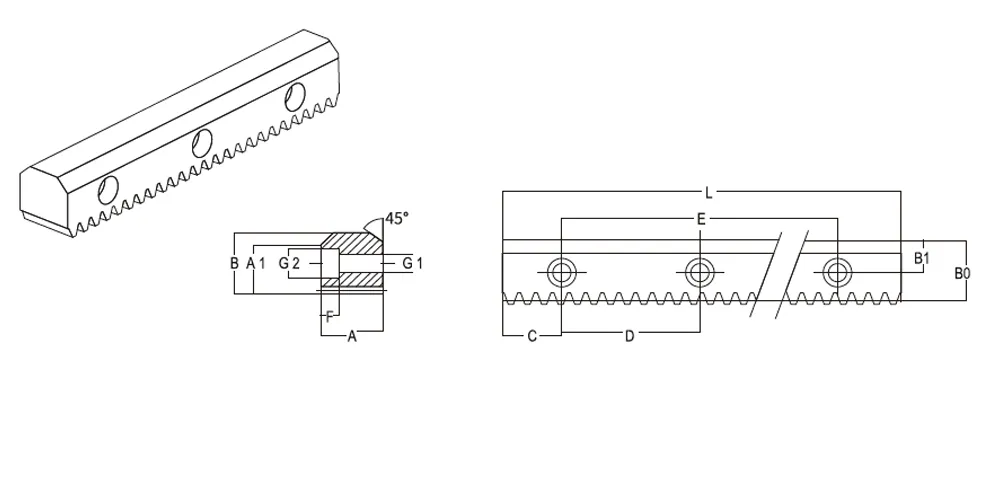
How the V-Type Straight Gear Rack Works
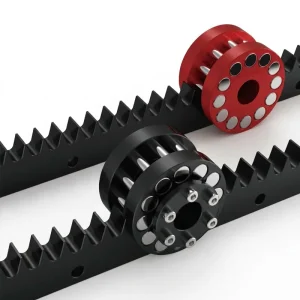
At its core, this Straight Gear Rack operates on the same rotary-to-linear conversion principle shared by all rack and pinion gear mechanisms: a pinion rotates about a fixed shaft and its involute teeth engage the rack tooth profile, pushing the rack — or the pinion carriage — along the linear axis. What sets the V-type variant apart is that the bar body itself incorporates two precision-ground V-shaped grooves (G1 and G2 in the dimension table) that mate directly with matching V-rollers or V-guide blocks on the carriage. This means the rack and pinion linear slide function is built into a single component, rather than distributed across a separate rack and a separate linear guide.
The production sequence is the key to this product's performance. Starting from pre-hardened bar stock, the blank is high-frequency quench-hardened at the tooth surface to HRC48–52° and at the V-rail surfaces to HRC50–52° (or HRC55–60° for the 42CrMo grade), then all four sides are ground flat to remove distortion from the heat treatment cycle. The tooth flanks and V-groove faces are subsequently finish-ground in the same clamping setup where possible, so their geometric relationship to each other is held to the tightest achievable tolerance. The resulting total pitch error of less than 0.036 mm per 1,000 mm of travel gives designers a reliable error budget to work with when calculating cumulative positioning accuracy across multi-bar axes.
Five Key Performance Advantages
Integrated V-Rail Guidance
The V-groove profile machined into the rack body serves a dual purpose: it constrains carriage motion with the same component that drives it. This consolidation eliminates the alignment offset error that arises whenever a rack is mounted adjacent to — but not coincident with — a separate linear guide. In precision grinding tables and measuring machines used across Europe and Japan, this feature is considered essential for sub-micron repeatability.
Surface Hardness HRC48–52°
High-frequency induction quenching concentrates heat treatment energy precisely at the tooth surface and V-rail contact zones, achieving HRC48–52° without through-hardening the core. The core retains its toughness and shock resistance, while the surface resists abrasive wear from the mating pinion and guide rollers. For a duty gear rack in a machine tool that runs 20 hours per day, this combination extends service intervals significantly compared to through-hardened alternatives.
DIN6e25 Pitch Accuracy
With a guaranteed total pitch error below 0.036 mm per metre, this spur gear rack meets the DIN6e25 tolerance class — a standard widely referenced in European machine tool specifications. Paired with a quality servo and encoder, a positioning system built around this linear rack and pinion can reliably achieve sub-0.05 mm absolute positioning over axes up to 1.2 metres without pitch-error compensation tables in the controller.
Dual Material Options
The S45C grade delivers a reliable balance of machinability and hardness for general precision applications, while the 42CrMo alloy steel option provides significantly higher core tensile strength and fatigue resistance. Engineers specifying this as a heavy-duty shelves gear rack or a high-cycle automation axis in North American automotive plants can select the alloy grade to accommodate dynamic load calculations without upsizing the module or cross-section.
Four-Side Ground Reference Faces
All four mounting faces are flat-ground after heat treatment, providing datum surfaces that can be bolted directly to precision sub-plates or machine beds without the scraping or shim-adjustment procedures required for non-ground rack stock. This simplifies installation on rack and pinion linear slide assemblies and dramatically reduces the skill level needed to achieve correct mesh geometry on the shop floor.
Material Selection & Hardening Process
Two steel grades are offered across the EP V-type ground gear rack range. S45C is a JIS-standard medium-carbon steel (broadly equivalent to AISI 1045 and DIN C45E) that machines cleanly and responds predictably to surface heat treatment. Its carbon content of approximately 0.42–0.48% is high enough to support high-frequency induction quenching to HRC48–52° at the tooth and V-rail surfaces while the core, which never reaches quenching temperature, retains a tensile strength in the range of 700–850 MPa. This profile suits the majority of industrial automation, measuring equipment, and general precision machine tool applications encountered in markets from Southeast Asia to the United Kingdom.
The 42CrMo option is a chromium-molybdenum alloy steel with higher hardenability and significantly greater fatigue strength, making it the preferred choice for high-cycle or heavy-load scenarios. After induction quenching, V-rail hardness reaches HRC55–60°, which is directly comparable to the hardness specification of premium European-branded guide rail systems. The alloy addition retards grain growth during heating, resulting in a finer martensitic structure and higher wear resistance at equivalent hardness compared to plain carbon grades. For any application described as a duty gear rack — running more than two shifts per day under consistent dynamic load — the 42CrMo grade is the technically correct selection.
Where This Straight Gear Rack Is Used
Precision Surface Grinding Machines
The table drive on a precision surface grinder is one of the most demanding applications for a straight gear rack. Reversal must be fast and backlash-free to avoid dwell marks on the workpiece. The DIN6e25 accuracy of the V-type rack, combined with its integrated guiding, keeps the grinding wheel path parallel to the table surface throughout the stroke, producing the flatness tolerances that toolroom and aerospace part grinding requires.
Coordinate Measuring Machines
CMM bridge and ram axes in quality control labs across Germany and the United States require extremely low friction variation and near-zero pitch error throughout the measuring stroke. The V-type gear rack provides a self-guiding linear axis whose combined positional error budget can be characterised and compensated in software, enabling measurement uncertainty figures well below 1 µm in controlled metrology environments.
Laser Cutting & Engraving Systems
Fibre laser cutters in sheet metal fabrication shops use rack and pinion gear drives because ball screws cannot economically cover the 2–4 metre cutting fields required. The V-type rack's hardened tooth surface resists the fine metal dust that permeates these environments, while the ground V-rail maintains carriage alignment even as ancillary guides experience wear — reducing rework rates and improving cut-edge straightness.
Drill Press & Tapping Units
ए drill press gear rack in a vertical machining unit must resist the combined radial and axial forces generated during metal-cutting cycles. The high-frequency hardened rack tooth profile of the V-type bar handles these loads without the surface pitting that degrades unhardened rack stock after a few thousand drilling cycles, keeping spindle feed smooth and depth-setting consistent over the machine's service life.
Semiconductor & Electronics Manufacturing
PCB drilling machines and semiconductor wafer handling equipment in South Korea and Taiwan operate at high cycle rates with stringent repeatability demands. The low cumulative pitch error of the EP V-type linear gear rack keeps tool-to-target offset within acceptable limits across thousands of daily cycles, reducing substrate scrap and avoiding the costly re-calibration downtime associated with low-grade rack-and-pinion drive components.
Need a Precision Ground Straight Gear Rack?
Browse module sizes, lengths, and material options across our full straight and helical gear rack catalogue.
संबंधित उत्पाद
प्लास्टिक गियर रैक
When operating conditions call for low weight, corrosion resistance, or lubrication-free running — cleanroom environments, food processing conveyors, or laboratory automation equipment — our plastic gear rack series is the logical companion product. Available in POM and PA (nylon) materials, these racks share the same tooth pitch dimensions as our steel series, so engineers can prototype with plastic and switch to steel for production without redesigning the drive geometry.
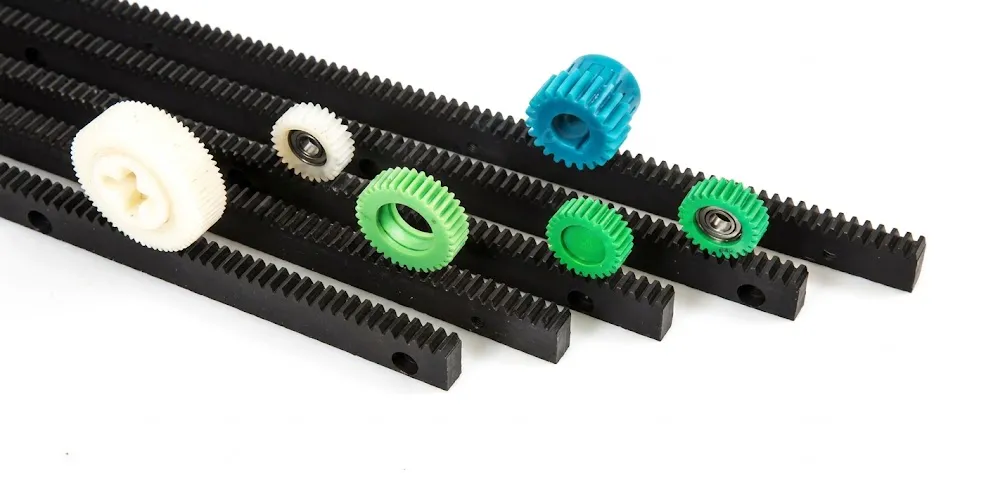
Helical Gear
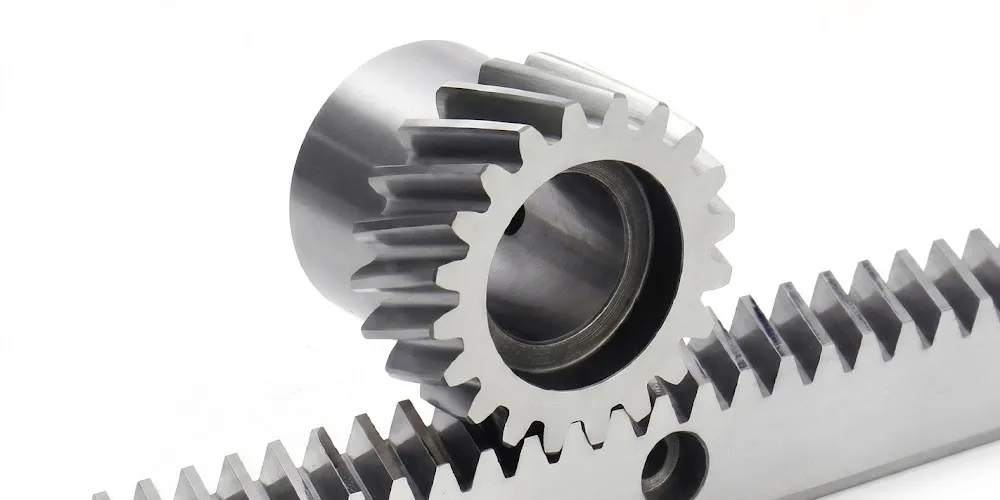
While this product uses a straight tooth profile optimised for zero axial thrust in applications where lateral force on the carriage is undesirable, many high-speed and high-load linear drives benefit from a helical pinion paired with a helical rack. Our full range of Helical Gear pinions covers modules matching our steel rack series, providing a one-stop supply solution — both the driving pinion and the Straight Gear Rack ship from the same production source, ensuring guaranteed mesh compatibility and consistent quality control.
हमारी विनिर्माण सुविधा के बारे में
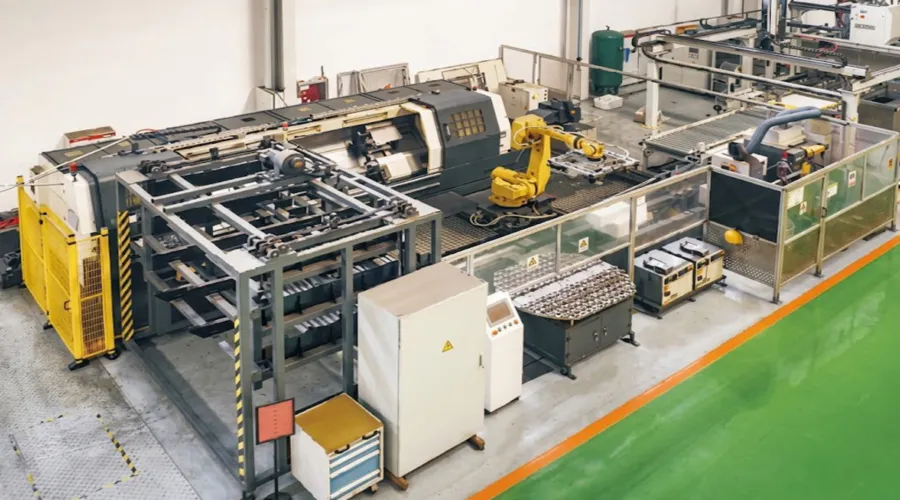
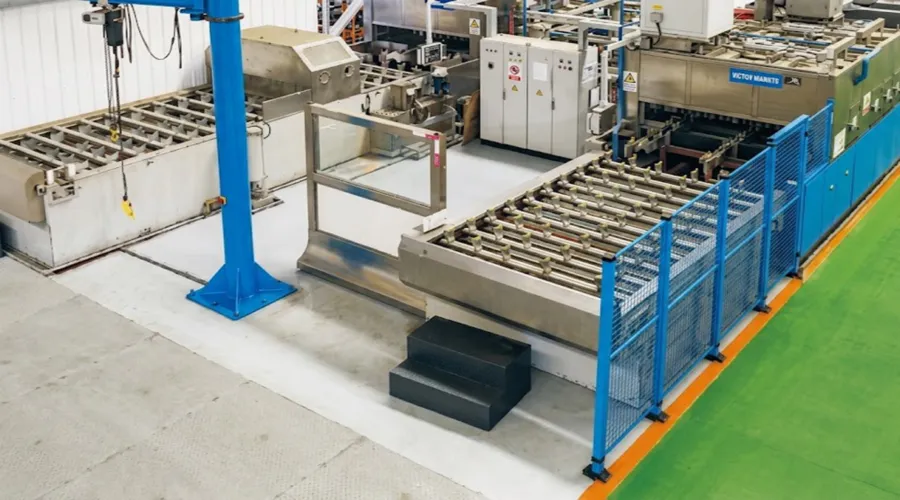
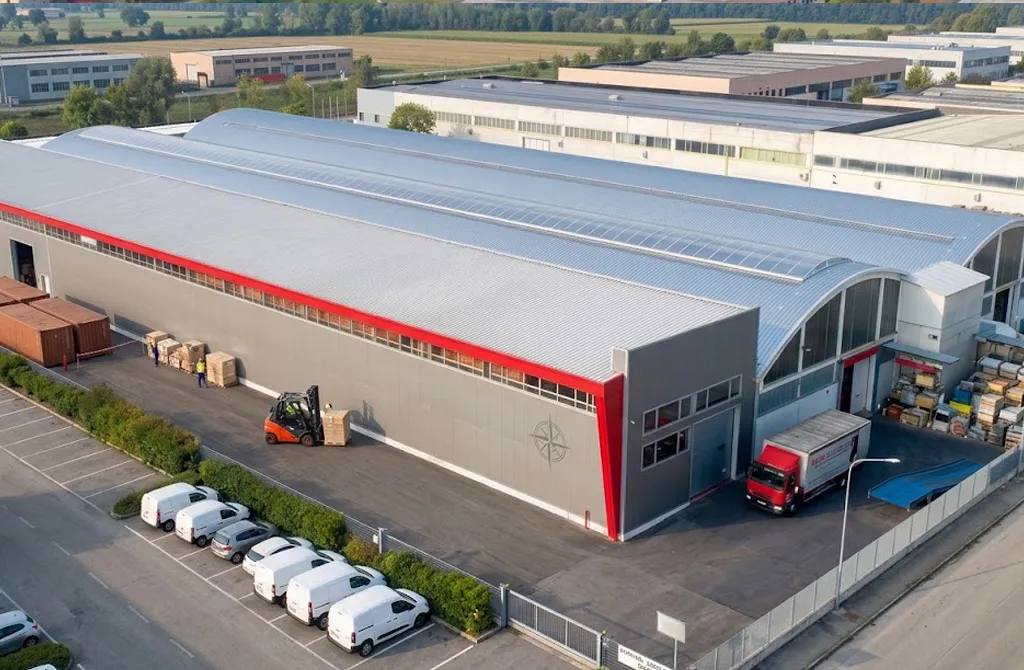
Founded on more than a decade of accumulated knowledge in mechanical power transmission, our manufacturing operation covers a wide spectrum of drive and motion components — agricultural gearboxes, worm gear reducers, planetary gear drives, power take-off shafts, hydraulic cylinders, gears, sprockets, worm gears, pulleys, drive shafts, and custom mechanical assemblies. Our facility is certified to ISO 9001:2015, and we fabricate parts in ductile iron, grey cast iron, cast steel, precision investment-cast steel, and cast aluminium depending on application requirements.
Every straight gear rack that leaves our production line — from a small gear rack for a compact instrument to a full-length custom gear rack for industrial special-purpose machinery — goes through the same documented inspection sequence. Tooth pitch, profile, and surface roughness are verified against the declared accuracy class before shipment, and batch traceability records are retained so any field issue can be investigated back to the production parameters of the specific bar supplied.
कार्यशाला
अक्सर पूछे जाने वाले प्रश्नों
संपादक: पीएक्सवाई