
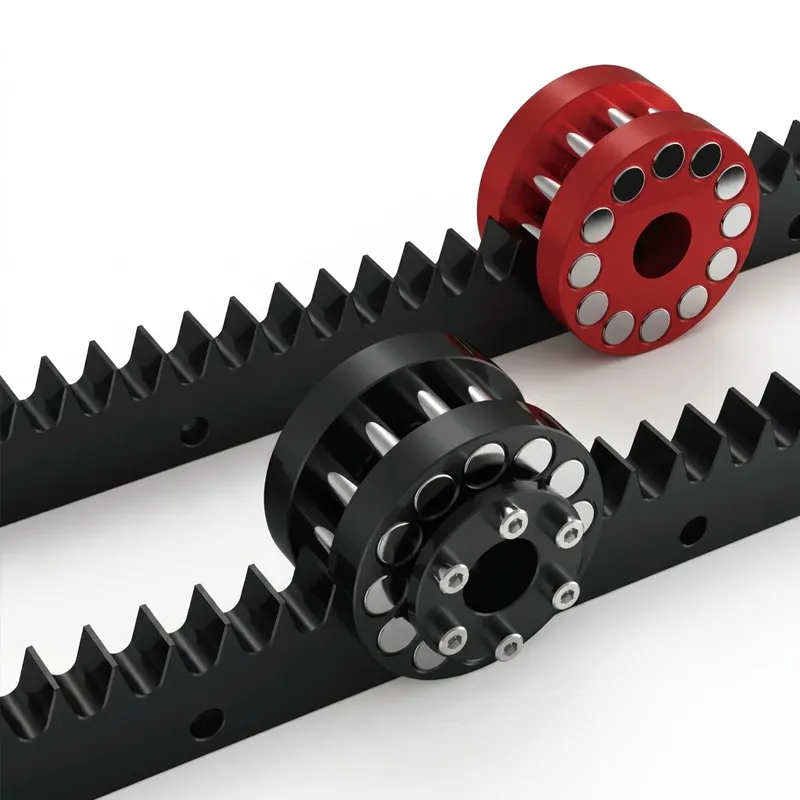
EP-S45C Zero-Backlash Gear Rack High Frequency Quenching HRC48–52°
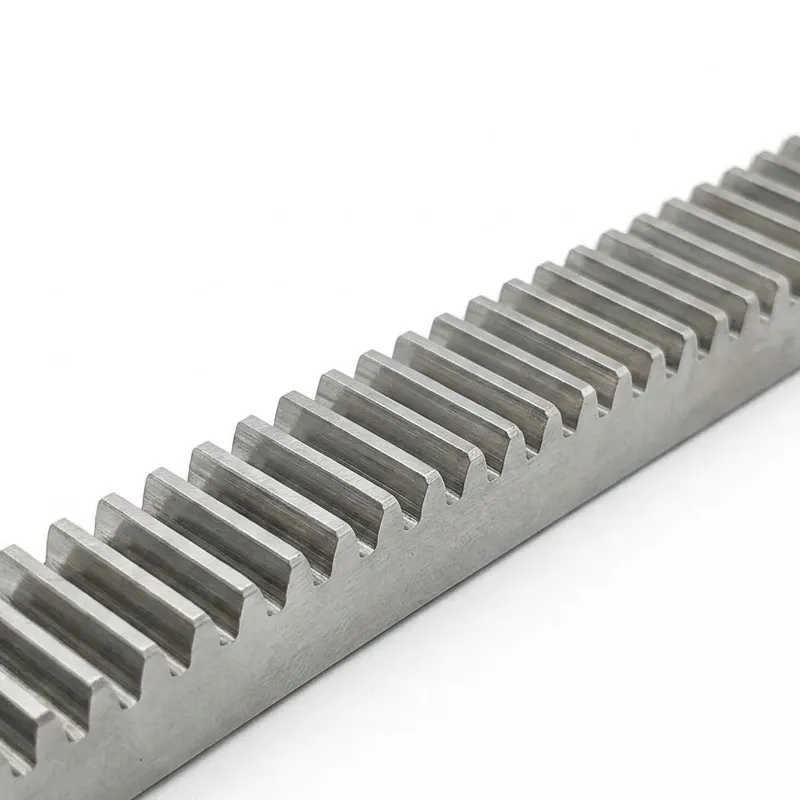
The EP-S45C Zero-Backlash Gear Rack is a high-performance linear motion component engineered for precision applications requiring minimal play. Manufactured from S45C steel, it undergoes high-frequency quenching to achieve a surface hardness of HRC48–52°, ensuring exceptional wear resistance and durability. The rack features four-side surface grinding for superior dimensional accuracy and is finished with black chromium plating for corrosion protection. Available in large modules (M16, M20, M25) with standard lengths up to 1000mm, it is designed for heavy-duty machinery. Options include pre-drilled mounting holes or solid backs (suffix “N”) for custom machining. Ideal for CNC routers, gantry systems, and automation equipment where high rigidity and precise positioning are critical.
Zero Backlash · High Frequency Quenching · Black Chrome Finish
EP-S45C Zero-Backlash Gear Rack
High Frequency Quenching HRC48–52° · Four-Side Surface Grinding · Black Chromium Plating · Module M16 / M20 / M25
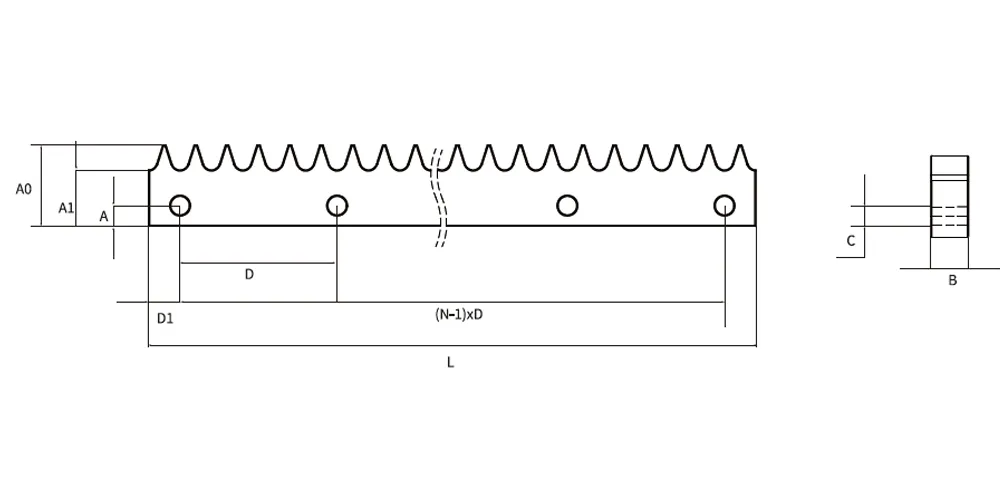
Технічні характеристики
Material: S45C | Heat treatment: High-frequency quenching HRC48–52° | Unit / Dimension: mm
Processing: Four-side surface grinding, surface black chromium plating | Non-drilled variant: add suffix "N" (e.g. STLBX1610-N)
| Code | Модуль | L (mm) | Tooth No. | Б | A0 | A1 | D | D1 | Hole No. | А | C |
|---|---|---|---|---|---|---|---|---|---|---|---|
| STLBX 1610 | 16 | 992 | 62 | 12 | 30.5 | 20.2 | 96 | 16 | 11 | 7 | 7 |
| STLBX 2010 | 20 | 1000 | 50 | 16 | 42 | 29 | 100 | 50 | 10 | 10 | 9 |
| STLBX 2510 | 25 | 1000 | 40 | 19 | 48 | 31.5 | 100 | 50 | 10 | 12 | 11 |
All specifications are subject to change without notice. Please confirm before ordering. Custom sizes and materials are available upon drawing.
What Is a Zero-Backlash Gear Rack?
А zero-backlash gear rack is a precision linear motion component engineered to eliminate the lost motion that occurs when a drive reverses direction. In a conventional gear rack and pinion assembly, a small clearance exists between the tooth flanks of the rack and the mating pinion — a necessary tolerance in standard designs that accommodates thermal expansion, lubrication film, and manufacturing variance. That clearance becomes a dead band during reversal: the drive must travel through it before force is transmitted again, causing a positioning error that undermines the repeatability of the axis. The EP-S45C zero-backlash gear rack addresses this fundamentally by pairing an extremely tight tooth profile tolerance with a surface preparation process that allows the mating pinion to be adjusted into preloaded contact, closing the dead band entirely without generating excessive friction.
The four-side surface grinding process ensures all mounting datum faces are geometrically correct after the high-frequency quenching cycle, which is where many lower-grade racks accumulate the warpage that later appears as irregular backlash variation along the travel axis. The black chromium plating applied after grinding serves a dual purpose: it provides a consistent, low-friction tooth surface that reduces pinion wear, and it offers corrosion protection without adding significant dimensional variation — chrome layer thickness is controlled to maintain the tooth profile within specification. This combination of material, heat treatment, surface finish, and dimensional control is what separates a true zero-backlash rack and pinion gear system from one that merely claims tight tolerances on a standard product.
Available in Module 16, Module 20, and Module 25, the STLBX series addresses large-module, high-force applications where backlash elimination is critical — think heavy-axis machine tool tables, large-format CNC portal frames, and industrial test rigs where measurement error and motion error must be decoupled.
How Zero-Backlash Rack and Pinion Works
In any standard rack and pinion gear system, the pinion teeth mesh with the rack teeth to convert rotary input into linear output. The fundamental challenge is that manufacturing tolerances require a small clearance — backlash — between mating tooth flanks so the gears do not jam. While this is acceptable for conveying or general transport applications, it introduces a reversal dead band that undermines the positioning accuracy of servo-driven precision axes. The gear ratio of rack and pinion remains constant, but that small dead band means the controller cannot distinguish between commanded motion and actual rack displacement during the reversal phase.
The zero-backlash approach used in the STLBX gear rack series addresses this through two coordinated mechanisms. First, the tooth profile is ground to a tighter involute tolerance than standard hobbed rack stock, so the inherent tooth-to-tooth error is minimised before the pinion is fitted. Second, the mating pinion assembly incorporates a spring-preload or scissor-gear arrangement that keeps one set of tooth flanks in constant loaded contact with the rack tooth surface even during reversal. The black chromium surface on the rack reduces the coefficient of friction at the contact zone, which lowers the hysteresis force associated with preloading and allows a higher preload force — and therefore tighter backlash elimination — without an unacceptable rise in drive power consumption. Engineers in German machine tool facilities and Japanese precision automation plants routinely specify this type of linear rack and pinion arrangement for axes where bidirectional repeatability below 0.01 mm is required.
5 Reasons Engineers Choose This Gear Rack
True Zero Backlash in Reversal
The STLBX gear rack is specifically designed to work with preloaded pinion systems that eliminate the directional dead band entirely. This is the defining requirement for servo axes in CNC machining centres and large-format coordinate measuring systems across North American and European precision manufacturing facilities, where reversal error directly appears as contour deviation in the finished part.
HRC48–52° Surface Hardness
High-frequency induction quenching achieves HRC48–52° at the tooth surface while leaving the bar core ductile and tough. For a heavy-duty shelves gear rack or a large machine tool axis running multiple shifts per day, this surface hardness directly translates to extended tooth life under rolling contact fatigue — the dominant wear mechanism in preloaded rack systems where the preload force keeps tooth flanks in continuous contact.
Black Chromium Surface Coating
The black chromium plating layer is harder than standard electroless nickel and provides a sliding surface with lower friction than uncoated ground steel. In zero-backlash applications where the preloaded pinion maintains constant tooth contact, a lower friction coefficient means less heat generation and reduced power losses in the drive — a meaningful efficiency benefit in large-stroke axes used in Australian and Southeast Asian industrial automation plants running 24-hour production cycles.
Large-Module Range M16–M25
Most off-the-shelf zero-backlash rack products focus on small and medium modules suited to light automation. The STLBX series targets the large-module segment — M16 through M25 — where heavy cutting forces, large carriage masses, or structural loading requirements demand substantial tooth cross-section. This makes it a viable choice for heavy portal bridges, structural steel processing lines, and duty gear rack applications that smaller products simply cannot serve.
Four-Side Ground Datum Faces
All four mounting faces are ground flat after heat treatment, providing bolt-ready reference surfaces that require no further preparation. This simplifies fixture design and eliminates the shimming procedures that are otherwise needed when hardened but unground rack stock distorts during quenching. For rack and pinion linear slide applications where mounting geometry directly affects mesh quality, factory-ground datums reduce setup time and remove a significant source of installation-induced positioning error.
Material, Heat Treatment & Surface Finish
S45C medium-carbon steel is the base material for the STLBX zero-backlash gear rack series. As a JIS standard grade comparable to AISI 1045 and DIN C45, S45C offers a well-understood combination of machinability, hardenability, and cost-effectiveness. The carbon content — nominally 0.42–0.48% — places it squarely in the range where high-frequency induction quenching reliably produces a martensitic case hardness of HRC48–52° at a controlled depth, while the underlying core retains tensile strength in the 700–850 MPa range and sufficient ductility to absorb impact loading without brittle fracture. This through-body toughness is particularly relevant in large-module racks where tooth root bending stress is significant during heavy cutting or acceleration events on large machine axes.
Following induction hardening, the bar undergoes four-side surface grinding on a precision surface grinder. This step is not optional trimming — it is the operation that establishes dimensional accuracy after the distortion introduced by quenching. A bar that is merely hardened without post-grinding typically holds pitch error of ±0.05 to ±0.1 mm per metre due to thermal warpage; after grinding, this figure drops to levels compatible with the zero-backlash preload system. The final black chromium electroplating step deposits a controlled-thickness layer of hard chrome with a characteristic dark appearance. Unlike conventional bright chrome, black chrome has a fine-grained microstructure that produces a low-friction surface finish particularly suited to the sliding and rolling contact that occurs at the preloaded tooth interface in a zero-backlash rack and pinion gear assembly.
Сценарії застосування
Large-Format CNC Machining Centres
Heavy-axis CNC milling and boring machines with table strokes from 1 to 5 metres demand a linear gear rack that maintains bidirectional positioning accuracy under cutting forces in all directions. The large-module STLBX series provides the tooth bending strength to handle these loads while its zero-backlash surface specifications allow the servo system to achieve the reversing accuracy that aerospace and energy-sector part tolerances require.
Structural Steel Processing Lines
Beam drilling, sawing, and punching lines in structural steel fabrication shops in the United States and Germany use large-module gear rack and pinion drives to position heavy workpiece clamps and cutting heads. Zero-backlash performance keeps hole spacing repeatable across a full beam length without cumulative positioning drift, reducing the re-work rate on structural connections that must meet tight bolt pattern tolerances.
Rack and Pinion Press Applications
A heavy-duty rack and pinion press — including hydraulic press tables, die-setting slides, and forging machine feed mechanisms — subjects the rack to substantial bending loads at the tooth root on every stroke. The M16–M25 module sizes of the STLBX series are sized specifically for this class of application: larger tooth cross-sections carry higher tangential force per unit face width without root fatigue failure, and the black chrome coating reduces galling at the tight-tolerance mesh interface.
Automated Welding & Cutting Gantries
Portal welding machines and large plasma or oxy-fuel cutting gantries in shipbuilding yards in South Korea and heavy fabrication shops across Canada use large-module gearbox rack and pinion drives for their long-traverse axes. Zero-backlash performance keeps torch or electrode positioning accurate during the direction reversals at weld seam ends, eliminating the characteristic start-stop burn marks that appear when a standard-backlash rack drive overshoots or undershoots during reversal.
Testing Machines & Industrial Test Rigs
Component fatigue testing machines, vehicle suspension test rigs, and industrial dynamometers require drive axes that can faithfully reproduce programmed displacement waveforms without the waveform distortion introduced by backlash. In a high-cycle fatigue test, even 0.05 mm of backlash produces a load-reversal artefact that corrupts the S-N data. The STLBX zero-backlash rack and pinion gear eliminates this distortion, making it the standard choice for test rig builders across Australia and the Netherlands.
Specify Your Zero-Backlash Drive Today
Module 16, 20, and 25 in stock. Custom dimensions and non-drilled variants available on request.
Супутні товари
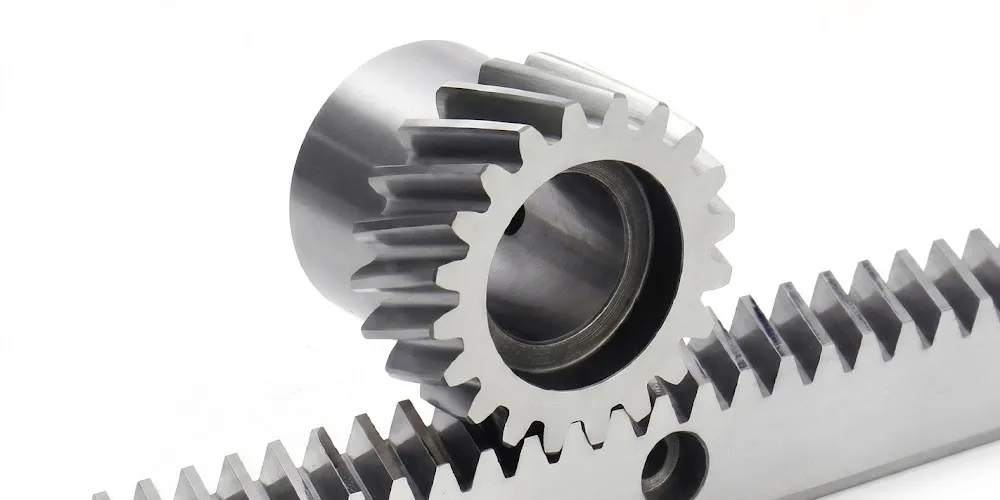
Helical Gear
Where the application load or speed requirements point toward a helical drive rather than the straight-tooth STLBX profile, our full range of Helical Gear pinions provides the matching driving element. Helical pinions spread tooth load across an oblique contact line, reducing peak Hertzian stress at each mesh point — a benefit that complements the tight-tolerance rack surface of a zero-backlash system, since lower peak contact stress extends the service life of the chrome surface layer. Both products ship from the same production source, ensuring dimensional compatibility and consistent quality across the complete gear rack and pinion assembly.
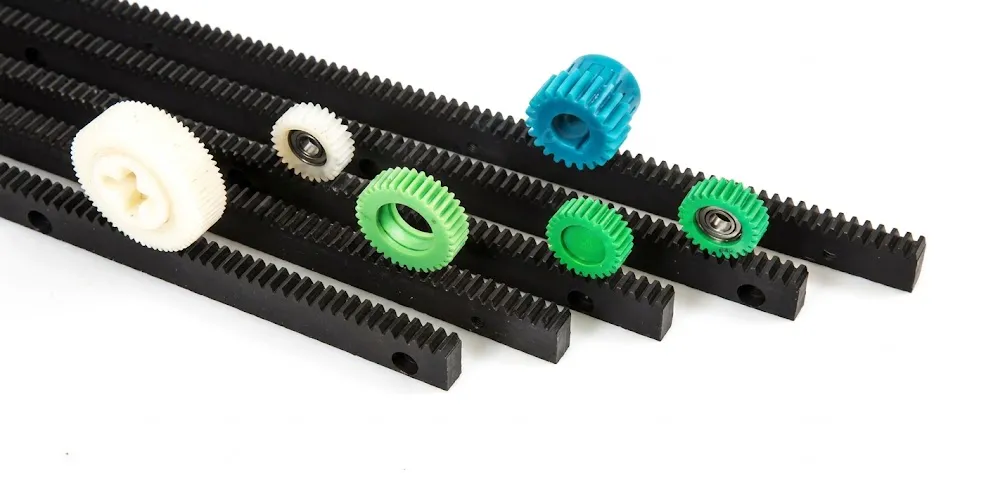
Пластикова зубчаста рейка
For prototype development, low-load positioning systems, or environments where metal contamination is unacceptable — food processing facilities, cleanrooms, and wet chemical handling equipment — our plastic gear rack range offers a lubrication-free alternative. Available in POM and nylon grades, these racks share the same tooth pitch geometry as our steel series. Engineers can validate motion system geometry using plastic rack and switch to the hardened steel zero-backlash variant for production without redesigning the mounting hardware, saving development time and cost.
Про наше виробництво
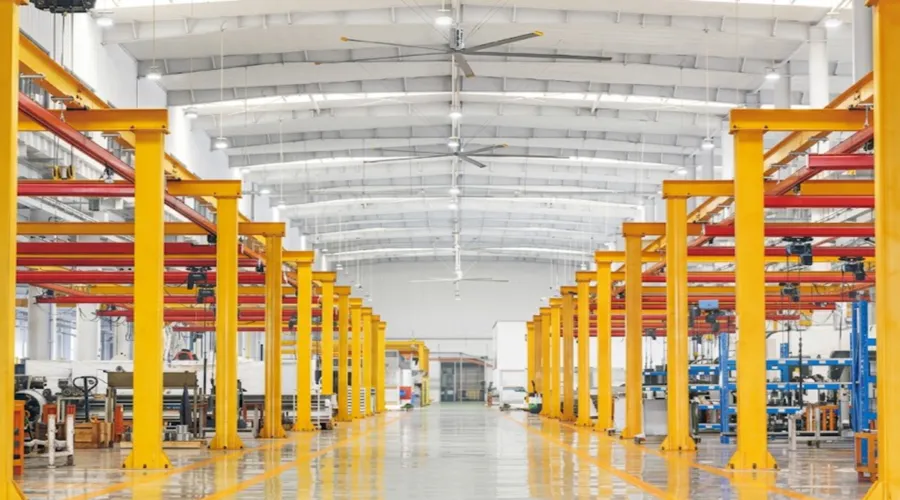
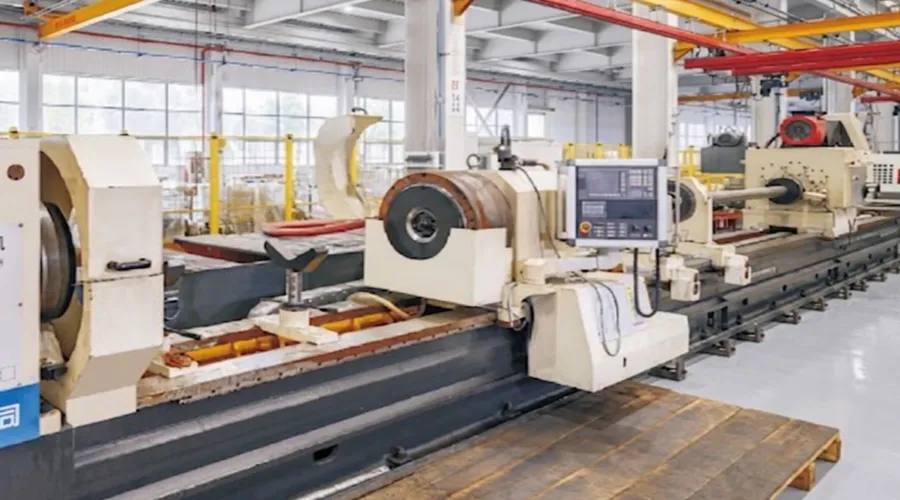
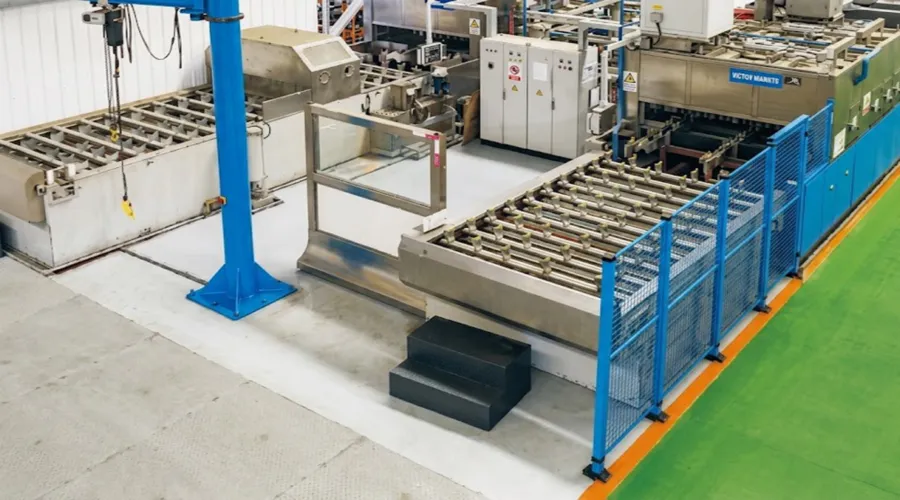
More than ten years of concentrated experience in mechanical power transmission underpins every product we manufacture. Our ISO 9001:2015 certified facility produces a broad spectrum of components — agricultural gearboxes, worm gear reducers, planetary gear drives, power take-off shafts, hydraulic cylinders, gears, sprockets, chains, worm gears, pulleys, drive shafts, and both standard and bespoke mechanical assemblies. Raw materials include ductile iron, grey cast iron, cast steel, precision investment-cast steel, and cast aluminium, selected to match the mechanical demands of each application.
Every gear rack that leaves our production line — whether a small gear rack for a compact instrument or a large-module custom gear rack for special-purpose industrial machinery — passes through a documented inspection workflow. Tooth pitch, profile form, and surface hardness are all verified against the declared specification before dispatch, so customers receive components that perform as specified from day one.
Семінар
Часті запитання
Редактор: PXY
Супутні товари
-
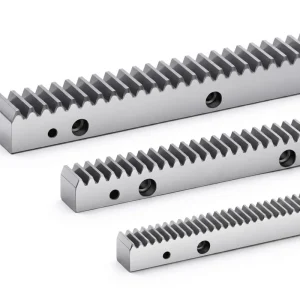
Пряма зубчаста рейка EP-S45C — від 4 до 8 отворів, загартування та відпуск HB20-25°
-
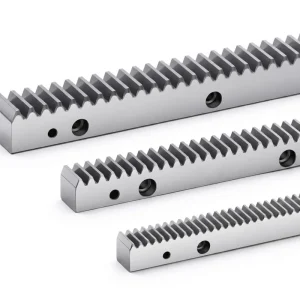
Зубчаста рейка EP-S45C/42CrMo з 4–8 отворами, 20–212 зубцями, прямою формою — зубчаста рейка з циліндричним циліндром DIN6 GB5
-
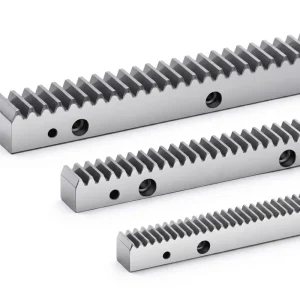
Пряма зубчаста рейка EP-S45C — високочастотне гартування HRC48-52°
-

EP-S45C/42CrMo V-Type Ground Straight Gear Rack