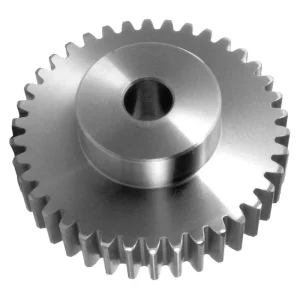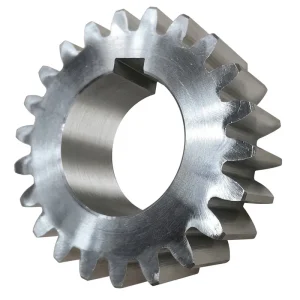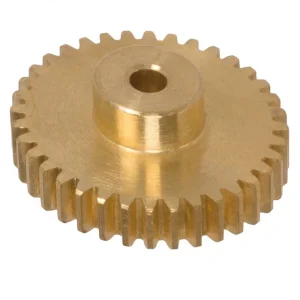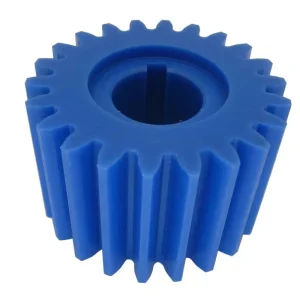
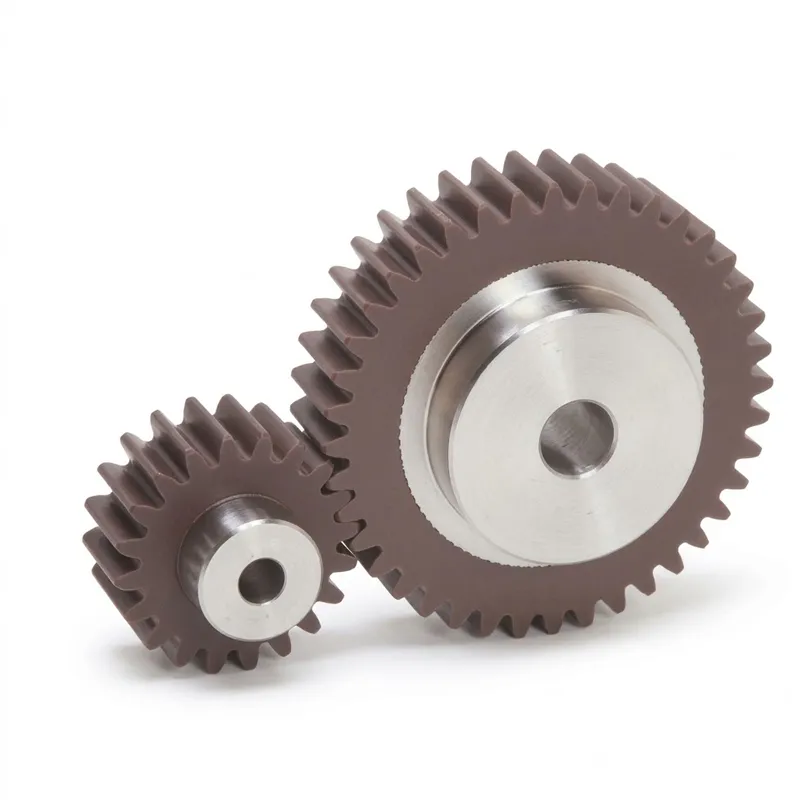
EP-Plastic Spur Gears with Steel Core
The EP-Plastic Spur Gears with Steel Cores series combines the quiet operation of plastic with the structural integrity of metal, designed for high-load precision applications. Manufactured from MC602ST nylon with an S45C steel core, these gears achieve a tooth hardness of 115–120 HRR without additional heat treatment. They feature a standard 20° pressure angle and full-depth teeth, meeting JIS Grade N9 (JIS B1702-1: 1998) and JIS Grade 5 (JIS B1702: 1976) precision standards. A representative model, the NSU1-50 (Module 1, 50 Teeth), features a 50mm pitch diameter, 52mm outside diameter, and 10mm face width. With a 10mm bore and 34mm metal core diameter, it offers controlled backlash (0–0.34mm) for reliable synchronization. This hybrid construction ensures durability and dimensional stability in demanding industrial drives where pure plastic gears might fail.
HYBRID DRIVE COMPONENTS — SPUR GEAR SERIES
EP-Plastic Spur Gears with Steel Core
A structurally superior plastic spur gear format — MC602ST polymer body over a precision S45C steel core, delivering the corrosion immunity of engineering plastics alongside the dimensional rigidity and bore strength only metal can provide.
Technical Specifications — NSU1-50 Reference Configuration
All dimensions in millimetres unless stated. Additional modules, tooth counts, and bore sizes available on request through the custom spur gears programme.
| Plastic Spur GearsParameter | NSU1-50 Value | Notes / Standard |
|---|---|---|
| मॉड्यूल | M1 | Metric involute |
| दांतों की संख्या | 50 | Standard full depth |
| Shape (Hub Form) | S1 | With steel core |
| Bore (A) | Ø10 mm | Steel core bore |
| Hub Diameter (B) | Ø30 mm | S45C steel hub |
| Pitch Diameter (C) | Ø50 mm | Module × Teeth |
| Outside Diameter (D) | Ø52 mm | MC602ST tooth tip |
| Face Width (E) | 10 mm | Tooth contact width |
| Hub Width (F) | 10 mm | Steel core length |
| Total Length (G) | 20 mm | Hub + tooth body |
| Metal Core Diameter | 34 मिमी | S45C insert OD |
| Series Code | 12 | EP NSU series |
| Backlash Low | 0 mm | Minimum clearance |
| Backlash Up | 0.34 mm | Maximum clearance |
| Material — Tooth | MC602ST | Cast nylon polymer |
| Material — Core | S45C steel | Medium-carbon steel |
| दांत की कठोरता | 115 – 120 HRR | As moulded, no heat treatment |
| Pressure Angle | 20° | Standard involute |
| Precision Grade | JIS N9 / JIS Grade 5 | JIS B1702-1:1998 / JIS B1702:1976 |
| गुनवत्ता का परमाणन | आईएसओ 9001:2015 | Factory-wide QMS |
What Makes a Steel-Core Plastic Spur Gear Different?
The EP-Plastic Spur Gears with Steel Core series represents a deliberate engineering compromise in the best sense of the word. A standard all-polymer plastic spur gear offers weight savings, corrosion resistance, and self-lubricating properties — but it carries a structural limitation at the bore. Pressed or interference-fit plastic hubs can creep under torque, loosen on shafts over time, and crack under heavy radial overhang loads. The steel-core design eliminates all three failure modes by replacing the plastic hub with a precision-machined S45C medium-carbon steel insert, over which the MC602ST engineering polymer tooth body is moulded or pressed.
The result is a plastic spur gear that genuinely bridges two material worlds. The tooth flank and addendum region — the areas where corrosion and lubrication matter most — remain polymer, giving the gear its quiet operation, chemical resistance, and freedom from galling. The bore, hub, and shaft interface, where clamp loads and keyway stresses concentrate, are handled entirely by the steel core, rated at a tooth hardness range of 115 to 120 HRR in the as-moulded condition. This architecture makes the steel-core variant the preferred selection wherever a standard all-plastic spur gear would be borderline on shaft retention or fatigue life.
Our EP series covers product number NSU1-50 as a representative configuration, with module M1, 50 teeth, bore (A) of 10 mm, hub diameter (B) of 30 mm, pitch diameter (C) of 50 mm, outside diameter (D) of 52 mm, face width (E) of 10 mm, hub width (F) of 10 mm, and total length (G) of 20 mm. Metal core diameter is 34 mm with a series code of 12. Backlash tolerance runs from 0 mm (low) to 0.34 mm (up), meeting JIS grade N9 (JIS B1702-1: 1998) and JIS grade 5 (JIS B1702: 1976) precision standards.
Five Defining Advantages of the Plastic Spur Gears Design
① Enhanced Bore and Shaft Retention
The S45C steel core provides a rigid metal-to-shaft interface that prevents the bore creep and hub loosening seen in all-polymer gears under sustained torque. Keyway slots, set-screw flats, and tight H7 bore tolerances can all be applied to the steel insert without risk of cracking — a limitation that affects both nylon spur gears and acetal spur gears when machined in plastic alone.
② Controlled Backlash Across Service Life
Backlash in all-plastic gears tends to increase as the polymer creeps and the bore fit relaxes. With the steel core locking dimensional stability at the shaft interface, backlash in the EP steel-core plastic spur gear stays within the 0 mm to 0.34 mm design envelope throughout normal service life — a critical advantage in positioning systems and differential spur gear stages where repeatability is a primary specification.
③ Higher Torque Capacity at the Same Outer Diameter
Because the bore load path runs through steel rather than polymer, the permissible transmitted torque for a given outer diameter is significantly higher than an all-plastic equivalent. This allows designers to use a smaller-diameter plastic spur gear where an all-plastic gear would require a larger spur gear blank — reducing package size without sacrificing reliability, particularly useful when designing spur gears into compact gearbox stages.
④ Polymer Tooth Benefits Fully Retained
The MC602ST tooth profile preserves every property that makes a plastic spur gear worth specifying: self-lubrication, low mesh noise, chemical resistance to mild acids and coolants, and significant weight advantage over steel spur gears or stainless steel spur gears of equal pitch diameter. The steel core adds structural depth without changing the tooth's operating characteristics at the mesh point.
⑤ JIS-Traceable Precision Standard
Tooth geometry conforms to JIS grade N9 under JIS B1702-1: 1998, which is broadly equivalent to DIN 3962 quality class 9 — the standard commonly referenced when sourcing metric spur gears for industrial machinery in Europe, Australia, Canada, and Japan. Full-depth involute teeth at 20° pressure angle ensure direct interchangeability with existing spur gear sets across all major metric module systems.
Plastic Spur Gears Material Composition — MC602ST Body over S45C Core
Understanding the material pairing in this plastic spur gear format is essential for correct application selection. The two materials in use serve distinct mechanical roles, and neither is a compromise — each is optimised for its region of the gear.
MC602ST — Engineering Polymer Tooth Body
MC602ST is a cast nylon-based engineering resin developed specifically for gear tooth applications. It offers a balanced combination of stiffness, toughness, and low friction that positions it above standard nylon spur gears but below the hardness of delrin spur gears and acetal spur gears. Its tooth hardness in the 115 to 120 HRR range is consistent with long-cycle fatigue performance in moderate-load drives. The material is self-lubricating at the tooth surface, resistant to gear oils and common industrial solvents, and has sufficiently low thermal expansion to maintain involute profile geometry across a wide operating temperature range. When evaluating what plastic spur gears are made of in professional drive system design, MC602ST represents one of the more technically mature options available in the market.
S45C — Precision Steel Core Insert
S45C is a Japanese Industrial Standard medium-carbon steel (roughly equivalent to AISI 1045 / DIN C45) widely used in shaft, hub, and structural gear components requiring good machinability and moderate tensile strength. In the context of this plastic spur gear with steel core design, the S45C insert provides the dimensional stability, keyway machinability, and bore tolerance precision that no engineering polymer can reliably sustain under repeated shaft-mounting and removal cycles. The core diameter of 34 mm in the NSU1-50 configuration is sized to maximise the metal-to-polymer interface area, distributing torque evenly into the surrounding MC602ST body without stress concentrations that could cause delamination or polymer splitting at the hub periphery. No heat treatment is applied to the assembled gear — the material properties are designed to be sufficient in the as-manufactured condition.
How the Steel-Core Plastic Spur Gear Operates
Like any external spur gear, this product transmits torque by the successive meshing of involute teeth on parallel shafts. The tooth contact line runs parallel to the shaft axis — the defining characteristic of the straight spur gear family — which eliminates axial thrust forces and simplifies bearing selection. At a 20° pressure angle and standard full-depth tooth geometry, each tooth engagement produces a predictable, well-distributed load across the full face width of 10 mm in the NSU1-50 configuration.
What distinguishes the steel-core variant's operating behaviour from a comparable all-plastic spur gear is the load path through the gear body. In an all-polymer design, the torque path runs: shaft surface → polymer bore → polymer tooth root → tooth flank. Every link in that chain is polymer, and the bore interface is the weakest. In the steel-core design, the first two links change to: shaft surface → steel bore → steel core periphery → polymer tooth root → tooth flank. The torque is handed off to polymer only after it has already been distributed into the annular area of the MC602ST body, dramatically reducing stress concentration at the bore-to-tooth root transition.
The involute profile used across this series conforms to the standard full-depth system, meaning the gear will mesh correctly with any mating spur gear tooth of the same module — whether another plastic spur gear, a metal spur gear, a pinion spur gear, or a gear rack — provided the module and pressure angle match. The gear ratio between any two mating gears is simply the ratio of their tooth counts, making spur gear set design and gear ratio calculation direct and unambiguous. This remains one of the most practical advantages of the straight spur gear format for engineers designing spur gears into new product architectures.
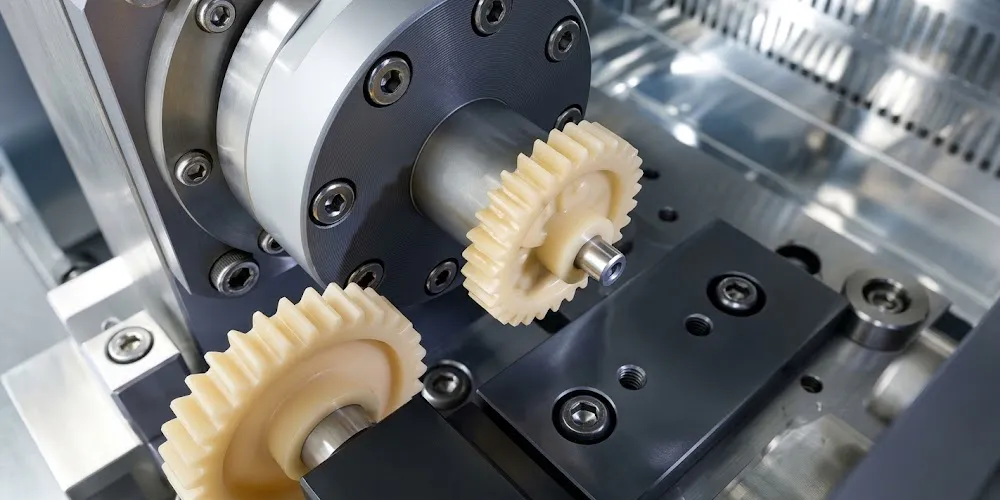
Application Scenarios — Where Steel-Core Plastic Spur Gears Perform Best
The steel-core format is not intended as a universal replacement for standard polymer gears. Its particular combination of properties makes it the optimal solution in the scenarios listed below — markets and applications served globally, with particular demand from industrial buyers in Canada, the UK, Germany, Japan, and Southeast Asia.
Precision Positioning Systems
CNC positioning tables, coordinate measurement machine axes, and automated optical alignment platforms require consistent backlash values over thousands of operating cycles. The steel-bore retention of this plastic spur gear prevents the gradual shaft-slip that would shift the zero position in an all-plastic gear drive, making it a reliable choice for metrology and semiconductor handling equipment.
Industrial Conveyor & Indexing Drives
Conveyor indexing heads and step-motion transfer units subject their drive gears to repeated start-stop torque reversals. The S45C steel core handles the inertial shock loading at the shaft interface, while the MC602ST tooth body absorbs mesh impact elastically — a complementary split of function that extends overall gear life compared to either a pure steel spur gear or a pure plastic spur gear used alone.
Pharmaceutical & Food-Grade Machinery
Equipment that must withstand regular chemical washdown cannot use external spur gear stages built from uncoated steel spur gears or brass spur gears without corrosion risk. The MC602ST tooth body resists cleaning agents, sanitisers, and dilute acids, while the steel core allows the gear to remain securely retained on its drive shaft throughout repeated wash cycles — a critical requirement for filling and capping lines in Europe and North America.
Robotics — Higher-Torque Joints
Where all-plastic gears are marginal on torque capacity for a given robot joint, the steel-core plastic spur gear allows the designer to stay with a polymer tooth mesh — preserving the acoustic and weight advantages — while accepting higher peak torques through the steel bore interface. This is particularly relevant for collaborative robot arm joints and industrial pick-and-place systems running at duty cycles above 70%.
Agricultural & Outdoor Power Equipment
Seed metering units, irrigation controllers, and implement drive governors in agricultural machinery are frequently mounted with interference-fit bores and must withstand vibration and grit contamination. The steel-core design resists the bore fretting and hub crack failures that terminate the service life of all-nylon spur gears in these environments, while the polymer tooth body avoids the rust and galling that disqualify uncoated metal spur gears from wet-field applications.
Differential & Reduction Gear Stages
In multi-stage differential spur gear or inline reduction configurations, the intermediate gear often carries both radial and torque loads that push the bore stress limits of all-plastic gears. The steel core provides a reliable intermediate support point in these layouts, allowing the designer to maintain polymer meshing surfaces throughout the gear train — a key factor in drives where acoustic signature and lubricant-free operation are specified.
Choosing Between Gear Types — Spur Gear vs Helical Gear vs Steel-Core Plastic
The difference between spur gear and helical gear formats is well understood: the straight spur gear generates no axial thrust, is simpler to align, and costs less per unit; the helical gear runs more quietly at high speed and carries higher load ratings at a given pitch diameter. The steel-core plastic spur gear sits in a third category that is sometimes overlooked when designing spur gears for mixed-duty applications — one where the noise and corrosion advantages of polymer teeth are genuinely needed, but where shaft retention requirements rule out an all-plastic approach.
For applications running below 800 RPM with moderate loads and clean shafts, an all-polymer plastic spur gear will typically suffice. For the same speed range but with larger shaft diameters, interference fits, or keyway requirements, the steel-core configuration is the technically correct selection. Above 800 RPM under sustained load, a steel spur gear or stainless steel spur gear should be evaluated against the polymer options, since tooth temperature rise becomes a significant design variable. The difference between spur gear and helical gear impact on system noise only becomes practically significant above roughly 1,200 RPM — below that threshold, the spur gear's simplicity advantages generally outweigh the helical and spur gear noise trade-off.
When evaluating plastic spur gears for sale, buyers should request confirmation of the material specification — particularly whether the product is an all-polymer design or carries a steel core — since the two products look similar in catalogue images but differ substantially in bore strength performance. Our plastic spur gear catalog clearly distinguishes these configurations for each product number.
Related Products — One-Stop Drive System Supply
Beyond the steel-core plastic spur gear, our manufacturing scope covers the complementary components needed to complete a full drive train specification. Sourcing from a single supplier reduces procurement lead time, ensures dimensional compatibility across mating components, and simplifies incoming quality inspection procedures.
डबल हेलिकल गियर
For drive stages where higher load capacity or lower noise at elevated speed is required beyond what the straight spur gear can offer, our double helical gear series provides a direct step up. Opposing helix angles cancel axial thrust, maintaining the bearing simplicity of a spur gear set while delivering the load rating of a fully developed helical stage. System designers who pair steel-core plastic spur gears in low-speed stages with double helical gears in high-speed stages can optimise both noise and cost across a multi-stage transmission.
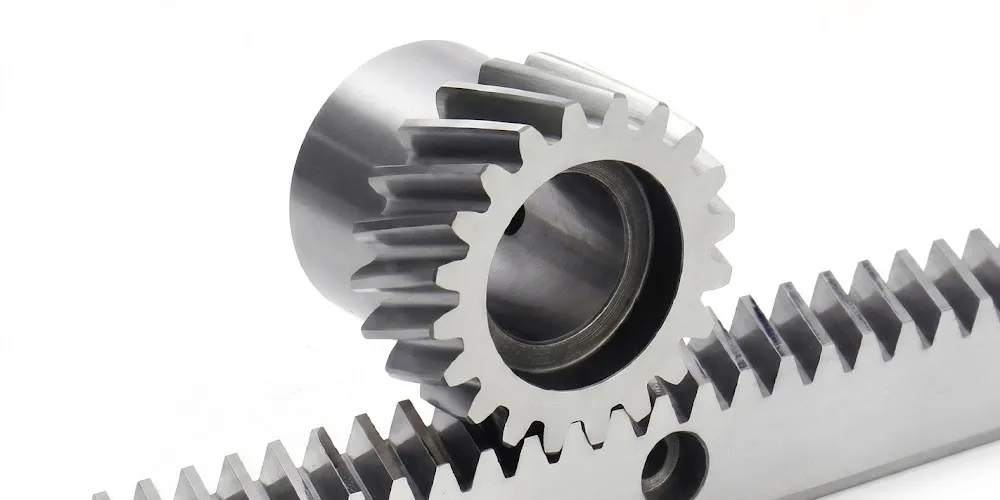
Gear Rack — Full Series
Any pinion spur gear from the EP series — including the steel-core plastic spur gear — can be paired with a matching gear rack to convert rotary motion into precision linear displacement. We supply gear racks in steel, stainless steel, and engineering polymer grades across the full metric module range, with tooth profiles that mesh directly with our spur gear series. Module M1 racks are available in standard lengths for immediate pairing with the NSU1-50 configuration, simplifying both engineering and procurement for linear actuator and gantry drive applications.
Order & Trade Information
Minimum Order Quantity
Standard steel-core plastic spur gears carry a baseline MOQ. Mixed configurations — varying tooth counts, bore sizes, or module — can be combined into a single order totalling approximately USD 1,500. For customers evaluating new designs, 1–5 pcs samples are available at sample pricing. Orders of 1–2 pcs for urgent spare requirements can be assessed on a case-by-case basis, though unit pricing will be higher for very small quantities.
Lead Time
Standard-stocked configurations: 3–7 working days. Standard production runs of catalogued plastic spur gears: 10–25 working days. Custom spur gears requiring non-standard bore, modified tooth profile, or keyway machining: 20–45 working days. Sample and small-batch test orders (1–5 pcs): 7–25 working days, with complex configurations assessed individually.
Incoterms
Standard component shipments support EXW, FOB, CIF, and DAP terms. For urgent spare-part orders or small packages, EXW / FCA / DAP / courier service can be arranged. FCA, CFR, CPT, CIP, and DDP terms are negotiable for specific import markets or project-based procurement contracts. Contact our trade team with destination port and required Incoterm for a tailored quotation.
Documentation
Material certificates for both MC602ST and S45C, dimensional inspection reports, and ISO 9001:2015 quality certificates are available on request for each production batch. Custom spur gear orders placing design-change requirements on the steel core geometry will include a drawing approval step prior to production release.
About Our Production Capability
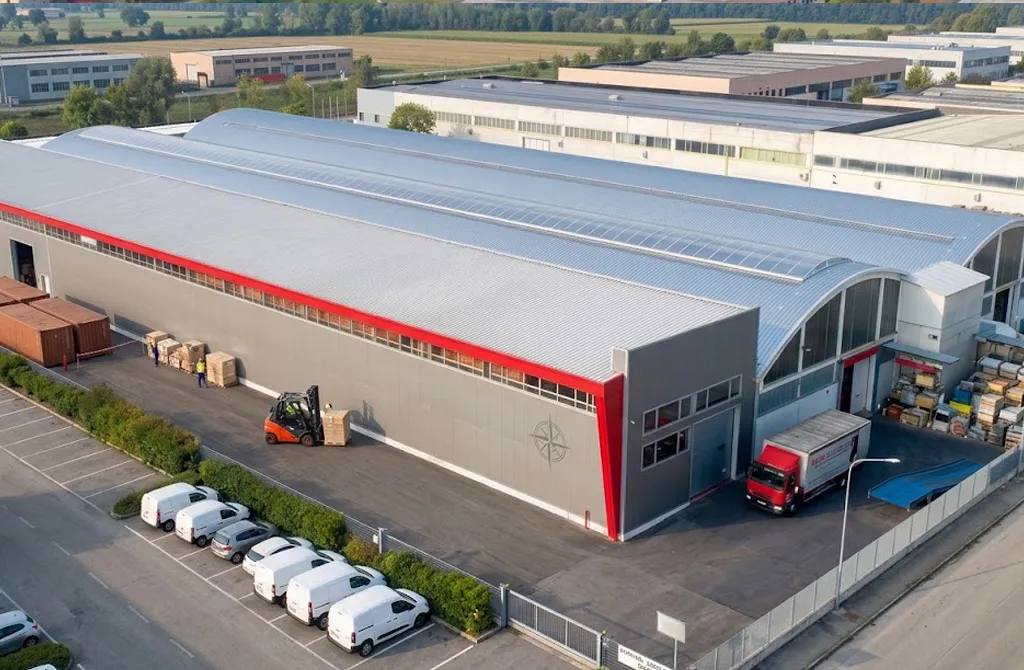
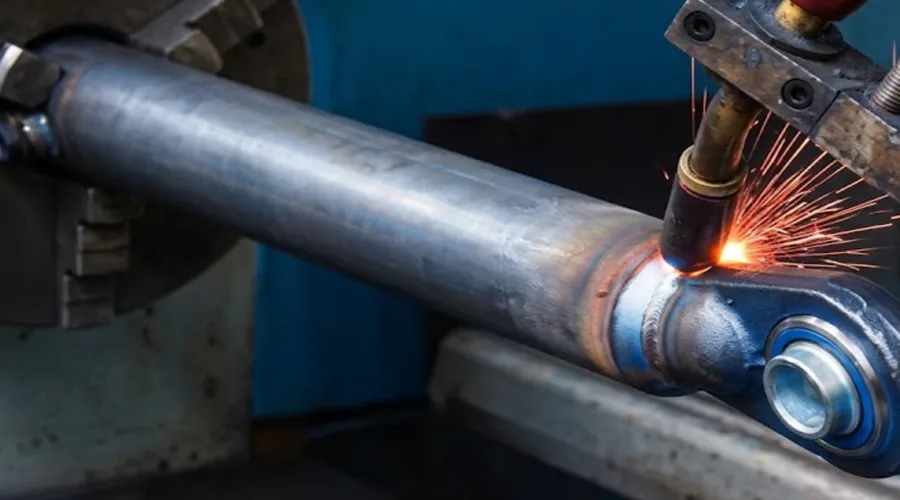
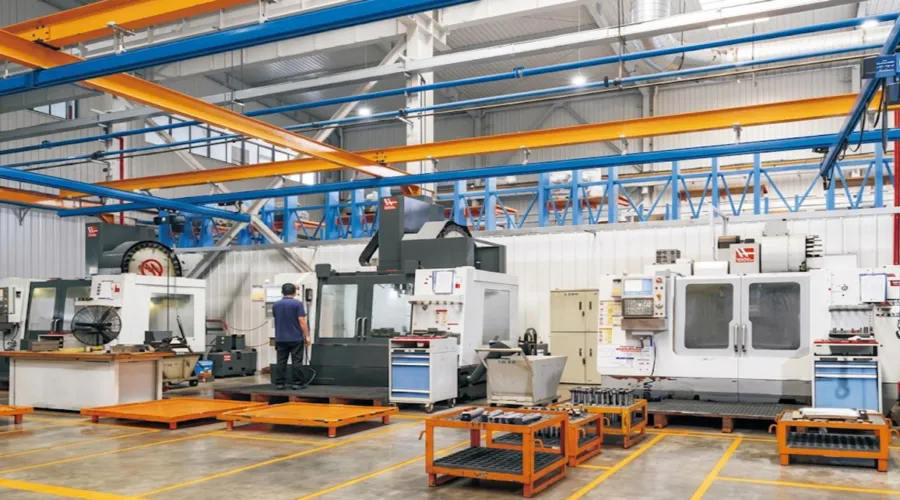
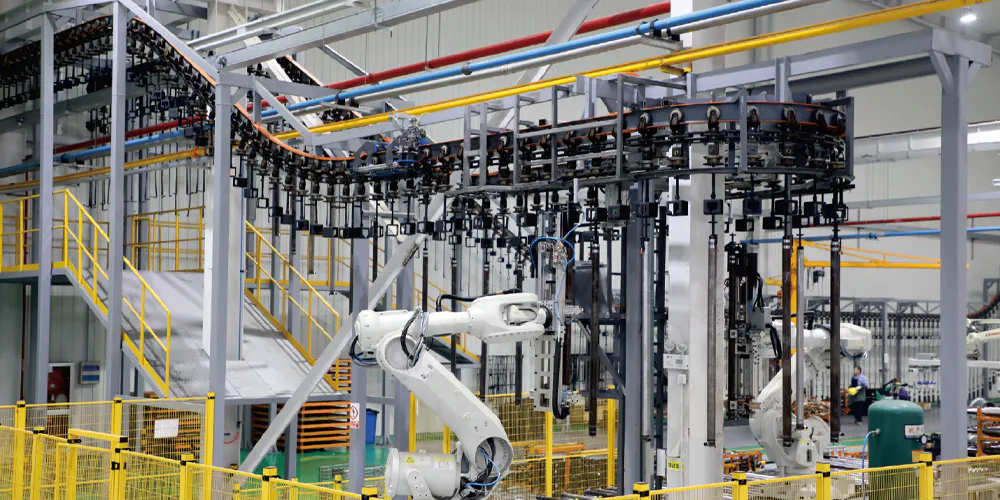
With more than a decade of focused experience in precision mechanical power transmission, our facility designs and builds a broad range of industrial components from the ground up. Our manufacturing scope covers agricultural gearboxes, worm gear reducers, planetary drive systems, power take-off shafts, hydraulic cylinders, drive chains, gears of all types, and electric motors — all produced under a single ISO 9001:2015 certified quality management framework.
The casting and fabrication side of our operation covers ductile iron, cast iron, cast steel, precision cast steel, and cast aluminium for gearbox housings, gear blanks, and custom assemblies. We manufacture gears, sprockets, worm gears, pulleys, worm shafts, and a full range of standard and non-standard mechanical drive parts — including every variant of plastic spur gear in the EP series.
कार्यशाला
अक्सर पूछे जाने वाले प्रश्नों
संपादक: पीएक्सवाई