
SELECTION GUIDE
A practical sizing reference covering spline type, shaft series, collapsed and extended length, and torque ratings — matched to the most widely operated round baler platforms globally.
Selecting the correct round baler PTO shaft for a specific baler model is not simply a matter of picking the nearest available length off a shelf. The shaft must match the tractor’s PTO output speed and spline configuration, the baler’s input torque rating and shaft series requirement, and the working geometry of the hitch — collapsed and extended length, maximum operating angle, and tube overlap at full extension. Get any one of these wrong and the shaft either fails early, transmits damaging loads to the gearbox, or cannot be physically installed. This guide works through the selection process systematically, with baler-platform-specific reference data for John Deere, Claas, and New Holland round baler series — three of the most widely operated baler families across North America, Western Europe, and Australia.
Understanding how to size a PTO shaft correctly also prevents the common mistake of replacing like-for-like on an already-incorrect original specification. If the previous shaft failed prematurely, the first question is whether it was the right specification to begin with — not just the right length. A shaft that looks similar to the original but is one series lower will fail at the same point in the season regardless of brand or material quality.
The Four Parameters That Define Correct Shaft Size
Every round baler PTO shaft selection comes down to four independent specifications that must all be satisfied simultaneously. None overrides the others — a shaft with the correct spline and length but the wrong series rating will fail under load; one with the right series and length but the wrong spline cannot be engaged. Working through these four parameters in sequence eliminates guesswork and avoids the frustration of ordering the wrong component twice.
1 — PTO Output Speed
Confirm whether the tractor’s PTO stub runs at 540 RPM or 1000 RPM. This determines the spline count on the front yoke and affects the torque loading on the shaft for a given power output. Most modern high-capacity round balers — including the John Deere 9-Series, New Holland BR7000 Series, and Claas Rollant 400 — specify 1000 RPM operation. Older platforms and smaller balers typically use 540 RPM.
2 — Spline Configuration
At 540 RPM the tractor output stub is 1-3/8 in. with 6 splines. At 1000 RPM it is either 1-3/8 in. with 21 splines or 1-3/4 in. with 20 splines depending on the tractor power class and model year. Verify against the tractor operator’s manual — do not assume from memory, as the same tractor model may have shipped with different output configurations across production years.
3 — Collapsed and Extended Length
Measure the shortest operating distance between tractor PTO stub face and baler input yoke at the tightest turning position, and the longest distance at full straight-line hitch extension. The shaft’s collapsed length must be at least 10 mm shorter than the minimum operating distance; the extended tube overlap must remain above one-third of the inner tube length at maximum distance.
4 — Shaft Series and Torque Rating
The series number (4, 6, or 8) defines the outer tube diameter, wall thickness, U-joint cross size, and peak torque rating. Series 6 is the standard for most mid-to-large round baler platforms at 1000 RPM. The shaft series must be rated above the peak instantaneous torque the baler generates during a blockage event — not just the mean operating load under normal crop conditions.
Platform Reference: John Deere, Claas, and New Holland
The following table consolidates the PTO shaft specification requirements across the three baler platforms covered in this guide. These figures reflect the standard configuration for each model series; individual machines may vary based on market specification, year of manufacture, and fitted options. Always cross-reference with the baler’s original parts manual before ordering a replacement pto shaft for round baler applications.
| Baler Model | PTO Speed | Front Spline | Recommended Series | CV / Standard Joint | Overload Device |
|---|---|---|---|---|---|
| John Deere 469 / 569 | 1000 RPM | 1-3/8 in. × 6 or 21 spline | Series 6 | CAT4 / CAT5 CV | 80° wide-angle friction slip clutch |
| John Deere 448 / 458 | 540 RPM | 1-3/8 in. × 6 spline | Series 4–6 | Standard wide-angle | Friction slip clutch or shear bolt |
| Claas Rollant 354 / 374 / 455 | 1000 RPM | 1-3/8 in. × 21 spline | Series 6 | Wide-angle CV | Friction slip clutch |
| New Holland BR7050 / BR7060 | 1000 RPM | 1-3/8 in. × 21 spline | Series 6 | CV head | Slip clutch |
| New Holland 630 / 648 | 540 RPM | 1-3/8 in. × 6 spline | Series 4–6 | 기준 | Shear bolt or slip clutch |
| Claas Variant 360 / 380 | 540 / 1000 RPM | 1-3/8 in. × 6 or 21 spline | Series 6 | Wide-angle | Friction clutch |
Manufacturing Construction: What Determines Series Classification
The shaft series number is not an arbitrary marketing classification — it is defined by the outer tube diameter and wall thickness, the U-joint cross body diameter, and the resulting peak torque rating of the assembly. A Series 4 shaft uses a smaller cross and lighter tube than a Series 6, which in turn has a lower rating than a Series 8. The differences are not cosmetic; a Series 4 cross physically cannot be installed in a Series 6 yoke ear because the cross body diameter and bearing cup bore are dimensioned to different standards. This means that field repairs using mismatched series components are not possible, and that cross-series parts interchangeability does not exist.
For round baler PTO shaft applications on the baler platforms covered in this guide, Series 6 is the standard fit for all models specifying 1000 RPM input. The Series 6 cross body is typically 27 mm across the trunnion, with bearing cups precision-ground from 52100 bearing steel and held in the yoke ear by circlip retention. The telescoping tubes in Series 6 are lemon-section or star-section profiles cold-drawn from Q345 steel, providing low sliding friction and dimensional consistency across the full extension range. The outer guard is UV-stabilised HDPE with integrated support cones and a retention collar at each end yoke.
Material System Across Shaft Components
| 요소 | 재료 | Manufacturing Process | Functional Requirement |
|---|---|---|---|
| U-joint cross (Series 6) | 20CrMnTi 합금강 | Carburised, case-hardened 58–62 HRC | Fatigue resistance, tough core against shock |
| Bearing cups | 52100 bearing steel | Through-hardened, precision ground | Long service life under cyclic needle load |
| Inner and outer tubes | Q345 cold-drawn steel | Hot-dip galvanised or epoxy-coated | Corrosion resistance, low-friction sliding |
| Yokes and flanges | SAE 1045 forged steel | Normalised, zinc electroplated | High torque transfer, connection strength |
| Friction clutch discs | Sintered bronze / organic composite | Precision stack-assembled, spring-loaded | Consistent torque-limiting release |
| Guard tube | UV-stabilised HDPE | Injection-moulded, cone-integrated | CE/ASABE operator guarding |
How to Measure Shaft Length for a Specific Baler Hitch
Incorrect shaft length is the single most preventable selection error. It does not show up during installation — both a too-short and too-long shaft can be physically connected — but it creates an operating condition that either bottoms out the telescoping tubes during turns (causing the shaft to push the tractor and baler apart) or allows excessive tube extension that reduces the spline overlap below the minimum structural requirement. Both conditions lead to premature failure. The correct measurement procedure takes less than ten minutes with a tape measure and requires the tractor and baler to be connected at the working hitch height on level ground.
Minimum collapsed length: With the tractor turned to its maximum steering angle — not just straight-line position — measure the distance between the tractor PTO stub face and the baler input shaft flange face. This is your minimum operating distance. The shaft’s collapsed (compressed) length must be at least 10 mm shorter than this figure. If the shaft collapses to exactly the minimum distance with no clearance, it will make metal-to-metal contact inside the telescoping section during every headland turn, generating impact loads and accelerating wear on both tube profiles.
Maximum extended length: Measure the distance at the longest hitch configuration — tractor driving straight, baler at maximum drawbar extension. The shaft extended length at this position must maintain an inner-to-outer tube overlap of at least one-third of the inner tube’s working length. Below this overlap, the shaft cannot safely transmit rated torque because the contact area between the tube profiles is insufficient to resist torsional deflection.
Operating angle check: At the hitch height used in the field, confirm that the angle between the tractor PTO axis and the baler input shaft axis does not exceed the shaft’s rated maximum operating angle — typically 15° for standard U-joints, and up to 80° for wide-angle constant-velocity heads on Series 6 shafts. Operating continuously above the rated angle heats the U-joint and accelerates cross wear regardless of lubrication frequency.
Model-Specific: John Deere Round Baler PTO Shaft
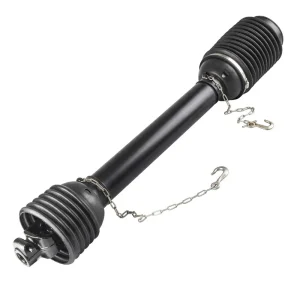
EP Round Baler PTO Shaft — John Deere 469 / 569 Series
A direct-fit john deere round baler pto shaft replacement for the 469 and 569 9-Series platforms. Built to the CAT4 / CAT5 constant-velocity driveline specification with an 80° wide-angle slip clutch and front yoke compatibility for both 1-3/8 in. × 6 spline and 1-3/8 in. × 21 spline tractor PTO outputs. The U-joint crosses are manufactured from 20CrMnTi carburised steel with a precision-ground 52100 bearing cup set. The guard assembly carries CE certification and meets ASABE S331 guarding requirements. Suitable for use with John Deere tractors across North America, Western Europe, and Australia.
New Holland and Claas: Platform-Specific Considerations
New Holland 630 / 648 and BR7000 Series
The new holland 630 round baler pto shaft and new holland 648 round baler pto shaft specifications differ between the older fixed-chamber models and the later BR7000 variable-chamber platforms. The 630 and 648 series operate at 540 RPM and accept a 1-3/8 in. × 6 spline front yoke, with a Series 4 or Series 6 shaft depending on the baler’s rated input torque. The BR7050, BR7060, and BR7070 platforms move to 1000 RPM operation and require a 1-3/8 in. × 21 spline yoke with a Series 6 CV shaft. The transition between these specifications is a common source of ordering errors when operators move from an older New Holland baler to a current-generation model on the same tractor. Confirming the model year and output speed before ordering avoids an expensive misfit on arrival.
Claas Rollant and Variant Series
Claas round balers across the Rollant 354, 374, and 455 and the Variant 360 and 380 all operate at 1000 RPM and use a 1-3/8 in. × 21 spline front connection. The wide-angle CV head is standard on these platforms to accommodate the articulation angles that occur in the smaller field sizes common across northern France, Belgium, and central Germany where Claas balers are predominantly used. The critical sizing variable on Claas platforms is the telescoping length — the tongue geometry varies between Rollant and Variant series, meaning a shaft sized for one Claas model does not necessarily fit another even within the same product family. Measure the actual hitch geometry rather than relying on cross-reference charts alone when selecting a replacement pto shaft for these balers.
Matching Shaft Torque Rating to Round Baler PTO Requirements
The torque demand on a round baler PTO shaft is not constant. Mean operating torque during a smooth baling pass through an even windrow is well within the continuous rating of any correctly specified shaft. The design challenge is the peak torque — the instantaneous spike that occurs when the pickup reel encounters a dense clump, when a bale compression cycle completes suddenly, or when the operator engages the PTO with the baler partially blocked. These peaks can reach two to three times mean torque before the slip clutch releases. The shaft series must be rated above these peaks, not just above the mean.
| Shaft Series | Continuous Torque Rating | Peak Torque Capacity | Typical Baler Application |
|---|---|---|---|
| Series 4 | ~460 Nm | ~1,200 Nm | Smaller 540 RPM balers, under 60 PTO HP |
| Series 6 | ~870 Nm | ~2,100 Nm | JD 469/569, New Holland BR7000, Claas Rollant 400+ |
| Series 8 | ~1,400 Nm | ~3,500 Nm | Heavy-duty silage balers, high-density crop conditions |
For the majority of mainstream round baler platforms — including the John Deere 9-Series, New Holland BR7000, and Claas Rollant 400 family — Series 6 is the correct fit at 1000 RPM. Operators running silage variants or working in unusually dense crop conditions should consider Series 8 if the baler’s input torque rating approaches or exceeds 2,000 Nm during peak loading.
호환 가능한 시스템 구성 요소
A correctly sized round baler PTO shaft performs best when the components it connects to — the tractor PTO adapter and the baler input gearbox — are also operating within their design specifications. Sourcing the shaft alongside its adjacent drivetrain components from a single engineering-led range eliminates the compatibility uncertainty that arises when these parts come from different supply channels.
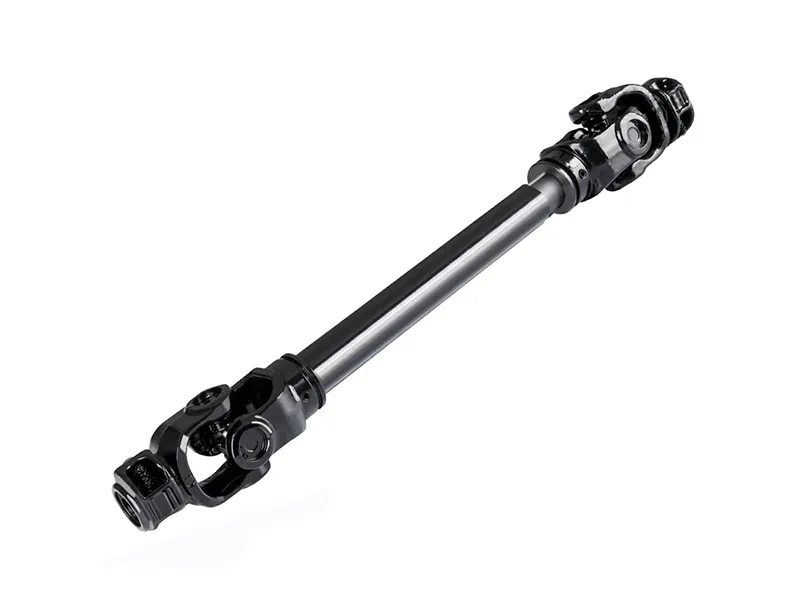
Multi-configuration driveshafts spanning Series 4 through 8, covering 540 RPM and 1000 RPM outputs across a wide range of tractor and implement combinations. When an operation runs multiple baler models on the same tractor fleet, a universal shaft stocked in the correct series and length eliminates the need to carry model-specific spares for each baler platform individually — reducing parts inventory complexity across busy hay and silage seasons.
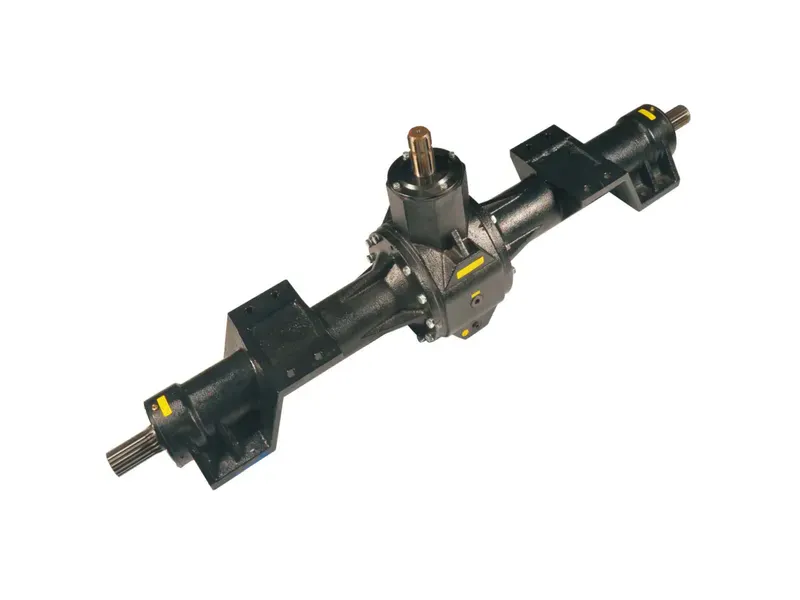
The baler input gearbox is the component that receives and distributes the torque delivered by the PTO shaft. When sizing a replacement round baler PTO shaft, confirming the gearbox input shaft diameter and spline count prevents installation problems at the implement end of the driveline. Sourcing the gearbox and shaft together from a coordinated range means the input spline profile, flange bolt circle, and torque rating are already matched — removing the trial-and-error fitting that frequently occurs when the two components are sourced separately.
제조업체 소개
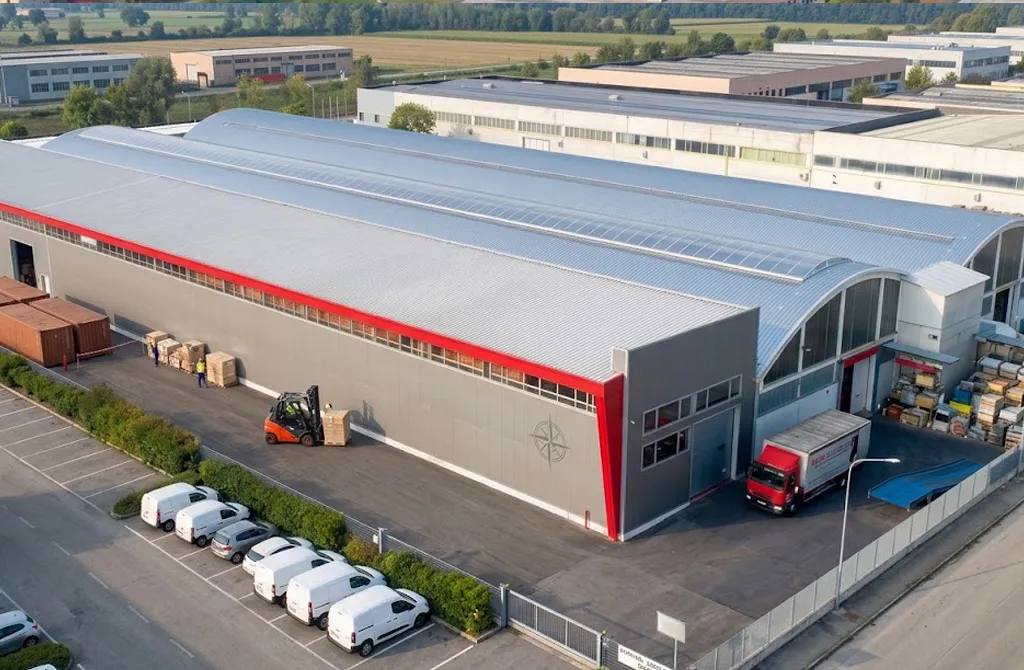
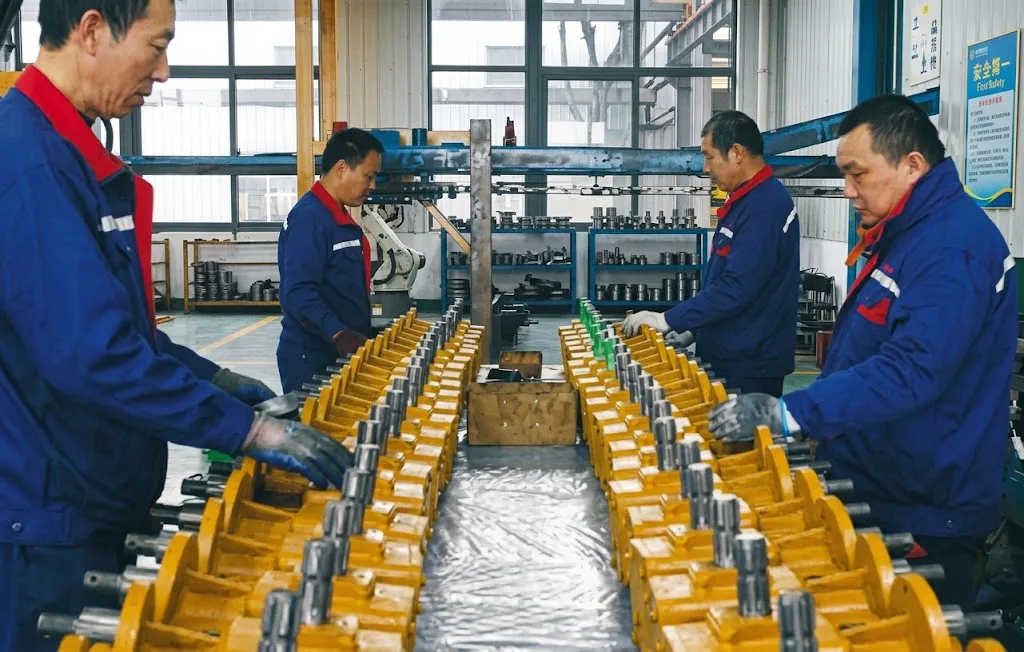
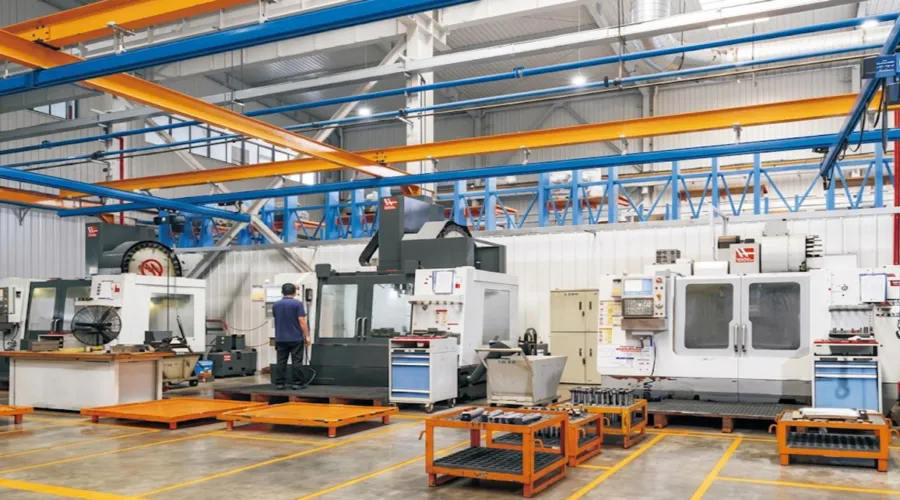
The engineering and manufacturing range covers agricultural gearboxes, worm gear reducers, planetary gear drives, power take-off shafts, hydraulic cylinders, gears, chains, and motors — all produced under ISO 9001:2015 certification across the full production cycle from incoming material inspection to finished assembly. Gearbox housings and mechanical assemblies are made from ductile iron, cast iron, cast steel, precision cast steel, and cast aluminium, with grade selection driven by the structural and thermal requirements of each application. Beyond the catalogue range, custom and non-standard components are designed and manufactured to customer-supplied drawings or application descriptions — sprockets, worm gears, precision shafts, pulleys, and assemblies — with quotation provided within 24 hours of receiving a technical inquiry.
작업장
자주 묻는 질문
편집자: PXY