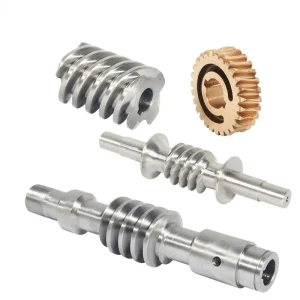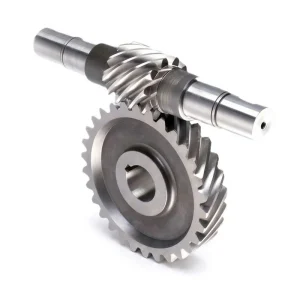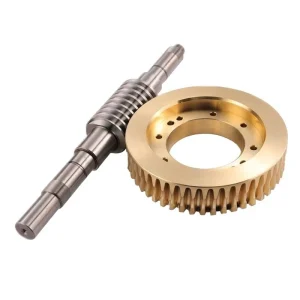
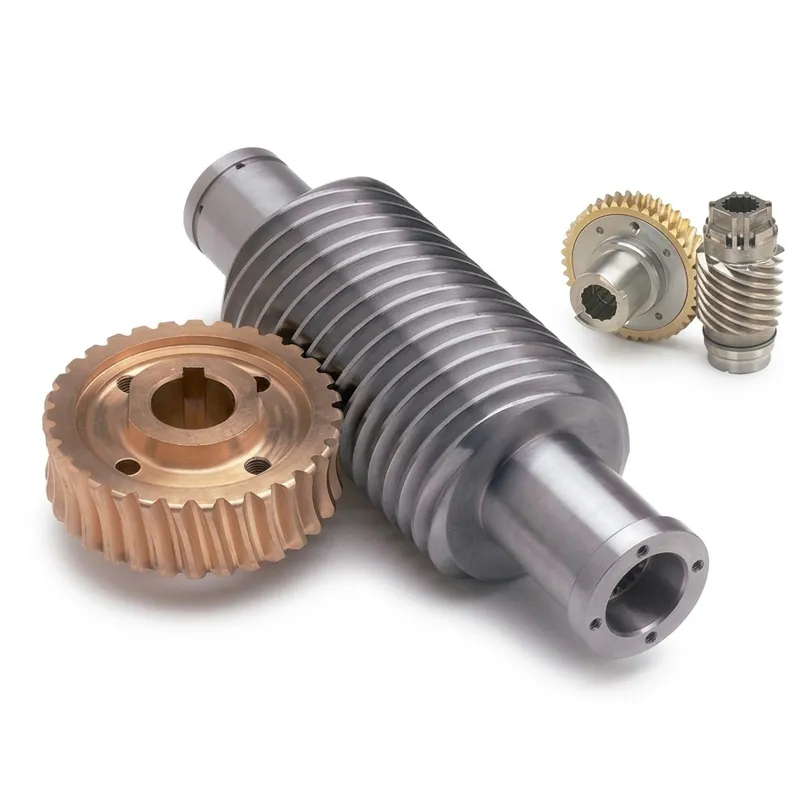
EP-Alloy Steel Worm And Worm Gear for Auto Parts
The worm and worm gear system is one of the most reliable and space-efficient power transmission solutions in mechanical engineering. This EP-Alloy Steel Worm And Worm Gear series is produced from high-grade alloy steel substrates with multi-material options available — including Aluminum, Copper, Brass, Stainless Steel, Steel, Iron, and Titanium — tailored precisely to each customer’s engineering requirement. The worm shaft engages the worm wheel through a helical thread mesh, converting rotational motion across perpendicular axes while naturally providing a high reduction ratio in a single compact stage.
Spanning dimensions from Φ5mm to Φ120mm and module range M0.2 to M2.2, these components serve a wide variety of mechanical assemblies including automotive steering linkages, medical devices, robotics, and aerospace actuators. Every piece in this alloy steel worm and worm gear lineup is subject to CNC Turning, Milling, Drilling, Hobbing, and Polishing operations, delivering tolerances as fine as 0.001mm. The worm and worm wheel assembly is further enhanced through surface treatments such as Anodizing, Galvanizing, Powder Coating, Laser Engraving, Silk Printing, and Brushing — selected based on the operating environment and customer specification.
EP-Alloy Steel Worm And Worm Gear for Auto Parts
Precision-machined alloy steel worm and worm gear sets engineered for automotive, industrial, and mechanical transmission systems. Dimensions Φ5mm–Φ120mm | Module M0.2–M2.2 | Full ODM/OEM support.
Technical Specifications
The table below lists the standard parameters for the EP-Alloy Steel Worm And Worm Gear for Auto Parts series. Custom specifications, non-standard modules, and alternative materials are available on request.
| Parameter | Specification |
|---|---|
| Product Name | Alloy Steel Worm And Worm Gear for Auto Parts |
| Dimension | Φ5mm – Φ120mm |
| Module | M0.2 – M2.2 |
| Material Type | Aluminum, Copper, Brass, Stainless Steel, Steel, Iron, Alloy, Titanium (as customer required) |
| Surface Treatment | Anodizing, Brushing, Galvanized, Laser Engraving, Silk Printing, Polishing, Powder Coating, etc. |
| Processing | CNC Turning, Milling, Drilling, Hobbing, Polishing, Bushing, Surface Treatment |
| Application | Automotive, Medical, Industrial, Military, Aircraft, Mechanical, etc. |
| Tolerance | 0.001mm / 0.01mm / 0.1mm |
| Customized | ODM / OEM supported |
| Sample | Sample available (1–5 pcs for new customers) |
| Modes of Packing | PE bag inside, carton outside, or per customer needs |
| Modes of Delivery | DHL, TNT, FedEx, UPS |
How the Worm and Worm Wheel Works
Understanding the working of worm and worm wheel starts with the geometry: a worm is essentially a screw-form gear with one or more helical threads cut around a cylindrical or hourglass-shaped blank. This worm shaft meshes perpendicularly with the worm wheel — a gear whose teeth are shaped to envelop the worm profile and form a broad, sustained contact patch across the thread flanks. As the worm rotates, each tooth of the worm wheel is progressively pushed forward, translating the input rotation by a ratio determined by the number of worm starts divided into the number of wheel teeth.
One of the most valued properties of the worm and worm gear system is its inherent self-locking behaviour under certain lead angles. When the helix angle is shallow enough, back-driving is mechanically resisted without any additional braking device — a critical safety feature in lifting equipment, automotive seat adjusters, and valve actuators. The worm and worm wheel assembly also operates smoothly at high reduction ratios in a single stage, making it uniquely efficient where compact packaging and large torque multiplication coexist. In automotive applications specifically, the worm and worm wheel steering gear translates steering wheel input into lateral wheel movement with consistent mechanical advantage. Lubrication is central to long service life: the sliding contact between worm shaft and wheel demands an oil film that minimises heat and wear on both alloy steel and brass worm wheel variants.
Five Key Advantages of This Worm and Worm Gear Series
High Gear Reduction in One Stage
The worm and worm gear system achieves reduction ratios from 5:1 to 100:1 within a single compact mesh — no multi-stage planetary sets required. This dramatically simplifies gearbox architecture while maintaining smooth, low-noise power delivery across the full speed range.
Precision Multi-Material Manufacturing
From alloy steel worm shaft to brass worm wheel or stainless steel worm gear sets, the material stack is matched to operating loads, corrosion exposure, and service temperature. Hobbing and CNC grinding hold tolerances as tight as 0.001mm, ensuring repeatable mesh quality across production runs.
Self-Locking Safety Under Low Lead Angles
At lead angles below approximately 6°, the worm and worm wheel cannot be back-driven — meaning a load applied to the output shaft cannot rotate the worm. This passive locking property removes the need for separate braking components in lifting, seat adjustment, and valve-control applications.
Full ODM/OEM Customisation Available
Customers can submit drawings for non-standard modules, hourglass worm profiles, duplex worm configurations, or custom shafting arrangements. Our engineering team evaluates each enquiry and provides tooling and dimensional confirmation before production begins — eliminating costly rework downstream.
Versatile Surface Treatment Portfolio
Surface finishing is not an afterthought here. Powder coating, anodizing, galvanizing, and laser engraving are selected to match the intended environment — whether that is high-humidity automotive underbody, sterile medical equipment, or outdoor agricultural machinery where the worm and worm wheel drive must resist UV and moisture ingress without compromising dimensional accuracy.
Material Selection for Worm and Worm Gear Components
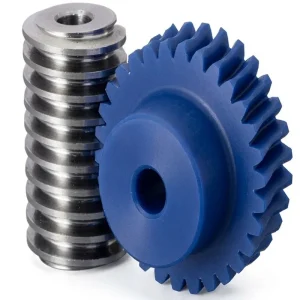
Material choice is arguably the single most critical engineering decision in a worm and worm wheel gear set. The worm shaft typically demands a harder material than the worm wheel to concentrate wear on the wheel tooth surface — the more easily replaced component. For automotive and general mechanical duty, alloy steel worms combined with brass worm wheel blanks represent the industry baseline, striking a balance between fatigue strength and surface compatibility. Where weight reduction is essential — such as in UAV actuators or portable medical tools — aluminum worms paired with nylon worm gear or plastic worm wheel designs deliver adequate performance without the mass penalty of ferrous components.
For corrosive environments, stainless steel worm gear sets are the preferred choice. Stainless worm gear options retain full dimensional integrity when exposed to cleaning agents, salt spray, or acidic industrial atmospheres. Titanium worm shafts are reserved for high-load, low-weight aerospace and military applications where neither cost nor exotic processing is a constraint. Copper and brass variants are valued in marine and food-processing sectors for their natural antimicrobial surface and soft-metal compatibility with steel worm threads. Regardless of the base metal selected, every worm and worm gear pair in this series undergoes dimensional inspection to verify tooth profile accuracy and centre-distance conformance before dispatch.
Application Scenarios
Automotive Steering Systems
The worm and worm wheel steering gear converts driver input from the steering column into controlled lateral movement at the road wheels. Alloy steel worm shafts engage bronze or brass worm wheel sectors to provide consistent mechanical advantage with minimal play, directly improving on-road safety and driver feedback in both passenger and commercial vehicles worldwide.
Industrial Conveyor Drives
In material handling and production-line conveyor systems, a worm and worm gear box delivers the high reduction and inherent self-locking that prevents loaded belts from rolling back during power interruptions. The compact footprint of the worm and worm wheel gearbox fits neatly beneath conveyors where space envelopes are tight, making this the preferred worm drive configuration across warehousing, food processing, and packaging facilities across Europe, the UK, and Australia.
Medical and Laboratory Equipment
Surgical tables, hospital beds, and analytical instruments rely on small, precise worm and worm wheel assemblies to produce reliable positioning under patient or sample loads. Stainless steel worm gear and plastic worm wheel combinations resist sterilising agents while providing the fine positional increments that clinical equipment demands. The uses of worm and worm wheel in medical settings continue to grow as device miniaturisation accelerates.
Robotics and Automation
Robotic joint actuators and collaborative arm designs make extensive use of the worm and worm gear system because the combination of high reduction ratio and self-locking enables stable static holding without continuous motor current. In applications requiring silent motion — laboratory automation or camera pan-tilt heads — the smooth meshing of alloy steel worm and worm gear profiles produces near-silent output that servo-centric solutions often cannot match.
Agricultural and Off-Road Machinery
Seed drill depth adjusters, baler tensioning arms, and irrigation valve actuators across farms in Canada, Brazil, the Netherlands, and South Korea integrate worm and worm wheel drives for their resistance to shock loads and intermittent duty cycles. A steel worm gear protected by powder coating or galvanising survives the dust, moisture, and chemical exposure inherent to field environments without requiring frequent maintenance stops.
About Us — 10+ Years of Mechanical Transmission Expertise
With more than a decade of accumulated production experience in mechanical power transmission, our manufacturing facility has developed engineering depth across a broad range of drive components. Our product portfolio covers agricultural gearboxes, worm gear reducers, planetary gear drives, power take-off shafts, hydraulic cylinders, gears, chains, and motors. The facility holds ISO 9001:2015 certification, underpinning a structured quality management system that governs raw material sourcing, in-process inspection, and final dimensional verification. We design and produce a comprehensive range of industrial and agricultural gearboxes and assemblies manufactured in materials including ductile iron, cast iron, cast steel, precision cast steel, and cast aluminium.
Related Products — One-Stop Gear Supply
To complement your worm and worm gear system, we manufacture a full range of precision gear products that integrate directly with worm wheel drive trains. Ordering mating components from the same facility ensures dimensional compatibility and simplifies supply chain management.
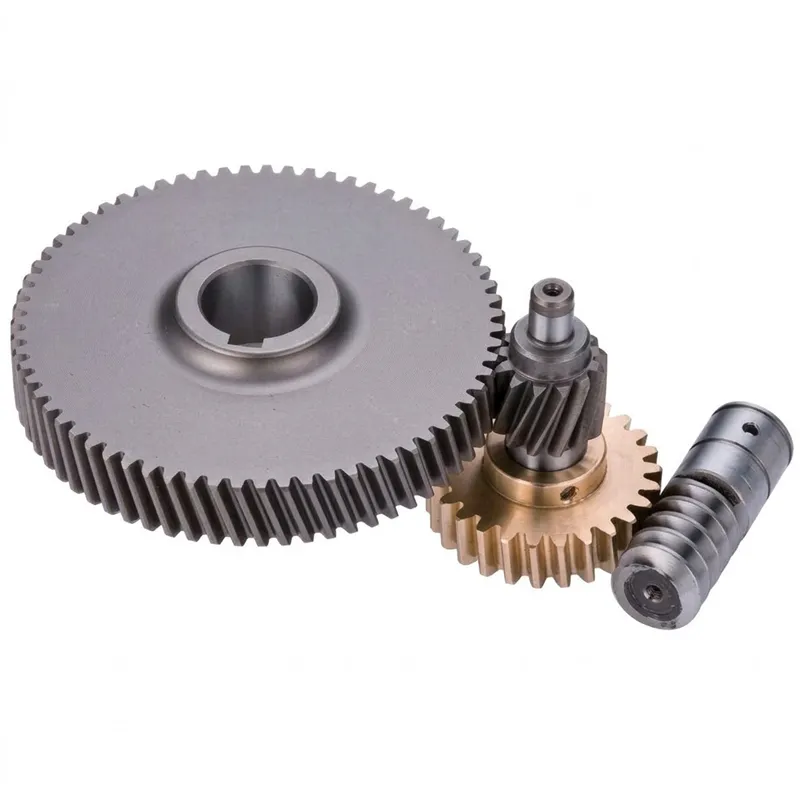
Double Helical Gear
For transmission systems where axial thrust must be cancelled and load capacity maximised, our double helical gears pair cleanly with output shafts driven by worm and worm wheel gearboxes. The opposing helix angles neutralise end-thrust forces — making these an ideal secondary reduction stage or parallel-shaft complement to a worm drive system. We supply full series across multiple modules and tooth counts to suit your worm and worm gear box integration requirements.
Gear Rack
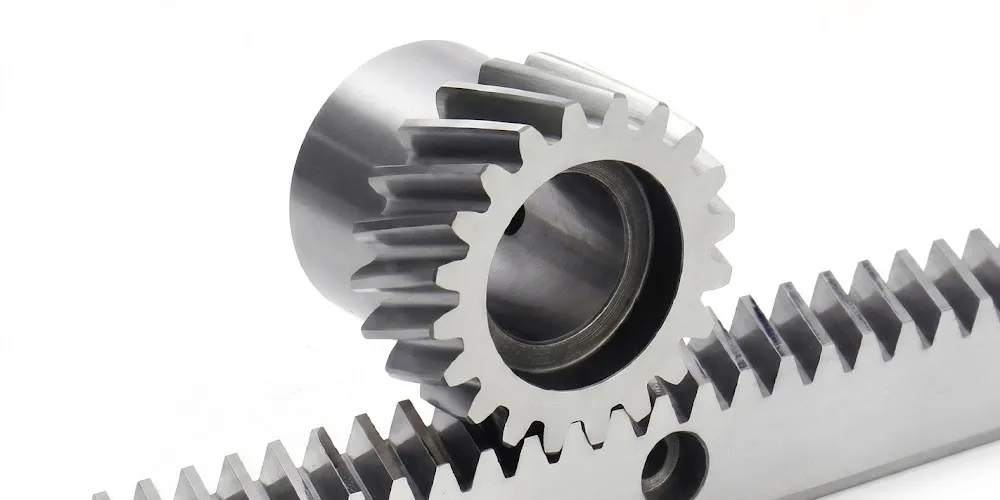
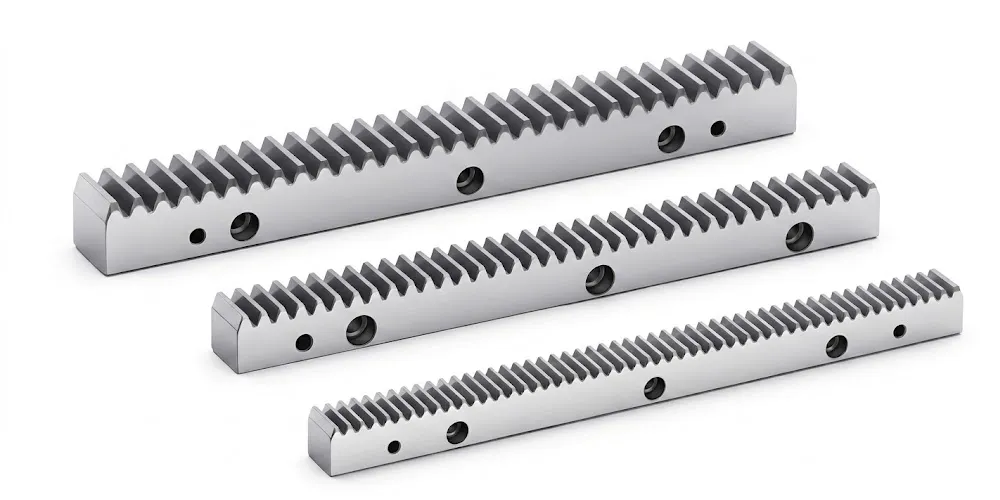
Our full-series gear racks convert rotational motion — including output from a worm and worm wheel drive — into precision linear travel. Suited to CNC machine tools, automation stages, and lifting columns, these racks are available in steel, stainless steel, and polymer versions with module pitches matched to standard spur gear pinions. Combine a worm and worm gear system for primary speed reduction with a rack-and-pinion final stage for a clean, integrated linear motion solution sourced entirely from one supplier.
Trade & Delivery Terms
| Item | Detail |
|---|---|
| MOQ | Standard parts have baseline MOQ requirements. Mixed models can be combined to reach around USD 1,500. 1–2 pcs orders can be evaluated but unit cost may be higher. |
| Sample Policy | 1–5 pcs samples available for new customers at sample price. Lead time: 7–25 working days (complex pieces evaluated per project). |
| Lead Time — Standard Parts | 10–25 working days |
| Lead Time — Custom / CNC Machined | 20–45 working days |
| Lead Time — High-Precision / Heat-Treated Gears | 30–60 working days (hobbed/ground worm and worm gear sets) |
| Trade Terms | EXW, FOB, CIF, DAP standard; FCA, CFR, CPT, CIP and DDP negotiable |
| Delivery Carriers | DHL, TNT, FedEx, UPS |
| Packing | PE bag inside, carton outside, or per customer requirement |
Frequently Asked Questions
What is the best alloy steel worm and worm gear for automotive power steering systems in heavy-duty trucks?
How do you calculate the gear ratio of a worm and worm wheel for an industrial conveyor drive in a food processing plant?
Where can I source custom worm and worm wheel assemblies with OEM support for agricultural machinery exported to Australia and Canada?
How should I maintain a worm and worm gear system in a robotics joint to extend service life in high-cycle automation environments?
When would you choose a plastic worm gear set over a metal worm and worm wheel in a light-duty medical device built for the European market?
Editor: PXY