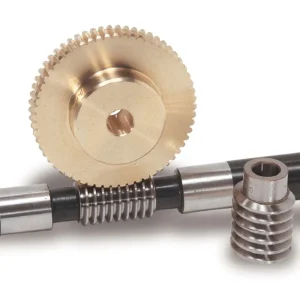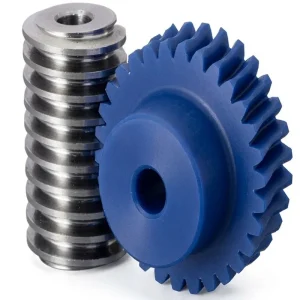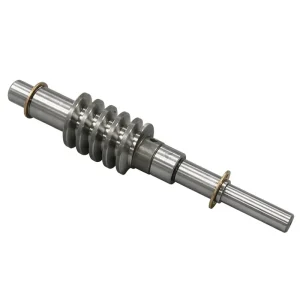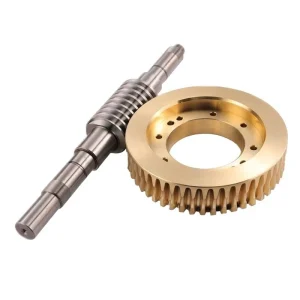
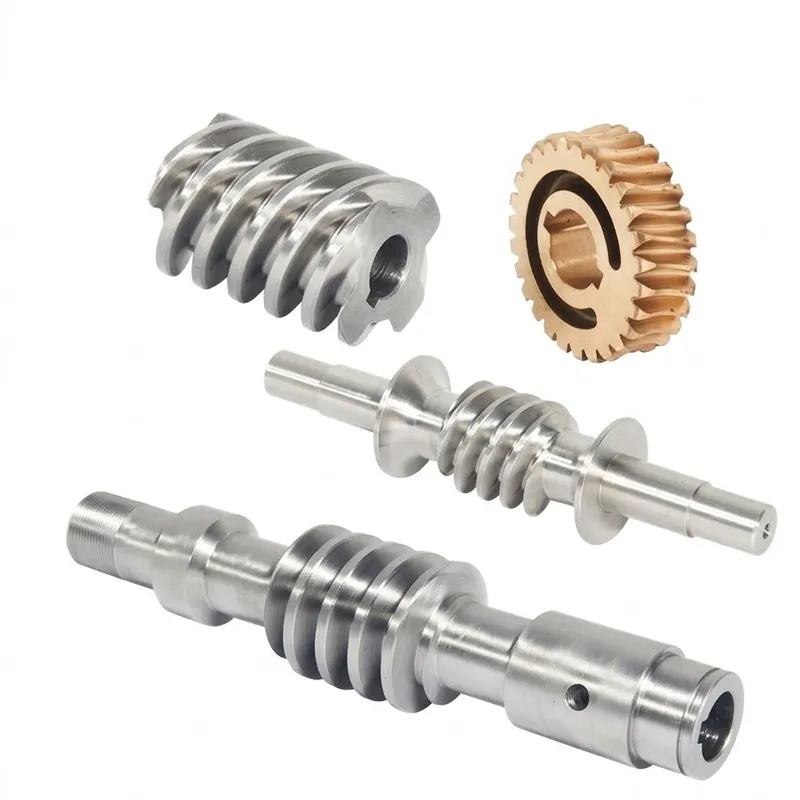
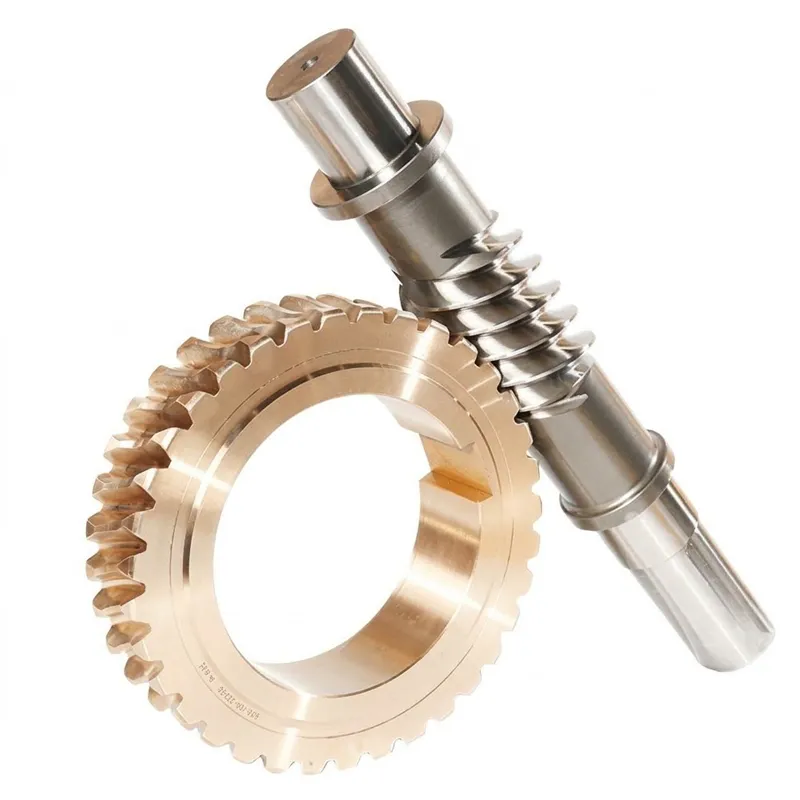
EP-Customized Worm Gear Set
Off-the-shelf worm drive gear sets can satisfy standard speed reduction requirements, but the moment an engineer faces a non-standard centre distance, an unusual input shaft orientation, a demanding duty cycle, or a material constraint driven by corrosion or weight targets, catalogue parts fall short. This custom worm gear set offering removes that barrier entirely. Starting from a customer drawing, a reverse-engineered sample, or even a brief describing load and speed requirements, the engineering team evaluates geometry, selects the optimal material grade, and plans a manufacturing sequence using gear blank turning, gear hobbing, gear shaping, tooth grinding, and heat treatment as required.
The product range covers every major worm gear pair configuration: cylindrical worm and worm wheel sets in single-start through quad-start thread counts, hourglass worm and wheel assemblies for maximum contact area and load distribution, micro worm gear set designs for miniature instruments and robotics, and large worm gear set builds for heavy industrial drives. Whether the enquiry is for a small worm gear set destined for a surgical positioning system in the Netherlands or a large steel worm gear set for an Australian mining conveyor, the production process is the same — engineered to tolerance, verified by inspection, and shipped on a schedule matched to project timelines. This worm gear set programme serves automotive, agricultural, electronic, industrial, medical, defense, and off-highway sectors across the UK, Canada, Brazil, South Korea, and beyond.
EP-Customized Worm Gear Set
Precision-engineered custom worm gear set solutions spanning spur, helical, bevel, hypoid and worm gear types — manufactured from alloy steel, stainless steel, brass, bronze and engineering polymers. Full ODM/OEM capability backed by ISO 9001:2015 quality control.
Technical Specifications
The table below summarises the standard capability envelope for the EP-Customized Worm Gear Set programme. Parameters outside these ranges are evaluated on a project basis — contact the engineering team with your drawing or specification for feasibility confirmation.
| Parameter | Specification / Range |
|---|---|
| Gear Types | Spur gear, helical gear, internal spur gear, ring gear, straight/spiral bevel gear, hypoid gear, crown wheel & pinion, gear shaft, worm gear & worm shaft, spline shaft & bushing, etc. |
| Gear Material | Carbon steel, alloy steel, stainless steel, brass, bronze, cast iron, nylon, etc. GB Steel grades: C45, 40Cr, 20CrMo, 20CrMoTi, 17CrNiMo6, 20CrMnTi, 42CrMo, etc. |
| Processing Methods | Gear blank turning, gear hobbing, gear milling, gear shaping, gear shaving, tooth grinding, broaching, etc. |
| Heat Treatment | Quenching, carburizing, nitriding, carbon-nitriding, salt bath quenching, etc. |
| Application Sectors | Automotive, Agricultural, Electronic, Industrial, Medical, Defense, Off-highway, etc. |
| Customisation | ODM / OEM — submit drawing, sample, or application brief |
| Sample Availability | 1–5 pcs samples available for new customers |
| Certification | ISO 9001:2015 |
| Packing | PE bag inside, carton outside, or per customer requirements |
| Delivery Carriers | DHL, TNT, FedEx, UPS |
How a Worm Gear Set Works
At the core of every worm gear set is the meshing interaction between a helically-threaded worm shaft and the enveloping teeth of a worm wheel. The worm — rotating about its own axis — drives the wheel through a sliding and rolling contact distributed across multiple tooth flanks simultaneously. Because the worm thread advances the wheel by exactly one tooth pitch per revolution of the worm, the fundamental gear ratio is simply the number of wheel teeth divided by the number of worm thread starts. A single-start worm paired with a 40-tooth wheel delivers a 40:1 reduction in a single, compact mesh — what the worm and worm gear system achieves in one stage would require two or three stages in a spur or helical gear train.
The geometry of the worm and worm wheel contact determines nearly every performance characteristic. Lead angle controls efficiency and self-locking behaviour: shallow lead angles below roughly 6° produce irreversible drives that resist back-driving without additional brakes, while steeper angles above 15° increase mesh efficiency toward 90% and permit reverse rotation when load is applied at the output. Tooth form — whether a ZA (Archimedean), ZN (normal convolute), ZI (involute), or ZK (milled) profile — affects load distribution, backlash, and the precision achievable during tooth grinding. Custom worm gear sets can be specified with any of these profiles, with the lead angle, number of starts, pressure angle, and tooth thickness all defined to match the target application rather than a catalogue standard. This engineering flexibility is what separates a purpose-built worm gear set from a stock worm drive gear set selected by approximation.
Five Key Advantages of the EP-Customized Worm Gear Set
Engineered-to-Order Geometry
Every worm gear set in this programme starts from the customer's actual load, speed, and space requirements. Module, lead angle, tooth form, centre distance, and bearing arrangement are all specified to fit the application rather than forcing the application to accommodate a catalogue part. This eliminates the dimensional compromises that inevitably arise when a stock worm drive set is used in a purpose-built machine.
Broad Material Portfolio from Steel to Polymer
The programme spans alloy steel worm gear sets with case-hardened and ground tooth flanks through to metal worm gear set options in stainless steel for corrosive environments, brass worm wheel builds for low-noise drives, and nylon worm gear or plastic worm gear set configurations for instrument and robotics applications where mass and acoustic signature matter more than peak load capacity. No single material fits all duties — the right choice is made per project.
Verified Heat Treatment and Hardness Control
Worm gear tooth fatigue and pitting resistance depend directly on surface hardness and core toughness. Every steel worm gear set in this series undergoes heat treatment — carburizing, nitriding, quenching, or salt bath quenching — selected to match the alloy grade and the intended contact stress. Hardness is confirmed by hardness test sampling before dispatch, and carburized worm shafts typically reach HRC 58–62 on tooth flanks with a tough un-hardened core that resists bending overloads.
Miniature to Large-Scale Range
A micro worm gear set for a precision optical instrument and a large worm gear set for a quarry hoist occupy completely different ends of the manufacturing envelope, yet both are handled within the same quality management framework. This range spans from miniature worm gear sets at sub-5mm shaft diameters through to large-bore worm wheel builds requiring heavy turning and gear hobbing on vertical lathes — a breadth that most gear suppliers cannot offer under one roof.
ISO 9001:2015 Process Discipline Throughout
Dimensional inspection at each stage — incoming raw material, post-hobbing tooth profile check, post-heat treatment hardness verification, and final assembly runout measurement — is built into the production routing rather than treated as an end-of-line check. This structured quality approach, certified under ISO 9001:2015, reduces the risk of dimensional surprises on arrival and supports customers in regulated sectors such as medical equipment manufacturing and defense supply chains across Europe and North America.
Materials Behind a Reliable Worm Gear Set
Choosing the right material pairing for a worm gear set is an engineering decision that shapes every downstream performance characteristic: load capacity, service life, noise level, and maintenance interval. The conventional baseline for industrial metal worm gear sets is an alloy steel worm — grades such as 20CrMo, 20CrMoTi, or 42CrMo are typical choices — matched with a phosphor-bronze or brass worm wheel. The steel worm is case-hardened and ground to a fine surface finish; the softer bronze or brass worm wheel sacrifices itself slowly and predictably, concentrating wear on the component that is more easily replaced. This asymmetric hardness strategy is well-established in both a 40:1 worm gear set for a bulk conveyor drive and a small worm gear set for an instrument feed mechanism.
Where the environment introduces corrosion risk — food production facilities in the Netherlands, marine deck equipment in coastal Australia, or pharmaceutical processing plants in Canada — stainless steel worm gear set builds using 304 or 316 grade stainless worm shafts paired with bronze wheels are specified. For applications where lubrication-free operation is required, or where weight reduction takes priority over peak torque, a plastic worm gear set using POM (acetal) or PEEK for the wheel running against a hardened steel worm becomes the logical choice. Nylon worm gear wheels specifically offer good fatigue resistance at moderate loads and absorb vibration naturally. The EP-Customized Worm Gear Set programme holds inventory of all major alloy families and can provide material test certificates on request for regulated-sector customers.
Application Scenarios
Automotive Seat and Window Actuators
Small worm gear sets and miniature worm gear sets are embedded throughout modern passenger vehicles — electric seat position motors, power window regulators, sunroof drive units, and mirror adjustment systems all rely on a compact worm gear pair to convert motor rotation into controlled linear or angular movement. The self-locking characteristic of the worm and worm wheel keeps each position held without continuous motor current. Our automotive-grade sets are produced in alloy steel and plastic worm drive variants to suit the torque and noise requirements of each specific actuator design.
Agricultural Machinery and Implements
Irrigation valve actuators, seed metering drives, baler tensioning arms, and sprayer pump drives across farms in Brazil, Australia, Canada, and South Korea all integrate worm drive gear sets chosen for their intermittent duty tolerance and shock resistance. Field machinery is routinely exposed to dust, fertiliser residue, and extreme temperature variation — making a robust metal worm gear set with powder-coated or galvanised housing the standard specification. Custom modules and output shaft arrangements are available to match the implement frame geometry directly.
Medical and Laboratory Positioning
Hospital bed elevators, surgical table tilt drives, and analytical instrument sample stages demand quiet, precise, and repeatable motion with no risk of inadvertent back-driving under patient or sample weight. A micro worm gear set or miniature worm gear set produced from stainless steel or engineering polymers satisfies these combined requirements: silent operation, self-locking position hold, and a material surface that can withstand chemical disinfection routines common in clinical environments across the UK and European healthcare markets.
Defense and Off-Highway Equipment
Turret traverse mechanisms, antenna positioning drives, and stabiliser systems in defense platforms require large worm gear set builds that combine very high reduction ratios with the ability to resist extreme shock and maintain position under vibration. Off-highway construction and mining equipment faces similar demands — a steel worm gear set driving a bucket wheel positioning stage, for example, must sustain continuous loads that would destroy a standard catalogue unit. Custom tooth geometry and carburized alloy steel grades 17CrNiMo6 or 20CrMnTi are matched to these duty cycles specifically.
Robotics and Factory Automation
Collaborative robot joints, pick-and-place arm wrists, and camera pan-tilt heads for machine vision all benefit from the high ratio compactness of a worm gear set. Where silent operation is essential — semiconductor wafer handling cells, optical bench positioners, or telescope worm gear set drives for astronomical tracking mounts — a brass worm wheel running against a ground alloy steel worm delivers the smooth, backlash-managed motion that servo-only systems struggle to match at comparable cost. Ratios from 20:1 to 100:1 are available in custom worm gear sets for these applications.
About Us — Over 10 Years in Mechanical Power Transmission
With a decade-plus of accumulated manufacturing experience behind every shipment, this production facility has built its reputation by solving the problems that catalogue gear suppliers cannot. The product scope covers agricultural gearboxes, worm gear reducers, planetary gear drives, power take-off shafts, hydraulic cylinders, gears, chains, and motors. ISO 9001:2015 certification governs the full production cycle — from incoming material verification to final dimensional sign-off before dispatch. Beyond standard ranges, the facility designs and produces a comprehensive selection of industrial and agricultural gearboxes and assemblies cast in ductile iron, cast iron, cast steel, precision cast steel, and cast aluminium. The component portfolio extends to gears, sprockets, worm gears, pulleys, worm shafts, and non-standard mechanical parts built to customer drawings. Whether the requirement is for a telescope worm gear set ordered by a research observatory in the Netherlands, a high-volume worm drive gear set for an assembly line in South Korea, or a one-off large worm gear set for a mining hoist in Western Australia, the same engineering rigour and production discipline applies from the first piece to the last.
Related Products — Complete Gear Supply from One Source
A worm gear set rarely operates in isolation. Output shafts connect to secondary gear stages, and input shafts couple to motors through flexible or rigid elements. Sourcing the complete drivetrain from a single manufacturer eliminates interface mismatches and simplifies procurement across your project.
Double Helical Gear
Used as a secondary reduction stage or a parallel-shaft transmission layer alongside a custom worm gear set, double helical gears cancel the axial thrust generated by single helical geometry. This makes them ideal for the output shaft of a worm and worm wheel gearbox where balanced loading is critical. The opposed helix angles distribute load symmetrically across both gear faces, supporting higher torque at a given module compared with single-helical equivalents. We produce full series in carbon steel, alloy steel, and stainless steel to integrate directly with your worm drive gear set assembly.
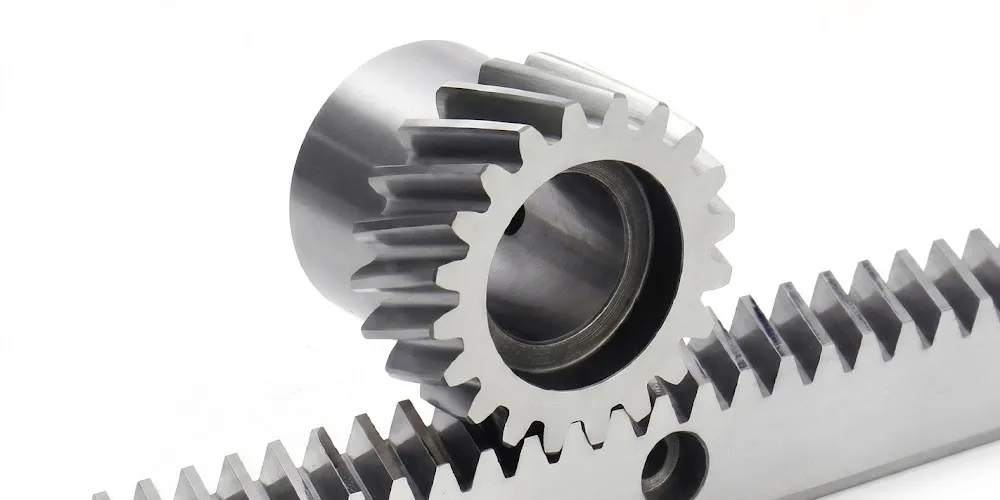
Gear Rack
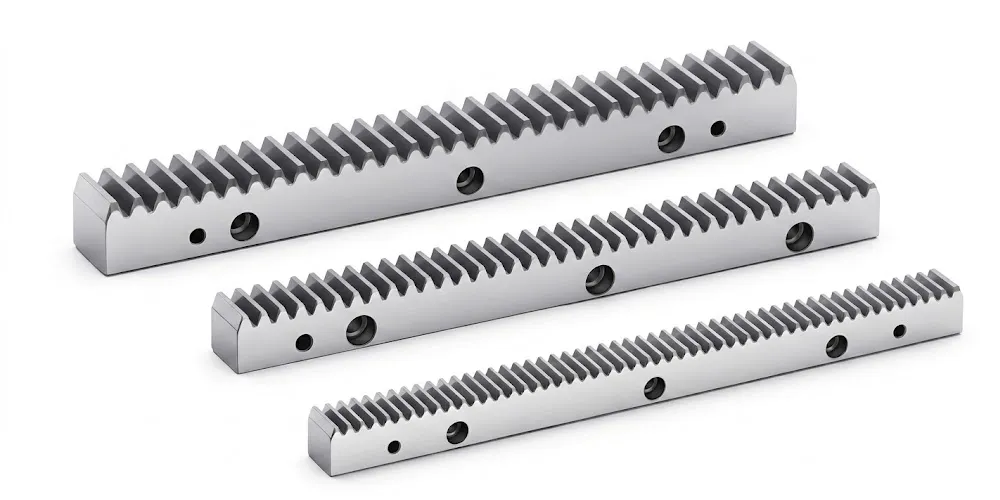
Pairing a gear rack with a pinion driven by the output of a custom worm gear set creates a clean, two-stage motion system: the worm gear set provides the speed reduction and self-locking, while the rack-and-pinion stage converts rotational output into controlled linear travel. This combination is widely used in CNC positioning tables, lifting columns, and automated gantries across manufacturing facilities in the UK, Canada, and Germany. Our full-series gear racks span steel, stainless steel, and engineering polymer variants with module pitches selectable to match the pinion on your worm gear pair output shaft.
Trade & Delivery Terms
| Item | Detail |
|---|---|
| MOQ | MOQ depends on drawing, material, tolerance, machining process and batch size. Mixed models can be combined to reach around USD 1,500. 1–2 pcs orders can be evaluated, but unit cost may be higher. |
| Sample Policy | 1–5 pcs samples available for new customers at sample price. Lead time: 7–25 working days (complex custom pieces evaluated per project). |
| Lead Time — Standard / Light Custom | 20–45 working days |
| Lead Time — High-Precision / Heat-Treated Worm Gear Set | 30–60 working days |
| Lead Time — Large / Heavy Custom Gear Set | 45–90 working days |
| Trade Terms | EXW, FOB, CIF, DAP standard; FCA, CFR, CPT, CIP, DDP negotiable |
| Recommended Terms for Custom Parts | EXW / FOB / CIF / DAP |
| Delivery Carriers | DHL, TNT, FedEx, UPS; sea freight for large worm gear set orders |
| Packing | PE bag inside, carton outside, or per customer specification |
Frequently Asked Questions
What is the best metal worm gear set material combination for a food processing conveyor in a European production facility?
How do I specify a custom worm gear set for a telescope worm gear set drive that requires minimal backlash for astronomical tracking in Australia?
Which plastic worm gear set material works best in a lightweight robotics joint actuator where lubrication-free operation is needed for a medical device manufacturer in Canada?
When should a 40:1 worm gear set be selected over a multi-stage helical gearbox for an industrial packaging line drive in the UK?
Where can manufacturers in South Korea source miniature worm gear sets for electronic consumer product actuators with fast lead times and OEM documentation?
Editor: PXY