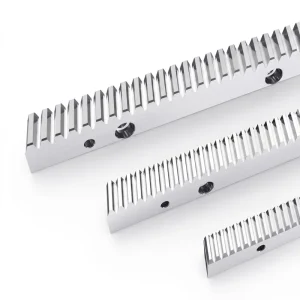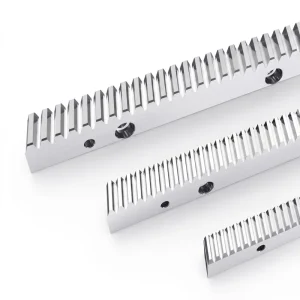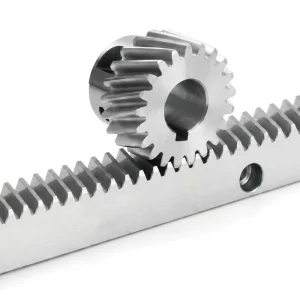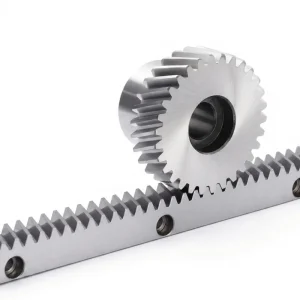
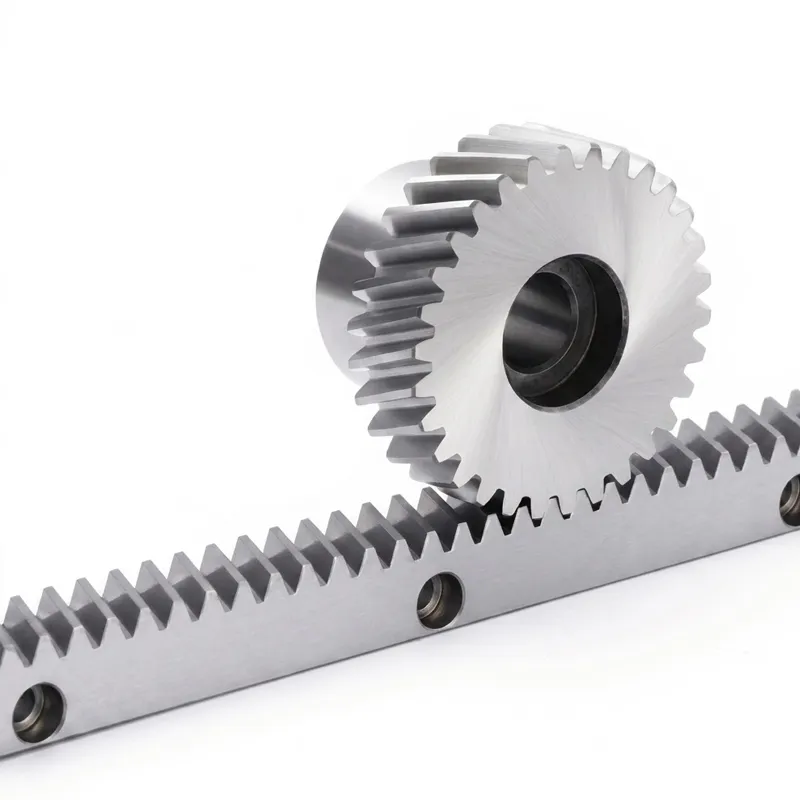
EP-S45C / 42CrMo Tooth-Surface Ground Helical Gear Rack
The AMX325 series helical gear rack represents a step up in tooth-surface quality within the EP gear rack family. Rated to DIN5 accuracy and produced through a two-stage finishing process — four-side flat grinding after hard tooth surface treatment, followed by dedicated tooth surface grinding — this rack delivers the tighter pitch error and smoother tooth-flank finish required by servo-driven CNC axes, precision gantry systems, and high-speed automated material-handling equipment deployed across Germany, Japan, Australia, South Korea, and North America.
Material options are S45C medium-carbon steel and 42CrMo chromium-molybdenum alloy steel. High-frequency quenching drives the tooth surface to HRC48–52° for S45C, while 42CrMo with carburizing quenching achieves HRC50–55°, providing a higher contact fatigue resistance for heavy-duty or longer-life applications. The right-hand helix angle of 19°31’42” is consistent across the EP rack and helical pinion gear family, enabling direct substitution between AMX325 racks and the matching EP helical pinion gears without re-calculating helix geometry. This inter-family compatibility is a practical advantage for design engineers building multi-axis CNC machines where the same helical rack and pinion geometry applies to every linear axis on the machine.
Standard segments cover 500 mm and 1 000 mm lengths across modules 1.5 through 8, providing a comprehensive selection for most machine design requirements. Racks without hole patterns are available — append suffix “N” to the model code (e.g. AMX325020100-N) for clean-mounting or adhesive-bonded installations. Custom cross-section geometries and non-standard lengths are accepted on engineering drawing submission, making this series a viable custom helical rack option for OEM equipment builders who need a ground rack matched precisely to their proprietary guide housing.
EP-S45C / 42CrMo Tooth-Surface Ground Helical Gear Rack — HRC48–52° / HRC50–55°
DIN5 Accuracy · S45C / 42CrMo Alloy Steel · Helical Teeth · Right Helix Angle 19°31'42" · Four-Side Grinding + Tooth Surface Grinding
Technical Specifications at a Glance of Helical Gear Rack
| Helical Gear Rack Parameter | تفصیلات |
|---|---|
| Accuracy Level | DIN5 |
| مواد | S45C / 42CrMo Alloy Steel |
| Tooth Profile | Helical teeth |
| Right Helix Angle | 19°31'42" |
| Hardness Treatment | High-frequency quenching HRC48–52° / Carburizing quenching HRC50–55° |
| Production Process | Four-side grinding (post hard tooth surface treatment) + Tooth surface grinding |
| Standard Lengths | 500 mm / 1 000 mm (custom available) |
| Module Range | 1.5 – 8 |
| Hole-free Option | Available — suffix "N" in model code (e.g. AMX325020100-N) |
Dimensional Parameters — AMX325 Series (Unit: mm)
End face pitch Pe = Module × π / COS(19°31'42") | Fp = Total pitch deviation | All dimensions in millimetres.
| Code | ماڈیول | Pt | L (mm) | L2 (mm) | Tooth No. | بی | A0 | A1 | D | میں | Hole No. | اے | C1 | C2 | ای | D1 | I1 | C3 | Fp |
|---|---|---|---|---|---|---|---|---|---|---|---|---|---|---|---|---|---|---|---|
| AMX325 015 050 | 1.5 | 4.9999 | 500.00 | 6.74 | 100 | 19 | 19 | 17.5 | 62.5 | 125 | 4 | 8 | 7 | 11 | 7 | 31.7 | 436.6 | 5.7 | 0.021 |
| AMX325 015 100 | 1.5 | 4.9999 | 1000.00 | 6.74 | 200 | 19 | 19 | 17.5 | 62.5 | 125 | 8 | 8 | 7 | 11 | 7 | 31.7 | 936.6 | 5.7 | 0.024 |
| AMX325 020 050 | 2 | 6.6666 | 500.00 | 8.5 | 75 | 24 | 24 | 22 | 62.5 | 125 | 4 | 8 | 7 | 11 | 7 | 31.7 | 436.6 | 5.7 | 0.021 |
| AMX325 020 100 | 2 | 6.6666 | 1000.00 | 8.5 | 150 | 24 | 24 | 22 | 62.5 | 125 | 8 | 8 | 7 | 11 | 7 | 31.7 | 936.6 | 5.7 | 0.024 |
| AMX325 030 050 | 3 | 9.9999 | 500.00 | 10.3 | 50 | 29 | 29 | 26 | 62.5 | 125 | 4 | 9 | 10 | 15 | 9 | 35.0 | 430.0 | 7.7 | 0.023 |
| AMX325 030 100 | 3 | 9.9999 | 1000.00 | 10.3 | 100 | 29 | 29 | 26 | 62.5 | 125 | 8 | 9 | 10 | 15 | 9 | 35.0 | 930.0 | 7.7 | 0.026 |
| AMX325 040 050 | 4 | 13.3333 | 506.67 | 13.8 | 38 | 39 | 39 | 35 | 62.5 | 125 | 4 | 12 | 10 | 15 | 9 | 33.3 | 433.0 | 7.7 | 0.025 |
| AMX325 040 100 | 4 | 13.3333 | 1000.00 | 13.8 | 75 | 39 | 39 | 35 | 62.5 | 125 | 8 | 12 | 10 | 15 | 9 | 33.3 | 933.4 | 7.7 | 0.028 |
| AMX325 050 050 | 5 | 16.6666 | 500.00 | 17.4 | 30 | 49 | 39 | 34 | 62.5 | 125 | 4 | 12 | 14 | 20 | 13 | 37.5 | 425.0 | 11.7 | 0.028 |
| AMX325 050 100 | 5 | 16.6666 | 1000.00 | 17.4 | 60 | 49 | 39 | 34 | 62.5 | 125 | 8 | 12 | 14 | 20 | 13 | 37.5 | 925.0 | 11.7 | 0.030 |
| AMX325 060 050 | 6 | 19.9999 | 500.00 | 20.9 | 25 | 59 | 49 | 43 | 62.5 | 125 | 4 | 16 | 18 | 26 | 17 | 37.5 | 425.0 | 15.7 | 0.028 |
| AMX325 060 100 | 6 | 19.9999 | 1000.00 | 20.9 | 50 | 59 | 49 | 43 | 62.5 | 125 | 8 | 16 | 18 | 26 | 17 | 37.5 | 925.0 | 15.7 | 0.035 |
| AMX325 080 050 | 8 | 26.6667 | 480.00 | 28.0 | 18 | 79 | 79 | 71 | 60.0 | 120 | 4 | 25 | 22 | 33 | 21 | 120 | 240.0 | 19.7 | 0.030 |
| AMX325 080 100 | 8 | 26.6667 | 960.00 | 28.0 | 36 | 79 | 79 | 71 | 60.0 | 120 | 8 | 25 | 22 | 33 | 21 | 120 | 720.0 | 19.7 | 0.038 |
Racks without holes available — suffix "N" to model code (e.g. AMX325020100-N). Custom dimensions and materials accepted on drawing basis. All specs subject to change; confirm before ordering.
How This Ground Helical Gear Rack Works
اے helical gear rack converts the rotational output of a driving helical gear pinion into precise linear displacement. When the pinion rotates against the rack's angled teeth, the interaction propels the rack — or the pinion carriage — along the rack's length at a speed determined by the pinion pitch-circle diameter and rotational velocity. The 19°31'42" right helix means each tooth enters contact at one end of the tooth face before the other, distributing instantaneous load across overlapping tooth pairs. This is the same progressive engagement principle that makes helical gear vs spur gear comparisons consistently favour the helical type on noise, contact ratio, and peak tooth stress — all factors that matter in servo-controlled linear drive systems where pitch deviation translates directly into positioning error.
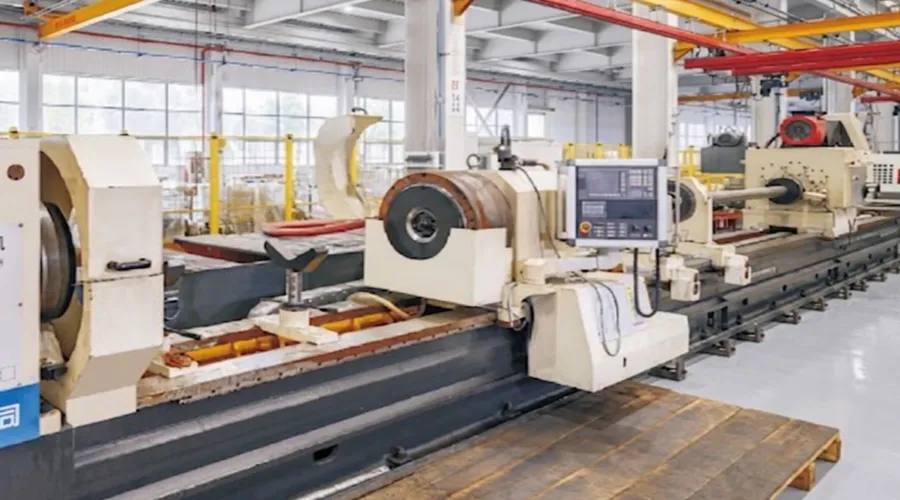
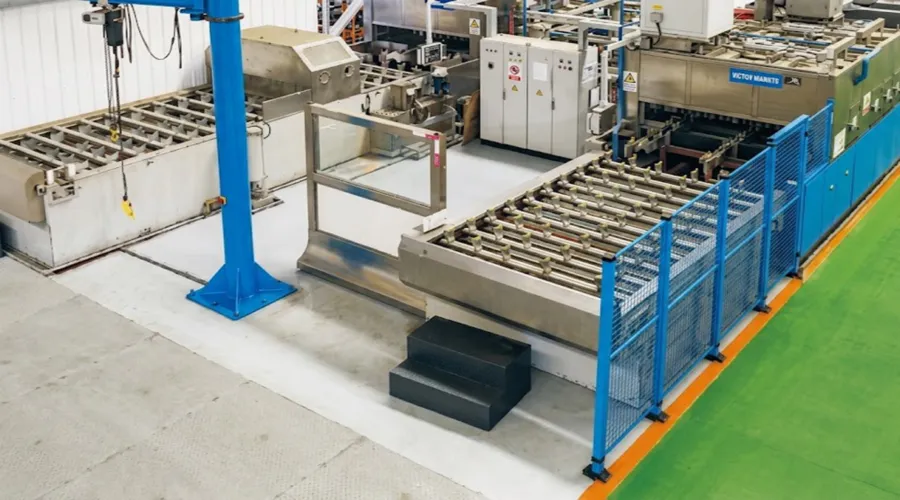
The two-stage finishing process distinguishes the AMX325 from standard hardened-and-ground racks. After heat treatment, the rack undergoes four-side flat grinding to establish accurate datum faces on the mounting and reference surfaces — the same step used in lower-accuracy series. The AMX325 then undergoes a separate tooth surface grinding pass on a precision rack-grinding machine. This stage targets the tooth flanks specifically, removing the residual form error left by the quenching cycle and achieving the tighter pitch and profile tolerance characteristic of DIN5 accuracy. In a helical rack and pinion drive system with servo feedback resolution under 1 µm, this final grinding step is the difference between the controller compensating for rack error on every move and the controller simply executing the programmed position reliably.
Five Key Performance Advantages of Helical Gear Rack
① DIN5 Tooth-Surface Ground Accuracy
The dedicated tooth surface grinding stage drives this helical gear rack to DIN5 accuracy — a classification tighter than most catalogue racks. Fp values for Module 1.5–3 segments stay below 0.026 mm, and Module 4–8 stay below 0.038 mm over the full rack length. In servo-driven CNC gantry axes used by German machine tool builders and Japanese precision equipment OEMs, this accuracy level reduces quadrant glitch compensation, lowers following-error magnitude, and improves the contour accuracy of machined parts directly attributable to the rack drive.
② Dual Material for Matched Application
S45C with HRC48–52° high-frequency quenching suits high-cycle indoor drives in controlled environments — CNC routers, dispensing gantries, laboratory automation — where tooth-surface contact fatigue rather than core fracture is the dominant failure mode. 42CrMo with carburizing quenching at HRC50–55° provides higher core tensile strength and greater case depth, suited to heavier portal crane traverses and industrial press drives in Australian and Canadian facilities where per-tooth load levels are substantially higher and rack replacement requires significant downtime.
③ Helical Tooth Smooth Drive
The 19°31'42" helical teeth engage progressively rather than all at once, keeping the contact ratio above 1.5 at all times and substantially suppressing the gear-mesh frequency vibration that spur-tooth racks generate. In South Korean semiconductor inspection gantries and Dutch precision dispensing systems, this characteristic keeps the driven stage acoustically quiet and mechanically stable throughout a move — a requirement that straight-tooth racks cannot reliably meet at the traverse speeds modern servo systems demand.
④ Family Compatibility with EP Helical Gears
The 19°31'42" right-hand helix and the same module standard used across the EP rack family means this AMX325 series mates directly with the EP helical pinion gear catalogue — same helix angle, same module, verified compatible tooth geometry. Engineers assembling a helical rack and pinion drive from both series can specify the rack and the helical gear pinion from a single source, eliminating the tooth-geometry mismatch risk and simplifying quality documentation for machine CE marking or FDA equipment validation.
⑤ Broad Module Selection & Hole-Free Option
Modules 1.5 through 8 address the full span from fine-pitch small rack and pinion instruments to heavy-duty large-traverse gantry systems, with Fp tolerances verified at every module. The hole-free suffix "N" option suits installations where the rack is adhesive-bonded to an aluminium extrusion or located in a T-slot track — a configuration common in North American and UK machine-build integrators who design lightweight, tool-free rack-and-rail assemblies for quick customer installation. Custom non-standard cross-sections and lengths are available on drawing, covering OEM needs that the standard catalogue cannot address.
Material & Surface Treatment of Helical Gear Rack
S45C is a medium-carbon steel with approximately 0.45% carbon that machines predictably, responds uniformly to induction hardening, and achieves HRC48–52° tooth surface hardness through high-frequency quenching at a material cost accessible for standard catalogue production volumes. Its combination of adequate hardenability and good machinability makes it the baseline material for the majority of AMX325 orders — covering precision CNC routing axes, print-machine traverse drives, and laboratory gantry systems where the tooth surface hardness is the primary wear-resistance requirement and the bar cross-section remains in elastic stress well below S45C's tensile limit throughout service.
42CrMo is selected when the application pushes beyond S45C's capability envelope — typically where axial force per unit rack length, shock loading from rapid direction reversals, or elevated ambient temperature would cause S45C to plastically deform at the tooth root under sustained peak loading. The chromium and molybdenum additions raise the steel's hardenability to allow a deeper, more uniform case to form during carburizing quenching, achieving HRC50–55° with a case depth that supports Hertzian contact stress levels substantially above what high-frequency-quenched S45C provides. For heavy-duty conveyor rack drives in Brazilian processing plants and industrial press feed racks in South Korean heavy manufacturing, 42CrMo combined with tooth surface grinding to DIN5 is the combination that defines the service life of the machine rather than the rack.
درخواست کے منظرنامے۔
High-Speed CNC Router Axes
Wood, composite, and foam CNC routers with traverse widths of 1 500–4 000 mm rely on a ground helical gear rack for the primary Y-axis traverse. DIN5 accuracy keeps positional error low enough for furniture-grade surface finish at 60 m/min traverse speed, while the helical tooth profile prevents the vibration that causes tool chatter at transition points. German and Italian router builders specify tooth-surface-ground racks for this reason on every machine above mid-range.
Precision Pick-and-Place Gantries
Electronic component pick-and-place machines and adhesive dispensing gantries use Module 1.5–2 AMX325 racks on fast-moving X/Y axes that execute hundreds of point-to-point moves per minute. The DIN5 Fp tolerance of 0.021–0.024 mm per 500 mm segment ensures that repeat-position error is dominated by the servo control system rather than by rack pitch variation — keeping placement accuracy within ±0.05 mm over a full production shift in South Korean and Japanese SMT assembly lines.
Laser & Plasma Cutting Machines
High-power laser and plasma cutting gantries in Australian steel fabrication shops and Dutch shipbuilding facilities push helical rack and pinion drives to their combined speed, accuracy, and load limits simultaneously. The 42CrMo option at HRC50–55° handles the intermittent heavy braking loads from programme path reversals, while the tooth-surface-ground finish minimises position overshoot at path corners — directly reducing heat-affected zone width on the cut edge.
Automated Storage & Retrieval
Stacker crane X-axis drives in AS/RS installations traverse racks up to 100 metres long, stitched from multiple 1 000 mm segments. The AMX325 ground Fp tolerance keeps cumulative pitch error across joints predictable, allowing the stacker-crane position controller to correct for segment-to-segment deviation with a simple taught offset — a critical simplification in Canadian and UK cold-store AS/RS facilities where the rack operates at sub-zero ambient temperatures affecting both material properties and controller tuning.
Stone & Granite Processing Tables
Bridge-saw and waterjet tables cutting natural stone operate with high static loads (bridge weight often exceeds 800 kg) and slow traverse speeds, placing emphasis on rack rigidity and surface hardness over speed. Module 5–8 AMX325 in 42CrMo handles per-tooth loads in the range that exceeds the safe operating zone for standard hardened racks, while the ground tooth surface ensures consistent mesh stiffness at the slow feed rates that stone-cutting quality demands in Brazilian and Italian granite-processing facilities.
Optical & Metrology Equipment
Large-aperture optical mirror grinding machines and bridge-type coordinate measuring machines built in Taiwan and Germany specify tooth-surface-ground helical gear racks for drive axes where the rack pitch error budget is a direct sub-allocation of the machine's volumetric accuracy specification. At Module 1.5 with Fp under 0.024 mm per metre, the AMX325 contributes less positioning uncertainty per 500 mm of travel than most linear encoder systems' interpolation error — a result that simplifies the machine accuracy budget considerably.
About Our Factory
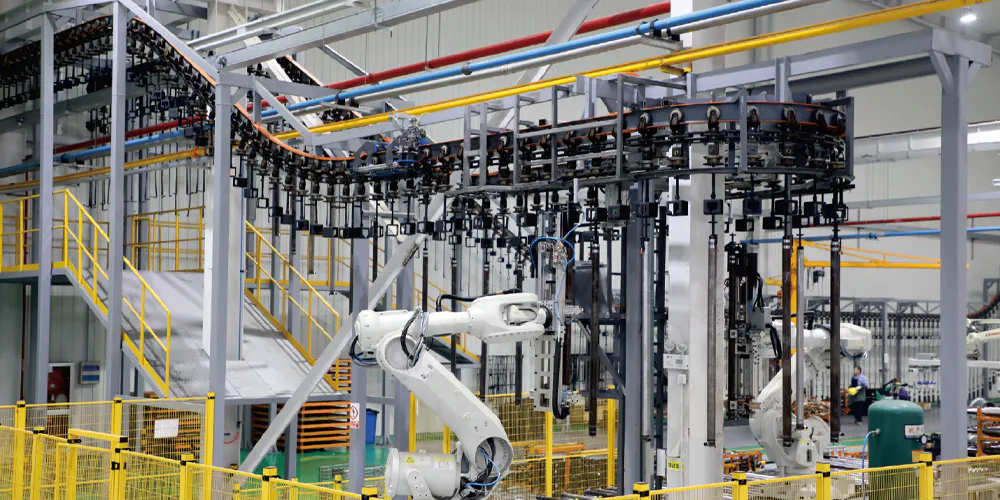
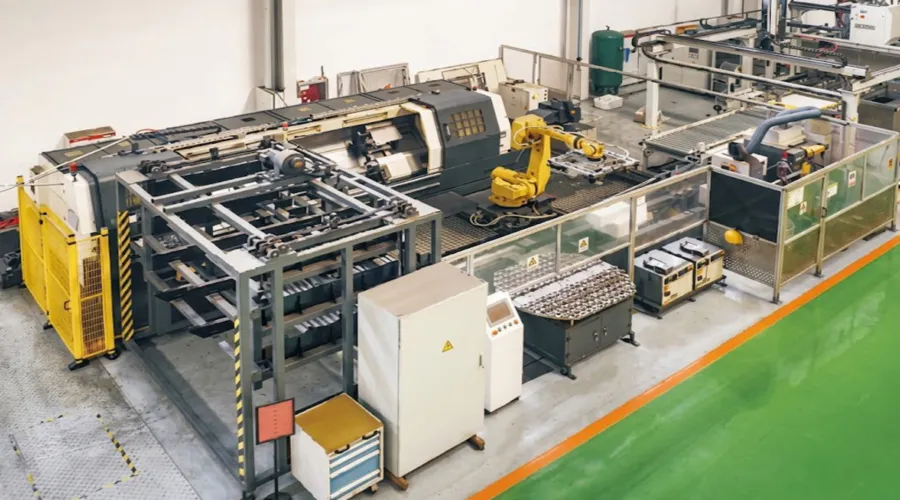
Our production facility has more than a decade of dedicated experience in mechanical power transmission manufacturing, with rack grinding and gear accuracy verification among our deepest technical capabilities. We hold ISO 9001:2015 certification and operate traceable gear-measurement instrumentation calibrated to national standards, covering tooth pitch, profile, and helix measurement for every precision rack and helical gear batch we produce.
Our product range spans agricultural gearboxes, worm gear reducers, planetary gear drives, PTO shafts, hydraulic cylinders, roller chains, and electric motors. Gearbox housings and assemblies are produced in ductile iron, cast iron, cast steel, precision investment-cast steel, and die-cast aluminium; standard components — gears, sprockets, worm wheels, pulleys, shafts — are stocked for fast dispatch, while OEM non-standard parts are manufactured to engineering drawings with agreed lead times. Whether you need a catalogue helical gear rack segment today or a custom ground rack profile for next quarter's machine build, our production scheduling team will confirm the right supply arrangement for your project.
ورکشاپ
متعلقہ مصنوعات
Helical Gear (Pinion)
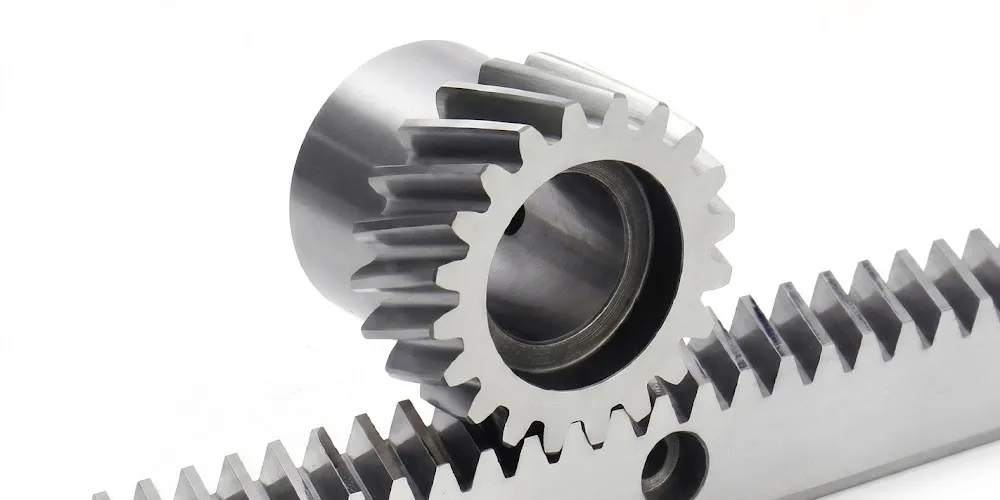
The matching helical gear pinion series shares the same 19°31'42" right-hand helix and Module standards as the AMX325 rack, providing a geometrically pre-verified helical rack and pinion pair from a single manufacturing source. Specifying both components together eliminates tooth-geometry mismatch as a design variable and gives procurement a single quality-document set for machine validation — a practical advantage for OEMs building CE-marked equipment for European markets. Our helical gear suppliers team can match pinion tooth count to your target gear ratio on request.
Gear Rack Range
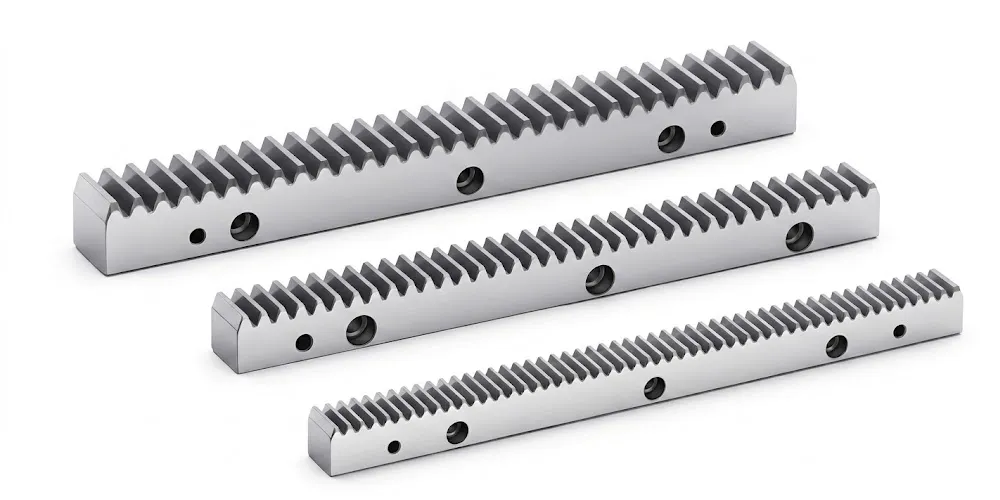
For applications where DIN5 tooth-surface grinding is more than the accuracy budget requires, our broader gear rack series covers DIN6 and DIN8 accuracy classes in the same helical tooth profile and module range. This allows designers to specify the correct accuracy grade for each machine axis independently — for instance, a ground AMX325 on the primary traverse axis and a DIN6 rack on a secondary positioning axis — sourcing all racks from a single compatible product family with consistent helix geometry and mounting cross-sections throughout.
اکثر پوچھے گئے سوالات
ایڈیٹر: PXY