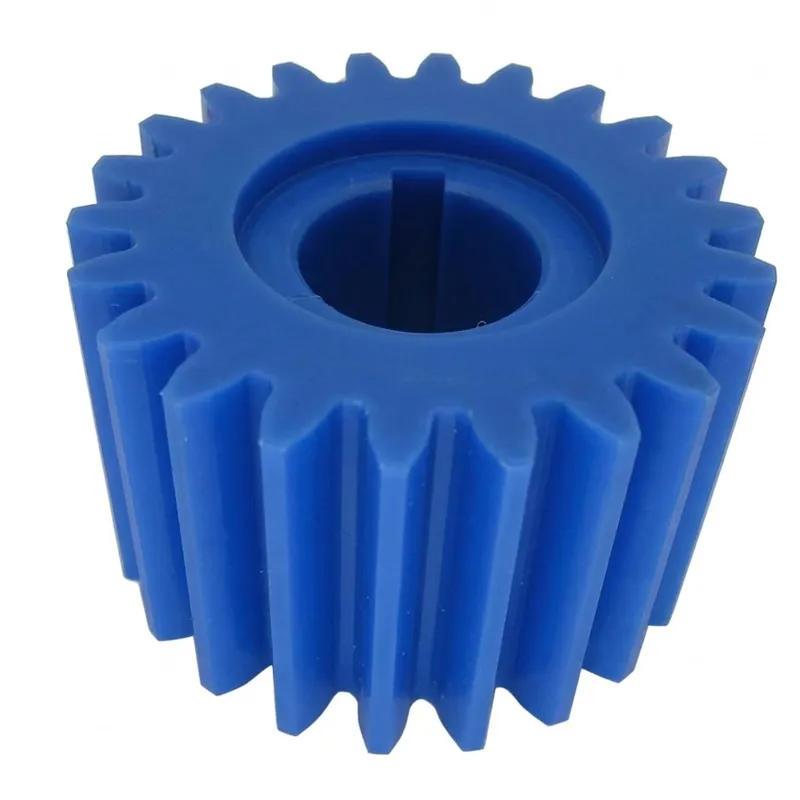
EP-Nylon Spur Gears
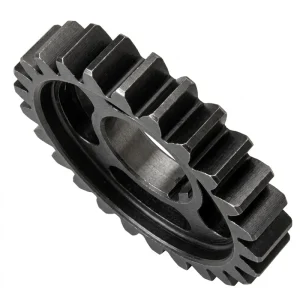
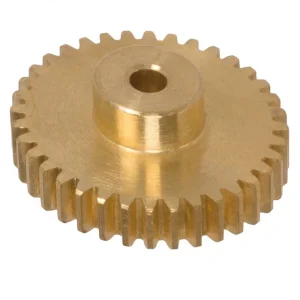
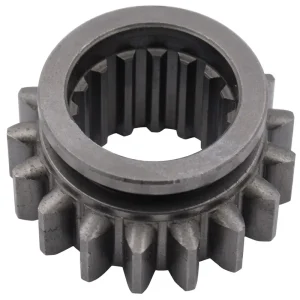
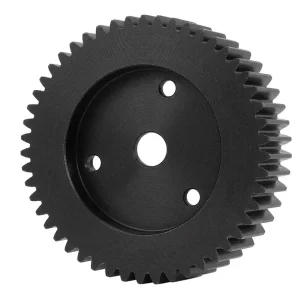
The EP-Nylon Spur Gears series provides lightweight, cost-effective transmission solutions designed for parallel shaft applications. Manufactured from high-performance Nylon (PA) and other engineering plastics like POM, UHMWPE, ABS, PTFE, PPS, and Peek, these gears offer quiet operation and excellent wear resistance. Available in modules ranging from M1 to M12, they adhere to international standards including ISO, DIN, ANSI, JIS, and BS, with precision grades from DIN6 to DIN9. Tolerances are tightly controlled between 0.001mm and 0.1mm. Teeth can be hardened, milled, or ground for enhanced durability. Surface finishes include polishing, anodizing, or zinc plating. Ideal for conveyor belts, electric motors, and light machinery, these gears ensure reliable performance with minimal noise. Packaging options include plastic bags with cartons or wooden cases, supporting flexible payment terms (T/T, L/C).
ENGINEERING POLYMER DRIVE COMPONENTS — SPUR GEAR SERIES
EP-Nylon Spur Gears
ایک اعلیٰ کارکردگی nylon spur gear series — PA-based engineering polymer, modules M1 through M12, precision grades DIN6 to DIN9, certified to ISO, DIN, ANSI, JIS, and BS standards — engineered for conveyor belts, electric motor drives, agricultural automation, and light industrial applications worldwide.
Technical Specifications — EP-Nylon Spur Gear Series
Full parameter reference. Custom module, tooth count, bore, and material grade available through our OEM/ODM programme.
| پیرامیٹر | EP Series Value | نوٹس |
|---|---|---|
| Product Type | Nylon Spur Gear (Straight Involute) | PA-based; other polymers available |
| Module Numbers | M1, M1.5, M2, M2.5, M3, M4, M5, M8, M12 and more | Metric involute system |
| مواد | PA, POM, UHMWPE, ABS, PTFE, PPS, PEEK | As customer specified |
| معیاری | ISO, DIN, ANSI, JIS, BS, Non-standard | Multi-standard certified |
| Precision Grade | DIN6, DIN7, DIN8, DIN9 | DIN 3962 accuracy classification |
| Teeth Treatment | Hardened, Milled, or Ground | Per application requirement |
| Tolerance Range | 0.001 mm – 0.01 mm – 0.1 mm | Three tolerance tiers |
| Surface Finish | Shot/sandblast, heat treatment, annealing, tempering, polishing, anodising, zinc-plated | As specified |
| Gear Tooth Profile | Involute, 20° pressure angle | Standard full depth |
| Packing | Plastic bag + Cartons or Wooden packing | Export-standard |
| Payment Terms | T/T, L/C | Standard international terms |
| حسب ضرورت | OEM / ODM | Drawing or sample accepted |
| کوالٹی سرٹیفیکیشن | ISO 9001:2015 | Factory-wide QMS |
Nylon Spur Gear vs Nylon Bevel Gear — Choosing the Right Format
One of the first selection decisions when designing spur gears for a new application is whether to use a parallel-shaft spur gear configuration or an angled-shaft bevel gear arrangement. The table below summarises the key differences between a nylon spur gear and a nylon bevel gear based on the product specifications from our engineering data:
| Feature | Nylon Spur Gear | Nylon Bevel Gear |
|---|---|---|
| Teeth Orientation | Parallel to the shaft | Angled to the shaft |
| Typical Applications | Conveyor belts, electric motors | Power transmission between non-aligned shafts |
| Relative Cost | Inexpensive | More expensive |
| Weight | Lightweight | Heavier |
| Noise Level | Quiet | Noisier |
| Load Capacity | Moderate (low-to-mid range) | Higher |
| Torque Capacity | Moderate (low-to-mid range) | Higher |
The selection between a nylon spur gear and a nylon bevel gear should always be driven first by shaft arrangement: if the input and output shafts are parallel, the spur gear is the correct and more economical choice. Only when shaft axes must be changed through 90° or another angle does the spur gear and bevel gear combination become the appropriate solution. For the vast majority of conveyor, motor output, and actuator applications where a lightweight, quiet, corrosion-free gear stage is the primary requirement, the nylon spur gear is the technically and economically optimal selection.
What Is a Nylon Spur Gear?
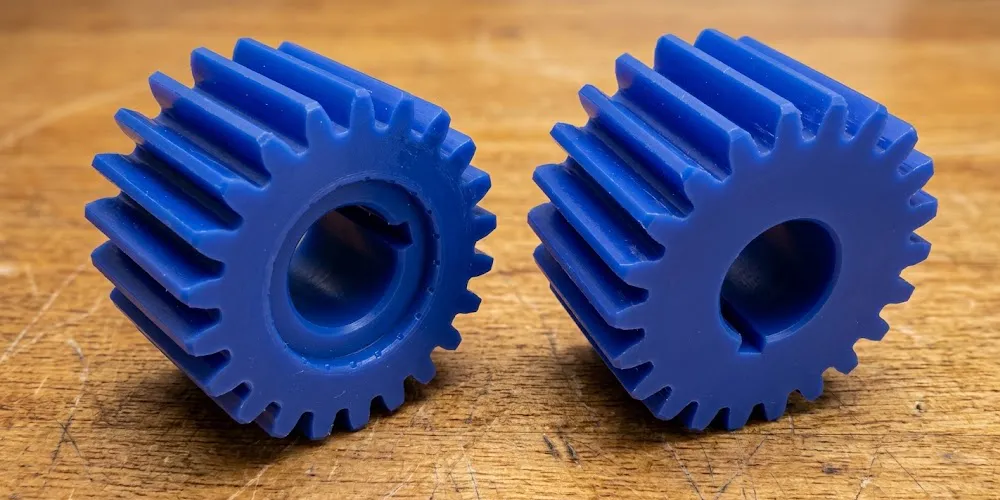
اے nylon spur gear is a straight-tooth cylindrical gear manufactured from polyamide (PA) engineering resin — commonly referred to as nylon — rather than conventional metals. The teeth run parallel to the rotational axis, giving the gear its defining characteristic: simple, direct torque transfer between parallel shafts with no axial thrust forces. This geometry makes the nylon spur gear one of the most straightforward mechanical drive components to design with, align, and replace in the field. Coupled with the inherent properties of polyamide — self-lubrication, impact resilience, chemical resistance, and low density — the nylon spur gear delivers a combination of performance attributes that metal gears cannot match at equivalent cost and weight in moderate-load applications.
Our EP-Nylon Spur Gear series is manufactured in PA alongside five additional engineering polymers — POM, UHMWPE, ABS, PTFE, PPS, and PEEK — with module numbers spanning M1 through M12. Precision grades cover DIN6 through DIN9 under the DIN 3962 accuracy classification, and the series is certified to ISO, DIN, ANSI, JIS, and BS standards, making it directly specifiable into OEM programmes for Europe, North America, Japan, Australia, and the UK without requiring market-specific re-qualification. Tooth treatment options include hardened, milled, and ground finishes, with tolerance capability down to 0.001 mm for the most demanding applications.
For procurement teams sourcing nylon spur gears suppliers for ongoing industrial programmes, the EP series offers the multi-standard, multi-material flexibility needed to consolidate what might otherwise be several separate supplier relationships into a single, ISO 9001:2015 certified source. Whether the application calls for a small nylon spur gear in a miniature actuator or a large module M8 gear in a conveyor drive, the EP series covers the specification without tooling changes or material re-qualification.
Five Reasons to Specify a Nylon Spur Gear
① Self-Lubricating Tooth Surface — No External Grease Required
Polyamide carries inherent lubricity at the tooth surface due to the amide group's affinity for absorbed moisture and the polymer's low surface energy against most mating materials. In a properly designed nylon spur gear drive running within the material's load and speed ratings, no external lubricant is required. This eliminates grease pockets, oil seals, and the re-lubrication maintenance intervals that are a recurring cost in metal gear drives. In food processing, medical device, and cleanroom automation applications, lubricant-free operation is not merely convenient — it is often a regulatory requirement that makes the nylon spur gear the only acceptable gear material for the application.
② Superior Impact Absorption — Elastic Tooth Deflection
Nylon's elongation-at-break value — typically 50–200% depending on grade — means a nylon spur gear tooth deflects elastically under shock or impact loading and returns to its original profile, rather than fracturing as a brittle material would. In agricultural machinery, packaging automation, and conveyor indexing drives where start-stop cycles generate repeated torque spikes, this elastic energy absorption significantly extends gear life relative to rigid polymer alternatives like POM (acetal spur gears) or glass-filled polymer grades. The trade-off is that POM is dimensionally more stable at the bore under sustained load, but for impact-intensive applications nylon's toughness advantage is the decisive factor.
③ Low Weight — Significant Inertia Reduction
At approximately 1.14 g/cm³, nylon weighs roughly 85% less than steel spur gears and around 60% less than aluminum spur gears of identical tooth geometry. In servo-driven systems where the motor must accelerate the gear train on every positioning cycle, reducing rotary inertia directly translates to faster cycle times, smaller motor sizing, and lower energy consumption per cycle. The nylon spur gear is particularly valuable at large module sizes — a large M8 or M12 nylon gear in an electric motor drive saves meaningful mass compared to a cast iron equivalent, reducing structural loading on the shaft and bearings simultaneously.
④ Corrosion-Free in Wet, Chemical, and Outdoor Environments
Unlike carbon steel spur gears or cast iron gears, a nylon spur gear does not rust, pit, or form corrosion products that accelerate mesh wear. This makes nylon the natural gear material for outdoor agricultural equipment exposed to rain, mud, and fertiliser chemicals; for marine deck equipment in saltwater environments; and for chemical process drives in contact with mild acids, alkalis, or organic solvents. In markets such as Canada, Australia, and Brazil where agricultural machinery must survive harsh seasonal cycles, the corrosion-free service life of a nylon spur gear often exceeds that of a coated steel equivalent that has suffered coating damage during installation.
⑤ Quiet Mesh — Acoustic Advantage Over Metal Gears
The elastic modulus of polyamide (PA6: approximately 2.8–3.0 GPa) is roughly 70 times lower than steel, which means the tooth mesh absorbs and dissipates vibration energy that would radiate as airborne noise in a metal gear pair. A well-designed nylon spur gear stage operating at moderate speed produces measurably lower operating noise than an equivalent steel or brass spur gear pair — a property exploited in office automation equipment, consumer appliance drives, and any product where acoustic signature is a competitive specification. This quiet-mesh characteristic applies regardless of whether the nylon gear meshes against a steel pinion spur gear or another polymer gear in a dissimilar-material pairing.
Material Properties — What Makes Nylon the Right Gear Polymer?
The question of what are plastic gears made of has a range of answers depending on the application. The EP series covers PA, POM, UHMWPE, ABS, PTFE, PPS, and PEEK. Among these, PA (polyamide — the engineering basis of nylon) is the most widely used polymer gear material globally for general-purpose light-to-moderate load applications. Understanding why requires a look at the specific mechanical and tribological properties that PA brings to a nylon spur gear tooth.
PA6 and PA66 — The Standard Nylon Grades
PA6 (polycaprolactam) and PA66 (polyhexamethylene adipamide) are the two principal nylon grades used in gear manufacture. PA66 has slightly higher tensile strength and a higher continuous-use temperature (around 120 °C vs 110 °C for PA6), making it preferred for higher-duty applications. PA6 offers better impact resistance and is easier to process, making it the default for injection-moulded nylon spur gear production at small to medium module sizes. Both grades are inherently self-lubricating and moisture-absorbent — the latter is a design consideration for bore fits, as nylon swells slightly in humid environments. Bore-to-shaft fits for nylon gears should account for this dimensional change, particularly in outdoor agricultural applications in high-humidity regions.
Glass-Filled and MoS₂-Filled Nylon Variants
Standard nylon can be enhanced with glass-fibre reinforcement (typically 15–33% GF content) to increase stiffness and reduce thermal expansion, producing a material with tensile strength approaching 180 MPa — significantly above the 80–85 MPa of unfilled PA6. Glass-filled nylon is preferred when designing spur gears for higher-load applications where unfilled nylon would show excessive creep. MoS₂ (molybdenum disulphide) filled nylon provides further reduction in the friction coefficient and improved wear resistance under dry-running conditions. For buyers sourcing custom spur gears where the operating load pushes the boundary of unfilled nylon's capability, specifying a glass-filled or MoS₂-filled PA grade in the EP series OEM programme is the technically correct step before moving to POM or metal alternatives.
How a Nylon Spur Gear Transmits Power
The operating principle of a nylon spur gear is the involute tooth engagement between two parallel rotating shafts. As the driving gear rotates, its teeth push along the flank of the meshing driven gear's teeth, maintaining contact along the line of action at a consistent pressure angle — 20° in the vast majority of metric spur gear applications. The involute profile ensures that the velocity ratio between the two shafts remains constant throughout the mesh cycle, which is the foundational requirement for smooth torque transfer in any precision drive. This constant velocity ratio property is why the involute spur gear has been the standard tooth form for industrial and instrument gearing for well over a century.
In a nylon spur gear stage, the tooth material's elastic compliance plays a role that is absent in rigid metal gears. When a tooth pair enters mesh, the initial contact load is distributed partly by elastic tooth deflection — the nylon surface deforms slightly under load and springs back as the tooth exits mesh. This micro-scale compliance broadens the effective contact zone slightly compared to a theoretical rigid gear analysis, reducing peak contact stress and the risk of surface fatigue. It also attenuates the transmission error ripple that arises from tooth-to-tooth pitch variation, contributing to the characteristically quiet operation of well-designed nylon gear stages.
The straight spur gear tooth arrangement produces zero axial force — a significant simplification for shaft and bearing design compared to helical spur gear stages of equivalent pitch diameter. For the typical applications of nylon gears — conveyor drives, electric motor output stages, agricultural actuators, and packaging automation — operating speeds are usually below 800 RPM, a range where the noise advantage of the helical gear over the straight spur gear is small and the mechanical simplicity of the spur gear format dominates the design choice. The spur gear vs helical gear decision for nylon applications therefore almost always resolves in favour of the straight spur gear on cost and simplicity grounds.
Application Scenarios — Where Nylon Spur Gears Perform Best
The EP nylon spur gear series addresses the most commonly specified application envelope for polymer gears globally — parallel-shaft, moderate-load, moderate-speed drives where corrosion resistance, quiet operation, and low weight are primary specifications. The sectors below represent the primary markets served by our nylon spur gears suppliers network.
Conveyor Belts & Material Handling
Light and medium conveyor systems in warehouses, distribution centres, and packaging lines worldwide use nylon spur gears for their combination of low weight, chemical resistance, and freedom from lubrication. PA gears in module M3 to M8 are the standard selection for conveyor drive head shafts where the gear must operate in ambient conditions ranging from cold stores at −20 °C to warm production environments at +60 °C, cycling continuously for extended shifts without re-lubrication stops.
Electric Motor Output Drives
As the image specification confirms, electric motor drives are a primary application for the nylon spur gear. Small fractional-horsepower motor output stages driving fans, pump impellers, document feeders, and medical device actuators routinely use PA spur gears precisely because the low inertia of the polymer gear allows the motor to reach operating speed faster, reducing thermal load on the motor winding during repeated start-stop cycles. Nylon spur gear suppliers serving the European and North American motor OEM markets typically offer module M1 to M4 in DIN7 or DIN8 precision for these applications.
زرعی مشینری
Seed metering controllers, spray pump drives, and implement sub-assemblies across agricultural machinery markets in Canada, Australia, and Brazil specify nylon spur gears for their resistance to mud, fertiliser spray, and seasonal temperature cycling. The elastic toughness of PA absorbs the vibration and shock loading inherent in field operation without the crack propagation risk that affects brittle polymers. The gear also avoids the rust-and-seizure failure mode that terminates uncoated steel spur gear life in wet-field environments without requiring ongoing maintenance.
Food Processing & Packaging
Filling heads, label applicators, capping drives, and product indexing mechanisms in food production environments specify PA or UHMWPE spur gears for their food-contact compliance and resistance to washdown chemicals. The nylon spur gear in food-grade PA6 or PA66 requires no lubrication at the tooth mesh, eliminating the oil-migration contamination risk that disqualifies internally lubricated metal gear stages from product-contact zones in food and beverage lines in the UK, Germany, and across the EU.
Office Automation & Consumer Products
Printer paper transport systems, scanner carriage drives, and domestic appliance timer mechanisms use small plastic spur gears and small nylon spur gears in PA6 at module M1 to M2 for their quiet mesh, dimensional consistency from moulding, and low cost at volume. The low noise level of the nylon spur gear is a direct competitive specification in office products, where acoustic signature is an explicit customer expectation. Buyers sourcing spur gears near me in Japan, South Korea, and Europe for consumer electronics OEM programmes commonly specify PA6 at DIN7 in this module range.
Light Industrial Automation
Pick-and-place robots, label dispensers, automated guided vehicle (AGV) wheel drives, and low-load conveyor indexers across factory automation use nylon spur gears as the standard gear stage material for their combination of light weight, zero-lubrication operation, and good wear resistance under moderate cyclical loading. In the AGV and collaborative robotics markets expanding rapidly in Canada, Germany, and Southeast Asia, the nylon spur gear is increasingly specified as the default light-duty drive gear where steel spur gears would impose unnecessary weight and maintenance burden.
Related Products — One-Source Drive System Supply
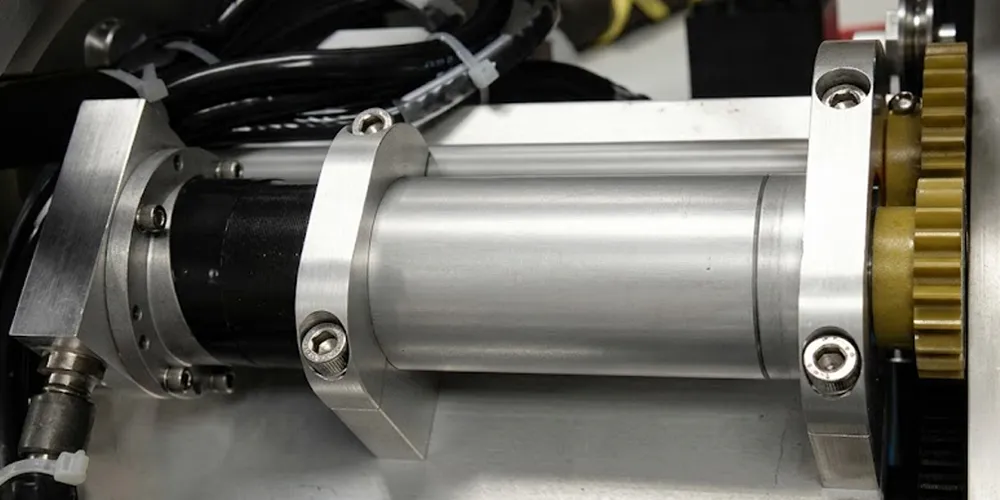
The EP nylon spur gear integrates into a complete drive system. To support procurement teams who need a single verified source for all gear train components, we manufacture the complementary products below — dimensionally compatible with the EP spur gear series at matching module and pressure angle.
ڈبل ہیلیکل گیئر
Where a downstream stage of a drive using a nylon spur gear reduction must handle higher load or deliver smoother transmission at elevated speed, our double helical gear series provides the performance upgrade without changing the overall drive layout. The opposing helix geometry cancels axial thrust while broadening tooth contact — suitable for output stages adjacent to the load in multi-stage machine drives where the nylon spur gear handles the first-stage, lower-torque reduction and a helical stage manages the higher-torque output. Buyers sourcing spur gears for sale alongside helical gear products can consolidate both into one shipment and one quality certificate.
گیئر ریک
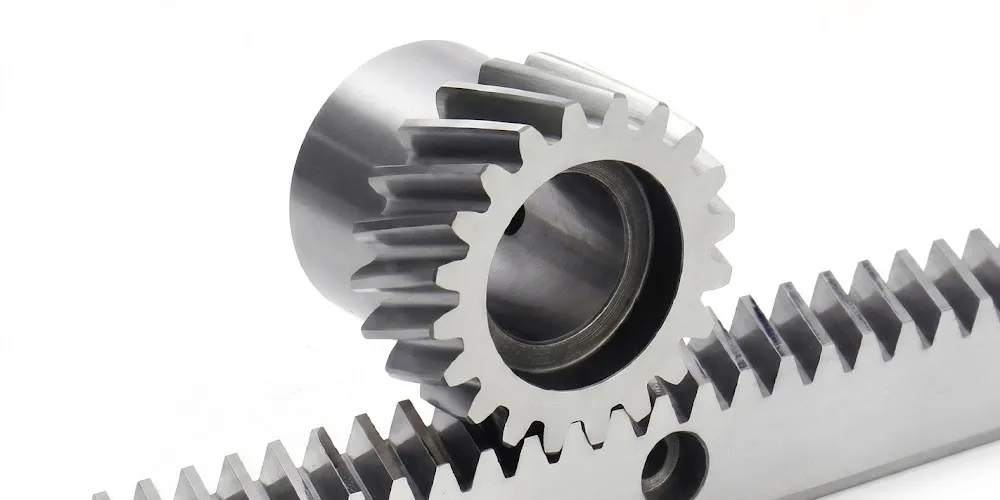
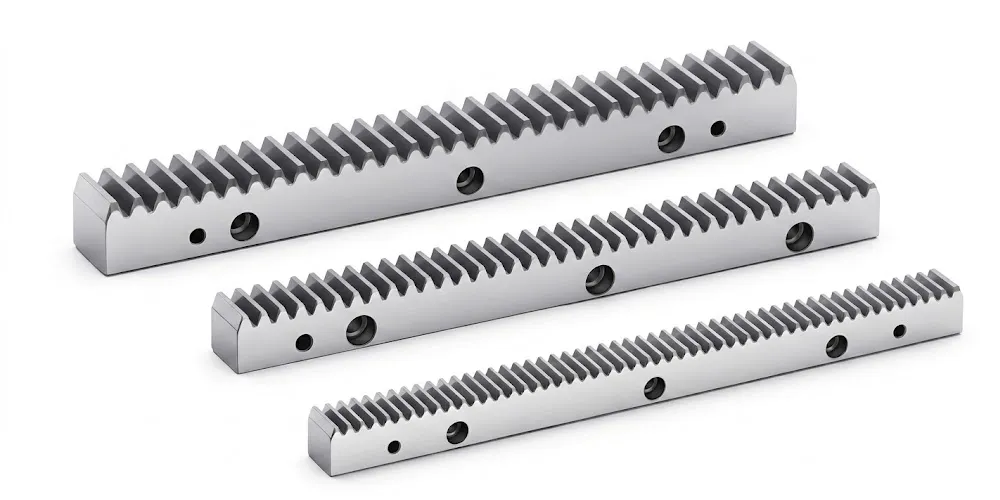
Pair any pinion spur gear from the EP nylon series with a matching gear rack to convert rotary motor output into precision linear motion. We supply gear racks in steel, stainless steel, and engineering polymer grades across the full metric module range covered by the EP nylon spur gear series — from M1 for miniature linear stages through M8 for conveyor and gantry positioning systems. Sourcing the driving nylon spur gear and the mating rack from the same supplier ensures module and pressure angle compatibility, simplifying incoming inspection and eliminating the fitment risk of multi-source procurement for the same drive stage.
Order & Trade Information
Minimum Order Quantity
Standard nylon spur gears carry a baseline MOQ. Mixed module sizes, tooth counts, and polymer grades can be combined into a single order totalling approximately USD 1,500, allowing buyers to evaluate several configurations in one shipment. For first-article evaluation, 1–5 pcs samples are available at sample pricing. Very small orders of 1–2 pcs for urgent replacement can be assessed on a case-by-case basis, though per-unit cost will be higher at sub-baseline quantities.
Lead Time
Standard catalogued nylon spur gears: 10–25 working days. Standard parts with bore modification or keyway machining: 15–35 working days. Custom OEM/ODM nylon spur gears from customer drawing or sample: 20–45 working days. Sample and test-piece orders (1–5 pcs): 7–25 working days, with complex material or geometry configurations assessed individually before production commitment.
Incoterms & Payment
Standard component orders: EXW, FOB, CIF, and DAP. Samples and urgent spare parts: EXW / FCA / DAP / courier service. FCA, CFR, CPT, CIP, and DDP negotiable for specific import markets or established procurement programmes. Payment terms: T/T (bank transfer) and L/C (letter of credit) both accepted. Packing: plastic bag + cartons for standard orders; wooden packing available for heavy or fragile configurations on request.
OEM / ODM Programme
Full OEM and ODM custom nylon spur gear production is a standard service. Customers may submit 2D engineering drawings, 3D models, or physical samples for reverse engineering. MOQ for custom configurations depends on material grade, module, precision class, and tooth treatment. Drawing approval precedes production release for all custom orders. Full material certification and dimensional inspection documentation is provided at delivery for every custom batch.
About Our Manufacturing Background
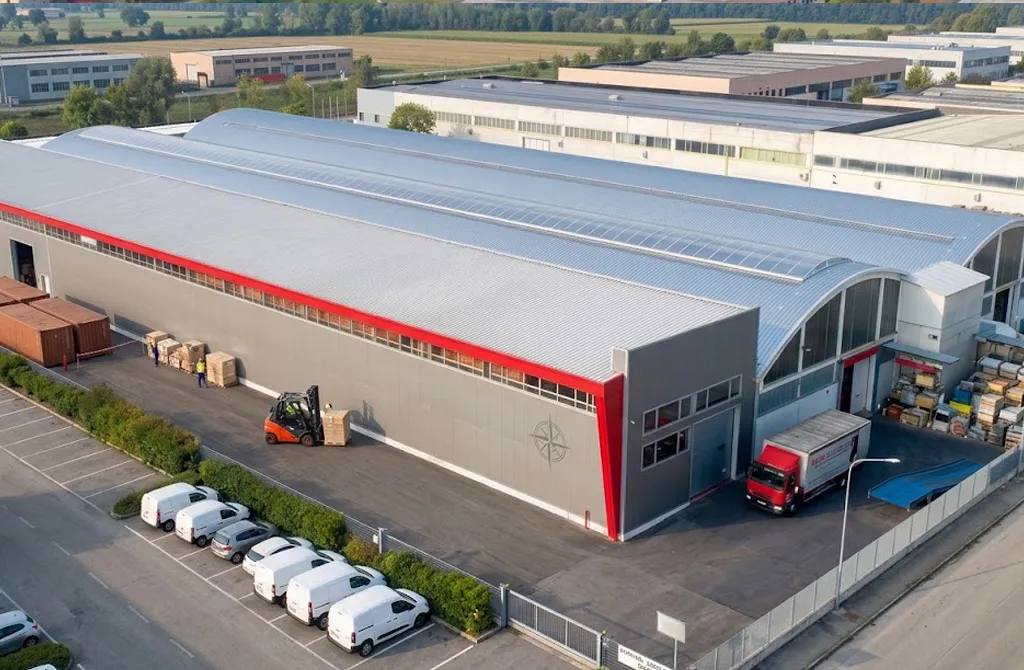
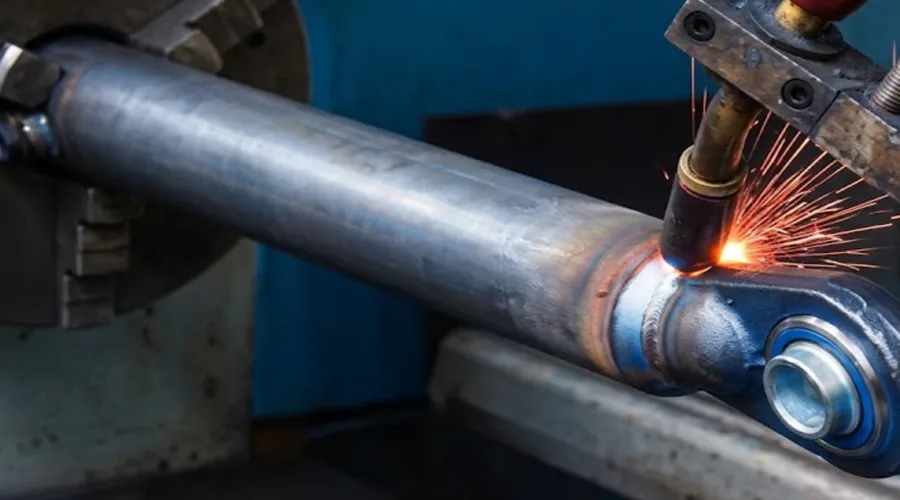
With more than ten years of dedicated experience in precision mechanical power transmission, our production facility covers the full breadth of industrial drive component manufacture — from agricultural gearboxes and worm gear reducers to planetary drive systems, power take-off shafts, hydraulic cylinders, drive chains, gears of all types, and electric motors. Every product category is managed under a single ISO 9001:2015 certified quality management system, ensuring consistent dimensional traceability and material certification across the entire product range.
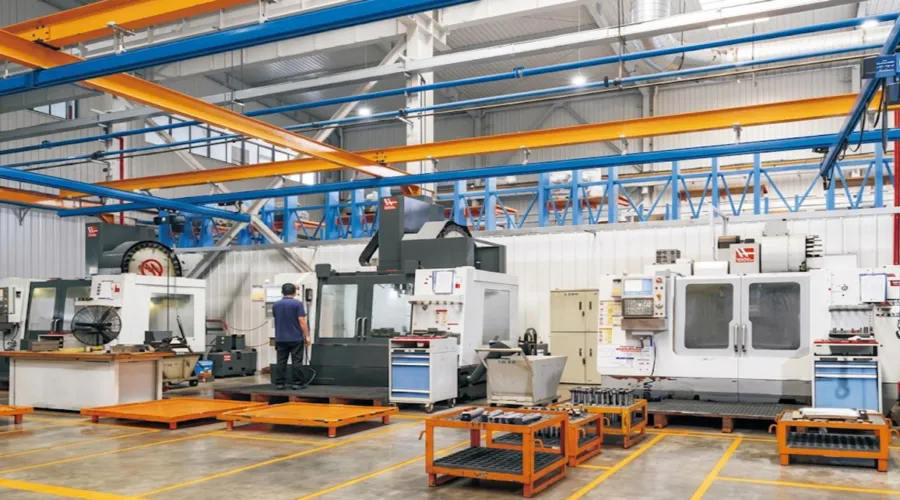
Our structural manufacturing capability covers ductile iron, grey cast iron, cast steel, precision cast steel, and cast aluminium for gearbox housings and large gear blanks. Our component range extends across gears, sprockets, worm gears, pulleys, shafts, worms, and all standard and non-standard mechanical parts. For the nylon spur gear series specifically, we operate CNC gear hobbing, profile milling, and gear grinding equipment across the full module range from M1 through M12 — giving us direct machining control over every precision grade from DIN9 standard to DIN6 ground finish.
We supply directly to OEM procurement teams and industrial buyers worldwide — no intermediary trading layer — which keeps lead times competitive and documentation complete for customers requiring certified drive components in Canada, Australia, the UK, Germany, Japan, South Korea, and across Southeast Asia. Our position as a direct spur gear manufacturer gives procurement teams a single auditable source for the full spur gear series and all related drive train components.
ورک شاپ

اکثر پوچھے گئے سوالات
ایڈیٹر: PXY