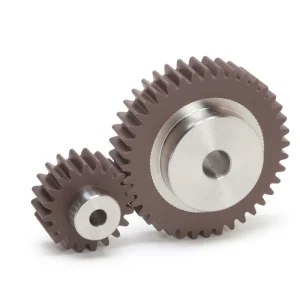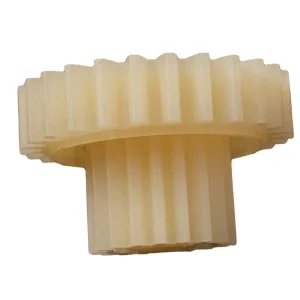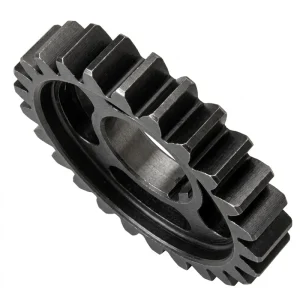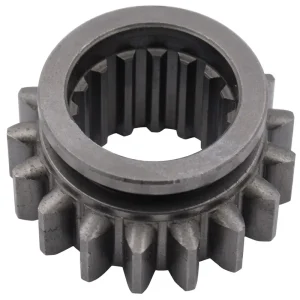
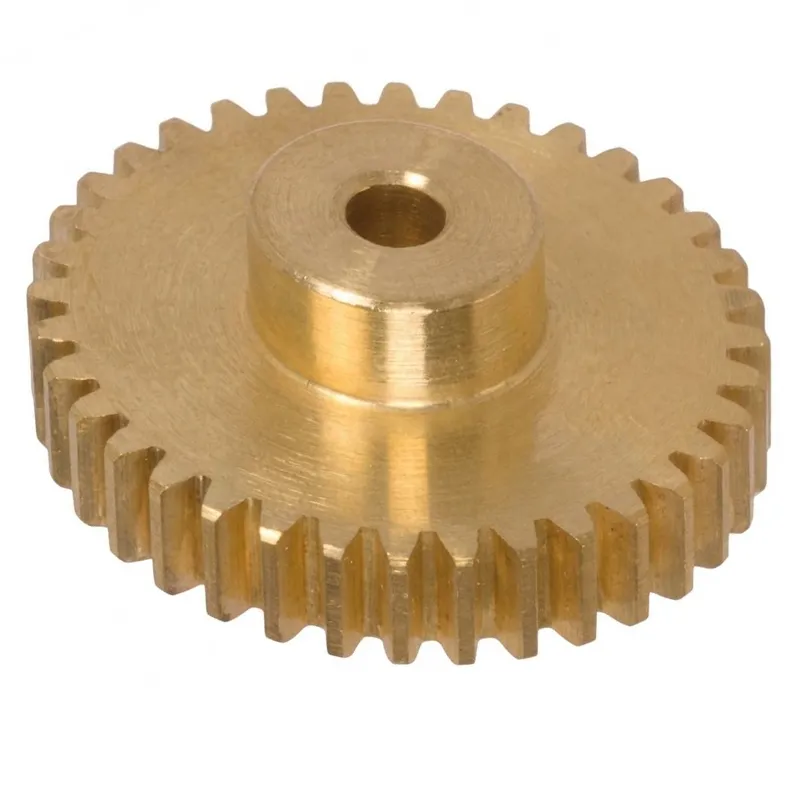
Gear Spur EP-Loyang
The EP-Brass Spur Gear series delivers high-precision transmission solutions crafted from premium Brass and Copper, offering superior corrosion resistance and electrical conductivity. Available in modules ranging from M0.15 to M2.2 and dimensions spanning Φ3mm to Φ120mm, these gears are engineered for critical applications in automotive, military, aircraft, medical, and mechanical systems. They meet rigorous international meshing standards, including JGMA 1, JIS 6, AGMA 13, DIN 5, and AGMA 12, ensuring reliable synchronization and durability. The series supports full ODM/OEM customization to meet specific design requirements and is certified under ISO 9001:2008/TS16949. Each unit is vacuum-packed for protection and available via express delivery (DHL/UPS). Ideal for environments requiring non-sparking, anti-rust performance, these brass gears provide robust torque transmission with minimal maintenance.
PRECISION METAL DRIVE COMPONENTS — SPUR GEAR SERIES
Gear Spur EP-Loyang
A precision-machined brass spur gear series covering Ø3 mm to Ø120 mm, module M0.15 to M2.2, certified to JGMA 1, JIS 6, AGMA 13, and DIN 5 standards — engineered for automotive, military, aerospace, medical, and precision mechanical applications worldwide.
Technical Specifications — EP-Brass Spur Gear Series
Full parameter reference for the standard EP series. Custom bore, module, tooth count, and material grade configurations available through our ODM/OEM programme.
| Parameter | Standard EP Series Value | Nota |
|---|---|---|
| Product Type | Brass Spur Gear | Straight involute tooth |
| Dimension (OD Range) | Ø3 mm – Ø120 mm | Min. start Ø3.5 mm at M0.2 |
| Module Range | M0.15 – M2.2 | Metric involute system |
| Material Type | Brass / Copper | As customer required |
| Meshing Grade | JGMA 1 / JIS 6 / AGMA 13 / DIN 5 / AGMA 12 | Multi-standard certified |
| Sudut Tekanan | 20° | Standard full depth |
| Application Sectors | Automotive, Military, Aircraft, Mechanical, Medical | See application section |
| Customisation | ODM / OEM | Drawing or sample accepted |
| Sample Availability | Available | 1–5 pcs at sample pricing |
| Packing Method | Vacuum-packed | Corrosion protection in transit |
| Delivery Carriers | DHL / UPS | International express available |
| Quality Certificate | ISO 9001:2008 / TS16949 | Factory-wide QMS |
What Is a Brass Spur Gear?
A brass spur gear is a straight-tooth cylindrical gear manufactured from copper-zinc alloy — most commonly free-cutting brass (CuZn39Pb3, roughly equivalent to C360 or CW614N) — which combines excellent machinability, moderate strength, and inherent corrosion resistance in a single material system. The gear's teeth are arranged parallel to the rotational axis, making the brass spur gear one of the mechanically simplest and most predictable gear forms in engineering practice. That simplicity translates directly into consistent torque transmission, straightforward gear ratio calculation, and a well-understood fatigue performance — properties that matter when specifying components for tightly controlled systems in defence, aerospace, and medical device manufacturing.
Our EP-Brass Spur Gear series spans outer diameters from Ø3 mm to Ø120 mm and module sizes from M0.15 to M2.2, covering everything from miniature instrument gears to mid-range load-bearing drives. The series minimum starting dimension of Ø3.5 mm at M0.2 illustrates the precision machining capability available at the small end of the range — dimensions that require CNC turning and gear cutting at tolerances only achievable with the right combination of material selection and machine capability. Brass and copper variants are both available, with material grade selectable to customer specification to meet OEM or ODM requirements. All product is vacuum-packed for shipment and delivered via DHL or UPS for international customers.
Five Reasons Engineers Specify Brass Spur Gears
① Superior Machinability — Tight Tolerances at Small Scale
Free-cutting brass alloys are among the most machinable metals available — ranking well above steel spur gears and stainless steel spur gears in chip formation and surface finish quality at high cutting speeds. This machinability advantage becomes decisive at small module sizes. Achieving an accurate involute tooth profile at M0.15 to M0.5 in steel requires specialist grinding operations; in brass the same accuracy is achievable by high-speed CNC gear hobbing without additional finishing, keeping unit costs controlled even at miniature scale.
② Natural Corrosion Resistance Without Coating
Brass forms a stable oxide layer that resists atmospheric corrosion, salt fog, and many industrial fluids without the zinc-plating, nickel-plating, or passivation steps required on carbon steel spur gears. In a brass spur gear drive, this means the gear maintains its dimensional accuracy and surface finish over service life without the coating-thickness variation that can affect backlash in plated metal spur gears. This property makes brass the preferred choice in marine instrument panels, outdoor military equipment, and medical devices where aggressive sterilisation environments rule out uncoated iron-based gears.
③ Low Friction Meshing Against Dissimilar Materials
Brass exhibits a naturally low coefficient of friction against steel, aluminium spur gears, and engineering polymers. A brass spur gear meshing with a steel pinion or nylon spur gear runs with lower galling tendency than a steel-on-steel pair, reducing the need for external lubrication in lightly loaded instrument and actuator drives. This dissimilar-material pairing strategy — brass driving gear against a steel pinion spur gear — has been a proven design technique in precision instrument gearboxes for over a century.
④ Non-Magnetic — Critical for Sensitive Environments
Brass is paramagnetic — effectively non-magnetic in practical terms. In applications near electromagnetic sensors, navigation instruments, MRI-compatible devices, or electronic control systems where ferromagnetic materials would distort field measurements or trigger false sensor readings, the brass spur gear is the natural metal gear selection. This property alone disqualifies steel spur gears from certain aerospace, defence electronics, and medical imaging applications where brass or aluminium spur gears are mandated.
⑤ Multi-Standard Certified — Global OEM Qualification
Compliance with JGMA 1, JIS 6, AGMA 13, and DIN 5/AGMA 12 in a single product family means OEM buyers designing spur gears into products for the Japanese, North American, and European markets can use the same EP-Brass Spur Gear component across all three regions without requiring separate localised specifications. ISO 9001:2008 / TS16949 factory certification backs this multi-standard claim with an auditable quality management system — a prerequisite for automotive, military, and aerospace supply chains.
Material Guide — Brass and Copper for Precision Spur Gears
The question of what material is commonly used in spur gears does not have a single answer — it depends on the operating environment, required strength, weight budget, and corrosion exposure. Among metal spur gears, brass stands out for the combination of machinability and corrosion resistance it provides at moderate strength levels. Understanding where brass spur gears fit in the material hierarchy helps engineers select correctly between brass, steel, stainless steel, aluminium, and engineered polymers.
Brass (CuZn — Free-Cutting Grade)
Free-cutting brass alloys contain a lead addition (typically 1.5–3.5%) that produces short, clean chips during machining — the property that enables high-feed hobbing of small-module involute profiles without burring or tooth-tip damage. Tensile strength typically falls in the 380–420 MPa range, which positions the brass spur gear above aluminium spur gears and engineering polymers but below hardened steel spur gears. For the moderate load levels found in instrument drives, actuator gearboxes, and light mechanical assemblies, this strength range is entirely adequate. Brass also has excellent dimensional stability after machining, maintaining tight bore tolerances and face width consistency without the stress-relief distortion that can affect steel gear blanks after turning.
Copper (Pure or Low-Alloy)
Pure copper or low-alloy copper variants are available on customer request for applications where maximum electrical conductivity, thermal conductivity, or specific biocompatibility requirements apply. Copper is softer than brass — Brinell hardness typically below 80 HB compared to 120–150 HB for free-cutting brass — so copper spur gears are generally reserved for light-load instrument applications where the material's unique properties outweigh the strength trade-off. In certain medical device and laboratory equipment designs, copper's antimicrobial surface properties also influence material selection. All material grades in the EP series are available with mill certificates confirming chemical composition and mechanical properties to support incoming quality verification in regulated supply chains.
Both brass and copper spur gear variants are manufactured under an ISO 9001:2008 / TS16949 quality framework. Dimensional inspection is carried out to the applicable meshing grade — JGMA 1 for the tightest tolerance class, through to AGMA 12 / DIN 5 for standard industrial precision. Customers who require a specific meshing grade for a particular application — for example, AGMA 13 for a defence instrument specification or JIS 6 for a Japanese OEM programme — should confirm the required grade at the time of enquiry so that gear cutting parameters and inspection criteria can be set accordingly.
How a Brass Spur Gear Transfers Torque
The operating principle of a brass spur gear is the involute tooth mesh between two parallel shafts. Teeth cut to the standard full-depth involute profile engage progressively as the driving gear rotates, pushing along the flank of the driven gear tooth at the specified pressure angle — 20° in the vast majority of industrial and instrument applications. The contact line between meshing teeth traces a straight path (the line of action) at constant inclination to the common tangent of the two pitch circles, which is what gives the involute profile its defining constant velocity ratio property. This means the gear ratio between a pinion spur gear and its mating gear stays exactly constant throughout every tooth engagement — no speed fluctuation, no cyclic torque ripple from the gear geometry alone.
The straight tooth arrangement of the external spur gear produces tooth contact that occurs entirely across the face width simultaneously, rather than progressing along a helix angle as in a helical spur gear. This gives the brass spur gear zero axial thrust force — a significant simplification for shaft and bearing design in small instrument gearboxes where axial preload control is difficult. The trade-off, as any comparison of spur gear vs helical gear will confirm, is that the instantaneous mesh engagement creates a slightly more abrupt load onset per tooth cycle than the progressive helical engagement. At the low rotational speeds typical of instrument and actuator applications — generally below 600 RPM — this is rarely a meaningful consideration.
In a paired spur gear set, the ratio is determined entirely by tooth count: a brass spur gear with 60 teeth driving a 20-tooth steel pinion produces a 3:1 speed reduction. Designing spur gears to a required ratio is therefore a straightforward arithmetic process, which contributes to the format's popularity in precision instrument design where traceability and repeatability of all component dimensions are paramount. Whether used as a differential spur gear stage, an internal spur gear reduction, or a simple external spur gear pair, the operating principle remains constant and well-understood across all configurations.
Where Brass Spur Gears Are Specified — Key Application Sectors
The multi-sector certification of the EP-Brass Spur Gear series — covering automotive, military, aircraft, mechanical, and medical applications — reflects the material's genuinely broad applicability. Below are the primary sectors where our brass spur gear products are regularly supplied to OEM and aftermarket customers globally.
Automotive Instruments & Actuators
Dashboard instrument drives, speedometer gearboxes, HVAC flap actuators, and throttle position indicator mechanisms all use small-module brass spur gears for their dimensional stability, corrosion resistance to automotive fluids, and compatibility with the dissimilar-material meshing pairs common in vehicle instrument design. The TS16949 certification of our quality system makes us directly qualifiable as a tier-2 or tier-3 automotive component supplier in markets including Canada, Germany, Japan, and South Korea.
Military & Defence Equipment
Sighting systems, range-finding mechanisms, communications equipment drives, and weapons sub-system actuators in defence applications demand non-magnetic, corrosion-resistant gear materials that can withstand salt fog and humidity cycling without dimensional drift. A precision brass spur gear at AGMA 13 or JGMA 1 accuracy meets these requirements with a well-documented, auditable supply chain. Custom spur gears for military OEM applications can be produced to customer drawings with full material and dimensional certification packages.
Aerospace & Aviation Instrumentation
Altimeters, attitude indicators, fuel gauges, and cockpit actuator drives have used brass spur gears as the standard small-module metal gear for decades — a legacy built on brass's combination of low density, non-magnetic behaviour, and manufacturing precision at miniature scale. At M0.15 to M0.5 module range, our EP series covers the smallest instrument gear sizes used in aviation sub-assemblies, with vacuum packing protecting the tooth profile during international air freight to assembly locations in Europe, North America, and Asia-Pacific.
Medical Devices & Laboratory Equipment
Infusion pump drive trains, diagnostic instrument positioning stages, surgical tool actuators, and laboratory autosampler carriage drives specify brass spur gears for their biocompatibility, resistance to cleaning agents, and freedom from magnetic interference with imaging equipment. At the small module sizes typical of medical instrument gearboxes — M0.2 to M0.5 — brass's machinability allows the tight tooth-form tolerances needed for consistent dosing accuracy in infusion and dispensing applications. Copper variants are also available where antimicrobial surface properties are a design consideration.
Precision Mechanical & Scientific Instruments
Theodolites, spectrometers, telescope drive systems, coordinate measuring machine probes, and scientific balance mechanisms are traditional strongholds for small-module metric spur gears in brass. The low coefficient of thermal expansion relative to aluminium spur gears, combined with brass's non-corrosive surface in laboratory air, makes the brass spur gear the standard reference material for precision instrument gear design. Buyers sourcing spur gears near me in the UK, Australia, or Germany for scientific instrument repair and manufacture regularly specify our EP series for metric module replacements.
Marine & Outdoor Mechanical Assemblies
Compass drive gears, navigation instrument mechanisms, and deck equipment control actuators in the marine sector benefit from brass's salt-water corrosion resistance — a property that disqualifies carbon steel spur gears and limits the applicability of aluminium spur gears in saline environments. Brass forms a stable protective oxide layer that survives extended saltwater spray exposure without pitting or dimensional loss, keeping gear mesh backlash within specification over long deployment periods without requiring periodic re-coating or replacement.
Brass Spur Gear vs Other Metal Gear Options — Making the Right Choice
What are the different types of spur gears available in metal, and when does brass make the most sense? Steel spur gears — both carbon and stainless steel spur gears — offer higher load ratings and surface hardness but are magnetic, require corrosion protection coatings, and are significantly harder to machine at small module sizes. Aluminium spur gears are lighter but softer and less wear-resistant than brass, limiting their life in high-cycle drives. Stainless steel spur gears offer good corrosion resistance but are noticeably harder to machine than brass, making them expensive at miniature module sizes. The brass spur gear occupies the intersection of non-magnetic behaviour, natural corrosion resistance, excellent machinability, and moderate strength — a combination that no other common metal matches simultaneously.
The difference between spur gear and helical gear behaviour is also relevant when selecting a brass spur gear for a new application. The straight spur gear generates no axial thrust, allowing simpler shaft and bearing design — an important cost factor in small instrument gearboxes where every component has a size and weight budget. The helical and spur gear comparison favours the helical format only when continuous high-speed operation (above roughly 1,000 RPM in brass) or noise reduction beyond what the involute spur gear naturally achieves is needed. For the majority of applications where brass is specified — instrument drives, actuators, slow-cycling mechanisms — the straight spur gear is the mechanically optimal choice.
When considering spur gear and bevel gear combinations in a drive train, the brass spur gear stage typically handles the parallel-shaft reduction closest to the load, where torque is highest and speed is lowest. The bevel stage, if present, handles the shaft-direction change. This division of function plays to the spur gear's strength — its simplicity and predictability under steady torque — while keeping bevel gear manufacturing complexity to the minimum needed for the application.
Related Products — Complete Drive System in One Source
Our manufacturing scope extends well beyond the brass spur gear. To support customers who need a complete drive train specification from a single verified supplier, we produce the complementary components below — each engineered to mesh directly with our spur gear series.
Gear Heliks Berganda
Where a drive stage downstream of the brass spur gear reduction requires higher load capacity or reduced noise at elevated speed, our double helical gear series provides the step up in performance. The opposing helix configuration eliminates net axial thrust while delivering wider tooth contact and smoother torque transfer than any straight spur gear of equivalent pitch diameter. Pairing a brass spur gear instrument stage with a double helical output stage is a practical design strategy for multi-stage compact gearboxes serving automotive and aerospace applications.
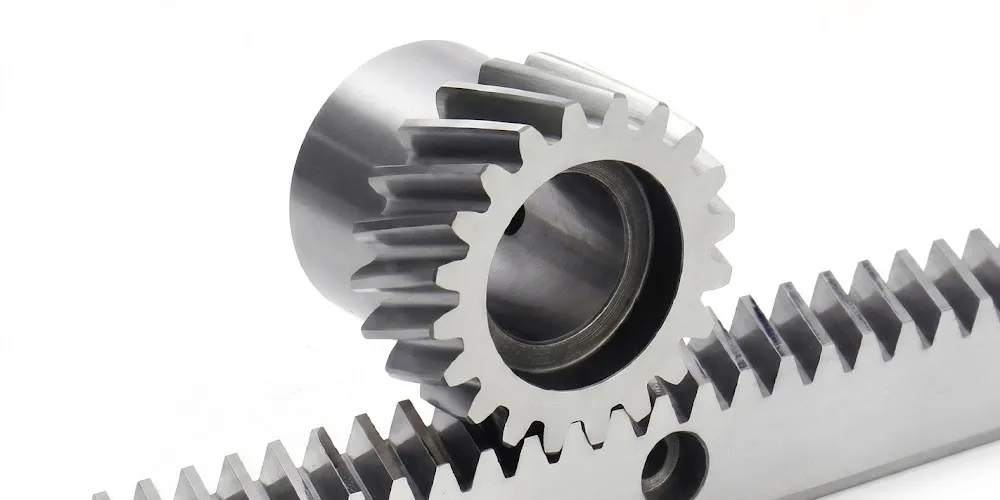
Rak Gear
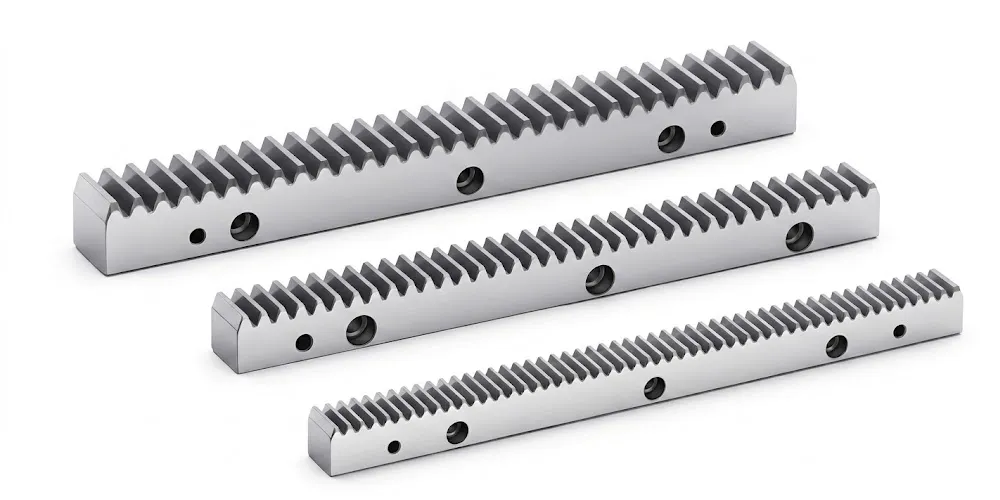
A precision brass spur gear paired with a matching gear rack converts rotary drive into controlled linear motion — a configuration used in precision laboratory positioning stages, medical device lead screws, and instrument traverse mechanisms. Our gear rack series covers metric module sizes that mate directly with the EP-Brass Spur Gear range, from M0.5 upward in steel, stainless steel, and brass rack options. Sourcing both the driving pinion spur gear and the rack from a single supplier ensures module and pressure angle compatibility without the verification risk of multi-source procurement.
Order & Trade Information
Minimum Order Quantity
Standard brass spur gears carry a baseline MOQ. Mixed module sizes and tooth counts can be combined into a single order totalling approximately USD 1,500, allowing customers to trial several configurations simultaneously. For new customers or design evaluation purposes, 1–5 pcs samples are available at sample pricing. Very small orders of 1–2 pcs can be assessed case by case, though unit cost will be higher for quantities below the standard baseline.
Lead Time
Standard catalogued brass spur gears: 10–25 working days. Standard parts with bore modification or keyway addition: 15–35 working days. Custom spur gears from customer drawing (non-standard module, tooth count, or bore): 20–45 working days. Sample and test-piece orders (1–5 pcs): 7–25 working days. Complex custom configurations are assessed individually at the time of order placement.
Incoterms & Shipping
Standard component orders: EXW, FOB, CIF, and DAP terms available. Small samples and urgent spare parts: EXW / FCA / DAP / DHL or UPS courier service. FCA, CFR, CPT, CIP, and DDP terms negotiable for specific import markets. All brass spur gears are vacuum-packed for corrosion protection in transit and delivered via DHL or UPS for international express shipments.
ODM / OEM Customisation
Full ODM and OEM custom spur gear production is available for the EP-Brass Spur Gear series. Customers may submit engineering drawings, 3D models, or physical samples for reverse engineering. MOQ for custom configurations depends on drawing complexity, material grade, machining process, and batch size. Custom orders include a drawing approval step prior to production release, with full dimensional and material certification documentation provided at delivery.
About Our Manufacturing Expertise
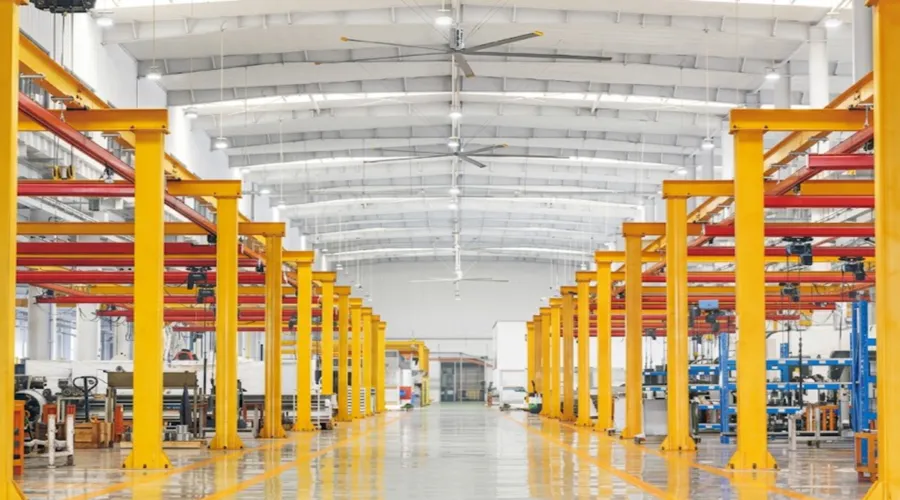
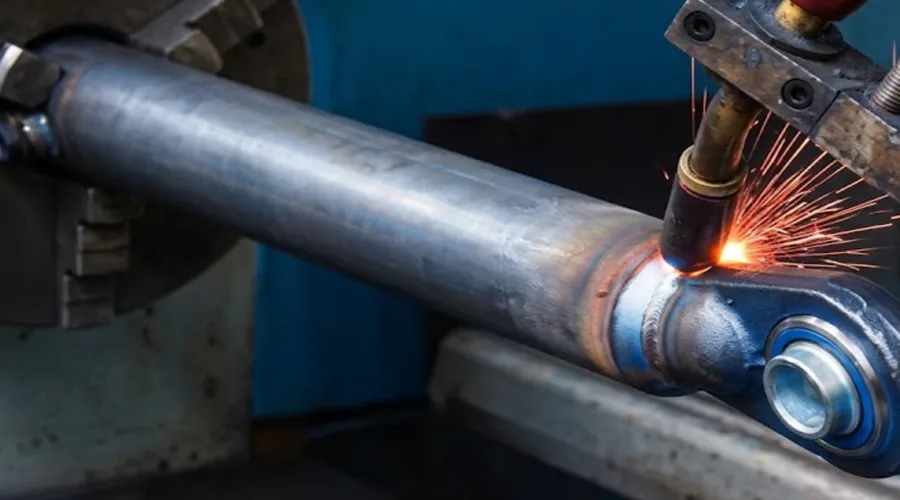
With over ten years of hands-on experience in precision mechanical power transmission, our facility manufactures a comprehensive range of drive components under a single ISO 9001-certified quality management system. Our production scope covers agricultural gearboxes, worm gear reducers, planetary drive units, power take-off shafts, hydraulic cylinders, drive chains, gears of all types, and industrial motors — all designed and built in-house.
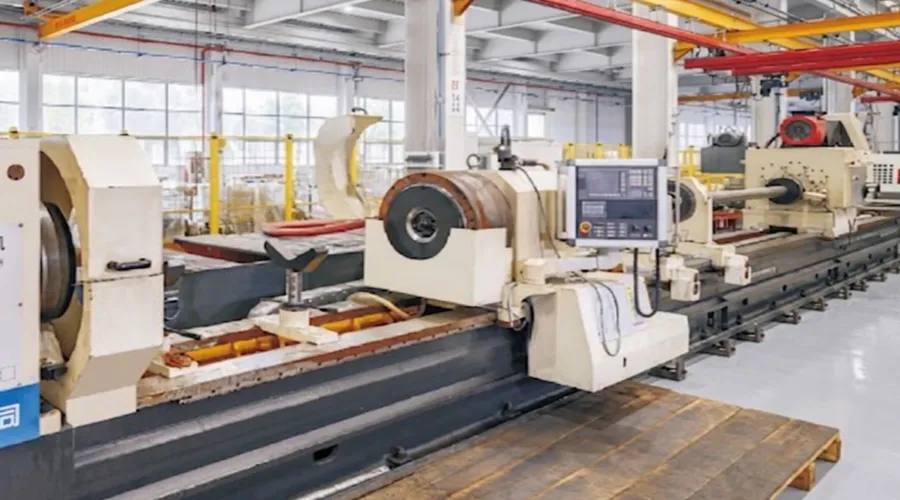
On the structural side, we cast and machine components in ductile iron, grey cast iron, cast steel, precision cast steel, and cast aluminium for gearbox housings, large gear blanks, and custom transmission assemblies. Our component range covers gears, sprockets, worm gears, pulleys, shafts, worms, and the full spectrum of standard and non-standard mechanical parts. For brass spur gear production specifically, we operate CNC gear hobbing and profile grinding equipment capable of achieving the small-module precision required for JGMA 1 and AGMA 13 accuracy class components.
Global export experience spans automotive OEMs in Canada and Germany, defence procurement in the UK, aerospace sub-assembly manufacturers in Japan and South Korea, and medical device manufacturers across Europe and North America. As a direct-factory spur gear manufacturer and spur gear supplier — with no trading intermediary in the supply chain — we offer the shortest possible path from machining floor to incoming inspection dock for international buyers sourcing spur gears for demanding regulated applications.
Kedai Kerja

Soalan Lazim
Editor: PXY