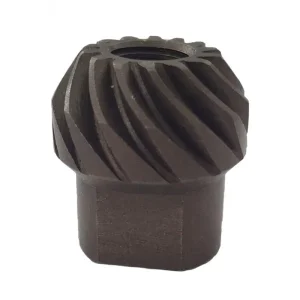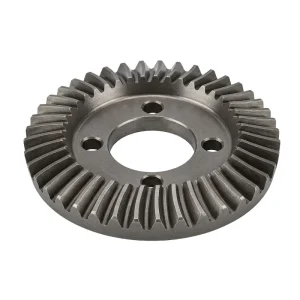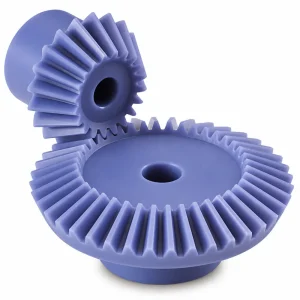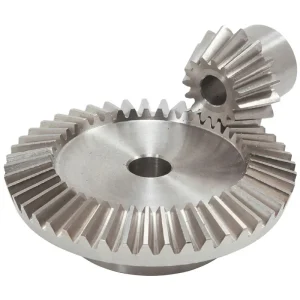
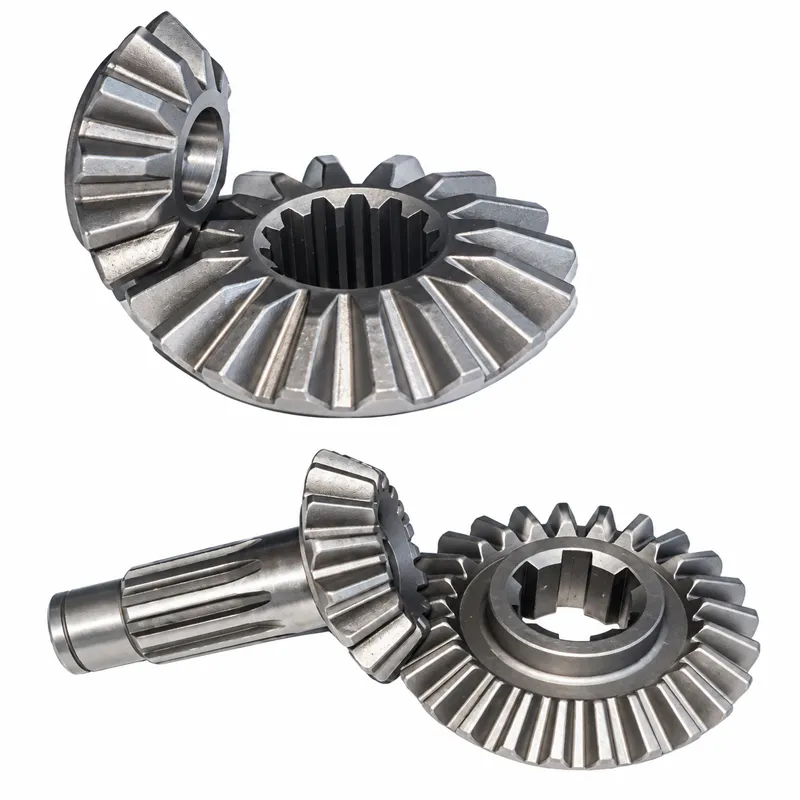
EP-Forging Bevel Gear
The EP-Forging Bevel Gear series offers precision-forged straight and spiral bevel gears manufactured through hot forging, cold forging, and compound developing processes. Available in alloy steels (20CrMnTi, 20CrMo, 42CrMo4), carbon steels (20#, 45#), and stainless steel, these gears achieve surface hardness of 58–62 HRC (case) with a tough 30–40 HRC core after carburising and quenching. Standard pressure angle is 20°, with 14.5°–25° available for custom applications. Precision grades include AGMA 12, AGMA 13, DIN 6, DIN 7, and JIS 5. The forging process aligns steel grain flow to the tooth profile, increasing tooth root bending strength by 20–30% compared to machined equivalents while reducing material scrap by 40–60%. Applications span saloon cars, passenger vehicles, heavy-duty trucks, engineering machinery, agricultural machinery, and wind power generation. ISO 9001:2015 certified with OEM/ODM customization available.
EP-Forging Bevel Gear — Precision Forged Straight & Spiral Bevel Gears for Heavy-Duty Industrial and Automotive Drive Systems
The EP-Forging Bevel Gear series represents the structural foundation of high-load, long-service drivetrain engineering. Through precision forging processes — hot forging, cold forging, and compound developing methods — each bevel gear in this series acquires superior grain flow alignment, higher tooth root bending strength, and tighter dimensional consistency compared to gears produced from raw bar stock or cast blanks. Both forging straight bevel gears and forging spiral bevel gears are available, covering the full range of angular power transmission requirements from passenger car differentials to wind turbine rotor drives. Precision forged bevel gears have earned OEM supplier status across saloon cars, passenger vehicles, mini-cars, heavy-duty trucks, medium-duty trucks, light-duty trucks, engineering machinery, agricultural machinery, and wind power generation installations globally. For procurement teams in Germany, the United States, Australia, South Korea, Brazil, and the United Kingdom sourcing a bevel gear that must meet high-cycle fatigue life requirements, resist impact loading, and maintain positional accuracy under sustained torque, the EP-Forging series offers a technically sound, certifiably consistent manufacturing solution backed by more than a decade of precision gear production experience.
Technical Specifications — EP-Forging Bevel Gear Series
The table below documents the core technical parameters for the EP-Forging Bevel Gear series. All values represent verified production standards covering both straight and spiral forging variants. Engineers conducting supplier qualification or design review should use this specification as the primary technical baseline. Post-forging operations — machining, heat treatment, and surface hardening — are applied in sequence following the initial forging stage, with each step governed by documented process controls within the same facility.
| EP-Forging Bevel Gear — Complete Technical Specification | |
|---|---|
| Parameter | Value / Detail |
| Jenis Gigi | Forging Straight Bevel Gear; Forging Spiral Bevel Gear |
| Forging Method | Hot Forging, Cold Forging, Compound Developing |
| Post-Forge Processing | Machining, Heat Treatment, Flame Hardening, Nitriding |
| Material (Standard) | Alloy steel (20CrMnTi, 20CrMo, 42CrMo4); Carbon steel (20#, 45#); Stainless steel; as customer required |
| Surface Hardness (Carburised) | 58–62 HRC (case); 30–40 HRC (core) |
| Bevel Gear Pressure Angle | 20° standard; 14.5°–25° available (custom) |
| Precision Grade | AGMA 12, AGMA 13, DIN 6, DIN 7, JIS 5 (by application) |
| Application Vehicles | Saloon cars, passenger cars, mini-car, heavy-duty trucks, medium-duty trucks, light-duty trucks |
| Application Machinery | Engineering machinery, agricultural machinery, wind power generation |
| Kustomisasi | OEM/ODM; customer drawing and sample accepted |
| Standar Mutu | ISO 9001:2015 certified; AGMA, DIN, JIS, ISO standard compliance |
The gear ratio of bevel gear pairs in the EP-Forging series follows the standard tooth count relationship. Miter gear configurations (1:1 ratio) are a commonly requested subset, particularly for robotics and automation drive systems where shaft redirection without speed change is required. Non-standard ratios from 1:1 through to approximately 6:1 are achievable within the forging tooling constraints, with the exact achievable range depending on the module size and tooth count combination specified by the customer engineering team.
What Is a Precision Forged Bevel Gear and How Does It Work?
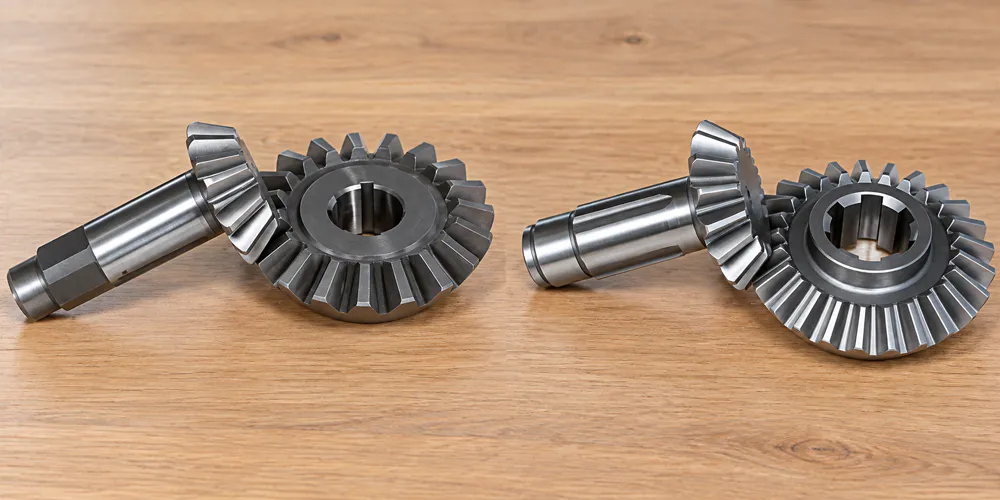
To understand what makes precision forged bevel gears distinct, it helps to start with the forging process itself. When a gear blank is pressed or hammered under high temperature and pressure into a die shaped to the gear's approximate profile, the steel's internal grain structure — the crystalline lattice of the alloy — flows to follow the contours of the tooth shape rather than being severed by machining. This retained grain flow is the source of the forged bevel gear's mechanical advantage: tooth root bending strength increases by 20–30% compared to a machined-from-billet equivalent, and surface fatigue resistance improves because the carburising or nitriding heat treatment that follows forging penetrates a material with tighter, more uniform grain boundaries. Hot forging produces the largest strength gains and is preferred for heavy-duty applications such as truck differentials and wind turbine gearboxes. Cold forging delivers superior dimensional accuracy with minimal scale or decarburisation, making it the process of choice for precision automotive bevel gears in passenger car and mini-car differential applications. Compound developing methods combine both approaches — hot forging for shape and strength, followed by cold sizing for final dimensional control — producing a bevel gear that combines the structural integrity of hot forging with the surface quality of cold working.
Understanding how a bevel gear works in the context of a forged component starts with the conical pitch surface principle that all bevel gears share. Power enters one shaft, and the meshing cone surfaces redirect torque through an intersecting angle — most commonly 90° — to a second shaft. In a forging straight bevel gear, teeth run radially across the cone face and engage abruptly, making them well-suited for low-speed, high-load applications where simplicity and ease of manufacture matter. In a forging spiral bevel gear, the curved tooth trace creates progressive, multi-tooth engagement, lowering the per-tooth contact stress and reducing noise — the configuration used in automotive differentials and aerospace transmission stages where pitch line velocity exceeds 10 m/s. Precision forged bevel gears are also referred to as miter gears when both the driving and driven gears have equal tooth counts, producing a 1:1 gear ratio of bevel gear while redirecting the shaft axis through 90°. The bevel gear pressure angle is standardised at 20° across the EP-Forging series, providing the balance between tooth bending strength and root clearance that automotive and industrial standards require. What separates the precision forged bevel gear from cast or fabricated alternatives is that this angular power transmission geometry is expressed through a material structure that has been mechanically worked to its highest available strength state before any finishing operation begins.
Five Key Advantages of the EP-Forging Bevel Gear
① Superior Grain Flow Tooth Strength
Precision forging aligns the steel grain structure parallel to the tooth profile contours, producing tooth root bending fatigue strength up to 30% higher than a machined-from-bar alternative of the same material grade. This is the primary mechanical reason that forging bevel gear components are standard across automotive OEM differential and transfer case supply chains, where warranty life targets and road load spectra demand fatigue performance that casting or turning cannot reliably deliver.
② Hot, Cold & Compound Process Flexibility
Three manufacturing routes are available within the same product programme: hot forging for maximum impact and fatigue strength in heavy-duty truck and engineering machinery bevel gears; cold forging for net-shape dimensional accuracy in high-volume passenger car applications; and compound developing for applications that require both structural performance and surface dimensional quality within tight tolerances. The ability to select the appropriate process for each application is a key bevel gear maker advanced capability that reduces total part cost across the programme.
③ Reduced Material Scrap vs. Machining
Precision forging produces a near-net-shape bevel gear blank whose tooth profile is close to the finished dimension before any machining begins. This reduces material removal requirements in subsequent milling, grinding, and shaving operations by 40–60% compared to starting from round bar stock — a meaningful cost and sustainability advantage at the production volumes typical of automotive OEM supply contracts in Germany, South Korea, and the United States. Less material removed also means less heat generated at the machining stage, reducing the risk of surface thermal damage to the carburised case layer.
④ Broad Application Coverage — OEM Qualified
The EP-Forging bevel gear is already adopted by OEM suppliers across saloon cars, passenger cars, mini-cars, heavy-duty trucks, medium-duty trucks, light-duty trucks, engineering machinery, agricultural machinery, and wind power generation. This broad application history means the forging process parameters, heat treatment cycles, and inspection criteria have been validated across multiple duty spectra — giving new customers a proven baseline to build their own qualification programmes from, rather than starting from first principles.
⑤ Complete Post-Forge Processing In-House
Forging is only the first stage. The EP-Forging bevel gear undergoes a full sequence of machining, heat treatment (including carburising, quenching, and tempering), flame hardening, and nitriding processes within the same production facility. This single-source control from raw billet to finished precision bevel gear eliminates the inter-supplier quality variation that arises when forging, heat treatment, and finish machining are subcontracted to separate vendors — a common failure mode in bevel gear supply chains serving the agricultural and construction machinery markets in Brazil, Australia, and Canada.
Material Engineering Behind the EP-Forging Bevel Gear
The forging process only delivers its full mechanical benefit when matched to the correct alloy chemistry and heat treatment sequence. The material selection for a precision forged bevel gear is therefore not simply a material grade choice — it is an integrated decision spanning alloy composition, forging temperature window, cooling rate after forging, and the subsequent heat treatment cycle.
20CrMnTi is the dominant carburising alloy for automotive precision forged bevel gears in differential and transfer case applications. Its forging temperature window (900–1150 °C) is well-suited to the hot forging of large ring gear blanks, and after carburising to a case depth of 0.8–1.5 mm and quenching, the case achieves 58–62 HRC with a tough, ductile core at 30–40 HRC — precisely the hardness gradient that maximises both surface contact fatigue resistance and tooth root impact toughness simultaneously. 20CrMo is specified when superior core toughness under cyclic impact loading is the priority — heavy-duty truck differentials and off-highway engineering machinery bevel gears are the primary applications, where shock loads from rough terrain or variable load cycles would cause subsurface fatigue in a lower-toughness core material. 42CrMo4 is through-hardenable to approximately 50–55 HRC and is used for precision forged bevel gears in applications where surface hardness requirements are moderate but dimensional stability under operating temperature variations must be tight — marine propulsion bevel gear stages and industrial gearboxes in the oil and gas sector are typical. For renewable energy applications, particularly wind turbine main gearbox bevel gear stages deployed in Australian and North Sea offshore installations, alloy steel grades with enhanced low-temperature toughness certification (Charpy impact testing at −20 °C or below) are specified to address the cold ambient conditions during winter operation. All material grades are supported by mill certificate traceability and heat treatment records, satisfying the documentation requirements of OEM supplier quality systems in Germany, the United States, and South Korea.
Installation Principles — How to Install a Precision Forged Bevel Gear
The installation procedure for a forging bevel gear follows the same fundamental sequence as any precision bevel gear pair, but the tighter tooth accuracy and higher surface hardness of forged components introduce additional considerations that a technician installing a cast or lower-grade machined bevel gear would not typically encounter. Understanding how to install a precision bevel gear correctly is essential to realising the full fatigue life that the forging process and heat treatment have built into the component.
The first step is to confirm that the housing's bearing bores and shaft support geometry are within the drawing tolerances. Because a precision forged bevel gear at AGMA 13 accuracy grade will have pitch errors measured in single-digit micrometres, any housing bore misalignment or bearing seat out-of-roundness beyond 0.01 mm will shift the tooth contact pattern enough to introduce edge loading that accelerates micropitting — negating the contact fatigue strength advantage that forging delivers. After confirming housing geometry, mount the pinion shaft and set bearing preload: for automotive applications, a rolling drag torque of 1.0–2.5 N·m is standard. Introduce the ring gear, adjust carrier shims or adjuster rings to achieve the specified backlash (typically 0.08–0.18 mm for M3–M6 module forging spiral bevel gear sets at this service class), and verify the tooth contact pattern with marking compound. The correct contact pattern for a precision forged bevel gear — whether a straight or spiral variant — covers 50–65% of tooth face length, centred lengthwise and positioned slightly toward the tooth root under light hand load. Under full operating torque, the pattern will shift heel-ward; this is intended behaviour. Any edge contact appearing at full load indicates an assembly error that must be corrected before the unit enters service. This installation rigour is particularly emphasised for bevel gear examples in wind turbine gearboxes and heavy vehicle drivelines, where an assembly error that causes premature failure is far more costly to diagnose and correct in the field than in the assembly workshop.
Forging Bevel Gear Application Scenarios — Where Structural Strength Defines the Choice
Precision forged bevel gears are specified when load severity, service life requirements, or both exceed what a conventionally machined bevel gear can reliably sustain. The following application categories represent the primary sectors where the EP-Forging series is qualified and in active OEM use.
🚗 Automotive Drivetrains
Differential ring-and-pinion sets and spider gear assemblies in saloon cars, passenger vehicles, and light commercial vans are among the highest-volume precision forged bevel gear applications globally. The cyclic load spectrum of a passenger car differential — millions of full-torque events over the vehicle's life — demands the tooth root strength that only a well-executed carburised forging bevel gear provides. OEM suppliers in Germany, Japan, South Korea, and the United States have qualified this series for both front-wheel-drive and all-wheel-drive architectures.
🚛 Heavy & Medium-Duty Trucks
Rear axle differentials and inter-axle differentials in medium and heavy-duty trucks experience torque levels that are three to eight times higher than passenger vehicle differentials per unit gear size. Hot forging 20CrMo or 42CrMo4 bevel gear blanks followed by deep case-hardening provides the combined bending and contact fatigue resistance needed for 1,000,000 km service life targets on intercontinental freight routes in Australia, Brazil, Canada, and across Europe. The dimensional consistency of precision forging also simplifies the matched-set differential bearing adjustment process during truck axle assembly.
🌬 Wind Power Generation
Wind turbine main gearboxes transfer rotor torque — at very low speed but extremely high torque magnitude — through a series of gear stages including an angular drive bevel gear set before the final helical stage drives the generator. A bevel gear for wind applications must sustain 20-year service life with minimal maintenance access, in environments ranging from desert heat to sub-Arctic cold. Precision forged bevel gears with certified low-temperature toughness and surface compressive residual stress from shot peening are the standard specification for onshore and offshore wind installations in Northern Europe and Australian coastal regions.
✈ Aerospace & Defence
Aircraft engine accessory drives, helicopter tail rotor transmission stages, and navigation system gearboxes demand a precision bevel gear that maintains positional accuracy and fatigue integrity under combined vibration, temperature cycling, and extreme load events. The weight-specific strength advantage of precision forged bevel gears — stronger per kilogram than cast or machined equivalents — directly supports the mass reduction requirements of aerospace drive systems, where every saved gram translates into payload capacity or fuel efficiency across the aircraft's operating life.
🌾 Mesin Pertanian
Tractor axle differentials, harvester header drives, and powered irrigation system right-angle drives all present the bevel gear with a particularly challenging duty cycle: continuous operation under variable loads, exposure to dust and moisture ingress, and minimal planned maintenance windows during seasonal harvest periods. Precision forged bevel gears in agricultural equipment deployed across Australia's grain belt, Brazil's soybean regions, and Canadian prairie farming operations must sustain this duty without failure across multiple harvest seasons, making the structural strength advantage of forging directly visible in equipment downtime statistics.
🤖 Robotics & Marine Systems
Industrial robot wrist pivot drives and marine propulsion right-angle gearboxes represent two ends of the precision bevel gear application spectrum: robotics demands sub-arc-minute positional accuracy under rapid load reversal; marine applications demand corrosion resistance and sustained torque capacity over years of continuous operation. The EP-Forging bevel gear addresses the robotics segment through AGMA 13 accuracy grade alloy steel forging; marine applications are served through stainless steel or specially coated alloy steel variants with Charpy impact certification appropriate for shipboard operating temperatures in North Sea and North Atlantic service.
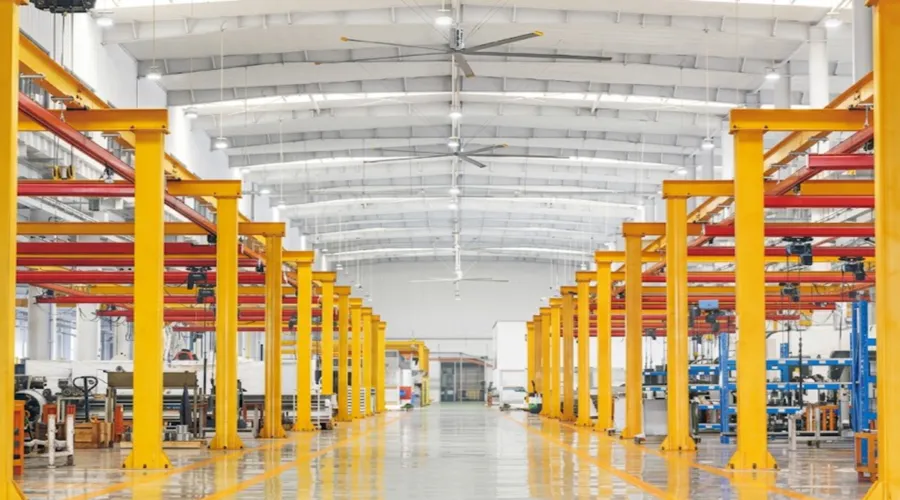
About Our Production Facility — Over Ten Years in Precision Gear Manufacturing
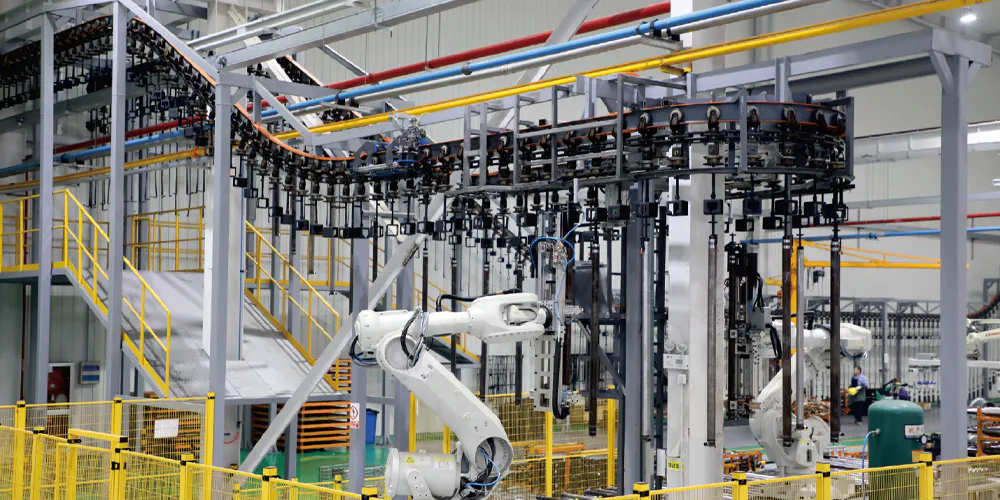
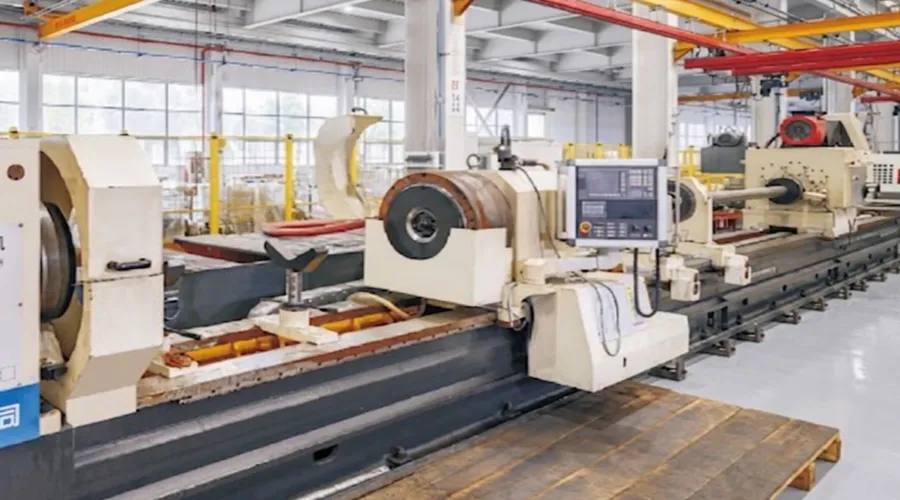
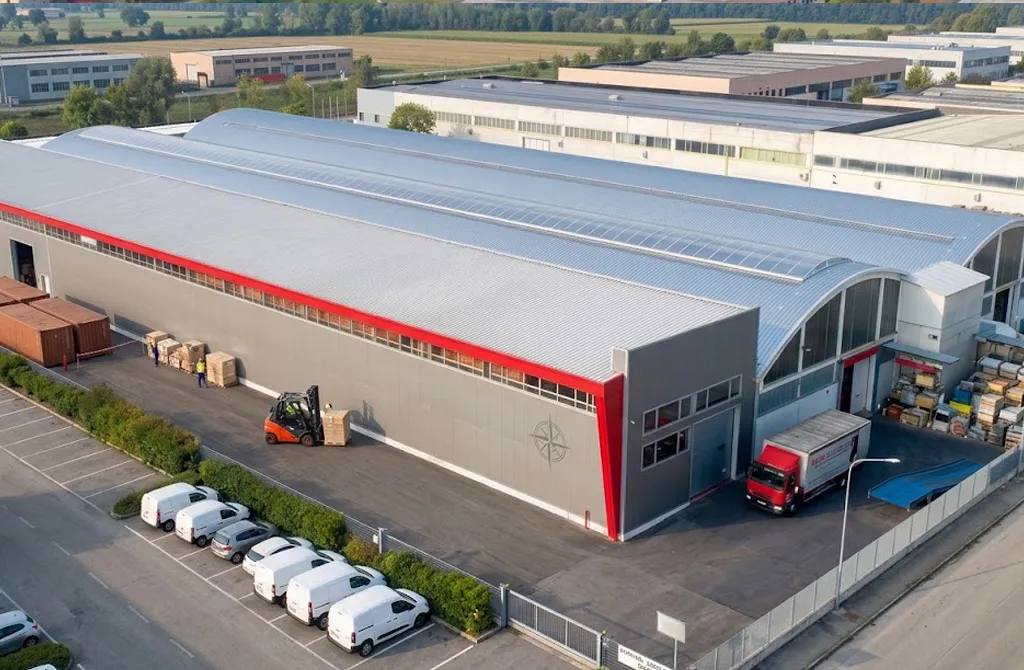
Over a decade of dedicated engineering and production experience underpins every precision forged bevel gear we deliver. Our manufacturing operation covers agricultural gearboxes, worm gear reducers, planetary drive systems, power take-off shafts, hydraulic cylinders, roller chain assemblies, and industrial motors — all within the same ISO 9001:2015 certified quality management framework that governs the EP-Forging Bevel Gear series. This breadth is not incidental: it reflects a genuine systems-level understanding of how a bevel gear interacts with the shafts, bearings, housings, and associated gearing that surround it in a complete drive assembly.
We design and manufacture industrial and agricultural gearbox assemblies using ductile iron, cast iron, cast steel, precision cast steel, and cast aluminum, alongside a comprehensive catalogue of standard and non-standard mechanical components including gears, sprockets, worm gears, pulleys, worms, and transmission shafts. For customers sourcing a forging bevel gear as part of a larger gearbox development programme, this in-house breadth means that the bevel gear, the gearbox housing, the associated helical stages, and the output shaft can all be specified and qualified through a single engineering conversation — eliminating the interface management complexity and supply chain risk of coordinating multiple specialised subcontractors across an OEM product development timeline.
Bengkel
Compatible Products — System Integration from a Single Source
A forging bevel gear performs at its best when the components that surround it — upstream helical stages and downstream linear drives — share the same dimensional accuracy standards and surface quality levels. Sourcing these complementary components from the same manufacturing facility removes tolerance stack-up uncertainty from the gearbox design and simplifies incoming inspection logistics for assembly operations in high-volume automotive and industrial production environments.
Roda Gigi Heliks Ganda
In multi-stage gearboxes, a double helical gear (herringbone) stage provides the primary speed reduction on the parallel input shaft before the forging bevel gear redirects the drive axis. The herringbone geometry cancels the net axial thrust force that a single helical stage would impose on the input shaft bearing, which matters particularly in gearboxes where the forging bevel gear's own mesh is already generating a combined radial and axial load that the housing must manage. Matching the herringbone gear module, accuracy grade, and material certification to the forging bevel gear from the same source reduces the qualification workload at the gearbox system level and ensures unified documentation across a combined drive assembly PPAP submission.
Rak Perlengkapan
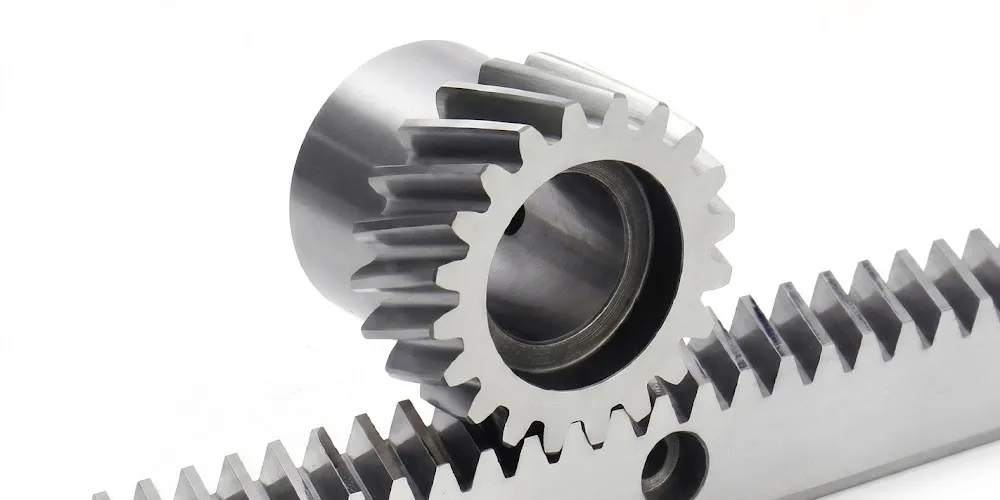
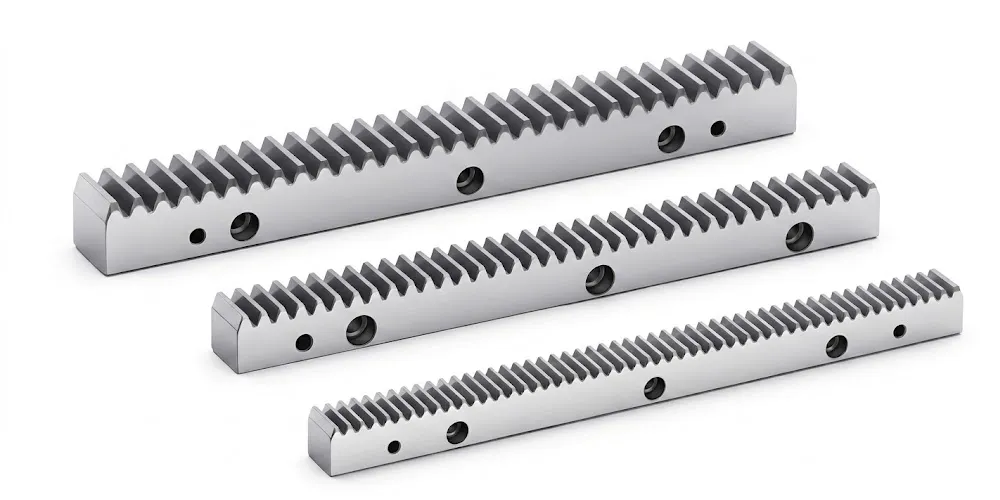
When the rotary output of a bevel gear drive needs to be converted into linear positioning — on a construction crane slewing drive, a marine davit mechanism, or a CNC machine tool linear axis — a gear rack and pinion system provides the conversion. The gear rack module and surface hardness must be matched to the upstream forging bevel gear stage to prevent the rack becoming the life-limiting component in the overall drivetrain. We produce gear racks in the same facility using the same material certification and accuracy grade system as the forging bevel gear range, ensuring that the combined drive system delivers consistent accuracy and service life across the full motion pathway from the motor input to the linear output position.
Frequently Asked Questions — EP-Forging Bevel Gear
Editor: PXY