
Complete Series · Agricultural Transmission
Caixa de engrenagens da enfardadeira quadrada
What Is a Square Baler Gearbox?
A square baler gearbox is the central mechanical transmission unit of a square baling machine. It receives rotational power from the tractor’s PTO shaft (or a dedicated power source), converts it through a precisely engineered gear set, and delivers the adjusted speed and torque to the baler’s main crankshaft, plunger mechanism, knotter, and ancillary drives simultaneously. Without a correctly specified gearbox, the baler cannot produce consistently dense, properly tied rectangular bales — regardless of tractor power or crop conditions.
The gearbox performs two distinct functions that are often underappreciated: speed conversion (either increasing or decreasing shaft speed through a defined gear ratio) and shock isolation (absorbing the inertia discharge events that occur when the plunger meets sudden resistance in a dense crop load). The second function is frequently the determining factor in gearbox service life — a unit sized only to nominal working power will experience tooth fatigue during the inertia events that every square baler generates multiple times per field hour.
Square baler gearboxes range from compact single-output units for mid-range tractors (80–140 hp) through high-peak-rated models for commercial large-square baler platforms (up to 1100 hp peak), dual-output transmissions for automatic-feed machines, and multi-output central gearboxes for big square balers with three simultaneously driven axes. Each type addresses a distinct set of machine kinematic requirements — selecting the wrong type is as consequential as selecting the wrong power rating.
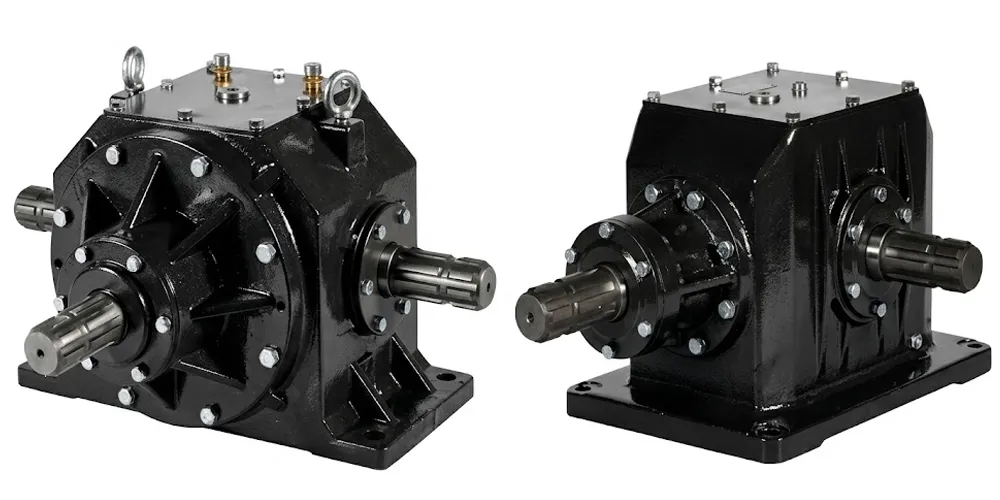
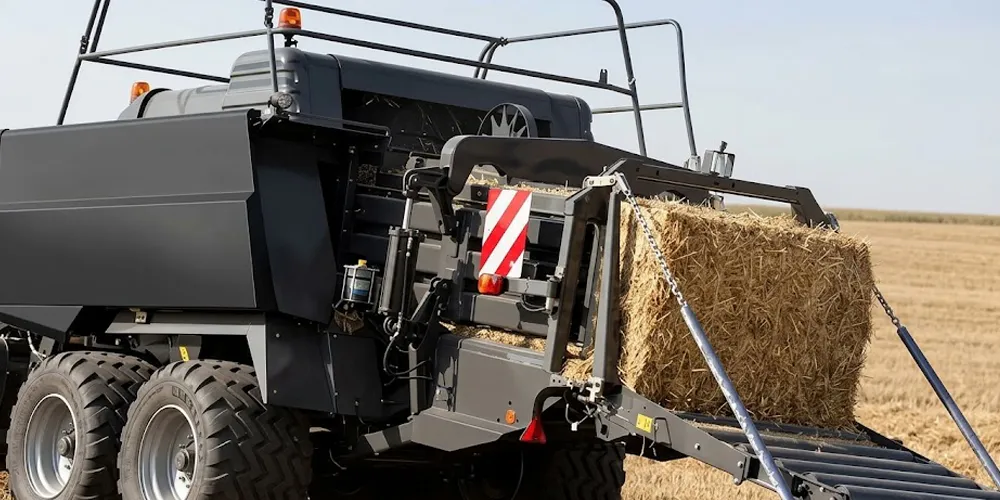
Caixa de engrenagens da enfardadeira quadrada
-
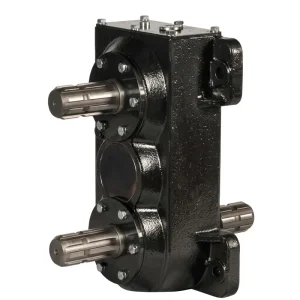
Caixa de engrenagens para enfardadeira quadrada EP-80-120HP
-
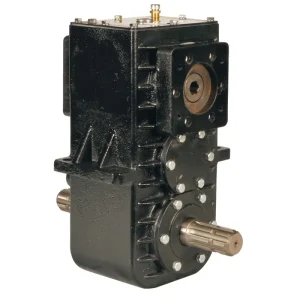
Caixa de engrenagens para enfardadeira quadrada EP-180-250HP (EP-FK263)
-
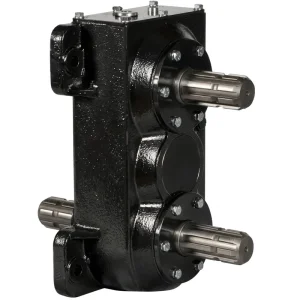
Caixa de engrenagens para enfardadeira quadrada EP-120-140HP (EP-FK270)
-
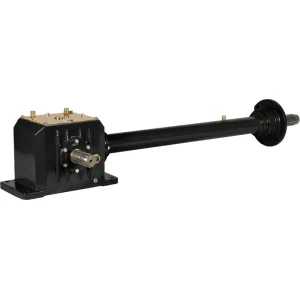
Caixa de Engrenagens para Enfardadeira Quadrada EP-140-500HP
-
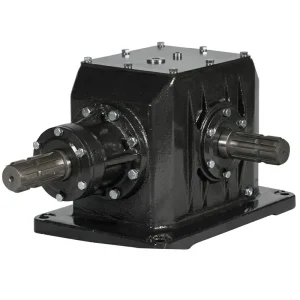
Caixa de Engrenagens para Enfardadeira Quadrada EP-FK150-120-550HP
-
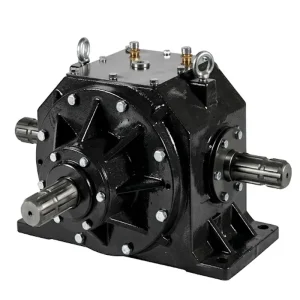
Caixa de engrenagens para enfardadeira quadrada EP-130-1100HP
-
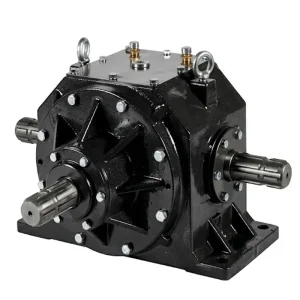
Caixa de engrenagens para enfardadeira quadrada EP-180-700HP
-
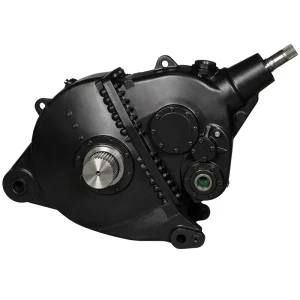
Caixa de engrenagens EP-192kW para enfardadeira de fardos quadrados grandes.
-
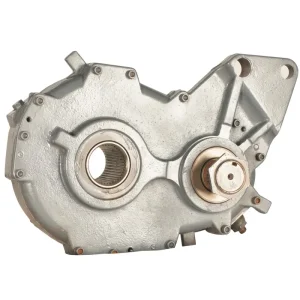
Caixa de engrenagens EP-60HP para enfardadeira de fardos quadrados grandes.
Gleason Straight Teeth vs Gleason Helical Teeth
All models in this series use Gleason-standard bevel gear tooth forms. The two types have distinct performance characteristics that determine which is appropriate for a given application.
| Característica | Gleason Straight Teeth | Gleason Helical Teeth |
|---|---|---|
| Contact Ratio | 1.0 – 1.3 (one pair at a time) | 1.6 – 1.9 (multiple pairs) |
| Empuxo axial | None — pure radial/tangential loads | Present — absorbed by tapered bearings |
| Nível de ruído | Higher at speed | Quieter — smoother tooth engagement |
| Peak Load Capacity | Good — simpler bearing requirements | Higher — load shared across more teeth |
| Aplicação típica | 80 – 550 hp class single-output models | 700 – 1100 hp class and all big baler models |
| Misalignment Tolerance | More forgiving | Requires precise bearing preload |
OEM / ODM
How to Select the Right Square Baler Gearbox
Selecting a square baler gearbox involves four sequential decisions. Work through them in order — an error at any step will result in either inadequate performance or unnecessary over-specification.
Identify Your PTO Input Speed
Most modern agricultural tractors deliver 540 r/min at the standard PTO connection. Some older European models operate at 720 r/min. High-speed PTO outputs at 1000 r/min are used on certain utility tractors and industrial power sources. A dedicated motor-driven installation may deliver 1000 r/min directly. Confirm this from the tractor's operating manual or PTO shaft coupling markings before selecting any gearbox.
Determine the Required Output Speed
The baler's crankshaft design speed is specified in the machine's technical manual or on the original gearbox nameplate. Match the gearbox output speed to this value. The gear ratio is the relationship between your PTO input speed and the required output speed: divide required output by PTO input to find the needed ratio (e.g., 1328 ÷ 540 = 1:2.46). Installing a gearbox with an incorrect ratio will cause knotter mistiming and bale density variation even if the tractor power and mounting are correct.
Specify by Peak Load — Not Nominal Power
The most common selection error is choosing a gearbox based on tractor PTO horsepower rather than the machine's actual peak load. During a plunger jam event, the baler's flywheel kinetic energy discharges through the gearbox in milliseconds — this spike can be 2–5× the tractor's PTO output. A gearbox rated only to nominal working load will fracture teeth under this event. Select by peak load rating (hp or N·m maximum) at least equal to the calculated inertia discharge load — a figure your machine supplier or our engineering team can confirm for your specific baler model and operating conditions.
Verify Dimensional & Interface Compatibility
Before ordering, confirm three dimensional checks against the original gearbox or the baler's drawing: (a) mounting bolt hole pattern and pitch, (b) output shaft diameter, keyway, or spline specification, (c) housing overall envelope versus available frame space. For splined shaft interfaces, confirm the spline standard (metric M-series, or Diametral Pitch DP-series) and both tooth count and pressure angle. A gearbox that is correctly rated but geometrically incompatible requires machine frame modification — avoidable by confirming dimensions before purchase.
Gear Ratio Types Explained
Speed Increase (Step-Up)
The majority of square baler gearboxes are speed-increasing: a 540 r/min PTO input is stepped up to 718–1328 r/min at the output, matching the crankshaft speed required by the baler design. Gear ratios range from 1:1.33 to 1:2.69 in this series. Higher ratios produce faster plunger cycling — greater throughput — but also higher peak inertia loads at the gearbox during jam events.
Direct Drive (1:1)
A 1:1 ratio gearbox passes the PTO speed through unchanged while isolating the baler’s drivetrain from torsional vibration and shock. This configuration suits balers whose crankshaft is already designed to run at PTO speed (540 r/min) without an intermediate step. The gearbox adds structural rigidity and shock damping to the coupling, not a speed change.
Speed Reduction (Step-Down)
Deceleration gearboxes reduce the input speed while multiplying torque proportionally. Used at secondary drive positions on big square balers — density adjustment mechanisms, feed roll drives, hydraulic pump drives — where the mechanism must operate at low speed under high sustained torque. The 2.1:1 deceleration model in this series converts 266 r/min to 126 r/min with 45 kW / 60 hp capacity.
Service & Maintenance Guidance
Every 50 Hours
Check oil level at sight glass or dipstick. Inspect shaft seals for early weeping. Check mounting bolt torque on base flange — cyclic peak loads progressively loosen improperly torqued fasteners. Clean debris from around shaft seals and housing vents.
Every 200–250 Hours
Complete oil drain, flush, and refill with ISO VG 220 GL-4 or GL-5 gear oil (confirm grade for your specific model). Inspect and replace shaft seals if any weeping is visible — a seal change at planned intervals costs a fraction of the oil contamination damage that a failed seal allows. Check shaft axial play.
At 1500–2500 Hours
Bearing inspection and replacement if axial play exceeds 0.05–0.08 mm at shaft end. Gear tooth surface inspection via borescope or oil debris analysis — pitting on more than 15% of active tooth face area indicates fatigue progression toward fracture. Plan rebuild or replacement before the fracture event rather than after it.
Failure Indicators
Knocking noise under load (not audible at idle): gear tooth damage or bearing spalling. Oil discoloration to dark brown with metallic sheen: wear particles in suspension. Output shaft radial play visible by hand: bearing inner ring loosening. Oil weeping at input shaft: dust lip damaged, replacing before the primary lip fails preserves the bearing.