
Construction & Material Handling · Application Guide
A technical reference for logistics automation engineers, warehouse systems integrators, and procurement teams specifying worm gear single speed reducers for fulfillment center conveyor, sorter, and pallet drive systems across the United States, Germany, the United Kingdom, Japan, Australia, and the Netherlands.
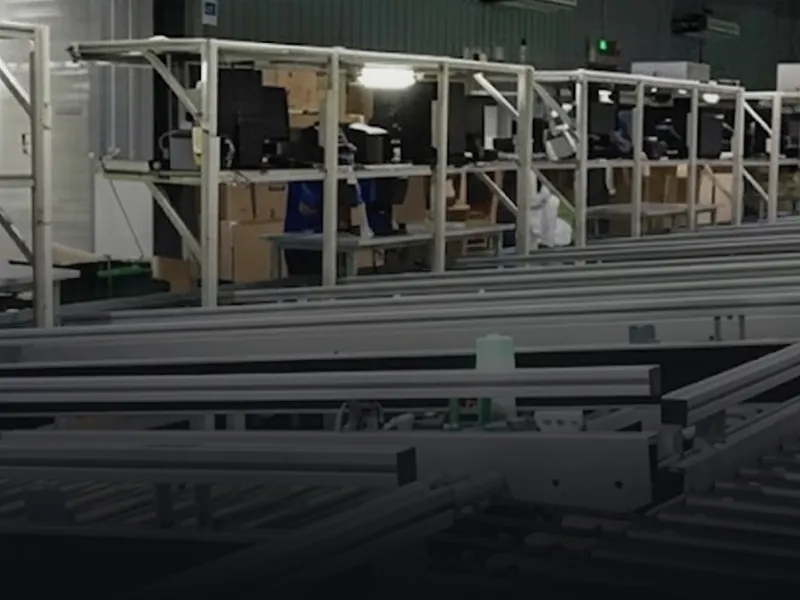
The growth of e-commerce has placed warehouse conveyor and sorting systems under a level of operational intensity that static retail distribution centres never encountered. A major fulfillment centre in the United States or Germany may run 20 or more hours per day during peak season, with conveyor systems that collectively carry tens of thousands of packages per hour through receiving, sorting, packing, and outbound consolidation. Every belt drive, roller conveyor drive, pallet chain drive, and sorter divert drive in this network is powered by a motor-reducer combination, and the single speed reducer — specifically the compact, low-noise worm gear type — is the most widely specified choice for the lower and mid-power bracket of these applications.
What separates e-commerce logistics from most other single speed reducer applications is the emphasis on three operational factors that are rarely primary selection criteria in heavy industry: noise level, positioning accuracy, and maintenance accessibility. A warehouse sorting system must operate quietly enough to maintain a safe working environment for staff on the fulfillment floor — a کاهنده دنده کرم that vibrates or whines affects both compliance with occupational noise exposure regulations (EN ISO 11690 in Germany; OSHA 1910.95 in the United States) and the accuracy of acoustic sensors that sort packages by detecting audible impacts. Positioning accuracy matters because sortation divert mechanisms, accumulation conveyor gap-control units, and pick-to-light conveyor indexers must stop and start at precisely controlled positions. And maintenance accessibility determines how quickly a single failed reducer unit can be swapped without disrupting the network around it.
Drive System Architecture in Warehouse and Sorting Facilities
A modern fulfillment centre uses four distinct conveyor drive types, each with different speed, torque, and duty profile requirements for the single speed gear reducer. Belt conveyors — the backbone of the system, running product horizontally between stations — operate at 0.3–1.5 m/s and require low-speed, high-torque drives with reduction ratios of 15:1 to 40:1. Roller conveyors in accumulation zones run slower (0.1–0.5 m/s) and must stop and start frequently as packages queue — the single stage speed reducer on these drives must handle high start frequency without thermal overload. Pallet conveyors — heavy-duty chain-driven decks moving unit loads of 500–2000 kg — require the highest torque outputs and the most structurally robust reducer frames. Sorter divert drives — the belt shoes, pop-up rollers, and paddle arms that redirect individual packages — demand high positional repeatability at each divert event, which favours the low-backlash characteristic of a well-specified worm gear mesh over a helical or bevel-helical alternative with greater inherent backlash.
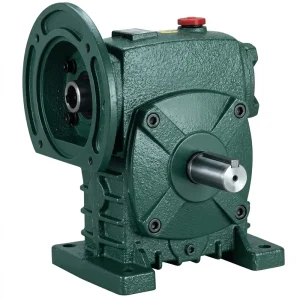
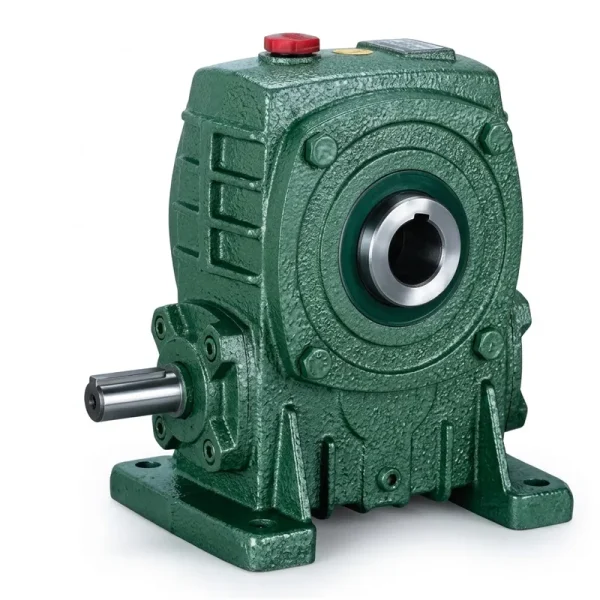
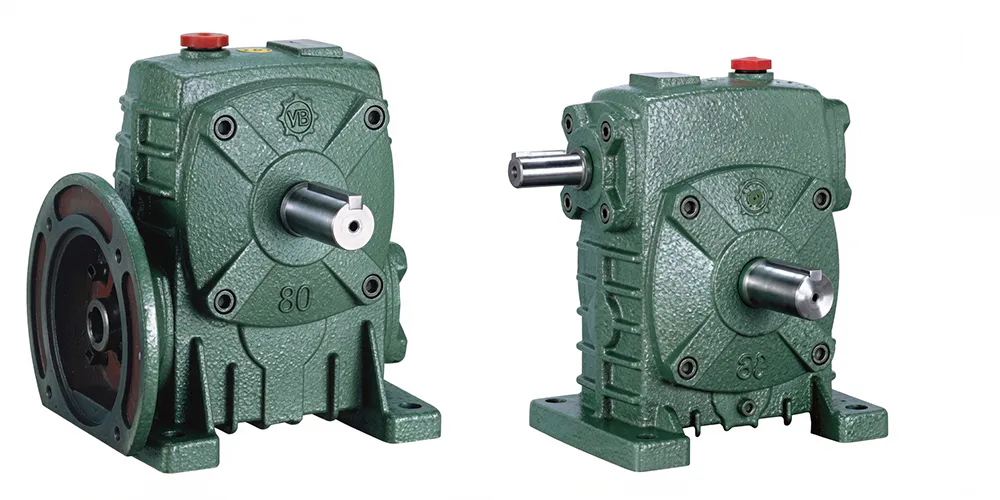
The vast majority of these drives are powered by three-phase asynchronous motors in the 0.12–7.5 kW range, controlled by variable-frequency drives (VFDs) for speed regulation and soft-start capability. The single speed reducer provides the fixed gear ratio and torque multiplication in this motor-VFD-reducer chain, with the VFD providing the fine-speed adjustment and the reducer providing the mechanical output at the conveyor drive sprocket or roller. In European fulfillment centres — the largest concentration of automated logistics in Germany, the Netherlands, and the United Kingdom — the compact NMRV-type worm gearmotor has been the industry standard for belt conveyor head drives for over two decades, and the WP-series open-frame reducers cover the heavier pallet conveyor and sorter drive applications where gearmotors are impractical.
Manufacturing Structure for Low-Noise, High-Cycle Logistics Service
الف single speed worm reducer for e-commerce logistics service must be manufactured to tighter noise and vibration specifications than a comparable unit for industrial conveyor use. The primary source of noise in a worm gear reducer is the worm mesh: variations in tooth-to-tooth contact stiffness as each tooth enters and exits engagement create a pressure wave at the mesh frequency and its harmonics. The amplitude of this noise is directly governed by the worm thread profile accuracy and surface finish — a reduction in worm flank surface roughness from Ra 0.8 µm (standard catalogue finish) to Ra 0.4 µm (precision finish) typically reduces airborne noise at the mesh frequency by 4–6 dB, which is perceptually significant in a warehouse environment where dozens of drives are running simultaneously.
The housing for a logistics-grade single speed reducer uses precision-bored bearing seats with closer position tolerances than standard industrial catalogue units — typically ±0.01 mm on bearing bore diameter and ±0.02 mm on the centreline-to-centreline distance between worm shaft and wheel. These tighter tolerances minimise the variation in mesh backlash across a population of units (important when hundreds of identical reducers are installed in a single sortation loop), and reduce the tooth engagement noise that arises from excessive backlash at each meshing impact. Housing wall sections are specified with minimum-resonance geometry: the wall thickness-to-surface-area ratio is optimised to avoid structural resonances in the 200–1000 Hz range that coincides with the typical mesh frequency of compact warehouse reducers running at belt speeds of 0.5–1.5 m/s.
Material System for Logistics and Sortation Drives
Case-carburised alloy steel, hardened to HRC 60–62 and ground to Ra 0.4 µm on both drive and coast flanks. The precision ground finish on the coast flank is important for logistics drives: frequent start-stop cycles engage the coast flank repeatedly at low speed, and a rough coast flank generates audible impact noise at each direction change or braking event that is unacceptable in occupied warehouse spaces.
High-tin phosphor bronze tooth ring, centrifugally cast for dense microstructure and then finish-hobbed to tight tooth profile tolerances. The fine grain of centrifugally cast bronze produces lower surface roughness after hobbing than sand-cast material, contributing directly to the reduced mesh noise that is a primary performance specification for logistics centre drives — particularly for sortation systems where acoustic package detection is part of the facility’s tracking and QC process.
Die-cast aluminium alloy (A380 or equivalent) for compact frame sizes up to approximately 100 mm centre distance, providing the weight reduction important in multi-level conveyor mezzanine structures where the aggregate weight of dozens of drives adds significantly to the mezzanine structural load. The die-casting process produces consistent, repeatable wall thicknesses that avoid the resonant hot spots found in irregularly cast grey iron housing sections.
For compact single-direction logistics conveyor drives, deep-groove ball bearings with C3 internal clearance and lifetime-lubricated sealed shields provide the low friction torque needed for smooth VFD-controlled low-speed starts, and eliminate the periodic bearing re-greasing requirement that is impractical when hundreds of drives are installed at various heights in a multi-level fulfillment system. Pre-lubricated sealed bearings are re-placeable as a unit without housing disassembly in most WP-series frame sizes.
PTFE-faced radial shaft seals are specified for logistics drives rather than standard NBR rubber lip seals, for two reasons. The PTFE face provides lower running friction — reducing the breakaway torque at each VFD-commanded start, which directly affects the accuracy of the positioning stop. The PTFE face also resists the cleaning chemicals (primarily quaternary ammonium compounds and food-grade sanitisers in cold-chain logistics facilities) that are sprayed on conveyor surfaces during hygiene maintenance cycles in pharmaceutical, food, and beverage fulfillment operations.
Pharmaceutical and food fulfillment operations in Australia, the EU, and North America require reducers in the packaging-adjacent zone to be lubricated with NSF H1 registered food-grade gear oil to prevent contamination risk from incidental oil contact with product packaging. NSF H1 registered synthetic PAO ISO VG 220 worm gear oils are available in tin-bronze-compatible formulations and meet the lubrication performance requirements of the single speed reducer while complying with the food safety standards applicable in these facilities.
Selection Reference — Single Speed Reducers for Logistics and Sorting Applications
The table below provides selection guidance across the principal conveyor and sorter drive types in a modern fulfillment centre. All entries assume a 4-pole (1450 RPM) motor and a service factor of 1.25–1.5 applied to the running torque before entering the reducer catalogue. The complete product range with torque-ratio tables is at the single speed reducer product page.
| Drive Function | Belt/Chain Speed | Motor (kW) | نسبت | Series |
|---|---|---|---|---|
| Flat belt conveyor (light package) | 0.5 – 1.5 m/s | 0.12 – 0.75 | 15:1 – 30:1 | EP-WPDS (0.12 – 15 kW) |
| Accumulation roller conveyor | 0.1 – 0.5 m/s | 0.25 – 1.1 | 25:1 – 50:1 | EP-WPDS / EP-WPKZ |
| Sortation divert mechanism | Variable / index | 0.37 – 1.5 | 20:1 – 40:1 | EP-WPDS / EP-WPKA |
| Pallet chain conveyor (medium) | 0.1 – 0.3 m/s | 1.5 – 5.5 | 30:1 – 60:1 | EP-WPKA (5–260 kg) |
| Pallet conveyor (heavy, 2000 kg) | 0.05 – 0.2 m/s | 5.5 – 11 | 40:1 – 60:1 | EP-WPKS (4–365 kg) |
| Warehouse truck loading dock leveller | Hydraulic / slow | 0.75 – 3.0 | 40:1 – 60:1 | EP-WPKA / EP-WPDS |
Recommended Products for Logistics and Warehouse Applications
Noise Compliance and Occupational Health in Logistics Facilities
Occupational noise exposure in fulfillment centres is a regulated threshold in all major e-commerce markets. In Germany, the Workplace Ordinance (BetrSichV) and DIN EN ISO 11690 require that noise-generating equipment be assessed at the planning stage, and that the combined noise level at operator workstations does not exceed 80 dB(A) averaged over an 8-hour shift without hearing protection. In the United States, OSHA 29 CFR 1910.95 sets an 85 dB(A) action level for an 8-hour shift. A large sortation system with 200–400 individual drive units can readily generate an aggregate noise level approaching these thresholds if each reducer generates 58–62 dB(A) of airborne noise at one metre.
The noise contribution of a single speed worm reducer in a logistics conveyor application is dominated by the worm mesh frequency tone and its harmonics. Specifying precision-ground worm flanks (Ra 0.4 µm) and a minimum-resonance housing geometry reduces the mesh tone by 4–8 dB compared with standard catalogue specification, providing meaningful headroom below the regulatory threshold even in dense drive-array installations. For particularly noise-sensitive zones — quality control stations, pick-to-light workstations, and customer service areas within or adjacent to the fulfillment floor — further noise reduction is achievable by combining the low-noise reducer specification with an anti-vibration pad between the reducer foot and the conveyor frame, which attenuates the structure-borne transmission path that contributes 3–5 dB to the total noise level at the workstation independent of the airborne emission from the reducer housing itself.
High-Cycle Start-Stop Service and Service Factor Application
The start-stop duty cycle of an accumulation conveyor or sortation divert drive in a peak-season fulfillment centre is one of the most demanding thermal loading conditions a compact single stage speed reducer encounters. In a high-throughput sortation loop, each divert mechanism may cycle 1200–2400 times per hour — a start, an index, and a stop approximately every 1.5–3 seconds. Each start event draws 2–3 times the steady-state running current and imposes a proportionally elevated torque spike on the worm gear mesh. At this cycle frequency, the thermal accumulation in the compact reducer housing can reach critical levels within 30–60 minutes if the reducer was selected without a service factor adequate for the duty cycle.
The correct service factor approach for high-cycle logistics drives combines the base smooth-load factor (1.0 for VFD-soft-started drives) with an addition for cycle frequency above the baseline of 2 starts per hour (typically +0.1 per additional 2 starts per hour, capped at a total addition of 0.5 for extremely high-cycle indexers). For the highest-cycle applications — 1200+ starts per hour — the result is a combined factor of 1.5–1.75, and the frame size selected must carry this corrected torque continuously without the sump temperature exceeding the limit for the synthetic PAO oil specified. A thermal check calculation comparing the reducer’s rated thermal capacity (from the catalogue dissipation curves) against the actual heat input rate at the service factor is strongly recommended for sortation drive specifications in Japanese and German logistics installations, where the throughput density per square metre of conveyor system is the highest in the world.
Maintainability — Rapid Swap-Out in Operating Facilities
In a fulfillment centre that operates 20 hours per day during peak season, an unplanned conveyor drive failure at any point in the sortation network can back up packages through the entire preceding system within minutes. The maintenance response time from fault detection to conveyor restart is one of the most commercially important parameters in logistics facility design — and it is directly affected by how quickly a failed single speed reducer can be removed and replaced. WP-series reducer designs with standard IEC flange inputs, foot-mount provisions, and hollow-shaft outputs support rapid swap-out: the motor is disconnected (5 minutes), the torque arm bolt is released (2 minutes), the hollow bore shrink-disc is released (5 minutes), and the new unit is installed in reverse sequence. Total motor-to-restart time with a pre-staged spare unit is typically 20–30 minutes for a trained maintenance technician — comparable to a rotating spare strategy in a manufacturing plant and far faster than the 2–4 hours required to align a solid-shaft coupled replacement.
Standard stocking of one spare reducer per 30–50 drive stations — a ratio used by major logistics operators in the UK, Netherlands, and United States — balances capital cost against downtime risk. The WP-series dimensioning approach (standardised housing sizes, IEC-standard input flanges, consistent mounting hole patterns across output torque increments) means that a spare unit covers a range of conveyor drive positions rather than being tied to a single specific location, improving the effective coverage of the spare stock. For very large facilities — 500+ drives in a single sortation loop — formal failure mode and maintenance records are kept by warehouse management system integration, and the planned replacement intervals for high-cycle sortation divert drives are typically set at 18 000–24 000 operating hours based on field experience in Japanese and European automated distribution centres.
قابلیت تولید
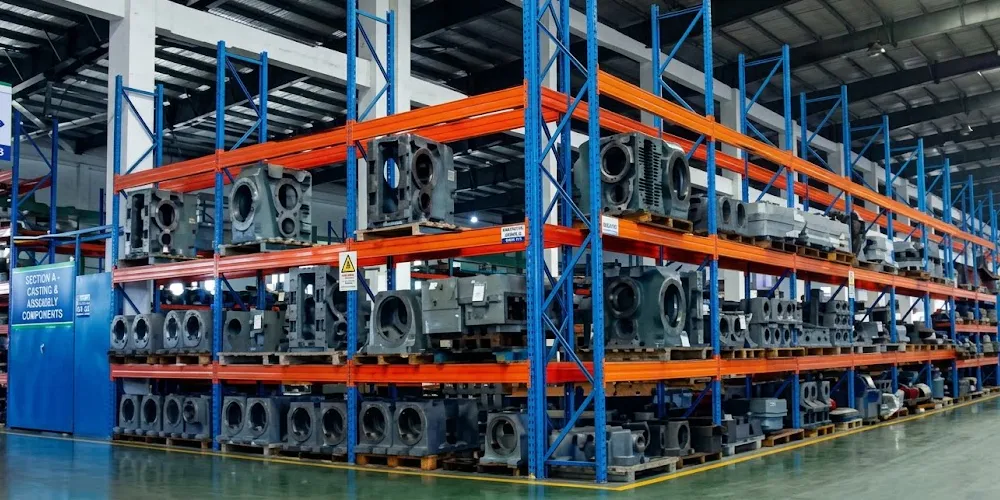
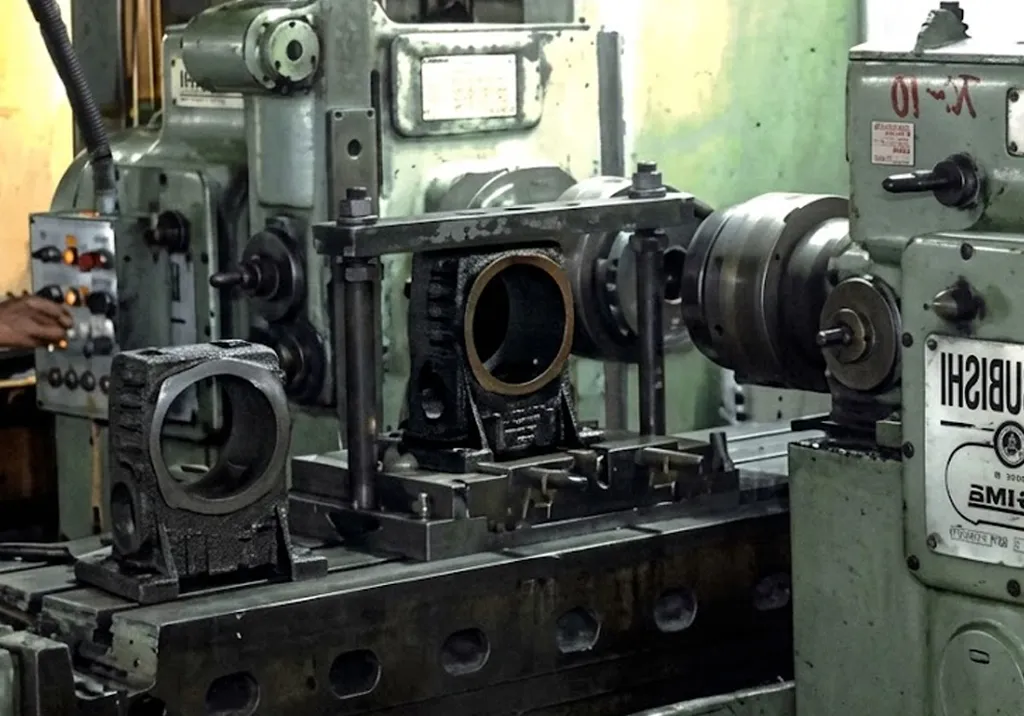
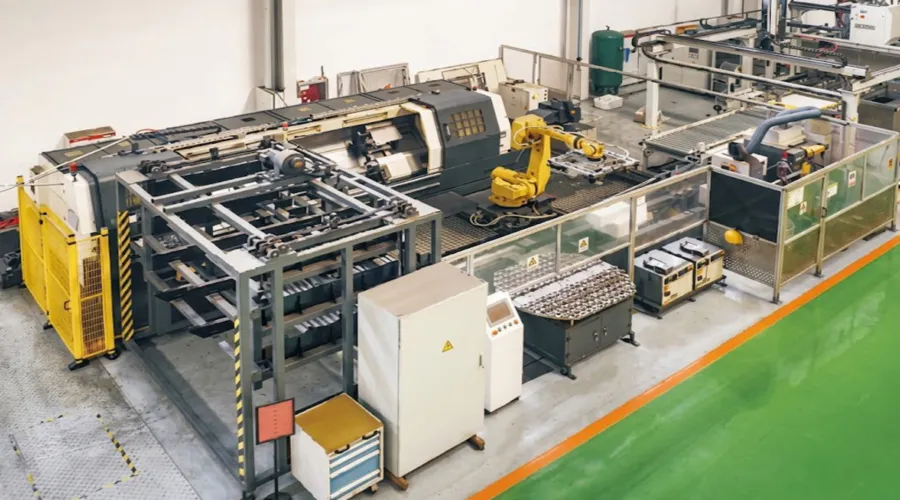
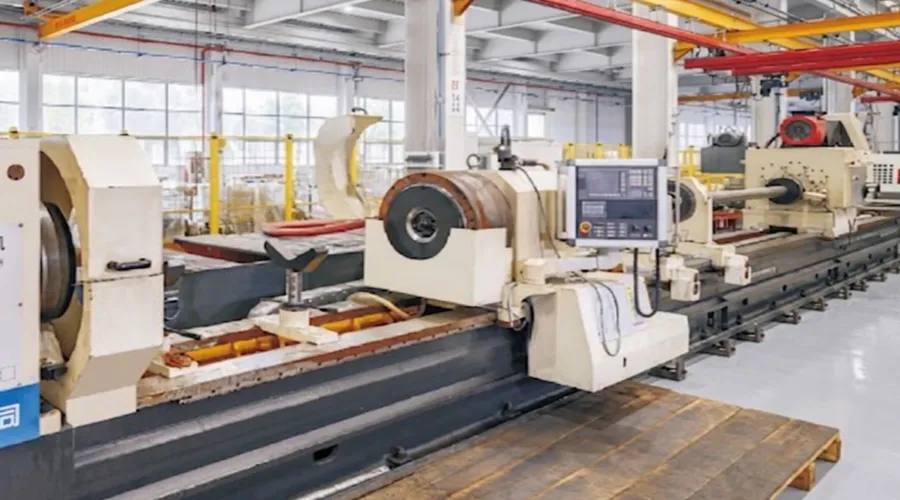
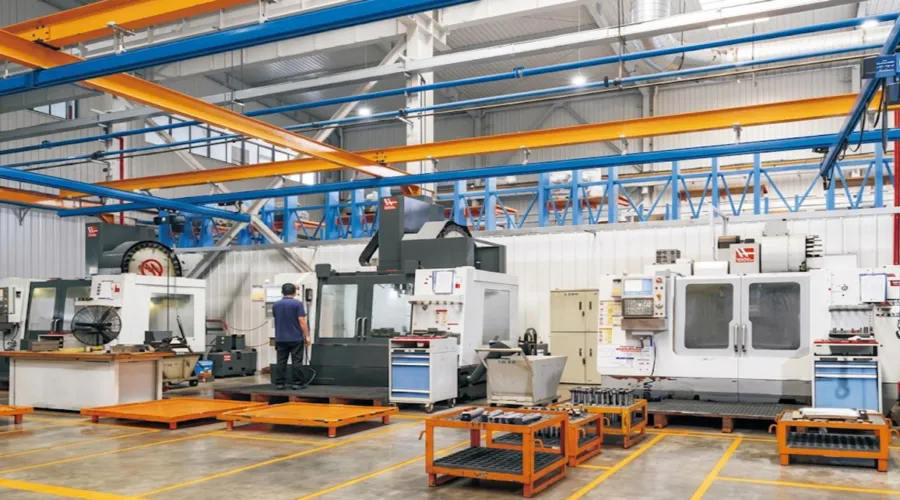
Our manufacturing facility has more than ten years of engineering experience in mechanical power transmission, supplying worm gear reducers, planetary gear drives, agricultural gearboxes, power take-off shafts, hydraulic cylinders, precision gears, roller chains, and electric motors to logistics, automation, construction, and industrial equipment markets — all under ISO 9001:2015 quality management system certification. Structural housing components are produced in ductile iron, grey cast iron, cast steel, precision investment-cast steel, and aluminium alloy selected for the specific load, noise, and weight requirements of each product. Gear teeth, worm shafts, sprockets, pulleys, and output shafts are machined to DIN and ISO dimensional standards on multi-axis CNC hobbing, grinding, and turning centres. Customers requiring a complete conveyor drive system — reducer, motor, coupling hardware, and mounting provisions — can source all elements from a single technically accountable supplier, simplifying procurement for logistics automation system integrators in the United States, Germany, the Netherlands, the United Kingdom, Japan, and Australia.
کارگاه
Compatible Drive Components
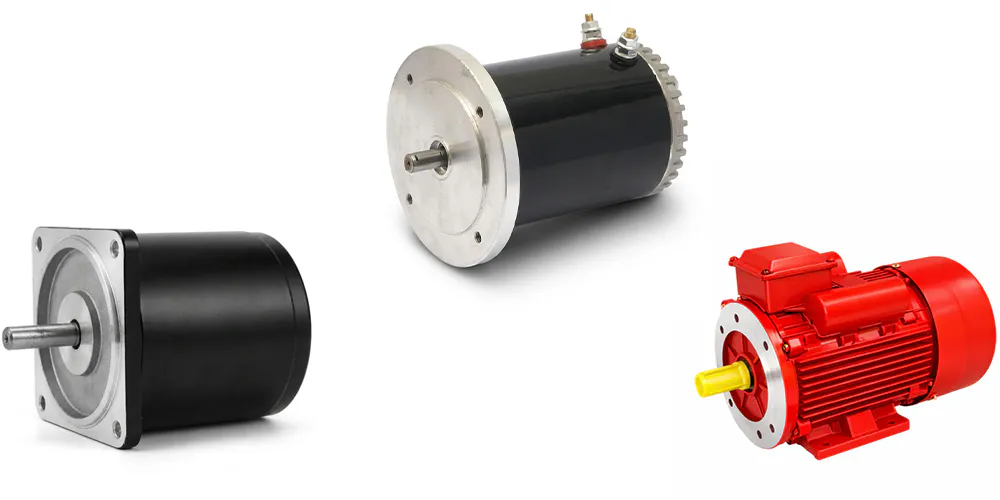
A complete warehouse conveyor drive system requires a matched motor and, for variable-speed sortation applications, compatible VFD-ready motor specifications. The following product lines are available from the same manufacturing source.
سوالات متداول
تدوینگر: PXY