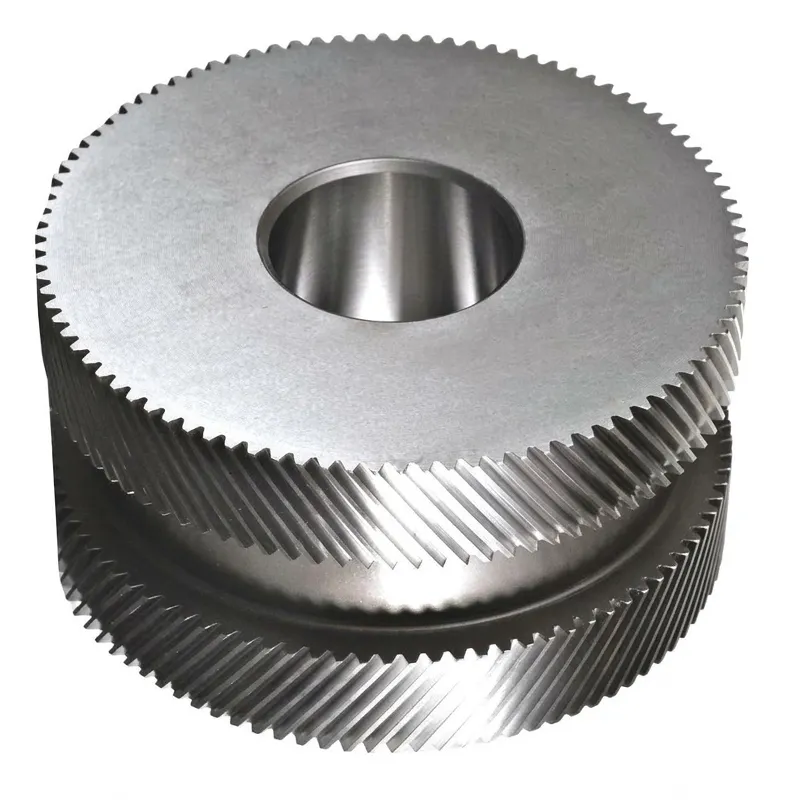
Ingranaggio a doppia elica in acciaio al carbonio EP
The EP-Carbon Steel double helical gear is engineered for industrial power transmission environments where load capacity, toughness, and cost-efficiency all matter.
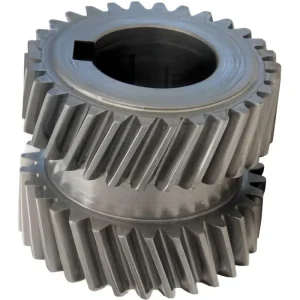
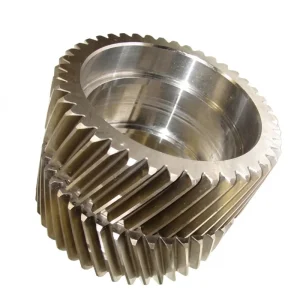
The double helical tooth geometry of this gear brings the same mechanical advantages found across the entire double helical gear product family: opposing helix angles that cancel axial thrust internally, higher contact ratios than spur gears, and smoother, quieter mesh behavior under load. The EP-Carbon Steel variant is dimensioned with a thickness range of 50 to 150 mm and a hobbing capacity of 5 to 100 mm, making it a practical solution for mid-to-large scale parallel shaft gearbox builds, industrial conveyor drives, and heavy-process machinery across sectors from steel production to mining, quarrying, cement, and general manufacturing. All geometric parameters — module, number of teeth, helix angle, bore diameter, and keyway — are available for custom specification to match your existing drivetrain.
Material: Carbon Steel | Thickness: 50 – 150 mm | Hobbing Capacity: 5 – 100 mm | Pressure Angle: 20°
Material Grade: SS304 (base stock) | Fully Customizable | Factory-Direct Supply
Specifiche tecniche
The following table summarizes the standard parameters of the EP-Carbon Steel double helical gear. All values marked as customizable can be specified per customer drawing or application requirement. Contact our engineering team for non-standard module, helix angle, or surface treatment requirements.
| Parametro | Standard Value | Customizable Range |
|---|---|---|
| Tipo di ingranaggio | Ingranaggio a doppia elica | — |
| Materiale | Carbon Steel (C45, 40Cr, 20CrMnTi) | Alloy steel, customized per spec |
| Material Grade (Base Stock) | SS304 / Carbon steel, customized | Per customer drawing |
| Thickness (Face Width) | 50 – 150 mm | Customized per application |
| Hobbing Capacity | 5 – 100 mm | — |
| Pressure Angle | 20° | 14.5° available |
| Modulo | M1 – M20 (standard) | Non-standard module on request |
| Helix Angle (each half) | 15° – 35° (opposing) | Up to 45° per requirement |
| Numero di denti | 10 – 300 (custom) | Per specification |
| Tooth Flank Hardness | HRC 50 – 62 (case-carburized) | Through-hardened or normalized |
| Precision Grade | DIN 6 – 8 / AGMA 10 – 12 | DIN 5 on request (ground) |
| Trattamento superficiale | Blackening / phosphating | Zinc plating, nickel plating, bare |
| Max Pitch-Line Velocity | Up to 25 m/s (ground grade) | Per gear grade and lubrication |
| Outer Dimensions (L × OD) | Per drawing (e.g., 100 mm × 250 mm) | Fully customizable |
Five Key Advantages of the Carbon Steel Double Helical Gear
High Torque Capacity
Carbon steel grades used in this double helical gear achieve significantly higher bending strength and surface hardness than many alternative materials after heat treatment. Through-hardening or case-carburizing brings the tooth flank hardness to the range needed for heavy continuous-duty drives — conveyor systems, large parallel shaft gearboxes, and mill drives — without the geometric distortion risk of bulk through-hardening in thicker sections. The result is a double helical gear that sustains high torque loads reliably over long service intervals.
Self-Balancing Axial Thrust
Like every double helical gear in this family, the carbon steel variant features two mirror-image helical tooth rows whose axial force vectors cancel each other. Shaft bearings carry radial load only, extending their operating life and removing the need for dedicated thrust bearing arrangements. This is one of the core advantages of double helical gear geometry over single helical designs and is especially valuable in heavily loaded applications where thrust bearing maintenance is costly or operationally disruptive.
Wide Thickness Range — 50 to 150 mm
The available face width range of 50 to 150 mm makes this double helical gear adaptable across a broad spectrum of drive sizes. Narrower face widths suit compact gearbox stages where space is constrained; wider faces increase torque capacity and load sharing across the helical tooth contact. Selecting the right face width for a given application is part of the double helical gear design process our engineering team supports, ensuring the gear you order is correctly proportioned for the transmitted power and required service life.
Precision Hobbing to 100 mm
Hobbing capacity of 5 to 100 mm covers the range from small-module pinion gears through to medium-large industrial gear stages. Hobbing is the preferred process for helical gear machining at scale because it generates consistent involute profiles with repeatable accuracy across a production batch. Our gear hobbing machines are calibrated to deliver tooth profile and lead deviations within DIN tolerance bands, and post-hobbing grinding is available for applications requiring the tightest precision grades.
Full Custom Configuration
Gear module, pressure angle, number of teeth, helix angle, bore diameter, keyway dimensions, surface treatment, and material grade are all open to specification. Our manufacturing team can work from customer drawings, sample gears, or a set of operating parameters — speed, power, ratio, centre distance — and back-calculate the required double helical gear geometry. Custom made helical gears are a core part of what we do, and first-article samples with dimensional inspection reports can be supplied before production quantities are released.
Working Principle of the Double Helical Gear
To understand why the double helical gear occupies the upper tier of parallel-shaft gear technology, it helps to trace exactly what happens during mesh. As the driving gear rotates, engagement with the mating pinion begins at a single point on one edge of the tooth — not across the entire face simultaneously, as occurs with a spur gear. This point of contact then travels diagonally along the tooth flank in a smooth rolling motion until it exits at the opposite end. Meanwhile the next tooth pair has already begun to engage, so the load is always shared across at least two tooth pairs and often more. This is the contact ratio advantage that helical teeth deliver regardless of whether the gear is single or double helical.
What distinguishes the double helical gear is the second set of helical teeth, angled in the exact opposite direction to the first. As the left-hand helix tries to push the gear axially to the left, the right-hand helix generates an equal and opposite force to the right. These cancel, leaving the gear shaft in a state of near-zero axial thrust. No external thrust bearings are required to absorb this load. In a heavily loaded carbon steel double helical gear transmitting hundreds of kilowatts, the forces that would otherwise stress the thrust bearing arrangement are entirely resolved within the gear mesh itself — a mechanically elegant solution that directly improves drivetrain reliability.
The relief groove visible at the center of most double helical gears is a feature of the manufacturing process rather than a structural element. It allows the hobbing cutter to exit the tooth space after generating each helix without interfering with the opposing set. This groove makes the carbon steel double helical gear straightforward to manufacture on standard gear-cutting equipment and easy to inspect dimensionally, without compromising its mechanical performance.
Material, Heat Treatment & Quality Assurance
Carbon steel is selected for the EP-Carbon Steel double helical gear because it provides an optimal balance between raw material strength, heat-treatment response, machinability, and economy. Depending on the application duty and required hardness profile, we work with medium-carbon grades such as C45 or 40Cr, and high-alloy case-hardening grades such as 20CrMnTi or 17CrNiMo6 for demanding high-cycle applications. The specific helical gear material grade is confirmed at the quotation stage based on the transmitted torque, required hardness, and operating environment the customer describes.
The heat treatment sequence for a typical carbon steel double helical gear begins with normalizing or annealing after forging to relieve residual stresses in the blank. Rough machining and semi-finishing follow, after which the gear undergoes carburizing, quenching, and low-temperature tempering — or induction hardening where surface hardness is required without full-depth carburization. After heat treatment, gear grinding corrects any thermal distortion in the tooth profile, ensuring the finished gear meets the declared DIN or AGMA precision grade. All stages are documented in our process traveller, and customers requesting material test certificates, hardness reports, and dimensional inspection data can have these included as part of the delivery package.
Our facility holds ISO 9001:2015 certification and applies this quality framework to every batch of carbon steel double helical gears. Traceability from raw material heat number through to final inspection record is maintained for every order, making this product a credible choice for OEM programs with rigorous supplier qualification requirements as well as for one-off replacement gear orders in European, North American, and Asia-Pacific markets.
Double Helical Gear Design: Engineering the Right Solution
Good double helical gear design starts with a clear picture of the operating conditions: transmitted power, input speed, gear ratio, duty cycle, and any constraints on center distance or housing envelope. From these inputs, the gear designer calculates the required module — which controls tooth size and bending strength — and selects a helix angle that delivers an adequate contact ratio without making the gear unnecessarily wide or difficult to machine. For carbon steel double helical gears in heavy-industrial service, helix angles between 25° and 35° per half are common, as they balance load distribution, noise performance, and the practicalities of helical gear milling at large face widths.
Material selection follows from the stress calculations. Medium-carbon grades like C45 are adequate for moderate-speed, moderate-load applications where cost matters and surface hardness requirements are not extreme. For higher duty — higher pitch-line velocities, shock loading, or longer required life — case-hardening alloy steels like 20CrMnTi or 17CrNiMo6 are specified. The helical gear material choice and heat treatment sequence are not independent decisions: the carburizing depth, quench severity, and tempering temperature all interact to set the final hardness profile across the tooth, and getting this right is central to achieving the rated load capacity of the finished double helical gear.
Tooth profile modifications — tip relief, profile crowning, and lead crowning — are increasingly standard practice on precision carbon steel double helical gears for high-speed or heavily loaded applications. Tip relief reduces the dynamic load spike that occurs at tooth entry and exit, which otherwise causes noise and accelerates tooth surface fatigue. Lead crowning compensates for minor shaft deflections and housing bore misalignment, ensuring the load is not concentrated at the tooth edges. These modifications are straightforward to implement during gear grinding and contribute meaningfully to the service life of the finished gear.
Application Scenarios for Carbon Steel Double Helical Gears
Carbon steel double helical gears cover the broadest range of heavy industrial drive applications. Their combination of high strength, established heat-treatment pathways, and competitive material cost makes them the workhorses of industrial power transmission worldwide — from German steel mills to mining operations in Australia, from cement plants in the Middle East to paper mills in Scandinavia. The following application categories represent where the EP-Carbon Steel double helical gear is most frequently specified.
Rolling Mill & Metalworking Drives
Hot strip and plate rolling mills place enormous shock and overload demands on gear trains. Carbon steel double helical gears in these applications are typically case-carburized to achieve a hard wear surface over a tough core — a hardness profile that resists both tooth face pitting and bending fatigue. The large face widths available in this product range, up to 150 mm, allow the torque to be distributed across a wide tooth contact zone, keeping Hertz contact stresses within design limits even under peak rolling loads.
Mining, Quarrying & Bulk Materials Handling
Conveyor drive gearboxes, ball mill pinions, and crusher gear stages in the global mining sector rely on carbon steel double helical gears for their toughness and repairability. When a gear does eventually wear in a remote mining operation in Western Australia, the Andes, or sub-Saharan Africa, carbon steel is the most readily replaceable material with the broadest local support network for heat treatment and machining. The self-balancing axial thrust of the double helical gear also reduces the total bearing count required in multi-stage conveyor gearboxes, simplifying maintenance.
Cement & Minerals Processing
Kiln drives, raw mill gearboxes, and finish mill gear stages in cement plants are among the highest-torque, lowest-speed continuous-duty applications in industry. Carbon steel double helical gears in these drives are typically large in diameter with wide faces, and are specified with normalized or through-hardened tooth profiles to maximize toughness under the slow-rolling, high-load conditions typical of a cement plant drivetrain. The double helical gear uses in this sector span both helical pinion gears driving large bull gears and fully matched double helical gear sets within multi-stage speed reducers.
Power Transmission & Speed Reducers
The carbon steel double helical gear is a natural fit for helical gear reducers and parallel shaft gearbox assemblies serving general manufacturing, water treatment, chemical process, and agricultural industries globally. Mid-range module carbon steel double helical gears in the 5 to 15 m module range cover most industrial speed reducer requirements, and the 20° pressure angle standard in this product range is compatible with the majority of existing parallel shaft gearbox designs — simplifying replacement or upgrade projects without requiring a complete housing redesign.
Marine Auxiliary Drives
Beyond main propulsion systems — which often use stainless or higher-alloy steels — marine auxiliary drives for anchor winches, deck machinery, and cargo handling equipment frequently specify carbon steel double helical gears for their cost efficiency and availability. The balanced axial load and smooth mesh behavior of the double helical gear reduce vibration transmission to the ship's structure, which matters both for structural fatigue and for crew comfort on passenger vessels and ferries operating in European and Asia-Pacific routes.
Agricultural Machinery & PTO Gearboxes
High-ratio PTO (power take-off) gearboxes on large tractors and combine harvesters increasingly incorporate double helical gear stages at the high-speed input end, where noise and efficiency are critical. Carbon steel grades are the standard choice for agricultural gearbox applications because they withstand the intermittent overloads and dusty operating conditions of field equipment without the cost premium of alloyed or stainless grades. Inch helical gears for North American OEM programs can also be produced to AGMA inch standards as part of the custom service offering.
Carbon Steel vs Stainless Steel Double Helical Gear — Which Should You Choose?
When specifying a double helical gear, the material choice between carbon steel and stainless steel is driven primarily by the operating environment rather than by mechanical performance targets. Carbon steel double helical gears outperform stainless on raw load capacity at comparable cost — medium and high-carbon grades respond better to case-carburizing, achieving surface hardness levels above HRC 60 that are difficult to sustain in austenitic stainless grades. For the same module and tooth count, a carbon steel gear will typically carry more torque for longer before the onset of tooth surface pitting.
Stainless steel double helical gears, conversely, are the right choice when corrosion resistance is the dominant design driver — food processing, pharmaceutical, marine environments with chloride exposure, and wash-down-intensive production lines. The superior corrosion resistance of austenitic stainless grades means the tooth flanks remain smooth and dimensionally stable over service intervals where a carbon steel gear would corrode, roughen, and generate debris that contaminates the lubricant and accelerates wear throughout the gear stage.
For buyers comparing single vs double helical gear options within a carbon steel range, the double helical configuration adds manufacturing complexity — the hobbing sequence is more involved and a relief groove must be carefully positioned — but the elimination of axial thrust and the gain in contact ratio make it the superior engineering choice for any application where shaft and bearing loads need to be minimized and noise levels are a specification requirement. In a properly designed parallel shaft gearbox, carbon steel double helical gears deliver a compelling combination of strength, longevity, and smooth operation that spur gears at comparable cost simply cannot match.
Related Products — Complete Drivetrain from One Source
Our manufacturing capability spans the full range of components that work alongside the double helical gear in a complete drivetrain assembly. Specifying matched components from a single manufacturing source simplifies engineering documentation, guarantees dimensional compatibility, and streamlines procurement across your project.
Ingranaggio elicoidale
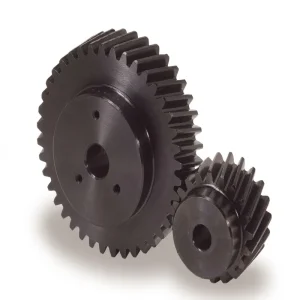
Our full range of standard and precision helical gears covers single helical profiles in both metric and inch module, including helical pinion gears, helical spur gear variants, and helical gearsets for matched pair installation. Whether a project calls for a small helical gear driving an encoder shaft or a large hobbed gear in a multi-stage speed reducer, our helical gear manufacturing process produces consistent tooth profiles across the entire size range. These gears are dimensionally compatible with our carbon steel double helical gear range and are available in the same alloy steel grades, making mixed-stage gearbox builds straightforward. Our engineering team can supply complete gearset drawings and mating tooth specifications for system-level verification.
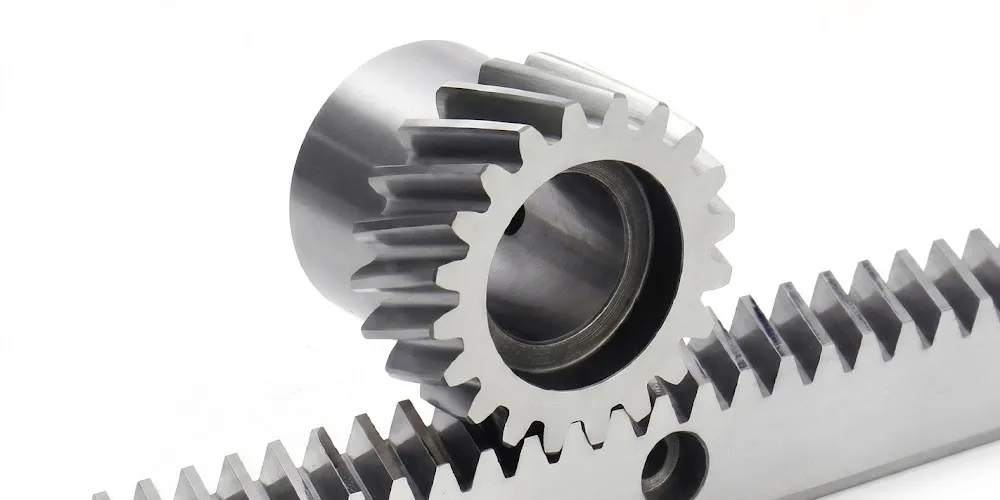
Portautensili
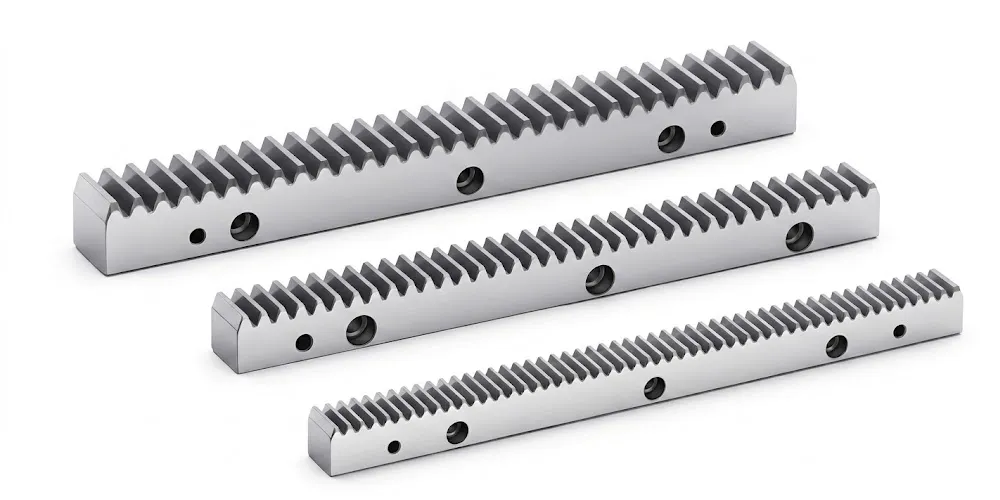
Precision gear rack manufactured to match our helical pinion gear range, enabling helical rack and pinion systems for linear motion applications. Our gear rack is produced in carbon and alloy steel grades with hobbed or ground tooth profiles, and is available in metric module to complement the EP-Carbon Steel double helical gear series where a rotary-to-linear conversion stage is required downstream of the gearbox output. Typical applications for matched helical rack and pinion sets include CNC gantry systems, automated guided vehicle drive modules, heavy-duty sliding gates, and machine tool carriages operating in manufacturing plants across Europe, North America, and the Asia-Pacific region. Supplying both the gearbox double helical gear stages and the downstream gear rack from a single source ensures consistent module, pressure angle, and surface quality across the entire drive system.
About Our Gear Manufacturing Facility
With more than ten years of focused experience in mechanical power transmission, our factory has developed the process capability and engineering depth to serve demanding customers in heavy industry, marine, agricultural, and general manufacturing sectors worldwide. Our product range spans agricultural gearboxes, worm gear reducers, planetary gear drives, power take-off shafts, hydraulic cylinders, gears, chains, and motors — all manufactured under the same quality framework and available through a single point of contact.
We are ISO 9001:2015 certified and design and manufacture a comprehensive range of industrial and agricultural gearbox assemblies using ductile iron, cast iron, cast steel, precision cast steel, and cast aluminum, alongside machined gears, sprockets, worm gears, pulleys, worms, shafts, and both standard and non-standard mechanical parts. Our helical gear factory is equipped with CNC gear hobbing machines, gear grinding centers, coordinate measuring machines, and a dedicated heat treatment facility — the complete production chain required to deliver a double helical gear from raw bar stock to finished, inspected, and documented component. Customers across Europe, North America, Australia, Southeast Asia, and the Middle East source carbon steel double helical gears from us as a factory-direct helical gear supplier, benefiting from engineering support, transparent documentation, and the quality consistency that ISO certification brings.
Domande frequenti
Redattore: PXY