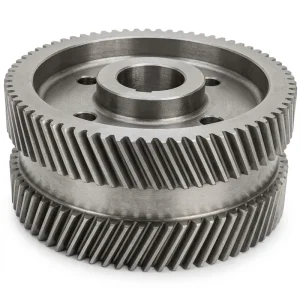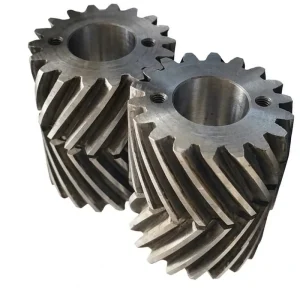
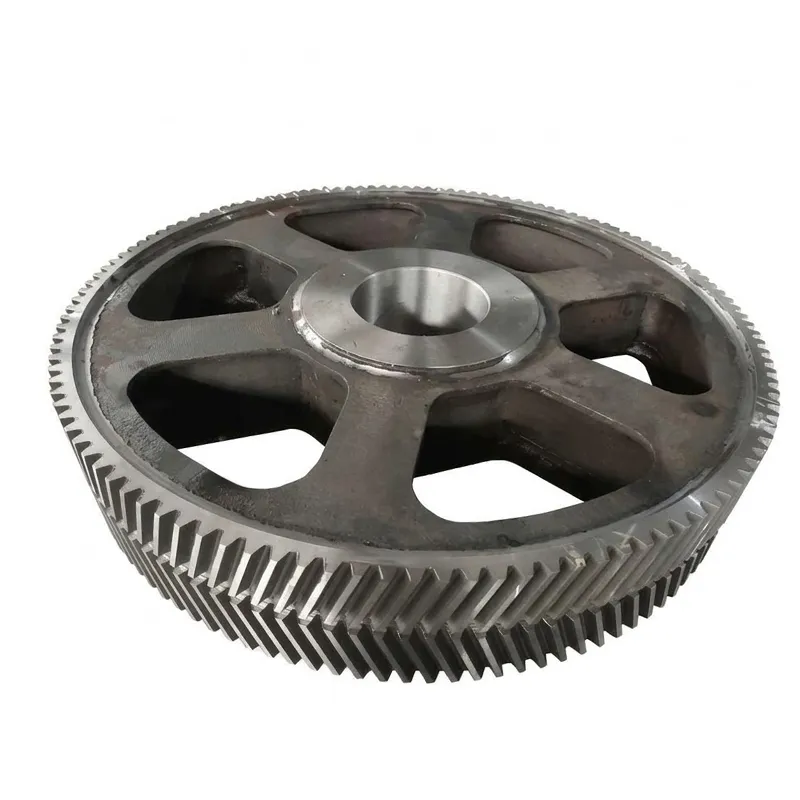
EP-Steel Double Helical Gear
The EP-Steel Double Helical Gear is a precision-engineered transmission component designed for smooth and efficient power transfer. Featuring a round shape with a standard diameter of 20mm, this gear is crafted from high-quality stainless steel (SS) to ensure durability and corrosion resistance. The double helical tooth design effectively cancels out axial thrust forces, resulting in quieter operation and reduced bearing load compared to single helical gears. Each unit features a polished surface finishing, which minimizes friction and enhances meshing efficiency. Fully customizable to meet specific application requirements, this gear is ideal for precision machinery, automotive systems, and industrial equipment where reliability and compact design are essential. Made in China, it offers a robust solution for demanding mechanical drives.
EP-Steel Double Helical Gear
Material: Stainless Steel (SS) | Diameter: 20 mm (Customizable) | Surface: Polished
Gear Type: Helical Gear | Shape: Round | Origin: Factory-Direct
مشخصات فنی
The table below summarizes standard parameters of the EP-Steel double helical gear. Custom configurations — covering module, tooth count, helix angle, bore, keyway, and surface treatment — are available upon request from our engineering team.
| پارامتر | Standard Value | Customizable Range |
|---|---|---|
| نوع دنده | Double Helical Gear (Herringbone) | — |
| مواد | Stainless Steel (SS) | Carbon steel, alloy steel, customized |
| Shape | Round (Cylindrical) | — |
| Diameter (Outside) | 20 mm | Customized per drawing |
| ماژول | M1 – M8 (standard) | Non-standard module available |
| Helix Angle | 15° – 30° (each half, opposing) | Up to 45° per application |
| Pressure Angle | 20° | 14.5° available |
| تعداد دندانها | 12 – 200 (custom) | Per specification |
| Surface Finishing | Polished | Black oxide, zinc plating, nickel plating |
| Precision Grade | DIN 6 – 8 / AGMA 10 – 12 | Higher grades on request |
| Hardness (Tooth Flank) | HRC 48 – 55 (case-hardened option) | Through-hardened or annealed |
| Application Speed (max) | Up to 3,600 RPM (standard) | High-speed grades available |
| Outer Dimensions (L × OD) | Per drawing (e.g., 40 mm × 20 mm) | Fully customizable |
What Is a Double Helical Gear?
الف double helical gear — sometimes called a herringbone gear in earlier engineering literature — is a type of gear where two sets of helical teeth are cut on a single gear blank, each set angled in opposite directions. This V-shaped or chevron tooth arrangement is what makes the double helical gear mechanically distinct from every other gear profile. Where a single helical gear generates a net axial thrust that must be absorbed by thrust bearings, the opposing tooth rows in a double helical gear cancel each other's axial forces internally, leaving the shaft nearly free of thrust loading. The result is a gear that transmits power more quietly, with lower vibration, and at higher efficiency than a comparable spur gear or single helical gear — without placing a burden on the bearing arrangement. That combination of smooth engagement and balanced loading makes the double helical gear the preferred choice in high-speed, high-power industrial drives the world over, from marine propulsion shafts to steel-mill rolling mill lines.
Our EP-Steel double helical gear is precision-machined from stainless steel stock to achieve tight dimensional tolerances and a polished running surface. The base diameter of 20 mm represents our standard starting point; the blank diameter, helix angle, module, number of teeth, and keyway geometry are all available for custom configuration, making this product equally suited for original equipment manufacturers specifying a bespoke helical gear design and for MRO buyers seeking a direct replacement in an existing parallel shaft gearbox.
Five Key Advantages of the Double Helical Gear
Zero Net Axial Thrust
The opposing helix angles on each half of the gear cancel axial forces in-plane. Bearings carry radial load only, extending service life and removing the need for heavy-duty thrust arrangements — a fundamental advantage of double helical gear design over single helical configurations in high-speed drives.
Higher Power Density
The continuous tooth engagement across two sets of helical teeth means more tooth pairs share the load at any instant. This distributes contact stress more evenly, allowing a compact double helical gear to transmit substantially more torque than an equivalent spur gear — reducing gearbox size and overall system weight without sacrificing rated capacity.
Smooth, Low-Noise Operation
Helical teeth engage progressively rather than all at once, and the herringbone geometry further stabilizes mesh behavior. The practical outcome is noticeably quieter running compared to spur gears, making double helical gears well suited to noise-sensitive environments such as marine drives, food-processing facilities, and precision manufacturing lines.
Stainless Steel Durability
Our steel double helical gear is machined from stainless steel (SS) selected for its corrosion resistance, tensile strength, and polishability. The polished running surface minimizes friction losses, lowers operating temperature, and resists surface fatigue — all critical to reliable, long-interval performance in industrial and process-industry environments worldwide.
Full Customization Available
Beyond the standard 20 mm diameter, every geometric parameter — module, pressure angle, number of teeth, helix angle, face width, bore diameter, keyway, and surface treatment — can be adapted to your specification. Custom made helical gears are our standard offering, not an exception, and our engineering team can work from drawings, samples, or performance requirements.
How Does a Double Helical Gear Work?
Understanding the working principle of the double helical gear starts with its geometry. Two mirror-image sets of helical teeth — each inclined at the same angle but in opposite directions — are machined on a single gear blank. When the gear meshes with its mating pinion, engagement begins at one end of each tooth and progresses diagonally across the face. Because both the left-hand and right-hand helices engage simultaneously with corresponding teeth on the mating gear, the axial forces they generate point in opposite directions and cancel each other. This self-balancing characteristic is the defining mechanical advantage of double helical gear geometry.
From a load distribution standpoint, the gradual, progressive tooth entry also increases the contact ratio compared to spur gears. More tooth pairs carry the transmitted load at any given moment, smoothing out peak contact stress and reducing the dynamic excitation forces that produce gear whine. In high-speed turbine gearboxes and parallel shaft gearbox applications, this translates directly into measurable gains in reliability and operating life. The polished tooth flanks on our EP-Steel units further reduce friction in the mesh zone, keeping thermal losses low even at elevated pitch-line velocities.
The gap or groove that often appears at the center of a double helical gear — sometimes called a relief groove — is not a structural weakness. It is a machining feature that allows the cutting tool to clear during helical gear machining of each half, ensuring both tooth sets are accurately indexed relative to each other. Some advanced manufacturing techniques can produce a truly continuous herringbone profile without a relief groove, but the grooved variant remains the dominant industrial standard because it simplifies the helical gear manufacturing process significantly and maintains tight tolerances on tooth spacing.
Material, Manufacturing & Quality Standards
The EP-Steel double helical gear is produced from stainless steel (SS) selected to meet the demanding requirements of industrial power transmission. Stainless steel offers a favorable combination of corrosion resistance, surface hardness after finishing, dimensional stability during machining, and compatibility with food-grade or chemically aggressive environments where carbon steel would corrode. The helical gear material selection is not arbitrary: SS grade, heat treatment state, and surface hardness are matched to the intended operating conditions and confirmed through material certification on request.
The manufacturing sequence follows a proven helical gear manufacturing process. Gear blanks are turned to diameter on CNC lathes, inspected for roundness and runout, then transferred to dedicated gear-cutting machines where the double helical tooth profile is generated by helical gear milling using precisely dressed form cutters or by hobbing for larger batches. After cutting, tooth flanks are inspected against DIN or AGMA tolerance standards for pitch error, profile deviation, and lead accuracy. Selected parts undergo gear grinding for the tightest quality grades. Final polishing of the running surfaces reduces surface roughness Ra to the specified level before parts pass through dimensional inspection and are packed for shipment.
Our facility operates under an ISO 9001:2015 quality management system. Every batch of EP-Steel double helical gears is traceable from raw material receipt through finished goods inspection. Customers requiring material test reports, dimensional inspection reports, or third-party verification can request these as part of the standard order documentation. This level of process control and transparency is what distinguishes a professional helical gear factory from a commodity supplier, and it underpins the confidence our customers place in critical drivetrain applications.
Double Helical Gear Applications
The double helical gear occupies the upper tier of power transmission design — it appears wherever engineers need high torque capacity, low noise, and minimal axial loading in a compact, reliable package. The following sectors represent the most common double helical gear applications we serve worldwide.
Marine Propulsion & Ship Drives
Marine main reduction gearboxes are among the oldest and most demanding applications for double helical gears. The absence of net axial thrust means shaft seals and thrust bearings are not overloaded, and the smooth engagement profile reduces noise transmission through the hull — critical for naval, passenger ferry, and offshore supply vessel operators.
Steel Mill Rolling Drives
Hot strip mills and plate rolling lines place extreme torque demands on their drive trains. The double helical gear handles these shock loads with a higher contact ratio and better load sharing than spur gears, keeping roll stand gearboxes running reliably through continuous, high-impact duty cycles.
Power Generation & Turbine Gearboxes
Steam and gas turbine step-up gearboxes run at very high speeds for decades without scheduled disassembly. Double helical gear sets in these units deliver the efficiency and low-vibration behavior that power plant operators require, while the balanced axial loading preserves the journal bearings supporting the high-speed pinion shafts.
Mining & Heavy Industrial Equipment
Conveyor drives, ball mill pinions, and crusher gearboxes in the mining sector benefit from the high power density and robust load distribution that double helical gears provide. Rugged operating environments — dust, shock loads, and extended running hours — are exactly where the advantages of double helical gear geometry are most tangible.
Compressors & Pumps
High-speed centrifugal compressor and double helical gear pump applications both call for smooth, quiet meshing with minimal vibration excitation. The balanced thrust characteristic of double helical gears eliminates the need for axial float in the rotor assembly, simplifying seal design and reducing the risk of axial rub events in tight-clearance compressor stages.
Food, Pharmaceutical & Chemical Processing
Stainless steel helical gears are particularly valued in clean-room and hygienic process environments. The corrosion resistance of SS, combined with the polished surface finish on our EP-Steel double helical gear, makes it compatible with wash-down routines and direct-contact food processing environments that would rapidly degrade carbon steel alternatives.
Double Helical vs Herringbone Gear — What Is the Real Difference?
Engineers sometimes use double helical vs herringbone gear as interchangeable terms, but there is a meaningful manufacturing distinction. A herringbone gear has a continuous V-shaped tooth profile running uninterrupted across the full face width, with no gap between the two helices. A double helical gear, in the stricter definition, includes a central relief groove that separates the two helical sections — a groove introduced to allow the cutting tool to exit the tooth space during helical gear machining without gouging the opposing helix.
Functionally, both configurations deliver the same axial balance. The herringbone (no groove) version has a marginally wider effective face width per unit of overall length, but machining it is significantly more complex, typically requiring specialized gear generators. The grooved double helical gear is more accessible to manufacture and inspect, and is produced in greater variety and at more competitive lead times. For most industrial applications — including parallel shaft gearbox builds, marine gearboxes, and heavy industrial conveyors — the grooved double helical gear is the rational engineering choice.
When comparing single vs double helical gear performance, the single helical gear offers simpler manufacture and is adequate for lighter-duty parallel shaft gearbox applications where axial thrust can be managed with the bearing system. Once power levels rise or noise targets tighten, the double helical gear earns its keep by removing the thrust problem entirely and delivering a higher contact ratio.
Double Helical Gear Design Considerations
Effective double helical gear design begins with establishing the power, speed, and gear ratio requirements of the drive. From these operating conditions the designer calculates the required module, which governs tooth size and strength, and selects a helix angle that delivers the desired contact ratio and face width. Higher helix angles increase the contact ratio and smooth the mesh but raise manufacturing complexity; for general industrial double helical gear design, angles between 20° and 30° per half represent a practical optimum.
Tooth geometry — including addendum, dedendum, root radius, and tip relief — is specified to avoid interference at low tooth counts and to optimise the load distribution across the face. For the EP-Steel double helical gear, the standard pressure angle is 20°, which balances tooth strength against smooth rolling action. Modified tooth profiles with tip relief or profile crowning can be applied to high-precision grades to reduce edge loading and improve robustness against minor misalignment in the gearbox housing.
Material selection and heat treatment follow from the Hertz contact stress and bending stress calculations. Our stainless steel (SS) blanks can be supplied in annealed condition for moderate-duty applications or case-hardened and ground for demanding, high-speed duty. The helical gear shaft interface — bore diameter, keyway, tolerance class — is dimensioned to suit the shaft it will be mounted on, and flange-mounted or hub configurations are available for applications where a keyed bore is not preferred.
Related Products — Full System Compatibility
Our manufacturing capability extends well beyond the double helical gear itself. We produce the full range of mating and complementary components your drivetrain may require, making us a genuine one-stop source for helical gear system solutions — from the pinion through to the gear rack, sprockets, and shaft couplings.
چرخ دنده مارپیچی
Our full range of standard and custom helical gears — covering spur-type profiles, spiral configurations, and helical pinion gear variants — is manufactured to the same quality standards as the EP-Steel double helical gear. Whether you need inch helical gears for North American equipment or metric modules for European or Asian machinery, we carry the tooling and the process capability to deliver. Helical gear sets are available as matched pairs with optimised tooth contact and can be paired with our parallel shaft gearbox assemblies. The combination of our helical gear manufacturing process and stainless or alloy steel material options makes this range compatible with the double helical gear units across all shared applications.
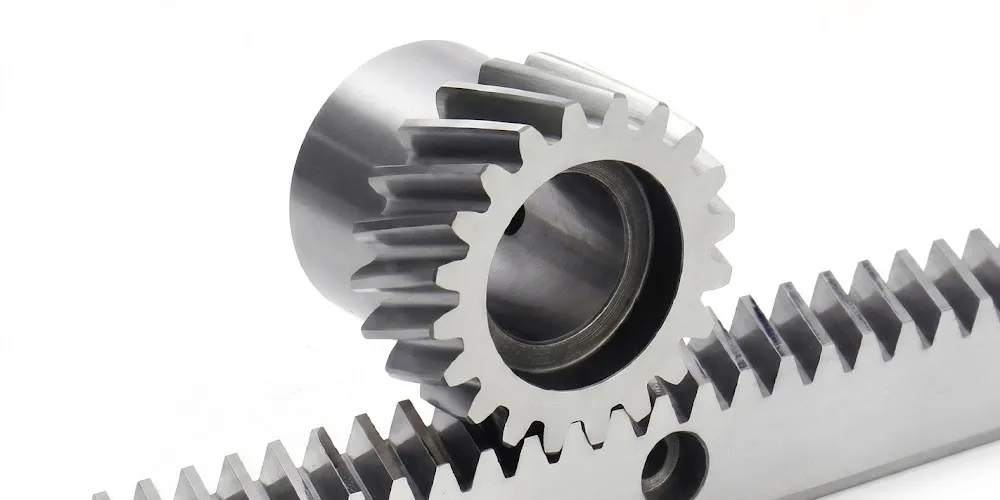
قفسه دنده
When linear motion is required in your system, our precision gear rack pairs directly with helical pinion gears to deliver smooth, backlash-controlled linear translation. Manufactured from the same material grades — including stainless steel options — our gear rack product line is dimensionally matched to our standard helical gear modules. The helical rack and pinion system converts rotary motion from a helical gear motor or gearbox output shaft into controlled linear displacement, widely used in CNC gantry axes, pick-and-place automation, and machine tool carriages. Supplying both the double helical gear stage and the downstream gear rack from a single source guarantees compatibility, simplifies procurement, and ensures consistent surface treatment and dimensional tolerancing across the entire assembly.
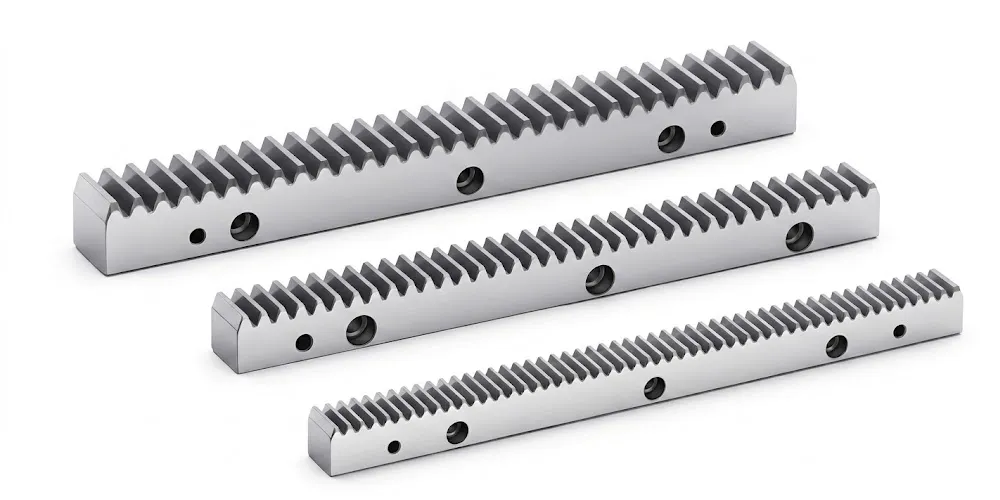
درباره کارخانه تولیدی ما
With more than a decade of specialized experience in mechanical power transmission engineering, our facility has grown into a recognized helical gear factory serving customers across the Americas, Europe, the Asia-Pacific region, and the Middle East. Our product range covers agricultural gearboxes, worm gear reducers, planetary gear drives, power take-off shafts, hydraulic cylinders, gears, chains, and motors — a portfolio broad enough to address most drivetrain projects from a single source.
Our facility holds ISO 9001:2015 certification, and our engineering team includes specialists in gear design, CNC machining, heat treatment metallurgy, and quality assurance. We also design and manufacture a wide range of industrial and agricultural gearbox assemblies in materials including ductile iron, cast iron, cast steel, precision cast steel, and cast aluminum — complementing the machined gear range with complete gearbox solutions. Beyond catalog products, our custom made helical gears and non-standard mechanical component capability means we can support OEM programs as well as MRO replacement requirements worldwide. Customers looking for a reliable helical gear supplier with factory-direct pricing and full documentation support will find the combination of process capability and quality infrastructure here that demanding applications require.
سوالات متداول
تدوینگر: PXY