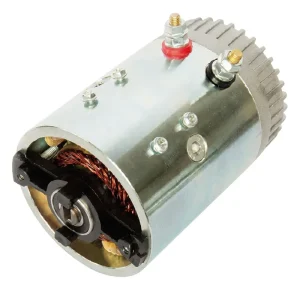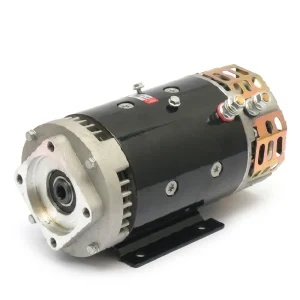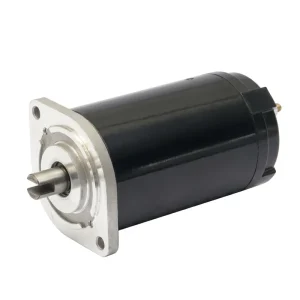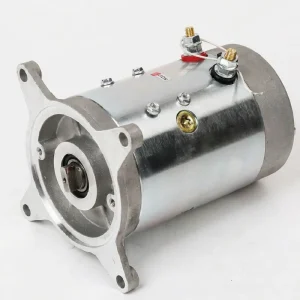
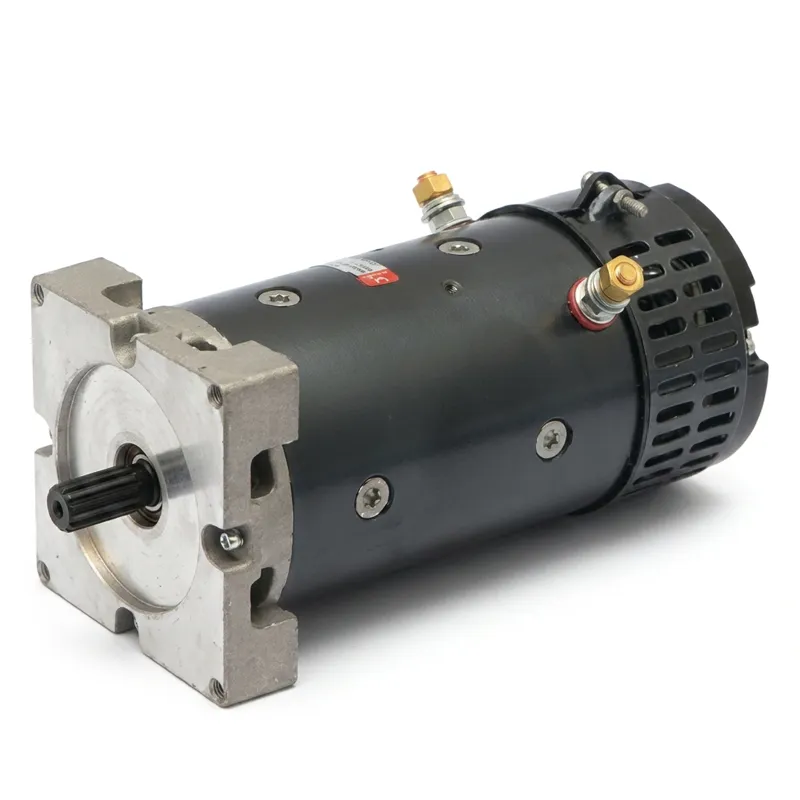
EP-XL2430TW 3000W 24V oljepumpmotor
The EP-XL2430TW occupies the mid-power tier of the 24V oil pump motor series, producing 3000W output at a rated current of 160 A. With a rated torque of 11 N·m and a duty cycle covering S2 5-minute and S3 15%ED intermittent operation, it bridges the gap between the 2200W models suited to lighter lift and dock applications and the 4000W units required for the heaviest truck-mounted hydraulic power units. This positioning makes the XL2430TW the practical first choice for integrators who find the lighter motor thermally marginal but have no need for the larger frame and higher current draw of the 4 kW class.
En tvåpolig konfiguration och medurs rotationsriktning är standard, med valfria 12V- och 48V-spänningsvarianter tillgängliga i samma mekaniska ram – en plattformsflexibilitet som förenklar OEM-produktdesign över flera elektriska fordonsarkitekturer utan att kräva en separat strukturell eller hydraulisk pumpkopplingsdesign för varje spänning. Motorn har klass F-isolering och en vattentäthetsklassning IP20, vilket gör den lämplig för installationer av slutna hydrauliska kraftenheter på inomhusutrustning och fordonsmonterade applikationer där motorn är skyddad från direkt vattenexponering.
Oljepumpmotorserie
EP-XL2430TW 3000W 24V oljepumpmotor
A 3 kW permanent magnet DC oil pump motor rated at 160 A and 11 N·m, designed for vehicle power units, hydraulic lift platforms, boarding trucks, and specialist mobile equipment where a mid-range 24V drive delivers the balance of power output, duty cycle, and package size the application demands.
Technical Specifications Oil Pump Motor
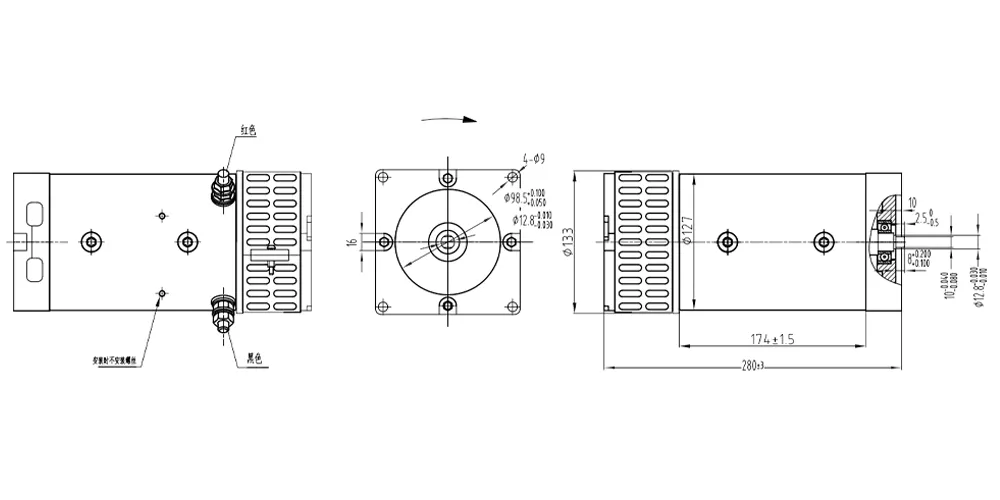
The table below presents the verified electrical and mechanical parameters of the EP-XL2430TW oil pump motor. Engineers specifying this unit for a new hydraulic power unit design or as a direct oil pump motor replacement in an existing installation should cross-check rated current, torque, duty cycle, and dimensional data against the host equipment's supply capacity, pump coupling geometry, and mounting bracket configuration before ordering.
| Parameter för oljepumpmotor | Värde / Specifikation |
|---|---|
| Motormodell | XL2430TW Oil Pump Motor |
| Nominell spänning (V) | 24 (valfritt: 12V, 48V) |
| Nominell effekt (W) | 3000 |
| Märkström (A) | 160 |
| Nominellt vridmoment (N·m) | 11 |
| Driftscykel | S2 5min – S3 15%ED |
| Isoleringsklass | F (max lindningstemperatur 155°C) |
| Vattentäthetsklassificering | IP20 |
| Pole Number | 2 |
| Rotationsriktning | Medurs (CW) |
| Kroppsdiameter (mm) | ∅98 (main body), ∅133 (flange) |
| Axeldiameter (mm) | ∅12.8 (h6 tolerance) |
| Total längd (mm) | 280 ±3 |
| Mounting Bolt Circle (mm) | 4× ∅9 holes, PCD 174 ±1.5 |
| Valfri konfiguration | 12V, 48V matningsvarianter tillgängliga |
| Tillämpningsområde | Fordonsmotorer, lyftar, påstigningstruckar, specialutrustning |
DC-motorns arbetsprincip
The XL2430TW is a two-pole permanent magnet DC motor, a configuration that produces a strong, uniform magnetic field in the air gap with a straightforward stator geometry. Two opposing permanent magnets in the stator housing establish the fixed field; the wound armature sits on a laminated iron core within this field and carries the working current supplied through carbon brushes bearing on the commutator segments. When current flows through an armature coil between the opposing brush polarities, the interaction between the armature electromagnetic field and the permanent stator field produces a tangential force on the armature conductors — this is the electromagnetic torque that drives the output shaft.
The two-pole layout of the XL2430TW generates a relatively high rotational speed at rated voltage compared to motors with more pole pairs, which suits gear oil pump motor applications where the pump is designed to operate at higher shaft speeds and achieve required flow rates through speed rather than torque. The DC motor working principle in this configuration is also notable for its linear speed-voltage relationship: reducing the supply voltage proportionally reduces motor speed, which in a variable-displacement hydraulic system allows the operator or control system to regulate oil pump flow rate through voltage adjustment without additional flow control valves. This controllability is one of the primary reasons engineers choose a high torque DC motor over AC alternatives for battery-powered mobile hydraulic equipment.
The commutator switching action — reversing current in each armature coil as it crosses the magnetic neutral axis — sustains continuous rotation without external electronics, an advantage over brushless DC (BLDC) motor designs in applications where simplicity of the control circuit is a priority. The A1 and D2 terminal arrangement used on the XL2430TW is compatible with standard 24V contactor-switching circuits and with PWM motor controller boards commonly used in lift and vehicle power unit designs across the USA, European, and Australian markets.
Fem viktiga produktfördelar
Mid-Range 3 kW Power Class
At 3000W and 160 A rated current, the XL2430TW fills the performance gap between the 2200W models used in lighter lift applications and the 4000W units required by the heaviest truck hydraulics. For lift platforms in the 750–1,200 kg rated capacity range and medium-bore hydraulic cylinders at pressures up to 200 bar, this mid-range oil pump motor delivers adequate torque and flow without the cable sizing, contactor rating, and battery capacity costs associated with a 200A-plus motor specification.
Balanced S3 15%ED Duty Cycle
The S3 15%ED rating represents a meaningful step above the 10%ED limit of lighter 24V oil pump motors, providing additional thermal headroom for applications with longer or more frequent actuation cycles without requiring the full 20%ED capability of the larger 4 kW model. This places the XL2430TW as the correct specification for mid-frequency dock leveller circuits, multi-platform vehicle lift systems, and industrial hydraulic clamping fixtures where the lighter motor would be at risk of thermal shutdown under the actual operating duty.
Two-Pole High-Speed Architecture
The two-pole permanent magnet stator configuration produces a higher no-load speed at rated voltage than four-pole or six-pole motors of equivalent frame size. For gear oil pump motor applications where the pump is designed to achieve rated flow at higher shaft speeds — a common design approach in compact hydraulic power units with small-displacement gear pumps — the two-pole configuration eliminates the need for a speed-increasing intermediate stage, simplifying the power unit assembly and reducing total part count.
Multi-Voltage Platform Flexibility
Factory-standard 24V operation with optional 12V and 48V variants in the same mechanical frame allows OEM product designers to use a single mounting bracket, pump coupling, and housing design across a product range covering different vehicle electrical standards. This standardisation reduces tooling investment and spare parts inventory complexity for OEM assemblers building mobile equipment for the North American, European, and Australian markets, where battery voltage standards vary by equipment category and regulatory environment.
Compact Square-Flange Mounting
The four-bolt square flange mounting pattern on a 174 mm PCD provides a rigid, well-distributed load path between the motor housing and the hydraulic power unit base plate or mounting bracket. Compared to foot-mount configurations, the flange arrangement minimises bending moment at the motor-pump interface — relevant at 3000W output where the gear coupling loads at rated torque are substantial — and suits the compact power unit packaging typical of vehicle-mounted and platform-integrated hydraulic installations.
Material och konstruktionskvalitet
The EP-XL2430TW is constructed to meet the combined structural, thermal, and electrical requirements of a 3 kW, 160 A intermittent-duty motor in mobile hydraulic service. The motor housing is precision die-cast from high-strength aluminium alloy, a material selected for its combination of structural stiffness — maintaining shaft bearing alignment under the radial and axial loads transmitted through the hydraulic pump gear coupling — and thermal conductivity, which assists convective heat dissipation from the winding losses to the ambient air through the ribbed housing exterior. The casting geometry is engineered with the stator magnet retention seats machined to close dimensional tolerances, ensuring consistent air gap geometry and field uniformity across production batches.
The armature core is laminated from silicon steel strip, with each lamination stamped, deburred, and insulation-coated before stacking and bonding. The two-pole design concentrates the magnetic flux path through a smaller number of lamination segments than higher-pole-count motors, which requires careful attention to the silicon content and lamination thickness to control core losses at the relatively high electrical frequency generated by the two-pole commutation cycle at rated speed. The armature winding uses copper conductors with a section and winding pitch specified for the slot dimensions and the 160 A current requirement, with Class F polyimide or equivalent film insulation on each conductor and a varnish impregnation process applied after winding to consolidate the coil pack and improve thermal conduction from the conductor to the lamination core.
The commutator bar material is a silver-bearing copper alloy that supports stable graphite brush film formation — the thin transfer layer that reduces friction and electrical contact resistance at the brush-commutator interface. At 160 A current density, film stability directly affects commutator surface erosion rate and electrical noise; the alloy specification is therefore an active material decision rather than a cost-neutral substitution. Brush grade and spring pressure are matched to the commutator alloy and the peripheral speed at operating RPM, targeting a brush wear rate that provides an acceptable service interval without generating excessive commutator surface wear. The two-pole permanent magnets in the stator are positionally retained by a combination of high-temperature adhesive and a mechanical retention ring that maintains magnet position and field strength through the thermal cycling of the S3 duty cycle over the motor's design service life.
Applikationsscenarier för oljepumpmotorer
The EP-XL2430TW 3000W 24V oil pump motor targets hydraulic power unit installations where the 2200W class is thermally marginal and the 4000W class is over-specified. Its mid-range power output, two-pole high-speed architecture, and multi-voltage option make it a practical specification across a diverse set of mobile and industrial hydraulic applications.
Medium-Capacity Vehicle Hydraulics
Truck-mounted hydraulic power units for tail-lift platforms, side-loading refuse vehicles, and vehicle-mounted access equipment in the 750–1,200 kg rated load range typically require a gear oil pump motor set in the 2.5–3.5 kW power band. The XL2430TW's 3 kW output and 11 N·m rated torque deliver the pump shaft speed and torque needed to generate adequate system pressure within the actuation time constraints of logistics and waste management vehicle operations across European, North American, and Australian markets.
Mid-Rise Scissor Lifts and Work Platforms
Battery-powered elevated work platforms with mid-range lift heights and rated capacities in the 350–700 kg class need a hydraulic oil pump motor that operates within the duty cycle limits of a reasonable battery pack without excessive overheating during multi-shift use. The XL2430TW's S3 15%ED rating gives it adequate on-time for typical platform raise-lower sequences in warehouse, construction, and maintenance applications, and the 48V optional configuration supports integration into the 48V battery architectures increasingly standard in European and North American powered industrial truck platforms.
Boarding Trucks and Ground Support Equipment
Airport and logistics boarding trucks with medium platform dimensions use the XL2430TW as the oil pump motor for hydraulic stair extension and height adjustment circuits. The motor's compact square-flange package fits within the undercarriage hydraulic power unit enclosures common in ground support equipment designs, and the IP20 rating is appropriate for the sheltered mounting positions where direct water spray is not a primary environmental risk. Clockwise rotation and the A1/D2 terminal layout match the wiring conventions used by the dominant European GSE equipment manufacturers.
Industrial Clamping and Pressing Circuits
Self-contained 24V hydraulic power units used for welding fixture clamping, assembly jig actuation, and small-scale hydraulic press operations in manufacturing facilities across Germany, Japan, and the USA benefit from a 3 kW DC electric motor that can be switched with simple contactor logic without a dedicated variable-frequency drive. The XL2430TW's high-speed two-pole output suits compact gear pumps that develop required clamping pressure at elevated shaft speed without needing a speed step-up stage between motor and pump.
Kompatibla kompletterande produkter
Hydraulic power unit drivetrains routinely pair the oil pump motor with companion electric motors for auxiliary circuits and worm gear reducers for torque multiplication in slow-speed actuation stages. We manufacture both product categories to dimensional and load-rating standards compatible with the XL2430TW, enabling full drivetrain sourcing from a single supply chain without the interface specification and lead time variability of multi-supplier procurement.
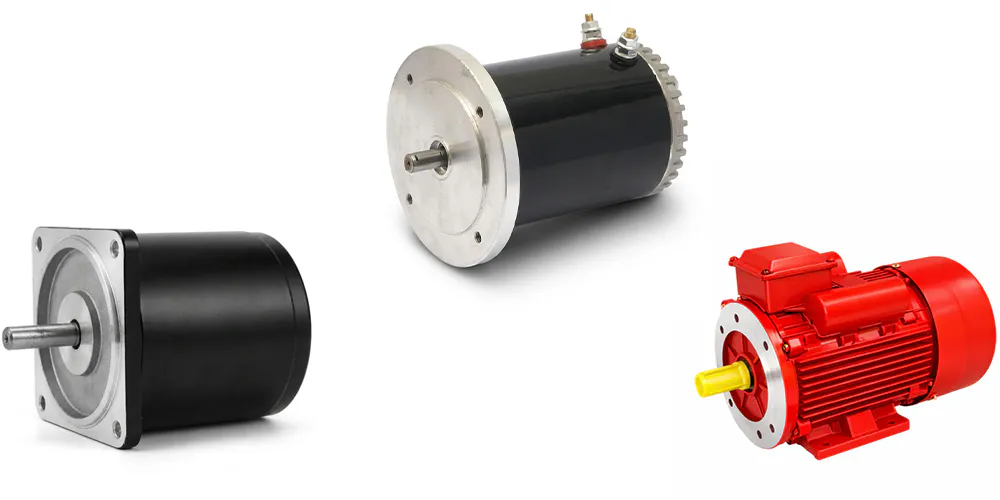
Elmotorer
Vårt utbud av elmotorer covers brushed DC, BLDC, and variable-voltage configurations for auxiliary pump circuits, cooling fans, and positioning actuators that operate alongside the XL2430TW in multi-motor hydraulic power unit assemblies. All motor frames are available with coupling interfaces compatible with standard gear pump flanges and shaft diameters.
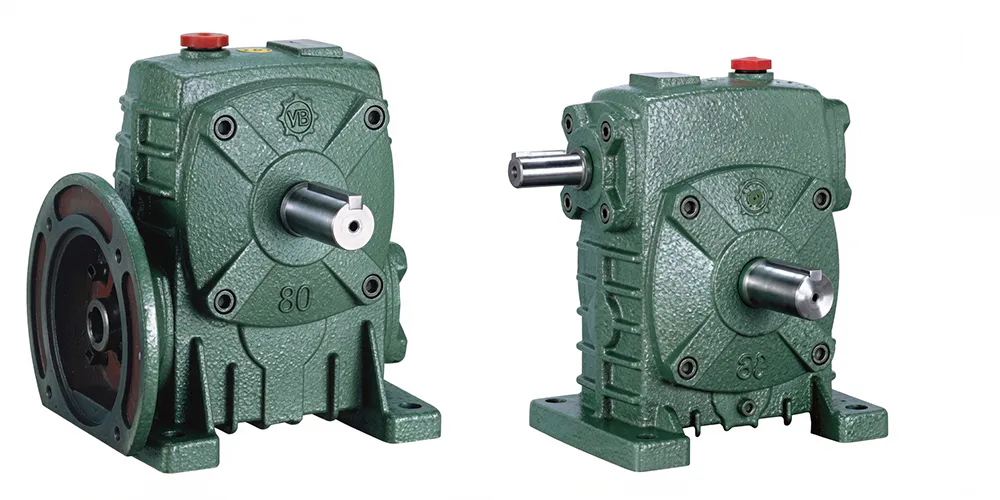
Snäckväxel
Where the XL2430TW's high-speed two-pole output needs to be reduced to a slower shaft speed for a linear actuator or a slow-moving drive mechanism, our worm gearbox range provides reduction ratios from 5:1 to 100:1 in input flange dimensions matched to the XL2430TW Oil Pump Motor output shaft geometry. Worm reducers are available in cast iron and aluminium alloy housings for different space and weight budgets.
Om oss
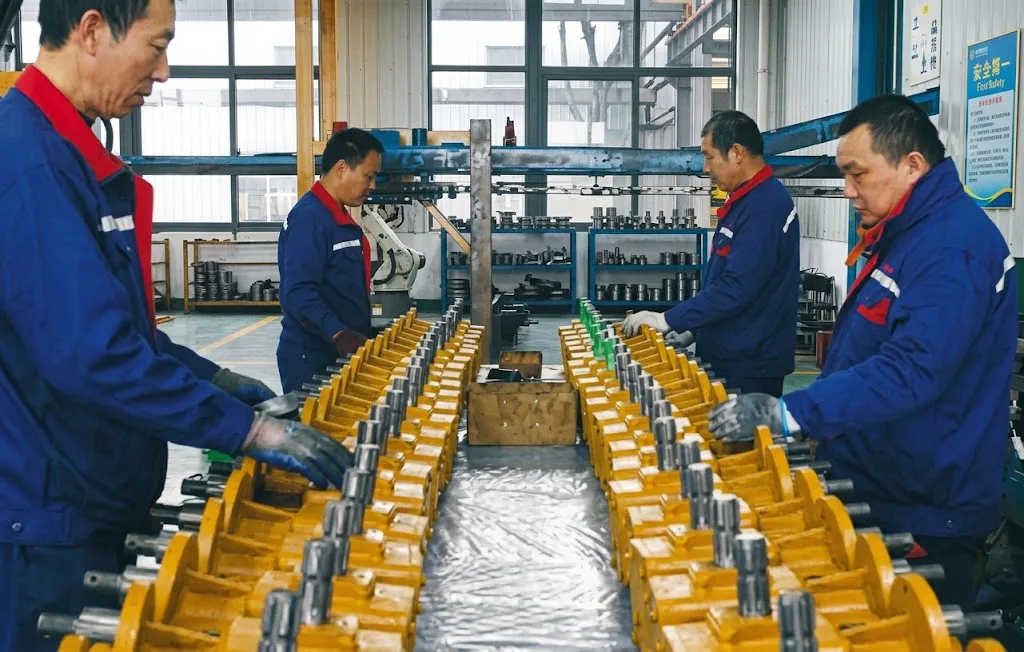
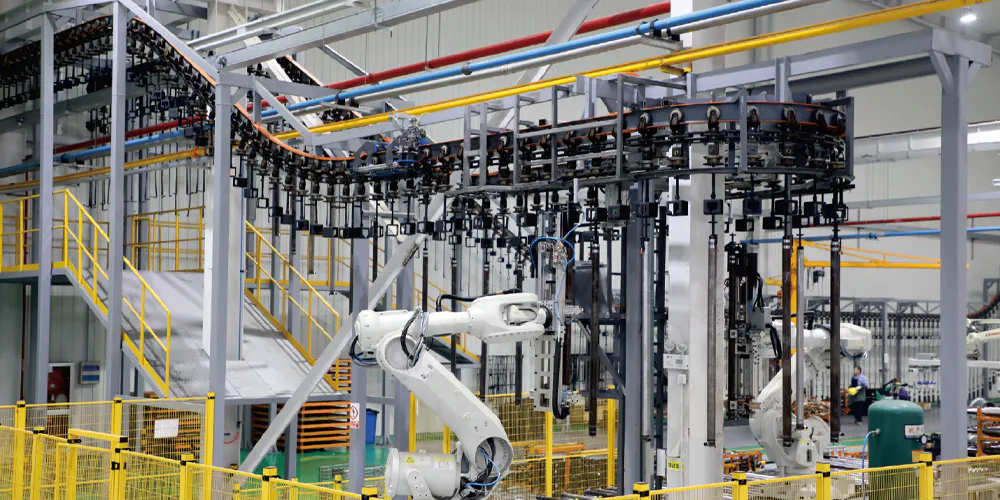
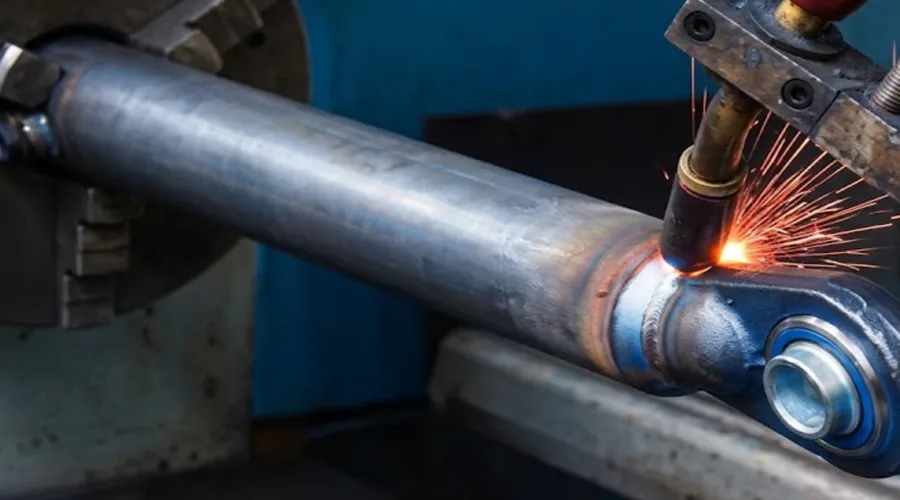
With over ten years of experience in mechanical power transmission engineering and manufacturing, our ISO 9001:2015 certified production facility covers a comprehensive range of products: agricultural gearboxes, worm reducers, planetary gear drives, PTO shafts, hydraulic cylinders, precision gears, roller chains, sprockets, worm wheels, pulleys, shafts, and DC electric motors. Standard catalogue products and custom-engineered assemblies are both produced in-house, using materials that include ductile iron, cast iron, cast steel, precision investment-cast steel, and cast aluminium depending on the structural and thermal requirements of the application.
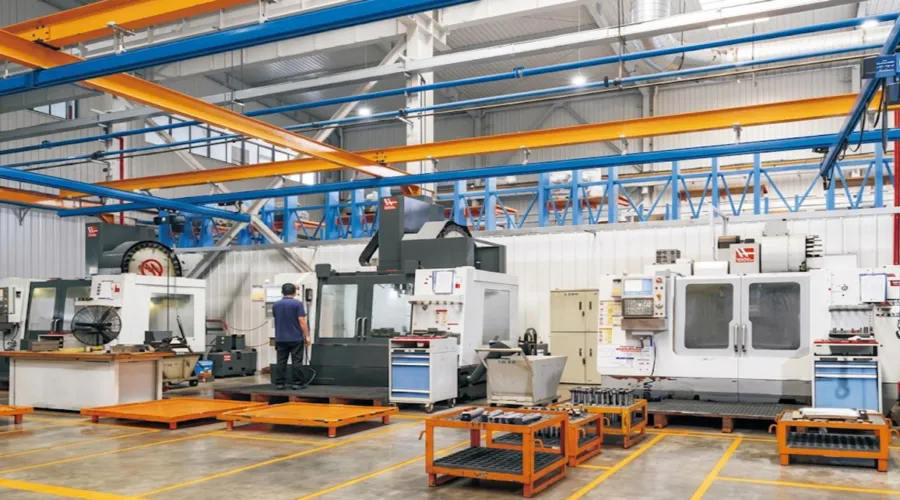
In-house machining capabilities span CNC turning, milling, gear hobbing, deep-hole drilling, surface grinding, and bore finishing, supported by CMM dimensional verification and full electrical load testing for motor products. This vertically integrated model — from raw material receipt through machining, heat treatment, assembly, inspection, and test under a single documented quality management system — allows us to maintain consistent product quality and respond efficiently to custom specifications from OEM and industrial maintenance customers across North America, Europe, Asia, and Australia.
Verkstad
Vanliga frågor
What is the difference between a two-pole and a four-pole permanent magnet DC oil pump motor, and which is better for a compact hydraulic power unit?▼
A two-pole DC motor, such as the XL2430TW, generates higher no-load speed at rated voltage than a four-pole motor of the same frame size because each commutation cycle produces a larger angular step. This higher speed suits gear pump coupling arrangements where the pump is designed for relatively high shaft speed and small displacement per revolution. A four-pole motor produces higher torque at lower speed from the same frame, making it better matched to larger-displacement pumps operating at lower shaft speeds. For a compact hydraulic power unit where a small gear pump needs to reach the rated system pressure quickly, the two-pole configuration is generally the more efficient match and typically results in a smaller, lighter oil pump motor assembly for a given hydraulic flow rate requirement.
How do I identify a compatible oil pump motor replacement for a 3 kW 24V tail-lift power unit in a European truck fleet?▼
For a 3 kW, 24V tail-lift hydraulic power unit in a European truck fleet, the critical matching parameters are: rated voltage (24V), rated power or current (3000W / 160A for the XL2430TW), mounting flange type and bolt pattern (4× ∅9 on 174 mm PCD for this model), overall motor length (280 ±3 mm), body and flange diameter (∅98 body, ∅133 flange), shaft diameter (∅12.8 h6), and rotation direction (CW). Confirm all six parameters against the existing power unit before ordering. Additionally, verify that the replacement motor's duty cycle rating equals or exceeds the original specification — using a motor with a lower duty cycle rating than the application requires is a common cause of premature oil pump motor failure in high-utilisation logistics vehicle fleets.
Which voltage variant of the EP-XL2430TW oil pump motor set should I specify for a 48V battery-powered elevated work platform in the USA?▼
For a 48V battery-powered elevated work platform in the USA, the 48V optional configuration of the XL2430TW is the correct selection. At 48V supply, the motor delivers equivalent mechanical output to the 24V version but at approximately half the armature current — a reduction from 160 A to around 80 A — which substantially reduces the cross-sectional area required for the power cables between the battery and the motor, lowers resistive voltage drop losses, and reduces the current rating required from the motor controller or contactor.
When should I use a high torque DC motor for an oil pump application instead of a brushless DC motor in Australian industrial equipment?▼
For oil pump motor applications in Australian industrial equipment, a brushed high torque DC motor like the XL2430TW is typically the better choice when the control system is based on simple contactor switching, when the equipment will be serviced by technicians who are familiar with brush and commutator maintenance but not with BLDC motor drive programming, or when budget constraints favour a lower-cost motor and simpler control circuit over the higher upfront cost of a BLDC motor and its dedicated electronic controller. A brushless DC motor becomes more attractive when the equipment runs at very high cycle rates where brush maintenance would be inconveniently frequent, or when partial-load energy efficiency is the primary system-level design constraint — for example, in battery-powered equipment where maximising runtime between charges is a commercial differentiator.
Where can I source a reliable 3 kW electric oil pump motor assembly for a vehicle-mounted hydraulic system in the Middle East or Southeast Asia?▼
For vehicle-mounted hydraulic systems in the Middle East or Southeast Asian markets, the EP-XL2430TW is available for direct export with full technical documentation: motor datasheet, outline and wiring diagrams, dimensional drawings, and ISO 9001:2015 quality certification. When evaluating this motor for high-ambient-temperature environments common across the Gulf, South Asia, and tropical Southeast Asia, note that the Class F insulation provides a thermal margin that supports reliable operation at elevated ambient temperatures, though duty cycle should be conservatively derated relative to temperate-climate ratings when ambient air temperatures consistently exceed 45°C.
Redaktör: PXY