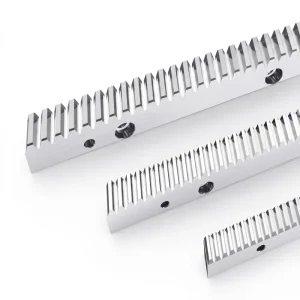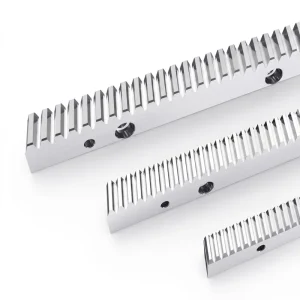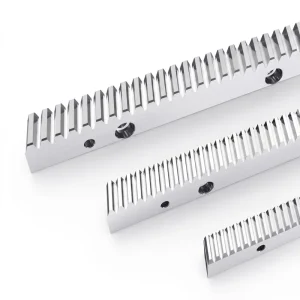

EP-S45C / 42CrMo V-Type Ground Helical Gear Rack — HRC48–52°
The EP V-Type Ground Helical Guide Gear Rack is a high-specification linear motion component that combines the functions of a precision helical rack and an integrated V-profile guide rail into a single machined bar. Rated to DIN6e25 accuracy, it is manufactured from S45C or 42CrMo alloy steel and subjected to three distinct grinding stages — four-side flat grinding, tooth surface grinding, and V-rail surface grinding — to deliver the dimensional consistency that demanding drive and guidance systems require.
What sets this series apart from a conventional linear gear rack is the 45°-angled V-rail machined directly into the bar body. This ground V-profile acts simultaneously as a guidance surface for a matching V-roller or V-block carriage and as the mounting datum for the rack itself — eliminating the separate profile rail, end blocks, and rail-to-rack alignment process that a conventional rack and pinion linear slide assembly requires. Because the V-rail and the tooth datum are produced in the same manufacturing sequence on the same clamping, their relative position is intrinsically accurate.
Standard lengths run from 630 mm to 1 230 mm depending on module, and module options cover 1.5, 2, and 3 in the catalogue shown. Custom lengths and non-standard cross-section geometries can be produced to engineering drawings.
EP-S45C / 42CrMo V-Type Ground Helical Gear Rack — HRC48–52°
DIN6e25 Accuracy · Helical Tooth Profile · Integrated V-Rail Guide · V-Rail Hardness HRC48–55° / HRC55–60° · Three-Stage Precision Grinding
Technical Specifications at a Glance of Helical Gear Rack
| Parameter | Specificatie |
|---|---|
| Accuracy Level | DIN6e25 |
| Materiaal | S45C / 42CrMo Alloy Steel |
| Tooth Profile | Helical teeth (斜齿) |
| Right Helix Angle | 19°31'42" |
| Tandhardheid | High-frequency quenching HRC48–52° / Carburizing quenching HRC55–60° |
| V-Rail Hardness | HRC48–55° / HRC55–60° |
| V-Rail Angle | 45° |
| Production Process | Four-side grinding · Tooth surface grinding · V-rail surface grinding |
| Total Pitch Error | GTF / 1000 < 0.036 mm |
| Module Range | 1.5 / 2 / 3 |
Dimensional Parameters of Helical Gear Rack (Unit: mm)
Total pitch error GTF/1000 < 0.036 mm | All dimensions in millimetres.
| Code | Module | Pt | L (mm) | L2 (mm) | A | B | B0 | C | D | B1 | A1 | G1 | G2 | F | E |
|---|---|---|---|---|---|---|---|---|---|---|---|---|---|---|---|
| VXX66315063 | 1.5 | 4.9999 | 630 | 5.143 | 14.5 | 24.5 | 22.9 | 65 | 100 | 13 | 20 | 7 | 11 | 7 | 500 |
| VXX66315103 | 1.5 | 4.9999 | 1030 | 5.143 | 14.5 | 24.5 | 22.9 | 65 | 100 | 13 | 20 | 7 | 11 | 7 | 900 |
| VXX66320063 | 1.5 | 4.9999 | 630 | 6.916 | 19.5 | 29.5 | 27.9 | 65 | 100 | 15.5 | 23.5 | 9 | 15 | 9 | 500 |
| VXX66320103 | 1.5 | 4.9999 | 1030 | 6.916 | 19.5 | 29.5 | 27.9 | 65 | 100 | 15.5 | 23.5 | 9 | 15 | 9 | 900 |
| VXX66325064 | 2 | 6.6666 | 630 | 8.76 | 24.7 | 33 | 30.61 | 70 | 100 | 18.5 | 25.2 | 9 | 15 | 9 | 500 |
| VXX66325094 | 2 | 6.6666 | 930 | 8.76 | 24.7 | 33 | 30.61 | 70 | 100 | 18.5 | 25.2 | 9 | 15 | 9 | 800 |
| VXX66325124 | 2 | 6.6666 | 1230 | 8.76 | 24.7 | 33 | 30.61 | 70 | 100 | 18.5 | 25.2 | 9 | 15 | 9 | 1100 |
| VXX66335063 | 3 | 9.9999 | 630 | 12.272 | 34.6 | 46.6 | 43.41 | 65 | 100 | 28.6 | 36.7 | 11 | 18 | 11 | 500 |
| VXX66335093 | 3 | 9.9999 | 930 | 12.272 | 34.6 | 46.6 | 43.41 | 65 | 100 | 28.6 | 36.7 | 11 | 18 | 11 | 800 |
| VXX66335123 | 3 | 9.9999 | 1230 | 12.272 | 34.6 | 46.6 | 43.41 | 65 | 100 | 28.6 | 36.7 | 11 | 18 | 11 | 1100 |
All specifications are subject to change without prior notice. Please confirm dimensions and tolerance requirements before placing an order. Custom cross-sections and lengths are available on drawing submission.

How the V-Type Ground Helical Gear Rack Works
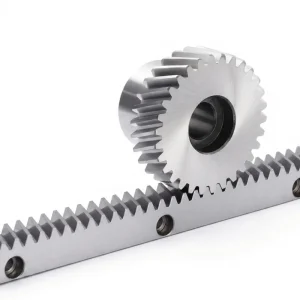
This product functions as both a gear rack drive element and an integrated precision guide in a single bar. The toothed face meshes with a matching helical pinion to convert rotational motor torque into controlled linear displacement — the fundamental principle behind every rack and pinion gear system. The 19°31'42" right helix angle causes successive tooth-pair contacts to overlap, spreading instantaneous contact force across multiple teeth simultaneously. This reduces per-tooth stress, lowers audible noise, and substantially suppresses the vibration pulses that accumulate into positioning error in high-cycle automated machines.
The V-rail surface, ground at 45° into the opposite or lateral face of the bar, performs an entirely separate mechanical role: it provides the guidance datum for a matched V-roller carriage or a V-block runner that constrains the driven assembly in two orthogonal directions simultaneously. Because both the tooth rack surface and the V-rail surface are machined and ground in the same production sequence from shared reference datums, the parallelism between the drive axis (defined by the gear rack pitch line) and the guidance axis (defined by the V-rail apex) is established at the factory — eliminating a time-consuming and often inaccurate on-site alignment step. The 45° V angle is mechanically efficient: it provides symmetric load sharing between the two flanks of the V in the lateral direction, preventing edge loading on the carriage rollers under eccentric forces such as those generated by cantilevered toolheads or asymmetrically positioned payloads.
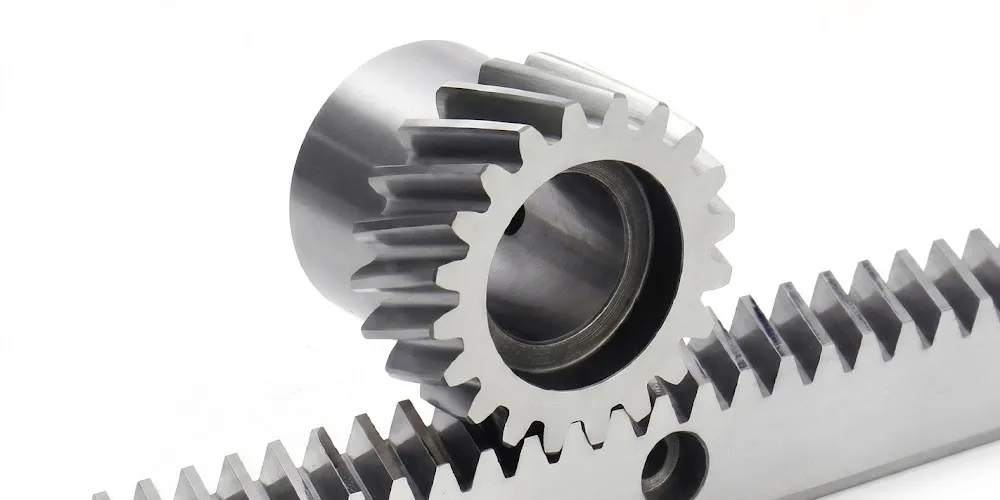
Five Key Performance Advantages of Helical Gear Rack
① Drive + Guide in One Component
Integrating a precision helical rack and a ground V-rail into a single bar eliminates the separate profile rail, rail-to-rack alignment fixtures, and additional fastener patterns a conventional linear rack and pinion plus separate rail assembly would require. In high-speed gantry systems deployed in European semiconductor fabs and Australian research instruments, this structural simplification also reduces assembly time significantly — a direct project cost saving that compounds across multi-axis machines.
② Three-Stage Precision Grinding
The manufacturing sequence — four-side flat grinding, followed by tooth surface grinding, then V-rail surface grinding — corrects heat-treatment distortion at each stage and ensures that all functional surfaces (mounting face, tooth flanks, V-rail) share a common machined datum. This cascade of grinding operations is why the total pitch error across any 1 000 mm length stays below 0.036 mm, a tolerance level that supports repeatable positioning in rack and pinion linear slide systems with servo feedback resolution under 1 µm.
③ Dual Hardness Zones
Tooth surfaces reach HRC48–52° (high-frequency quenching) or HRC55–60° (carburizing quenching), while the V-rail surface is independently hardened to HRC48–55° or HRC55–60° depending on the specification selected. This dual-zone hardening ensures that both the rack tooth contact and the V-guide roller interface achieve their respective fatigue-life requirements independently — without one dictating an over- or under-specified treatment for the other. It is a refinement that separates a dedicated guide-rack from a simple rack with a machined groove.
④ Helical Tooth Smooth Meshing
The 19°31'42" helix produces progressive tooth engagement that makes this helical rack and pinion noticeably quieter and smoother than an equivalent straight gear rack drive at the same module and speed. In optics-assembly machines and coordinate measuring equipment — applications used throughout German and Japanese precision-manufacturing industries — this vibration reduction translates directly into better measurement repeatability and longer bearing service life on the driven carriage.
⑤ Dual Material Options for Load & Environment
S45C suits the majority of high-precision automation applications where shock loading is controlled and the environment is managed. Where impact resistance, fatigue margin, and outdoor or near-process exposure demand more, 42CrMo provides the chromium-molybdenum alloying that raises core toughness without sacrificing surface hardenability. Canadian mining-plant conveyors and Dutch offshore-equipment drive systems are examples where the 42CrMo gear rack variant justifies its selection over the standard carbon-steel option, particularly when the V-rail simultaneously functions as a heavy-load guidance surface under sustained dynamic forces.
Material & Surface Treatment
S45C medium-carbon steel is the foundation material for the standard series. Its carbon content of approximately 0.45% makes it readily machinable through the three grinding stages without workpiece cracking, while the microstructure responds uniformly to high-frequency induction quenching — resulting in consistent HRC48–52° hardness across the tooth flanks and the V-rail surface. For most indoor precision automation environments — laser cutters, PCB drilling systems, optical inspection gantries — S45C provides the structural stiffness and surface hardness that keep the gear rack in tolerance over millions of operating cycles without re-adjustment.
The 42CrMo variant introduces chromium and molybdenum as alloying additions, which improve hardenability to greater depth, raise core tensile strength above 900 MPa, and boost resistance to fretting fatigue at the V-rail contact interface. When carburizing quenching rather than high-frequency quenching is selected, surface hardness rises to HRC55–60° on both the teeth and the V-rail — increasing the Hertzian contact-stress capacity of the rack tooth and reducing the risk of surface spalling in high-cycle, high-speed drive configurations. For gears rack and pinion applications in high-value capital equipment where planned maintenance is disruptive and tooth replacement costs are substantial, the 42CrMo / carburizing combination represents the lowest total ownership cost over a ten-year machine life.
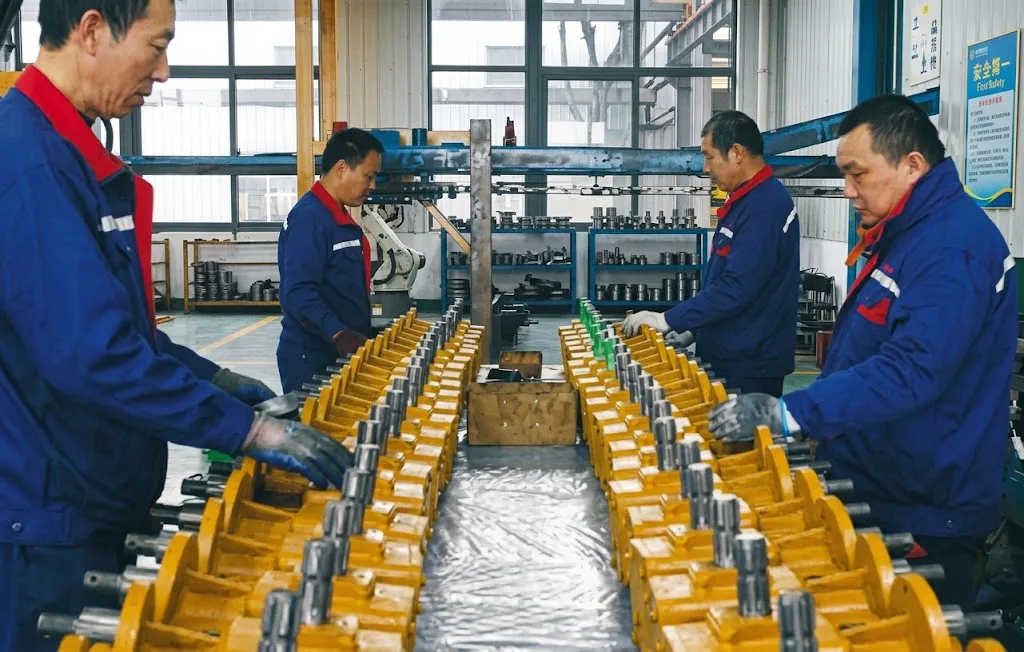
Toepassingsscenario's
Laser Cutting Gantries
High-power fibre laser cutting machines demand a combined drive-and-guide solution that keeps the cutting head on a stable, vibration-free path at traverse speeds up to 120 m/min. The V-type gear rack simultaneously drives the gantry bridge and provides the lateral guidance datum, reducing the number of precision rail components that must be individually aligned on the machine bed — a significant benefit when commissioning large-format machines in German, Italian, or South Korean sheet-metal facilities.
Coordinate Measuring Machines
CMMs used in aerospace and precision tooling quality-control laboratories require drive axes with sub-micrometre pitch consistency and guidance surfaces free of waviness that would introduce systematic measurement error. The ground V-rail surface, produced to the same DIN6e25 datum as the helical rack tooth flanks, delivers the surface-straightness quality that CMM bridge axes need without a separately qualified profile rail requiring individual calibration against the rack pitch line.
Plasma & Waterjet Cutting Tables
Heavy-duty cutting tables carrying large steel or stone workpieces subject the drive axis to both high static load (from workpiece weight) and repeated positional reversals (from cutting path changes). The 42CrMo variant with carburizing-quenched HRC55–60° V-rail and tooth surfaces handles these combined loads reliably in North American and Australian fabrication shops, where machine uptime is directly tied to production throughput and rack replacement in the field is a half-day job at minimum.
Semiconductor Inspection Equipment
Wafer-handling and optical inspection stages in semiconductor fabs — concentrated in Taiwan, South Korea, and the Netherlands — move payloads of a few kilograms at extremely low velocities with nanometre-level feedback control. In these machines the linear gear rack combined V-rail eliminates the micro-vibration that separate rail-and-rack joints can introduce at piezo-excitation frequencies, keeping the inspection image stable during acquisition without active vibration cancellation hardware.
3D Printing & Additive Manufacturing Gantries
Large-format industrial 3D printers — used in aerospace tooling, composite mould making, and architectural concrete printing — use precision linear rack and pinion drives to traverse the print head across build envelopes of 2–8 metres. The V-type combined rack-guide supports these applications well: Module 1.5–2 gives the pitch resolution needed for fine-layer deposition, while the integrated guidance eliminates the assembly stack-up error that a separately mounted linear rail would introduce in a multi-day machine build.
Medical Imaging & Patient Positioning
CT scanner table drives and radiation therapy patient-positioning systems operate in environments where acoustic noise limits are strict, positional accuracy affects clinical outcomes, and maintenance access is limited. A helical rack and pinion with a DIN6e25 ground tooth surface meets the noise and accuracy requirements simultaneously, while the single-body rack-guide construction reduces the number of precision adjustments required during scanner maintenance — an important factor for hospital biomedical engineering teams in the UK, Germany, and Australia.
Over onze fabriek
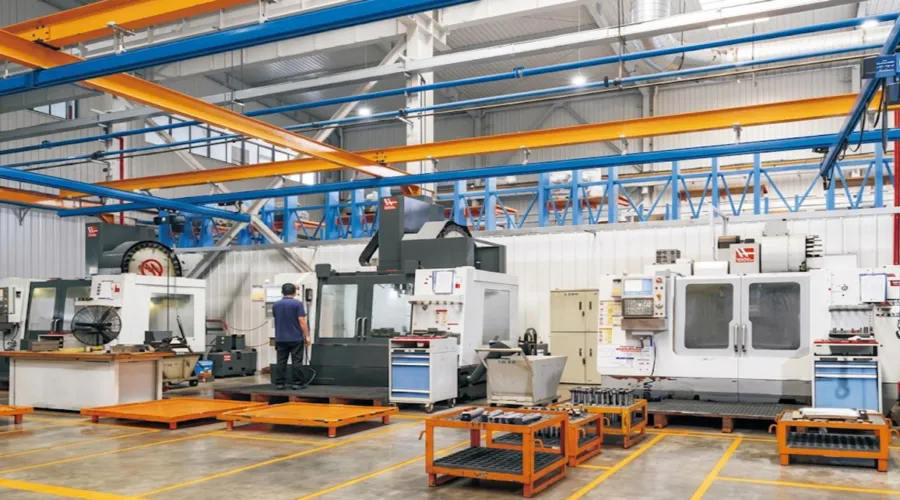
Our manufacturing facility has accumulated more than a decade of hands-on expertise in precision mechanical power transmission, covering design, production, and quality verification of components for industrial customers across six continents. We operate under ISO 9001:2015-certificering, with documented process controls at every production stage from raw material verification through final inspection and export packaging.
Our product scope includes agricultural gearboxes, worm gear speed reducers, planetary gear drives, PTO shafts, hydraulic cylinders, roller chains, and electric motors. We also produce a complete range of gearbox housings and drive assemblies — manufactured in ductile iron, grey cast iron, cast steel, precision investment-cast steel, and die-cast aluminium depending on load class and heat dissipation requirements. Standard components such as spur gears, helical gears, sprockets, worm wheels, pulleys, worms, and drive shafts are held in inventory for fast dispatch, while non-standard and OEM parts are produced to customer drawings with lead times confirmed at quotation. The gear rack series presented across this site — including this V-type combined guide-rack — represents our deepest product expertise, with dedicated grinding capacity and inspection gauging calibrated specifically for rack-pitch verification.
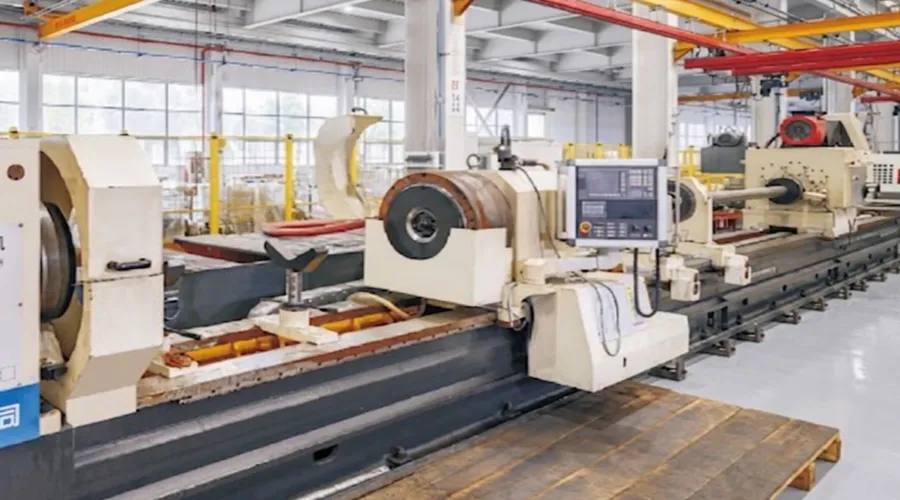
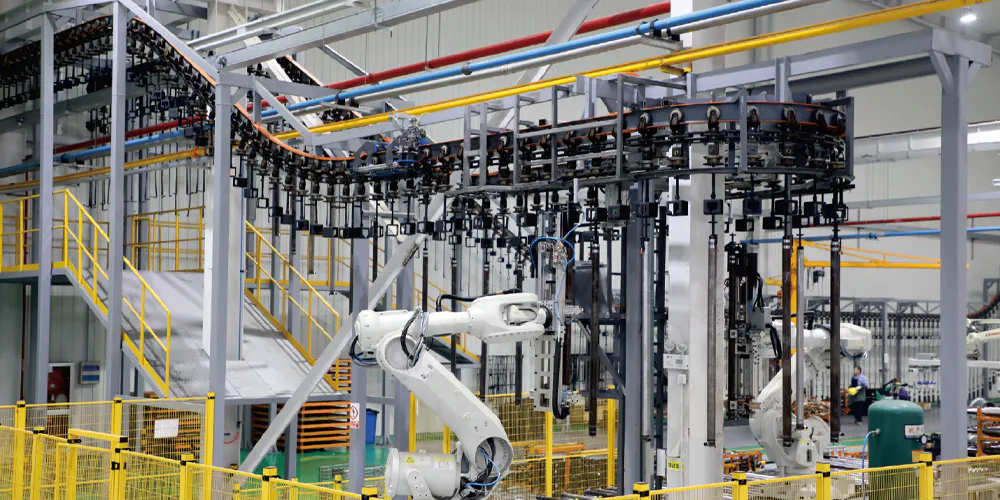
Workshop
Gerelateerde producten
Helical Gear
The full range of helical gears produced in the same facility pairs directly with this V-type gear rack to form complete drive trains. Since the helical pinion gear shares the same helix angle and tooth geometry as the rack, combined procurement removes tooth-geometry mismatch as a variable — and ensures that both components are traceable to the same production-quality system. Engineers integrating a gearbox rack and pinion unit with this V-type guide-rack benefit from pre-matched meshing geometry without additional design verification.
Kunststof tandwielrek
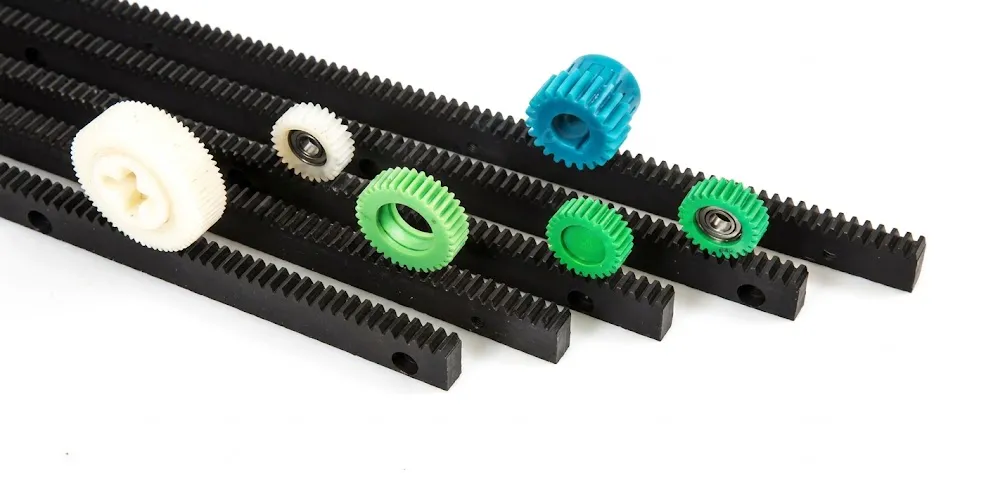
Where the application requires electrical isolation, self-lubrication, or minimal weight — such as in laboratory robotics, light-duty dispensing automation, or food-contact packaging equipment — our plastic gear rack series provides an alternative drive element. Produced from engineering-grade polymer with matched tooth pitch to our standard steel pinion range, the plastic rack integrates into the same rack and pinion gear drive concept with no pinion modification, allowing designers to switch materials without redesigning the drive layout.
Veelgestelde vragen
Redacteur: PXY