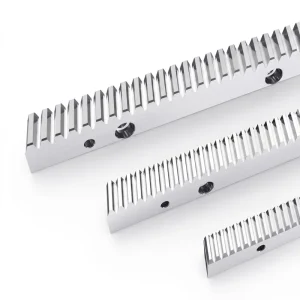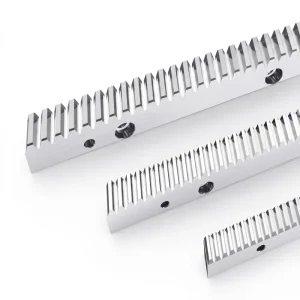
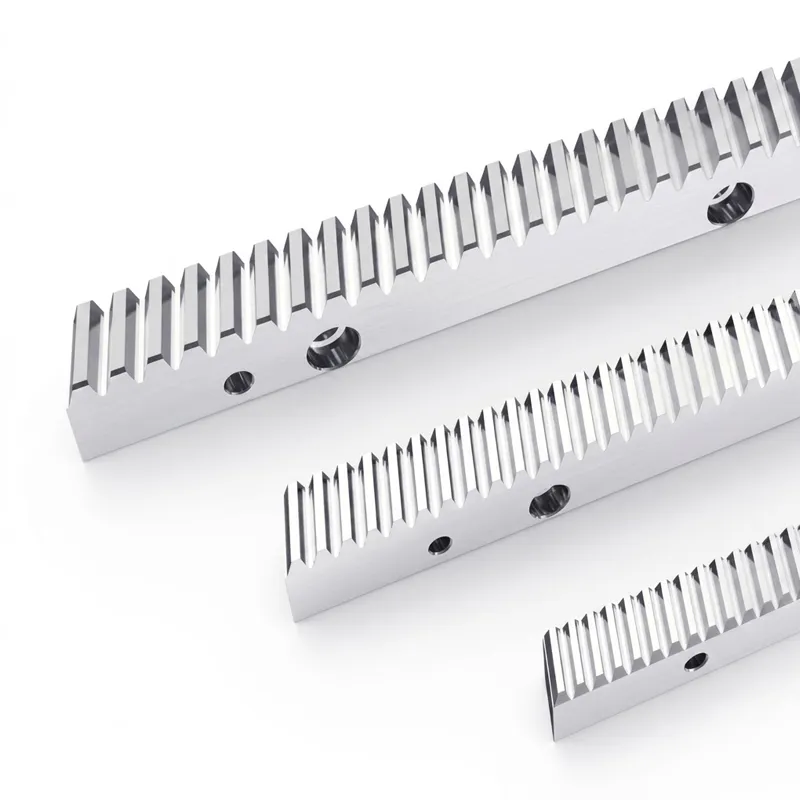
EP-S45C / 42CrMo Helical Gear Rack — High Frequency Quenching HRC48–52°
This gear rack’s material is S45C or 42CrMo alloy steel — two compositions that balance machinability with structural integrity. High-frequency quenching elevates tooth surface hardness to HRC48–52°, significantly extending service life under repetitive load cycles. Tooth flanks are finish-ground after heat treatment, ensuring each gear rack leaves the production line within tight dimensional tolerances and with a surface finish that minimises wear on the mating pinion. For environments requiring corrosion resistance, surface blackening or phosphating is applied as a standard post-process option.
Rack lengths are offered in 500 mm and 1 000 mm standard segments, with modules ranging from 1.5 to 12 — giving engineers a broad selection when calculating the gear ratio of rack and pinion for their specific drive system. Hole-free variants are also available; simply append the suffix “N” to the model code (e.g. STOER010N) when placing an order. Custom dimensions and materials are accepted based on customer drawings, making this one of the most flexible custom gear rack options available on the global market.
EP-S45C / 42CrMo Helical Gear Rack — High Frequency Quenching HRC48–52°
DIN6 International Grade 5 Accuracy · Helical Tooth Profile · Right Helix Angle 19°31'42" · Surface Hardness HRC48–52°
Technical Specifications at a Glance
| Parámetro | Details |
|---|---|
| Accuracy Level | DIN6 International Grade 5 |
| Material | S45C / 42CrMo Alloy Steel |
| Tooth Profile | Helical teeth |
| Right Helix Angle | 19°31'42" |
| Hardness Treatment | High-frequency quenching HRC48–52° / Carburizing & quenching HRC50–55° |
| Production Process | Four-side flat grinding · Fine insertion · Surface blackening or phosphating |
| Standard Lengths | 500 mm / 1 000 mm (custom available) |
| Module Range | 1.5 – 12 |
| Hole-free Option | Available — suffix "N" in model code |
Dimensional Parameters (Unit: mm)
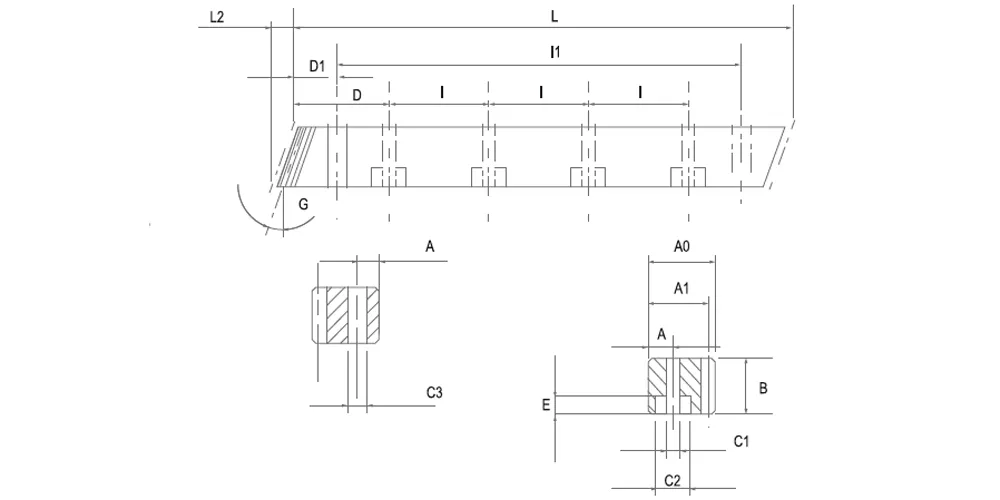
End face pitch Pe = Module × π / COS(19°31'42") | Fp = Total pitch deviation | All dimensions in millimetres.
| Code | Módulo | Pt | L (mm) | L2 (mm) | Tooth No. | B | A0 | A1 | D | I | Hole No. | A | C1 | C2 | mi | D1 | I1 | C3 | Fp |
|---|---|---|---|---|---|---|---|---|---|---|---|---|---|---|---|---|---|---|---|
| 552 010 050 | 1.5 | 4.9999 | 500.00 | 6 | 100 | 17 | 17 | 15.5 | 62.5 | 125 | 4 | 7 | 6 | 9.5 | 7 | 31.7 | 436.6 | 5.7 | 0.029 |
| 552 010 100 | 1.5 | 4.9999 | 1000.00 | 6 | 200 | 17 | 17 | 15.5 | 62.5 | 125 | 8 | 7 | 6 | 9.5 | 7 | 31.7 | 936.6 | 5.7 | 0.033 |
| 552 015 050 | 1.5 | 4.9999 | 500.00 | 6.74 | 100 | 19 | 19 | 17.5 | 62.5 | 125 | 4 | 8 | 7 | 11 | 7 | 31.7 | 436.6 | 5.7 | 0.029 |
| 552 015 100 | 1.5 | 4.9999 | 1000.00 | 6.74 | 200 | 19 | 19 | 17.5 | 62.5 | 125 | 8 | 8 | 7 | 11 | 7 | 31.7 | 936.6 | 5.7 | 0.033 |
| 552 020 050 | 2 | 6.6666 | 500.00 | 8.5 | 75 | 24 | 24 | 22 | 62.5 | 125 | 4 | 8 | 7 | 11 | 7 | 31.7 | 436.6 | 5.7 | 0.029 |
| 552 020 100 | 2 | 6.6666 | 1000.00 | 8.5 | 150 | 24 | 24 | 22 | 62.5 | 125 | 8 | 8 | 7 | 11 | 7 | 31.7 | 936.6 | 5.7 | 0.034 |
| 552 030 050 | 3 | 9.9999 | 500.00 | 10.3 | 50 | 29 | 29 | 26 | 62.5 | 125 | 4 | 9 | 10 | 15 | 9 | 35.0 | 430.0 | 7.7 | 0.032 |
| 552 030 100 | 3 | 9.9999 | 1000.00 | 10.3 | 100 | 29 | 29 | 26 | 62.5 | 125 | 8 | 9 | 10 | 15 | 9 | 35.0 | 930.0 | 7.7 | 0.037 |
| 552 040 050 | 4 | 13.3333 | 506.67 | 13.8 | 38 | 39 | 39 | 35 | 62.5 | 125 | 4 | 12 | 10 | 15 | 9 | 33.3 | 433.0 | 7.7 | 0.034 |
| 552 040 100 | 4 | 13.3333 | 1000.00 | 13.8 | 75 | 39 | 39 | 35 | 62.5 | 125 | 8 | 12 | 10 | 15 | 9 | 33.3 | 933.4 | 7.7 | 0.04 |
| 552 050 050 | 5 | 16.6666 | 500.00 | 17.4 | 30 | 49 | 39 | 34 | 62.5 | 125 | 4 | 12 | 14 | 20 | 13 | 37.5 | 425.0 | 11.7 | 0.034 |
| 552 050 100 | 5 | 16.6666 | 1000.00 | 17.4 | 60 | 49 | 39 | 34 | 62.5 | 125 | 8 | 12 | 14 | 20 | 13 | 37.5 | 925.0 | 11.7 | 0.04 |
| 552 060 050 | 6 | 19.9999 | 500.00 | 20.9 | 25 | 59 | 49 | 43 | 62.5 | 125 | 4 | 16 | 18 | 26 | 17 | 37.5 | 425.0 | 15.7 | 0.034 |
| 552 060 100 | 6 | 19.9999 | 1000.00 | 20.9 | 50 | 59 | 49 | 43 | 62.5 | 125 | 8 | 16 | 18 | 26 | 17 | 37.5 | 925.0 | 15.7 | 0.04 |
| 552 080 050 | 8 | 26.6667 | 480.00 | 28.0 | 18 | 79 | 79 | 71 | 60.0 | 120 | 4 | 25 | 22 | 33 | 21 | 120 | 240.0 | 19.7 | 0.037 |
| 552 080 100 | 8 | 26.6667 | 960.00 | 28.0 | 36 | 79 | 79 | 71 | 60.0 | 120 | 8 | 25 | 22 | 33 | 21 | 120 | 720.0 | 19.7 | 0.043 |
| 552 100 100 | 10 | 33.3333 | 1000.00 | 35.11 | 30 | 99 | 99 | 89 | 62.5 | 125 | 8 | 32 | 33 | 48 | 32 | 125 | 750.0 | 19.7 | 0.043 |
| 552 120 100 | 12 | 39.9999 | 1000.00 | 42.56 | 25 | 120 | 120 | 108 | 40 | 125 | 8 | 40 | 39 | 58 | 38 | 125 | 750.0 | 19.7 | 0.046 |
Racks without holes are also available — add suffix "N" to the model code (e.g. STOER010N). Custom dimensions and materials are accepted on drawing basis. All specifications subject to change; please confirm before ordering.
How a Helical Gear Rack Works
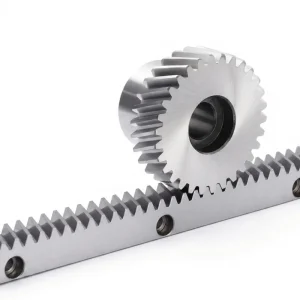
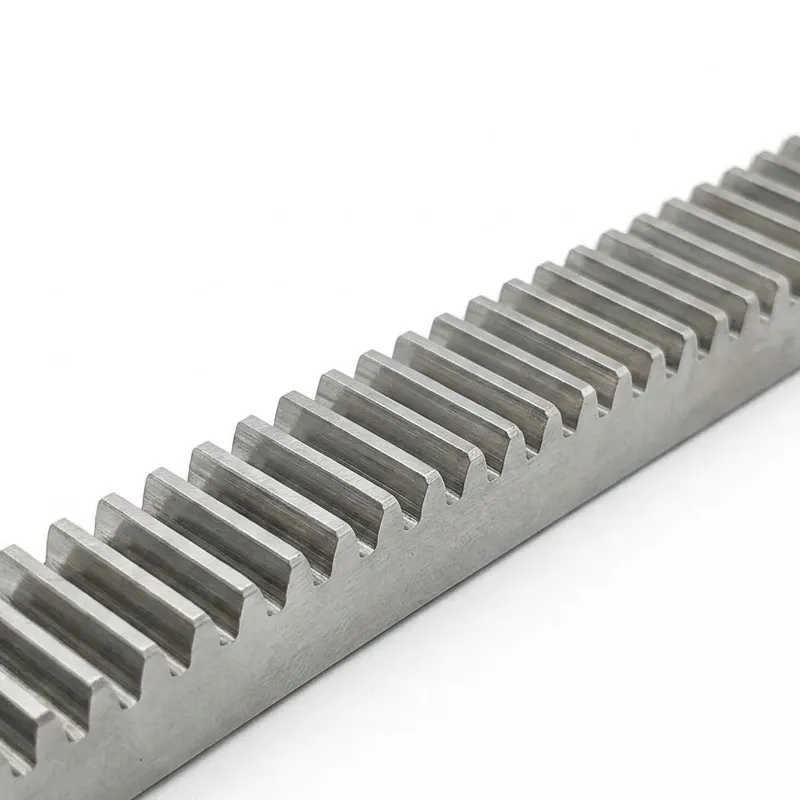
A gear rack is essentially a straight-toothed bar that converts rotational motion into linear displacement when paired with a driving pinion. In a rack and pinion gear arrangement, the pinion (a round gear) rotates against the rack's teeth and propels it along a fixed path — or, alternatively, the rack is stationary while the pinion and its carriage traverse the length of the bar. The direction and speed of linear travel depend directly on the pinion's rotational input, the module size, and the resulting gear ratio of rack and pinion. This core principle underpins a vast range of mechanical drives, from small rack and pinion linear slides on laboratory instruments to large-format gantry systems in heavy manufacturing.
The helical tooth variant used in this series introduces an angled tooth engagement — in this case a 19°31'42" right helix — that causes teeth to mesh progressively rather than all at once. Progressive engagement translates to lower impact loads, quieter operation, and higher load-carrying capacity compared to conventional spur gear racks. These properties are especially valued in CNC machining centres and automated guided vehicle (AGV) rail drives, where vibration and acoustic noise must be tightly controlled. The interaction can also be described as a linear rack and pinion drive — the helical design simply elevates that fundamental mechanism to a higher performance tier.
Cinco ventajas clave en el rendimiento
① DIN6 Grade 5 Precision
Cada gear rack in this line is manufactured and verified against DIN6 International Grade 5 tolerances. This level of accuracy ensures consistent pitch deviation, minimal backlash, and reliable repeatability cycle after cycle — a prerequisite for servo-driven positioning systems and precision linear rack and pinion slide assemblies used in machine tools across Europe and North America.
② HRC48–52° Hardened Tooth Surface
High-frequency induction quenching drives surface hardness to HRC48–52°, while retaining a tough core. This differential hardness profile resists pitting and abrasive wear from the mating rack pinion gear during millions of engagement cycles — especially critical in continuous-duty applications such as conveyor transfers and warehouse shuttle systems where the gear rack operates around the clock.
③ Helical Tooth Smooth Meshing
The 19°31'42" helical profile of this helical rack and pinion enables gradual tooth engagement that substantially reduces vibration, operating noise, and dynamic load spikes versus an equivalent straight spur gear rack. This characteristic directly improves surface finish quality in CNC portal mills and enhances passenger comfort in rack-driven elevator guides — two very different applications united by a shared need for quiet, jerk-free motion.
④ Four-Side Ground Finish
After heat treatment, each rack undergoes four-side flat grinding. This step removes heat-treatment distortion and delivers a reference surface that ensures accurate, burr-free installation in guide housings. Engineers in the Netherlands and Australia who have integrated this linear gear rack into gantry cranes and logistics sorters consistently note the ease of assembly — a direct benefit of the ground datum faces.
⑤ Flexible Customisation & Broad Module Range
Modules 1.5 through 12 cover drive requirements from compact small gear rack installations in semiconductor handlers to heavy-duty shelves gear rack structures in automated storage facilities. Custom drawings are accepted for non-standard cross-sections, materials, or lengths — supporting OEMs who need a custom gear rack that integrates precisely into their proprietary machine frame without adapter plates or re-engineering.
Material & Surface Treatment
Two steel grades are offered to match different application requirements. S45C is a medium-carbon structural steel widely used throughout the mechanical transmission industry. It machines readily, responds well to induction hardening, and achieves the required HRC48–52° tooth surface hardness at an economical material cost — making it the standard selection for most rack and pinion gear applications in automation, packaging, and material handling.
For environments involving higher shock loading or corrosive exposure, 42CrMo chromium-molybdenum alloy steel provides a noticeably stronger core with better fatigue resistance. This grade is commonly preferred for heavy portal crane rails, large industrial press gear racks, and outdoor infrastructure drives in the UK and Australian markets, where weather cycling and peak dynamic loads demand the extra structural margin that 42CrMo delivers. Both grades are available with surface blackening or phosphating as a finishing option, contributing additional corrosion inhibition for storage and transit.
Escenarios de aplicación
CNC Machining Centres
Helical gear racks drive gantry axes on large-format CNC routers and boring mills where axis accuracy determines part quality. The DIN6 tolerance and ground datum surfaces translate directly into positional repeatability within micrometres, enabling high-value aerospace and die-mould components to be machined in a single setup.
Automated Storage & Retrieval
Modern AS/RS installations in logistics hubs across South Korea, Canada, and the Netherlands depend on rack and pinion linear slides to position stacker cranes with sub-millimetre accuracy at speeds exceeding 4 m/s. This series withstands the multi-million-cycle demands of 24/7 warehouse operations without requiring frequent tooth-surface inspection.
Portal Cranes & Gantry Systems
Shipyards and heavy-industry plants rely on large-module gear racks — typically Module 8 to 12 — to traverse portal cranes along quayside rails. The 42CrMo option with carburizing-quenched HRC50–55° surface is particularly suited here, where per-tooth loads are extreme and rack replacement requires costly downtime.
Printing & Packaging Machinery
Register accuracy in web-fed printing presses demands precise, vibration-free linear gear rack drives for tension-roll positioning. Helical meshing keeps noise levels acceptable in factory environments and prevents the micro-vibration that can cause print banding — an issue that a standard spur rack and pinion would exacerbate at production speeds.
Medical & Laboratory Equipment
Small-module gear racks (Module 1.5–2) find use in diagnostic imaging tables, patient-positioning platforms, and automated pipetting systems where load capacity is moderate but motion smoothness and acoustic discretion are paramount. Surface blackening protects rack teeth in sterilisation-cycle environments without adding significant dimensional bulk.
Agricultural & Outdoor Machinery
Self-propelled sprayers and precision planting equipment increasingly use rack and pinion gear mechanisms for implement depth control and row-unit lateral adjustment. S45C racks with phosphating offer adequate corrosion protection in field conditions, while the broad module selection accommodates drives from small seed-placement actuators to large tillage-depth cylinders.
Sobre nosotros
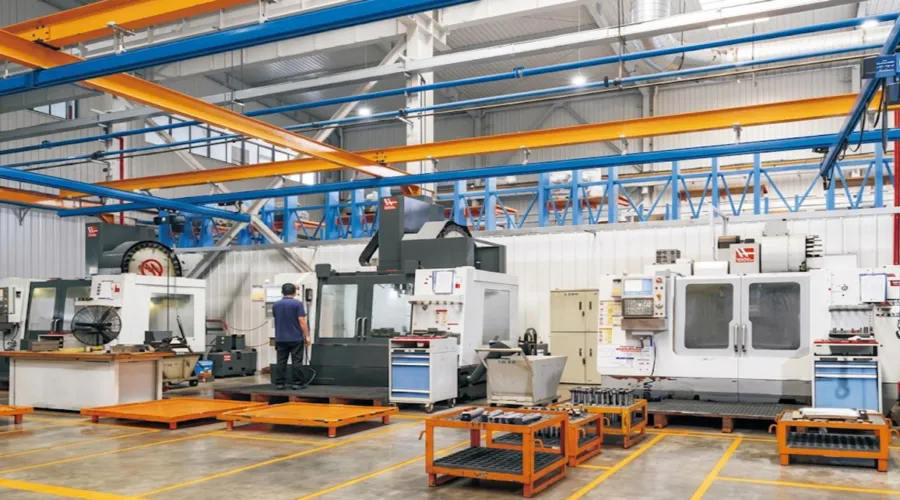
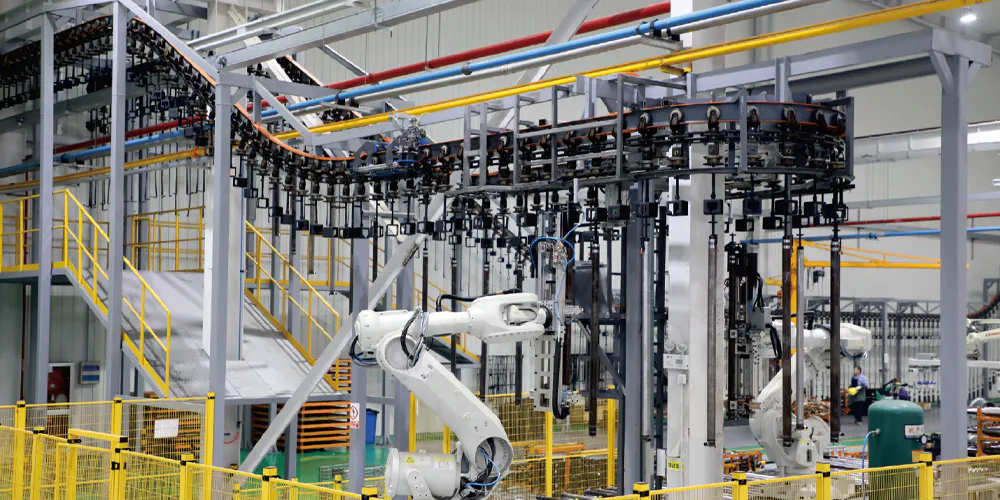
With more than a decade of accumulated expertise in mechanical power transmission, our production facility specialises in engineering-grade gearboxes, gear drives, and linear motion components for industrial and agricultural customers worldwide. Our manufacturing operations hold Certificación ISO 9001:2015, and every outgoing product is inspected against defined dimensional and hardness acceptance criteria before dispatch.
Our product range spans agricultural gearboxes, worm gear reducers, planetary gear drives, power take-off shafts, hydraulic cylinders, gears, roller chains, and electric motors. We also produce a complete selection of industrial and agricultural gearbox housings and assemblies machined from ductile iron, cast iron, cast steel, precision investment-cast steel, and die-cast aluminium. Standard parts — gears, sprockets, worm wheels, pulleys, worms, and shafts — are held in inventory, while non-standard components are manufactured to customer drawings with typical lead times communicated at time of quotation. Whether you need a single custom piece or ongoing bulk supply of straight gear rack segments, our flexible production scheduling can accommodate your requirements.
Taller
Productos relacionados
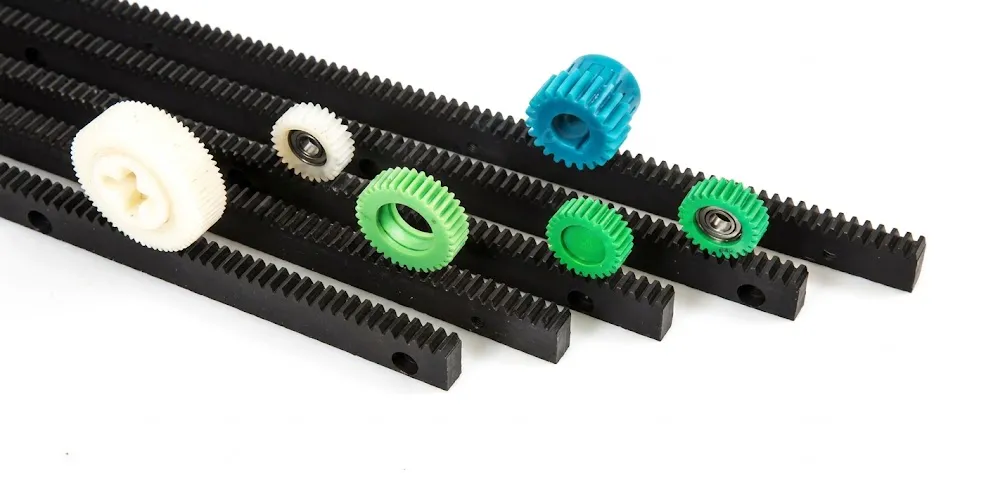
Cremallera de engranajes de plástico
Nuestro plastic gear rack range complements the steel series for applications where weight reduction, corrosion immunity, or electrical isolation matter more than peak load capacity. Commonly specified alongside steel pinions in food-processing conveyors, laboratory automation, and light packaging lines, these racks offer a one-stop sourcing solution — same factory, same quality control, matched tooth geometry for full rack and pinion gear system compatibility.
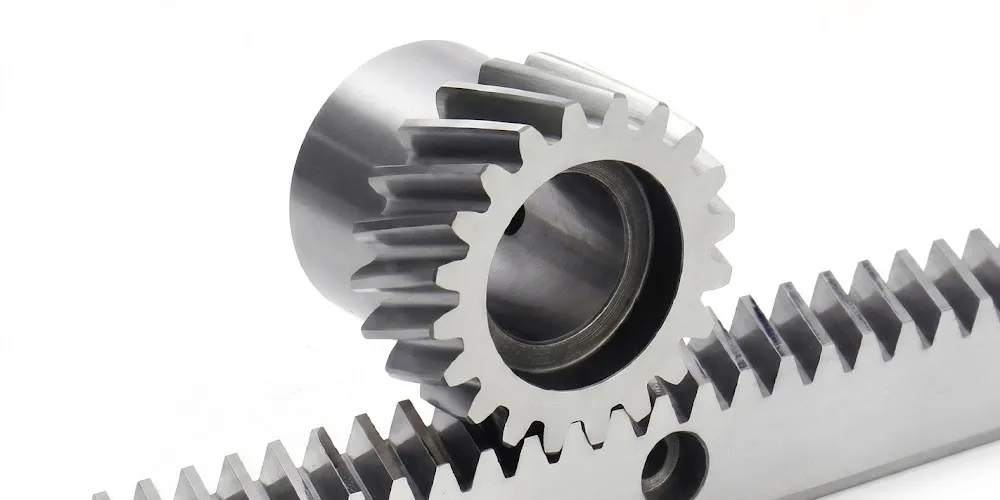
Helical Gear
The full series of helical gears available from the same production facility pairs naturally with this gear rack for complete drivetrain assemblies. Helical gears share the same angled-tooth engagement principle, so combining them with our helical rack and pinion creates a mechanically coherent, low-vibration transmission that eliminates the need to source rotary and linear components from different vendors — a significant advantage when commissioning multi-axis gantry systems.
Preguntas frecuentes
Editor: PXY