
Polymer Motion Components
Plastväxelställ
Lightweight · Self-Lubricating · Corrosion-Resistant · Low Noise · Custom Modules Available
Engineered polymer gear racks for automation, sliding gates, medical equipment, and light industrial drives — precision-formed in PA66, POM, MC Nylon, and reinforced polymer grades.
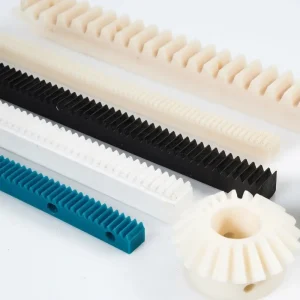
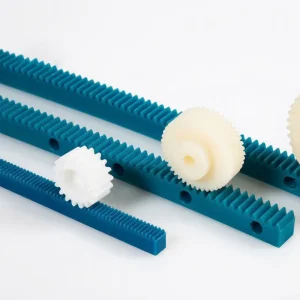
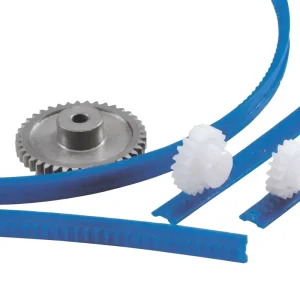
Plastic Gear Rack Types
Plastic Rack Materials Compared
Choosing the right polymer for your load, temperature, and environment
The material of a plastic gear rack determines nearly every aspect of its performance: how much load it can carry before deforming, how it responds to heat and moisture, what chemicals it can withstand, and how long it lasts in a given duty cycle. The four primary materials used in precision plastic racks each have a distinct performance profile — the following table summarizes the key differences to aid specification.
| Egendom | PA66 (Nylon) | POM (Polyacetal) | PA66-GF30 | MC Nylon |
|---|---|---|---|---|
| Tensile Strength | ~80 MPa | ~65 MPa | ~160 MPa | ~90 MPa |
| HDT (under load) | 66°C | 110°C | 220–250°C | ~185°C |
| Water Absorption | Moderate (~2.5%) | Very Low (<0.2%) | Low (~1.3%) | Moderate |
| Self-Lubrication | Good | Excellent | Good | Good |
| Wear Resistance | Good | Very Good | Good | Excellent |
| Flexibility | Moderate | Låg | Very Low | Låg |
| Chemical Resistance | Good (oils, dilute acids) | Excellent (solvents, fuels) | Good | Good |
| Slagmotstånd | High | Moderate | Moderate | High |
| Bäst lämpad för | General purpose, gate drives, automation | Low moisture, precision, food-grade | High load, elevated temperature | Heavy plastic rack, large section |
What Is a Plastic Gear Rack?
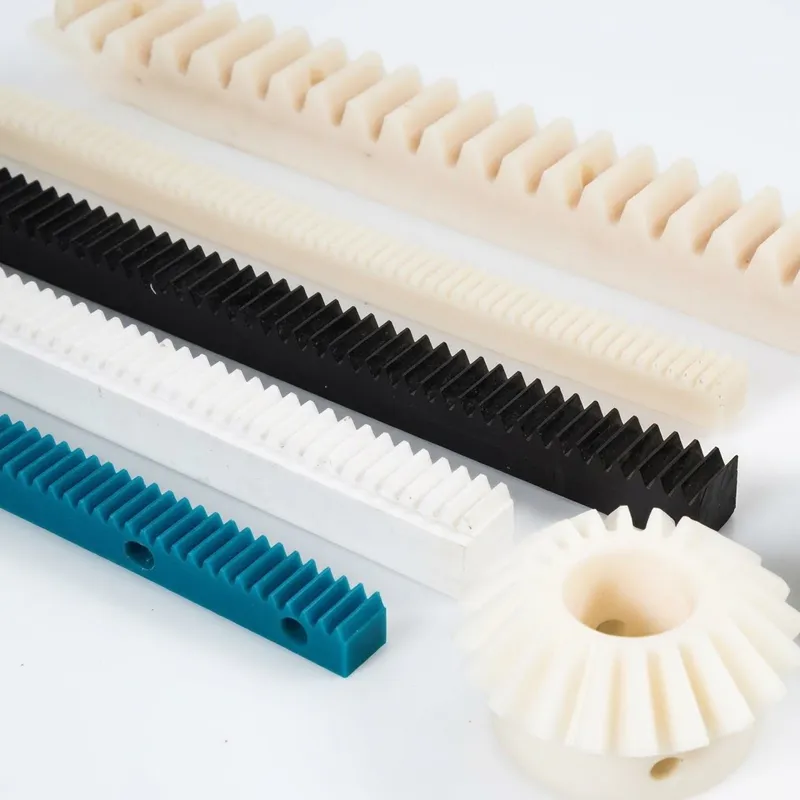
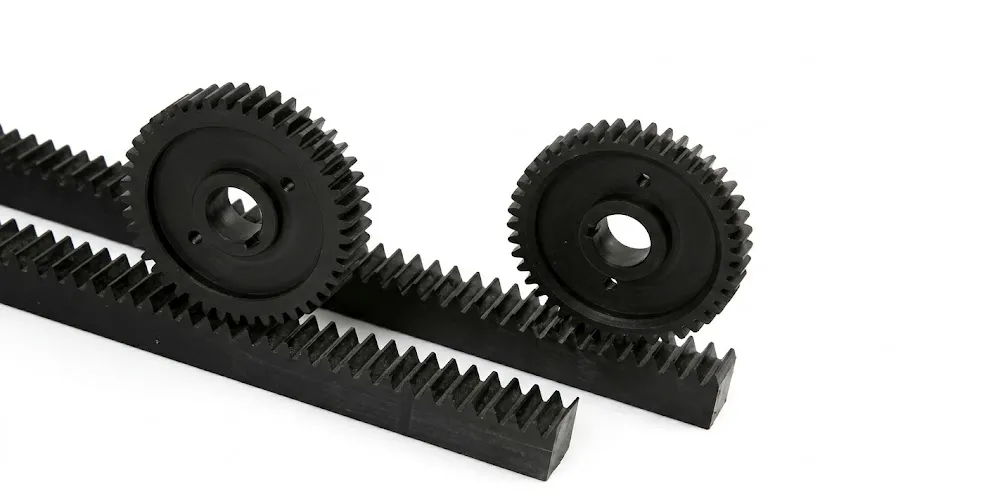
A plastic gear rack is a linearly toothed bar produced from engineering-grade polymer materials. Like its metal counterpart, it operates as part of a rack-and-pinion system: a rotating pinion gear meshes with the rack’s tooth profile, converting rotary motion into controlled straight-line displacement. The fundamental working principle — involute tooth geometry, 20° pressure angle, module-based pitch — is identical to steel racks. What changes is the material, and with it, a specific set of performance characteristics that make the plastic gear rack the preferred choice in a defined and important range of applications.
Plastic racks are compatible with both plastic and metal pinions. A polymer rack running against a hardened steel pinion is a common pairing for medium-duty drives: the softer rack material absorbs minor misalignment and distributes contact load gently, while the steel pinion provides long-term tooth geometry stability. A fully plastic rack-and-pinion set delivers maximum corrosion resistance and minimum system weight — suitable for light-duty applications where load capacity is secondary to environmental performance.
Installation & Maintenance Guide
Mounting and Alignment
Fix the rack to its mounting channel using the side-face mounting holes first, applying torque evenly. Verify tooth-to-pinion centerline distance with a feeler gauge — too tight a mesh compresses the plastic tooth tip, too loose allows excessive backlash and tooth tip impact. A light hand-pressure mesh with zero perceptible play at the tooth face is the target. Plastic racks tolerate minor parallel misalignment better than steel, but angular misalignment still accelerates edge loading and premature wear at one end of the tooth width.
Joining Multiple Rack Sections
For axes longer than a single rack section, end-machined variants (PRF series) are designed with half-tooth root end faces that form a complete tooth when two sections meet — maintaining correct pitch across the joint. Position adjacent racks with the end faces touching, align the tooth pitch using a pitch gauge before fixing, then secure the end pin holes. On a flexible rack application, the joint should fall in a straight section of the track where possible, not on a curve.
Lubrication and Maintenance
Under normal operating loads and temperatures, self-lubricating PA66 and POM plastic racks require no applied lubricant. Adding grease to a self-lubricating rack can attract and retain particulate contamination, which accelerates abrasive wear — so in clean environments, no lubrication is genuinely the correct maintenance approach. In dusty or lightly abrasive environments, a periodic wipe-down of tooth faces with a dry cloth is more beneficial than lubrication. If the application involves heavy loads or elevated temperatures, a thin dry-film lubricant (PTFE spray) is preferable to oil or grease.
Wear Inspection and Replacement Intervals
Plastic rack tooth wear is visible as a rounding and reduction in tooth tip height. Inspect tooth profile visually at each scheduled maintenance visit — a worn tooth tip that has lost more than 30% of its original radial height signals that replacement should be planned before failure. Unlike steel racks, plastic racks rarely fail catastrophically without preceding visible wear; the material deforms progressively, giving observable warning before full loss of function. Keep a spare rack section on-site for high-cycle or critical applications to minimize downtime at replacement.
Even reinforced PA66-GF30 has a tensile strength around 160 MPa — well below the 500–800 MPa range of case-hardened steel racks. For heavy CNC gantry axes, rack-driven elevators, and construction lifting equipment, a steel rack is the only option. Specifying a plastic rack beyond its load limit produces accelerated tooth wear and root cracking.
Under sustained compressive tooth contact load at elevated temperature, polymer materials creep — the tooth geometry deforms progressively even below the yield point. This matters in applications with continuous high loads at temperatures above 60–70°C. GF30 grades resist creep significantly better but still cannot match hardened steel. If the application runs continuously under high load at elevated temperature, steel is the correct specification.
Grit, sand, metal swarf, and other abrasive particles accelerate tooth surface wear on plastic racks far more rapidly than on hardened steel. Mining equipment, quarry conveyors, and aggregate handling systems present abrasive conditions that exhaust a polymer rack's surface in a fraction of the service life achievable with a hard steel rack. If the environment contains significant abrasive contamination, steel with appropriate sealing is the better choice.
Ground steel racks achieve DIN5 precision with total pitch errors under 0.030 mm per 500 mm of rack length. Injection-molded plastic racks cannot reach this precision level due to mold shrinkage variation and the lower stiffness of polymer under tooth engagement deflection. For CNC machining axes, precision robotics, and coordinate measurement systems requiring sub-0.05 mm positional accuracy, ground steel rack is the specified solution.
Knowing the Limits: When to Choose Steel Instead
The engineering case for a plastic gear rack is strong in its defined application range — but specifying polymer where steel is needed leads to premature failures that could have been avoided. The following limitations are inherent to the material category and cannot be designed around by selecting a better polymer grade:
Ready to Specify Your Application?
Request the Full Plastic Gear Rack
Our product catalog covers a comprehensive range of plastic gear racks—including rigid PA66, flexible strip types, GF30-reinforced versions, and machined MC nylon components—and provides specifications categorized by module, material technical data, and selection guides. Please provide details regarding your motion path geometry, load, speed, and operating environment, and we will recommend the most suitable rack type and material for your specific requirements.
How to Select the Right Plastic Gear Rack
Step1
Confirm the Motion Path
Is the rack running in a straight line, or does the path curve? For straight linear drives, any rigid rack form works. For curved paths — a curved gate track, a conveyor bend, a non-linear automation channel — only the flexible rack variant can conform to the path geometry. No amount of rigid rack segmenting will replicate the continuous curved mesh that a flexible rack delivers.
Step2
Define the Load
Calculate the tangential force at the rack tooth: Fu = m × g × μ + m × a for horizontal drives; add the gravity component (m × g) for vertical. Compare this against the allowable tooth bending load for your candidate module and material. If load exceeds what standard PA66 can handle at the required module, step up to GF30 grade or — for the largest sections — consider MC Nylon. If load is very light, standard unfilled PA66 or POM is sufficient and more economical.
Step3
Select the Module
Module determines tooth size and therefore load capacity. Plastic racks are most common in M1 through M4. M1–M1.5 suits very fine-pitch, light-duty positioning. M2 is the most widely used for gate drives and general automation. M3–M4 handles higher forces. Larger modules are available from MC Nylon machined blanks. Always verify that the chosen module produces a pinion pitch circle diameter that fits within the available shaft and clearance geometry of your assembly.
Step4
Choose Straight or Helical
Straight-tooth plastic racks are simpler to install and tolerate minor pinion misalignment — appropriate for most gate and general automation drives. Helical plastic racks engage the pinion progressively, producing smoother motion and lower audible noise — preferable for office equipment, medical devices, and any application where vibration or sound level is a design constraint. Note that helical plastic racks require a matched helical pinion to mesh correctly.
Step5
Assess the Environment
What chemicals, moisture levels, UV exposure, or temperature range will the rack operate in? For food-grade or washdown environments, POM offers the lowest moisture absorption and resists alkaline cleaning agents well. For salt-air or outdoor coastal installations, PA66 and POM both outperform uncoated steel without any surface treatment maintenance. For elevated temperatures above 80°C, only GF-reinforced grades or MC Nylon maintain adequate dimensional stability and tooth geometry.
Step3
Plan the Pinion Pairing
A plastic rack can run against a plastic pinion or a metal pinion. Metal-on-plastic is the most common pairing for medium-duty drives: the steel pinion maintains precise tooth geometry over many cycles while the plastic rack absorbs shock and eliminates lubrication requirements. For maximum corrosion resistance — marine, chemical, or cleanroom — a plastic pinion paired with a plastic rack produces a fully non-metallic drive train. Always match module and pressure angle precisely between rack and pinion.