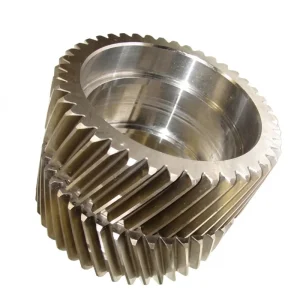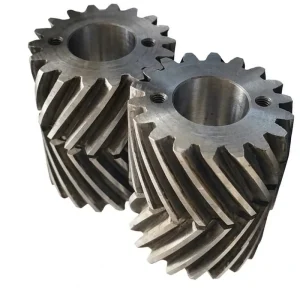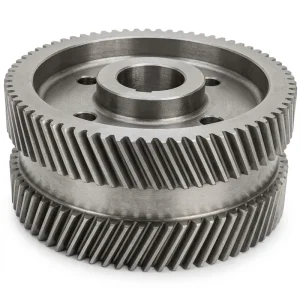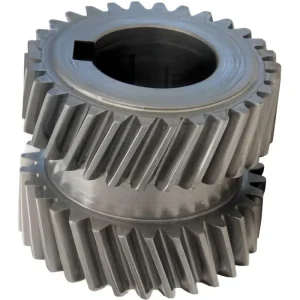
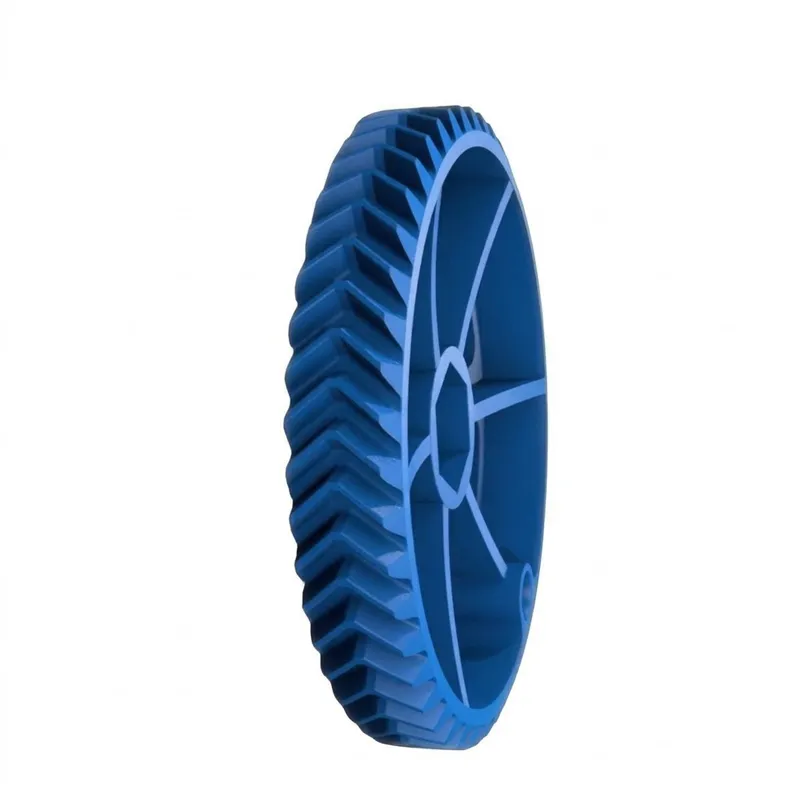
EP-Automotive Double Helical Gear
The EP-Automotive Double Helical Gear is a high-precision transmission component designed for lightweight and quiet operation in automotive, medical, and aerospace applications. Manufactured from advanced engineering plastics including POM, PA, PPA, PBT, and PEEK, these gears offer excellent wear resistance and self-lubricating properties. Available in diameters from Φ3mm to Φ120mm and modules ranging from M0.15 to M2.2, the double helical design effectively eliminates axial thrust, ensuring smooth power transmission. Produced to stringent meshing standards such as ISO 6, DIN 5/6, and AGMA 13, they guarantee low noise and high accuracy. Fully customizable via ODM/OEM services and certified under ISO 9001:2008/TS16949, each unit is vacuum-packed for protection. Ideal for precision instruments, electric vehicles, and robotic systems requiring reliable, low-inertia motion control.
EP-Automotive Double Helical Gear — Precision Polymer Double Helical Gear for Automotive and Light-Duty Drive Systems
The EP-Automotive Double Helical Gear brings the proven thrust-cancelling, high-contact-ratio performance of the double helical gear design into the polymer gear domain — a combination that is increasingly relevant as automotive and light-industrial drive designers seek to reduce weight, lower radiated noise, and eliminate lubrication requirements in compact actuator and auxiliary drive assemblies. Available in POM, PA, PPA, PBT, and PEEK as customised, with dimensions spanning Φ3 mm to Φ120 mm and modules from M0.15 to M2.2, this series addresses the growing market for precision-moulded or machined polymer double helical gears used in window lift drives, seat adjustment actuators, HVAC blower controls, EPS systems, and a broad range of automotive convenience and powertrain-adjacent mechanisms.
Technical Specifications — EP-Automotive Double Helical Gear
| Parameter | Specifikation |
|---|---|
| Växeltyp | Automotive Double Helical |
| Dimension Range | Φ3 mm – Φ120 mm |
| Standard Reference Dimension | Φ15 mm |
| Module Range | M0.15 – M2.2 |
| Standard Module | M0.25 |
| Material Type | POM, PA, PPA, PBT, PEEK — as customised |
| Meshing Grade | GB 6, ISO 6, JGMA 1, JIS 6, AGMA 13, DIN 6, DIN 5 |
| Applications | Medical, Industrial, Automotive, Military, Aircraft, Mechanical |
| Customisation | ODM / OEM — drawings and samples accepted |
| Sample Availability | Sample available before batch order commitment |
| Packing | Vacuum-packed with Plastic Tray |
| Delivery | DHL, TNT, FedEx, UPS |
| Certificate | ISO 9001:2008 / TS16949 |
What Is the EP-Automotive Double Helical Gear and Why Does Automotive Engineering Choose Polymer Double Helical Designs?
The shift toward polymer gearing in automotive applications is not a compromise — it is a deliberate engineering choice driven by the specific performance requirements of modern vehicle electronics, comfort systems, and compact auxiliary drives. Polymer gears, when correctly designed, run without grease — a significant advantage in sealed automotive actuators where relubrication access is impossible across a vehicle service life of 15 years and 250,000 kilometres. They also generate substantially less airborne noise than their steel counterparts at equivalent pitch line velocities, which matters directly to NVH (noise, vibration, and harshness) targets that automotive OEMs set for interior comfort. And at the small module sizes relevant to actuator drives — M0.15 to M2.2 — polymer gears can be injection-moulded to tight tolerances in high volumes, enabling cost-effective production at automotive production rates.
The double helical gear design adds a further layer of performance advantage to these polymer properties. The opposing helical tooth sets cancel axial thrust forces at the gear hub — eliminating the axial loads that would otherwise push against the moulded plastic bushings or small rolling-element bearings used in compact automotive actuator housings. In a conventional single-helix helical gear at the helix angles required for good overlap contact ratio (typically 20°–30°), the axial force component on a small actuator shaft can be comparable in magnitude to the radial force — a problem when the bearing arrangement in the housing is sized primarily for radial loads. The double helical gear removes this design constraint, enabling actuator housings to use simpler, lighter, and cheaper bearing arrangements without compromising gear mesh performance.
Förståelse what a double helical gear is used for in this automotive context means recognising that the helical geometry is not just for smooth power transfer — it is an acoustic and load-management tool. The overlap contact ratio of a double helical gear running at M0.25 (the nominal module for this series) is high enough that the meshing frequency harmonic noise of the gear pair falls below the audible sensitivity threshold of vehicle interior noise measurements. This is why automotive tier-1 suppliers in Germany, Japan, South Korea, and the United States increasingly specify double helical gear designs for their interior comfort actuators, and why procurement teams for these programmes look to helical gear manufacturers capable of producing polymer double helical gears to AGMA 13 / ISO 6 accuracy.
Five Key Advantages of the EP-Automotive Double Helical Gear
Zero Axial Thrust — Compact Bearing Arrangements
The opposing helix sections cancel axial tooth forces within the gear body, so the shaft bearings in a compact automotive actuator see only radial loads. This allows automotive designers to use smaller, lighter, and less expensive bushings or miniature bearings in actuator housings — directly contributing to the weight, cost, and package-size targets that drive platform engineering decisions at OEMs in Germany, Japan, and South Korea.
Inherently Quiet Polymer Mesh — NVH Compliance
Polymer gear materials — POM, PA, PPA, PBT, PEEK — are viscoelastic: they absorb meshing impact energy rather than reflecting it as airborne noise. Combined with the high overlap contact ratio of the double helical geometry, this produces a gear mesh that runs at noise levels typically 8–15 dB lower than an equivalent steel spur gear — a critical margin for meeting interior NVH targets in premium and mainstream vehicle programmes across the United States, UK, and European markets.
Multi-Polymer Material Range — Application-Matched Selection
POM for its dimensional stability and low friction, PA (nylon) for its impact toughness and moisture absorption characteristics, PPA for elevated-temperature environments near engine or transmission heat sources, PBT for electrical insulation and good surface finish, PEEK for the highest temperature and chemical resistance. Each material serves a distinct position in the automotive application matrix — from window lifters and seat drives at room temperature to underhood actuators at 130°C+ continuous exposure.
High Meshing Grade — AGMA 13 / ISO 6 / DIN 5
The meshing grades achievable in this series — GB 6, ISO 6, JGMA 1, JIS 6, AGMA 13, DIN 6, DIN 5 — represent the precision upper tier of small-module gear quality. AGMA 13 in particular requires post-moulding or post-machining inspection with air-gauge or coordinate measurement equipment. For automotive actuator applications where gear pair transmission error must stay below thresholds that would generate tonal whine, this quality level is not optional — it is a functional requirement.
ODM/OEM Custom Production — Sample-First Process
Full ODM/OEM customisation is supported, with samples available before batch commitment. Automotive procurement programmes routinely require first-article inspection reports, dimensional measurement against 3D drawing tolerances, and material certification before part approval (PPAP or equivalent). Our sample-first process supports this validation sequence, and vacuum-sealed plastic tray packing protects finished gears during intercontinental transit via DHL, TNT, FedEx, or UPS to automotive tier-1 facilities globally.
How Does the Automotive Double Helical Gear Work in Vehicle Drive Systems?
The operating principle of a double helical gear in an automotive actuator follows the same involute mesh mechanics as larger industrial double helical gear stages — but the scale, materials, and performance tolerances are calibrated to the specific demands of vehicle drive systems. As the driving gear rotates, both its right-hand and left-hand helical tooth sections engage their counterparts on the mating gear simultaneously. The axial thrust forces from the two sections act in opposite directions and cancel at the gear hub, leaving the shaft bearings — often plastic bushings or miniature ball bearings in a compact actuator — to carry only the radial mesh force and the tangential driving force.
At M0.25 with a Φ15 mm reference diameter, the individual tooth is very small — each tooth pitch is approximately 0.785 mm. At this scale, the involute profile accuracy achievable through precision moulding or CNC gear cutting determines whether the gear pair produces smooth, quiet power transmission or generates tonal noise at the meshing frequency harmonic. This is precisely why the EP-Automotive series is produced to AGMA 13 / ISO 6 accuracy — the transmission error at each tooth-to-tooth frequency must be low enough that it does not produce vehicle interior noise above the threshold of customer awareness. Automotive interior noise studies in German, Japanese, and Korean vehicle programmes consistently show that gear mesh frequencies below 1 kHz in convenience actuators require meshing accuracy better than DIN 6 to avoid customer complaints about drive system noise.
The self-centering property of the double helical gear mesh is an additional functional advantage in automotive contexts. Because the two helical sections balance their axial forces, the gear naturally seeks its axial equilibrium position during operation without requiring precision axial location of the gear on its moulded plastic shaft boss. This self-centering action absorbs the dimensional variation in shaft-to-housing axial fits that occurs between units in a high-volume automotive production run — reducing the sensitivity of the actuator's acoustic performance to manufacturing dimensional scatter, which directly improves first-time-right production yield at automotive tier-1 assembly lines.
Helical Gear Material — Polymer Selection for Automotive Double Helical Applications
The helical gear material selection for automotive polymer double helical gears is a multi-variable optimisation that must balance tooth strength, dimensional stability, operating temperature range, chemical compatibility with the actuator's lubricant (if any), and the moulding or machining process used to achieve the required tooth accuracy. POM (polyoxymethylene, also known as acetal or Delrin equivalent) is the most common base specification for automotive actuator gears because it combines low coefficient of friction, good dimensional stability in the presence of moisture, and excellent machinability — enabling post-moulding gear-tooth corrections that bring parts to AGMA 13 accuracy. POM gears can be self-lubricating in light-duty applications and are widely used in window lift, sunroof, and seat adjustment drives across US, European, and Korean vehicle platforms.
PA (polyamide, nylon grades) offers higher impact toughness than POM and better resistance to dynamic shock loading — relevant in actuators that experience start-stop cycling with inertial loads. The water absorption of PA causes dimensional growth in humid environments, which must be accounted for in tooth geometry design to ensure the backlash specification is maintained across the operating temperature and humidity range of the vehicle environment. PPA (polyphthalamide) and PBT (polybutylene terephthalate) extend the operating temperature ceiling significantly compared to standard PA or POM — PPA retains meaningful mechanical properties to 150°C continuous, making it the standard material choice for underhood actuators on the intake, EGR, or cooling system. PEEK (polyether ether ketone) sits at the top of the polymer gear material hierarchy, maintaining structural integrity above 200°C and offering exceptional chemical resistance — it is specified for double helical gear applications in high-temperature motorsport, aerospace auxiliary systems, and medical sterilisation environments.
The question of how helical gears are made in polymer at this module range — M0.15 to M2.2 — involves two primary routes: precision injection moulding using hardened gear-form inserts (for high-volume automotive production at thousands of parts per day), and CNC gear cutting (hobbing or form milling) for prototype, low-volume, or highest-accuracy requirements where moulded-in shrinkage variation cannot be fully corrected. Both routes are available within this series, with the process selection guided by the customer's required accuracy grade, production volume, and commercial timing.
Double Helical Gear Design in Automotive Context — Comparing Options
The question of which helical gear type to specify for a given automotive sub-system involves comparing single-helix helical gear options against the double helical gear design, and assessing whether the added manufacturing complexity of the double configuration delivers proportionate performance returns for the application. For large-module, high-torque industrial drives, the double helical gear's axial thrust cancellation has a well-established case. In small-module automotive drives, the argument centres on noise performance: the higher overlap contact ratio of the double helical design measurably reduces the amplitude of the gear mesh frequency component in the actuator's noise signature, which is the dominant tonal noise concern for vehicle interior comfort engineers.
The double helical vs herringbone gear distinction is also relevant at small automotive modules. As discussed in the industrial gear context, a true herringbone continuous tooth cannot be finish-cut or ground after moulding in the way a double helical gear with a centre groove can. For moulded polymer gears where the mould tool itself defines the tooth form, the distinction is less critical — a moulded herringbone is achievable in a side-action injection mould tool. However, for machined polymer gears at AGMA 13 accuracy, the double helical design with a centre groove is required to allow the end-mill or hob to exit at the centreline. Automotive applications that require AGMA 13 accuracy in polymer therefore invariably use the double helical configuration rather than the continuous herringbone form.
When evaluating single vs double helical gear options for a specific automotive sub-system — say, an EPS (electric power steering) auxiliary gear stage or a transmission park-lock actuator — engineers in the UK, Germany, Japan, and South Korea typically run NVH simulations comparing the two configurations at the target motor speed before finalising the specification. In the majority of cases above 1,500 rpm, the double helical gear design produces measurably lower total harmonic distortion in the acoustic output at the dominant meshing frequency, justifying its specification even where the additional mould tool cost for the double helical form must be amortised over the production programme volume.
Application Scenarios — Where EP-Automotive Double Helical Gears Are Used
The double helical gear applications covered by the EP-Automotive series span the full range of vehicle sub-systems where compact, quiet, maintenance-free polymer drives are specified. The following scenarios represent the primary deployment environments where the combination of polymer material properties and double helical gear geometry delivers results that single-helix or spur gear alternatives cannot match.
Window Lift and Sunroof Drives
Power window lift motors and sunroof drive units are among the most acoustically sensitive actuators in a vehicle — any gear whine from the drive mechanism is immediately audible to passengers in an otherwise quiet cabin. POM double helical gears in the M0.25–M0.5 range are standard in these drives at German, Japanese, and Korean OEM tier-1 suppliers, where the low friction, dimensional stability, and inherent mesh quietness of the double helical design consistently outperform spur gear and single-helix helical alternatives on NVH bench tests.
Seat Adjustment and Lumbar Actuators
Electric seat drive mechanisms — fore-aft, height, recline, lumbar support — operate in an environment where audible drive noise is a frequent customer quality complaint. The helical gear design's smooth, progressive tooth engagement is fundamental to achieving the near-silent operation that premium and mainstream vehicle platforms target. PA double helical gears in seat drives handle the higher impact loads of full-weight driver seating adjustments while maintaining the low transmission error that keeps gear mesh noise below cabin ambient levels at standard adjustment speeds.
HVAC Blend Door and Flap Actuators
Automotive HVAC systems use electric actuators to position air blend doors and distribution flaps — typically dozens of them per vehicle, each containing a small gear drive. POM or PBT double helical gear sets in these actuators operate without lubrication in a temperature range from –40°C (cold-soak start) to +85°C (engine compartment radiation). The double helical design's self-centering float accommodates the dimensional variation in moulded actuator housings across this temperature range without generating audible gear-engagement noise when the HVAC system activates in a quiet cabin.
EPS (Electric Power Steering) Auxiliary Stages
Column-type electric power steering systems include a reduction gear stage between the assist motor and the steering column. Polymer double helical gear sets in this position must handle the higher torques of steering assist while remaining below the noise threshold at which gear whine would be detectable through the steering wheel into the driver's hands — a condition called steering gear "clunk" or "moan" that is a common quality complaint in vehicles with inadequate gear accuracy. AGMA 13 polymer double helical gears in this application are increasingly specified by European and North American steering system tier-1 suppliers as platform noise targets tighten across vehicle segments.
Medical Device and Precision Industrial Drives
Beyond core automotive, the EP-Automotive double helical gear series is applied in medical device drives — imaging equipment positioning, surgical tool actuators, infusion pump drives — and in precision industrial automation where the combination of self-lubricating polymer, double helical quiet mesh, and compact module makes a compelling alternative to metal gear drives. PEEK double helical gears in medical device drives survive repeated autoclave sterilisation cycles that would corrode or degrade most metals, while maintaining the dimensional stability needed for accurate drive positioning in patient-critical applications used globally in Australian, UK, and US medical facilities.
Related Products — Complete Helical Drive System Sourcing
We manufacture the full range of helical gear types and related linear motion components alongside our double helical gear series, enabling automotive tier-1 suppliers, medical device engineers, and industrial design teams to source complete matched drive assemblies from a single helical gear supplier — simplifying qualification, reducing tolerance stack concerns, and consolidating procurement logistics.
Helical Gear — Standard and Custom Series
Our standard single-helix helical gear series covers module M0.15 through M6 in metal and polymer materials, right-hand and left-hand configurations, in hobbed and ground accuracy grades. Where the application does not require the thrust cancellation of a double helical gear — or where a crossed helical gear stage serves a non-parallel shaft drive — our helical gear series provides the same polymer material options and AGMA 13 accuracy grades as the automotive double helical series. Matched helical gear sets and helical pinion gears are available from the same production run for consistent pair quality.
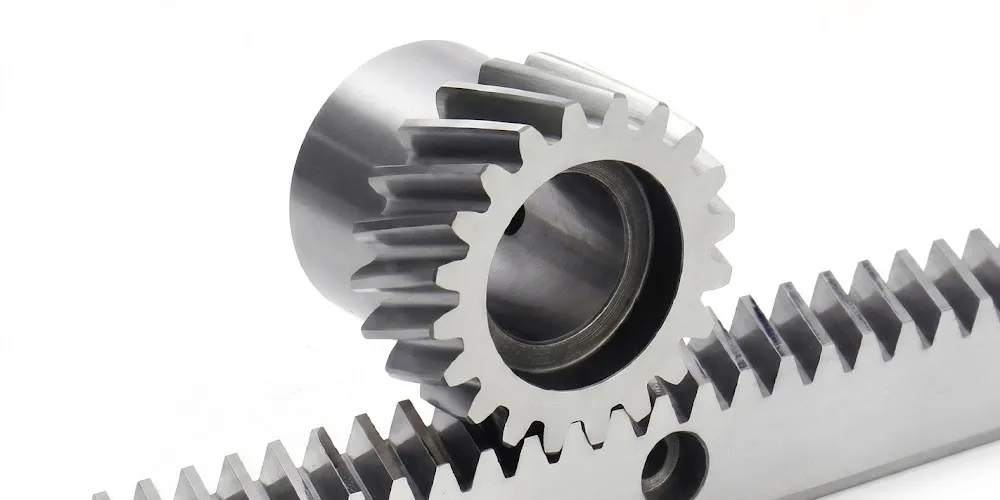
Gear Rack — Helical Rack and Pinion
Automotive and medical device applications that require linear motion — EPS rack-and-pinion steering systems, medical table positioning, precision slide drives — use helical rack and pinion systems that benefit from the same smooth, low-noise engagement as the rotary double helical gear. Our helical rack and pinion series is available in polymer and metal variants, matched to the helix angle of the mating helical gear pinion for consistent backlash and tooth-contact geometry across the full stroke of the linear axis. Polymer helical racks in POM or PA are self-lubricating and suitable for sealed automotive rack housings.
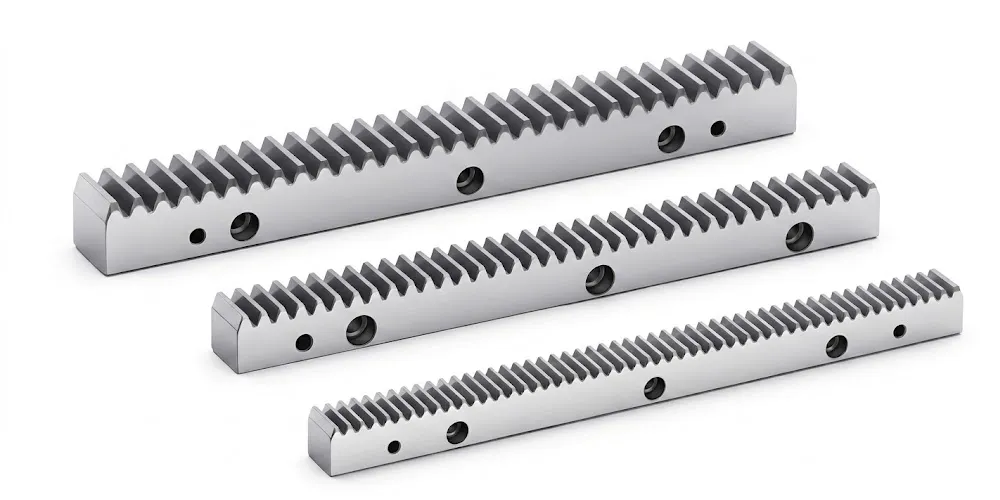
Om vår tillverkningsanläggning
With over ten years of accumulated expertise in mechanical power transmission manufacturing, our facility operates at the intersection of precision gear machining, polymer processing, heat treatment, and dimensional metrology. Our product portfolio spans agricultural gearboxes, worm gear reducers, planetary gear drives, power take-off shafts, hydraulic cylinders, gears, chains, and motors — giving our engineering team broad exposure to gear performance requirements across agricultural, industrial, and automotive application environments.
The facility is certified to ISO 9001:2008 / TS16949 — the quality management standard that underpins automotive supplier approval processes globally. We design and produce custom gears, sprockets, worm gears, pulleys, shafts, and non-standard mechanical parts to customer-supplied drawings or samples, covering ductile iron, cast iron, cast steel, precision cast steel, cast aluminium, and the full range of engineering polymers relevant to automotive and medical device applications. Sample production with dimensional reporting precedes all batch commitments for automotive programmes.
Our export logistics team ships to automotive tier-1 facilities and machine builders in Germany, Japan, South Korea, the United States, the United Kingdom, Australia, Canada, the Netherlands, and Brazil — providing the commercial documentation, material certifications, and traceability records appropriate to each market's automotive supplier qualification requirements.
Vanliga frågor
Redaktör: PXY