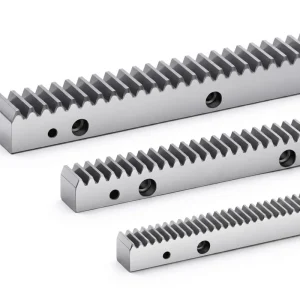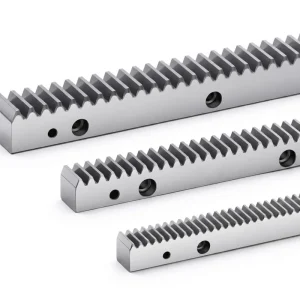
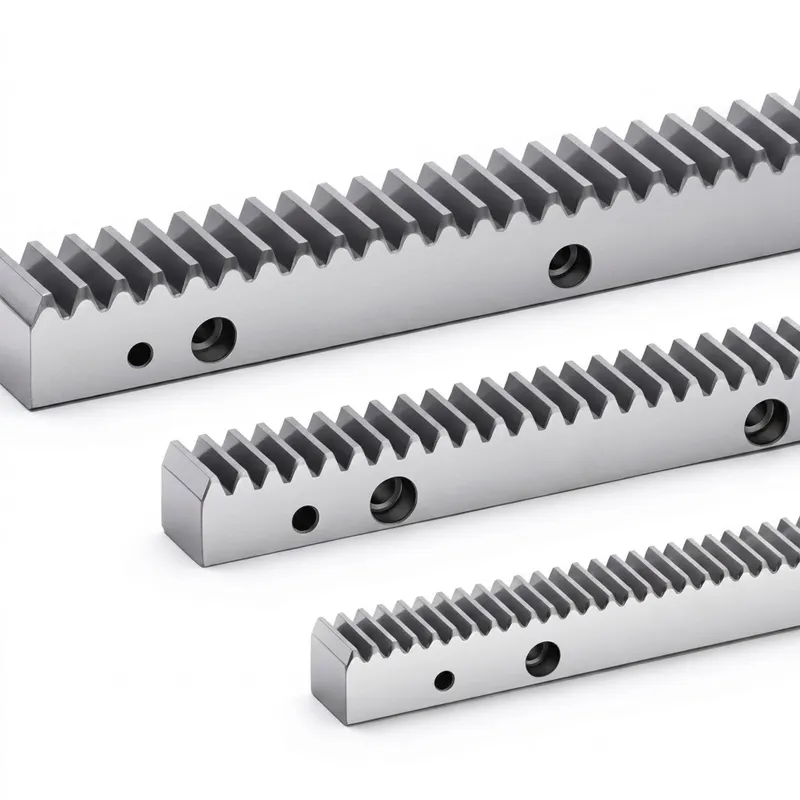
เฟืองแร็คแบบตรง EP-S45C — การชุบแข็งด้วยความถี่สูง HRC48-52°
A gear rack is a flat, toothed bar designed to mesh with a rotating pinion and convert that rotational input into straight-line motion — or, in reverse, convert linear force into torque. The rack and pinion gear pairing is one of the oldest and most mechanically direct motion-conversion solutions in engineering, valued for its inherent stiffness, straightforward serviceability, and ability to handle unlimited travel length through segment jointing.
What distinguishes this straight gear rack from a basic unmachined bar rack is the multi-stage surface treatment applied after heat treatment. Following high-frequency quenching — which drives the tooth surface to HRC48-52° while leaving the rack body at a more ductile working hardness — the blank undergoes four-side flat precision grinding to correct any post-hardening distortion and true up the body faces. A fine insertion finish on the tooth surface follows, and the completed rack is then treated with either surface blackening (a controlled oxide layer) or phosphating (a phosphate crystal conversion coating).
Racks without mounting holes are available as standard — add suffix “N” to the model number when ordering (for example, STOER010N).
SURFACE-TREATED STRAIGHT-TOOTH RACK
EP-S45C Straight Gear Rack — High Frequency Quenching HRC48-52°, DIN8 International Grade 7
เดอะ EP-S45C gear rack is a straight-tooth spur rack manufactured from S45C medium-carbon steel, surface-hardened by high-frequency quenching to HRC48-52°, and finished through four-side flat precision grinding, fine insertion, and surface blackening or phosphating treatment. Produced to DIN8 International Grade 7 accuracy, this spur gear rack covers module sizes from M1.5 to M12 with tooth counts of 20 to 212 per length — making it a versatile, cost-effective linear gear rack solution for general-purpose CNC equipment, conveyor systems, and light-to-medium duty automation worldwide.
ข้อกำหนดทางเทคนิค
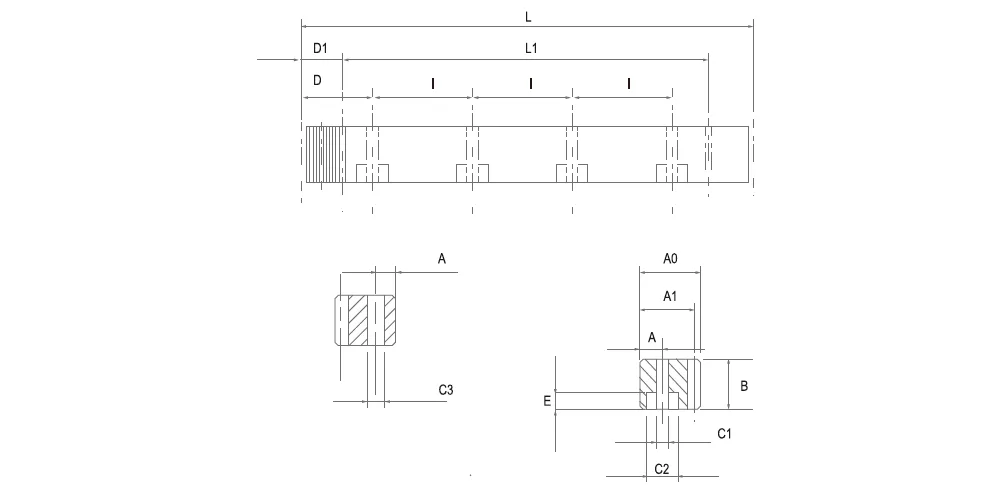
All EP-771 series models share the same dimensional schema. Pitch Pt = Module × π. The tolerance column Fp represents the cumulative pitch error across the full rack length under DIN8 International Grade 7. When specifying a rack and pinion gear axis, confirm that the pinion center height matches the rack's A0 dimension, and that the bolt-hole pattern (4 or 8 holes, hole diameter C3, bolt spacing I1) aligns with your machine bed. All dimensions in mm.
| Code | Mod. | Pt | L (มม.) | Teeth | บี | A0 | A1 | D | I | Holes | Fp |
|---|---|---|---|---|---|---|---|---|---|---|---|
| 771 010 050 | 1.5 | 4.7123 | 499.51 | 106 | 17 | 17 | 15.5 | 62.44 | 124.88 | 4 | 0.08 |
| 771 010 100 | 1.5 | 4.7123 | 999.03 | 212 | 17 | 17 | 15.5 | 62.44 | 124.88 | 8 | 0.09 |
| 771 020 050 | 2 | 6.2831 | 502.65 | 80 | 24 | 24 | 22 | 62.83 | 125.66 | 4 | 0.08 |
| 771 020 100 | 2 | 6.2831 | 1005.31 | 160 | 24 | 24 | 22 | 62.83 | 125.66 | 8 | 0.09 |
| 771 030 050 | 3 | 9.4247 | 508.94 | 54 | 29 | 29 | 26 | 63.62 | 127.23 | 4 | 0.088 |
| 771 030 100 | 3 | 9.4247 | 1017.88 | 108 | 29 | 29 | 26 | 63.62 | 127.23 | 8 | 0.101 |
| 771 040 050 | 4 | 12.5664 | 502.65 | 40 | 39 | 39 | 35 | 62.83 | 125.66 | 4 | 0.095 |
| 771 040 100 | 4 | 12.5664 | 1005.31 | 80 | 39 | 39 | 35 | 62.83 | 125.66 | 8 | 0.109 |
| 771 050 050 | 5 | 15.7079 | 502.65 | 32 | 49 | 39 | 34 | 62.83 | 125.66 | 4 | 0.095 |
| 771 060 100 | 6 | 18.8495 | 1017.88 | 54 | 59 | 49 | 43 | 63.62 | 127.23 | 8 | 0.109 |
| 771 080 050 | 8 | 25.1327 | 502.65 | 20 | 79 | 79 | 71 | 62.83 | 125.66 | 4 | 0.10 |
| 771 080 100 | 8 | 25.1327 | 1005.31 | 40 | 79 | 79 | 71 | 62.83 | 125.66 | 8 | 0.11 |
| 771 100 100 | 10 | 31.4159 | 1005.31 | 32 | 99 | 99 | 89 | 62.83 | 125.66 | 8 | 0.12 |
| 771 120 100 | 12 | 37.6991 | 1017.88 | 27 | 120 | 120 | 108 | 63.6 | 127.23 | 8 | 0.12 |
Dimensions in mm. Pt = Module × π. Fp = cumulative pitch error (DIN8 Grade 7). Hole-free option: suffix "N" to model code (e.g. STOER010N). Custom dimensions available to drawing.
How This Gear Rack Works in Practice
The core principle of the rack and pinion gear system is unchanged from its earliest applications: a circular pinion engages the straight teeth of the gear rack, and rotation of the pinion produces controlled linear travel of the rack — or, in a fixed-rack configuration, the pinion and its attached carriage move along the stationary rack. In either arrangement, the gear ratio of rack and pinion determines how much linear movement occurs per pinion revolution: linear travel per revolution equals π × module × pinion tooth count. This relationship is fixed and fully predictable, making the spur gear rack drivetrain inherently repeatable without closed-loop position feedback on the rack itself.
Where the EP-S45C series earns its place is in applications that need a reliable, serviceable linear rack at a practical specification — Grade 7 accuracy rather than Grade 5 or 6 — while still requiring the surface hardness and corrosion protection that distinguishes a production-grade gear rack from a basic hobbed bar. The high-frequency quenching process elevates the tooth surface to HRC48-52° without through-hardening the body, preserving toughness at the core. This means the rack can absorb occasional shock loads without the cracking risk associated with fully hardened components, which is a practical advantage in drill press gear rack replacements and similar maintenance applications.
The surface blackening or phosphating finish applied after grinding is not purely cosmetic. Blackening creates a thin iron oxide layer that slows surface oxidation in lightly humid storage or operating environments. Phosphating deposits a crystalline zinc or manganese phosphate layer that bonds tenaciously to the steel surface and holds lubricating oil in its micro-porous structure — effectively extending the interval between grease applications on any rack and pinion gear axis where access for re-lubrication is infrequent.
Five Defining Characteristics of This Gear Rack
Rather than leaving the ground surface bare, the EP-S45C gear rack is offered with either blackening or phosphating as a standard post-process. Blackening suits indoor machinery operating in clean, moderately humid workshops. Phosphating is preferred where the rack will be stored for longer periods before installation, or where the operating environment includes occasional moisture exposure — common in outdoor machinery and port equipment in South Korea, Australia, and coastal industrial sites across the UK.
Induction hardening concentrates the hardened zone at the tooth flank — the surface that actually contacts the pinion — while the rack body remains at a lower, tougher hardness. This profile is a deliberate engineering choice: it gives the rack tooth the wear resistance needed for extended service without making the body brittle. For general-duty automation and replacement applications where a Grade 7 duty gear rack is appropriate, HRC48-52° provides a long service life well beyond unhardened or case-hardened alternatives.
Four-side flat grinding removes the bow and twist that heat treatment introduces into long steel bars. Combined with the fine insertion step — a secondary tooth-profile finishing operation — this process sequence produces a straight gear rack whose body faces are flat and square and whose teeth are accurately pitched to DIN8 Grade 7 tolerance. For machine builders in the Netherlands, Germany, and Brazil who need a proven, installable rack without requiring their own incoming grinding, this as-shipped condition removes a setup step from the production line.
When the standard 4- or 8-hole bolt pattern does not match the machine bed layout — a frequent issue in retrofit projects and OEM equipment adapted from different platform generations — the hole-free variant ordered with suffix "N" provides a blank rack body that can be drilled and tapped to any pattern on site. This is equally useful when the gear rack is to be held by external clamps, adhesive bonding, or welded mounting brackets rather than through-bolts, giving integrators full flexibility over the mounting method.
Procurement teams configuring multiple machine variants — from compact small rack and pinion servo axes at M1.5 to heavy conveyor and lifting drives at M12 — can source the entire rack range from this single product family. The consistent dimensional schema across all modules means the pinion center height calculation, the hole-pattern specification, and the lubrication approach are the same regardless of which module size is being used, simplifying documentation and maintenance training across a mixed-module machine fleet.
Material, Surface Treatment & Quality
S45C is a medium-carbon steel grade used extensively in mechanical components that require a combination of machinability, adequate static strength, and the ability to respond to induction hardening. Its carbon content of approximately 0.42–0.48% gives it a predictable hardening response — tooth surfaces reliably reach HRC48-52° under controlled high-frequency quenching parameters, while the body hardness remains low enough for ductile behavior under bending and impact loads. This is an important distinction from through-hardened tool steels: an S45C gear rack will deform at overload rather than fracture, giving surrounding machine components a warning event rather than a sudden failure.
The production sequence for this spur gear rack follows a defined order that preserves the gains at each stage. Raw bar stock is cut and rough-machined to near-net shape. High-frequency induction hardening is then applied to the tooth face zone only, using precision-controlled coil geometry and quench timing to achieve the target HRC48-52° surface hardness. The hardened blank is then taken through four-side flat grinding — removing the distortion introduced by the hardening thermal cycle — followed by a fine insertion step that finalizes the tooth flank geometry. The completed rack is then immersed in the surface treatment bath for either blackening or phosphating, and inspected before packing.
Our manufacturing operation holds ISO 9001:2015 certification covering the complete production chain from material receipt through dispatch. Dimension checks on tooth pitch, body squareness, and surface hardness are carried out on each production batch. Custom dimensions and alternative materials can be produced against customer drawings — the only requirement is that the drawing specifies enough datum references to define the gear rack geometry unambiguously.
Where This Gear Rack Is Commonly Used
The EP-S45C at DIN8 Grade 7 is positioned as a general-purpose workhorse rather than an ultra-precision component. It covers the majority of applications where tooth-pitch accuracy at this grade is sufficient, surface hardness is required, and the surface treatment adds value through corrosion resistance or lubrication retention.
Entry-level to mid-range CNC routers for wood, plastic, foam, and light aluminum work use rack and pinion linear slide drives on the gantry X-axis. These machines often operate in workshops where the Grade 7 tolerance of this linear gear rack is more than adequate for the cutting accuracy required, and the blackened or phosphated finish provides storage protection during seasonal or batch production cycles.
Shuttle conveyors, cross-transfer stations, and indexing tables in manufacturing lines use short-travel rack and pinion gear drives to move products between lanes or stations. The EP-S45C in M2–M4 is a common specification here — compact cross-section, adequate surface hardness for frequent cycling, and the phosphated finish retains lubricant on axes where manual re-greasing is done infrequently due to production scheduling.
เดอะ drill press gear rack is among the most common replacement applications for this class of gear rack. Worn racks in pillar drills, radial arm drills, and milling-head quill feeds are replaced with Grade 7 S45C racks that match the original module and cross-section. The hardened tooth surface extends the replacement interval compared to the softer unhardened racks sometimes supplied as spares, reducing maintenance downtime in production workshops across North America, the UK, and Australia.
In rack and pinion press designs for light forming, stamping, and assembly operations, the M3–M6 gear rack handles the vertical ram travel. The S45C material at HRC48-52° provides adequate surface hardness for the compressive contact loads typical in light-force pressing, while the ground body faces ensure the rack runs squarely in its mounting channel without shimming — an important installation detail that affects press force consistency.
Seeder depth adjustors, implement lift arms, and crop-flow gate actuators in agricultural machinery use gears rack and pinion drives for simple, robust linear positioning. The phosphated surface finish is especially practical here — it provides an initial corrosion barrier in outdoor and field-storage conditions, and the oil-retaining surface character of the phosphate layer extends the protection interval compared to bare steel in the same environment.
Industrial sliding gates, heavy fire doors, and warehouse partition drives use duty gear rack and pinion systems for motorized travel. The EP-S45C in M4–M8 covers the structural demand of gate drives, and the blackened finish suits the aesthetic requirement of visible components in architectural or security applications in commercial buildings and logistics facilities in Brazil, Canada, and the Netherlands.
System-Compatible Components
Specifying a rack and pinion axis as a complete system — rack, pinion, and mating drive — from one source eliminates the tooth-geometry compatibility questions that arise when components are sourced separately. We supply the following products engineered for direct compatibility with the EP-S45C rack range.
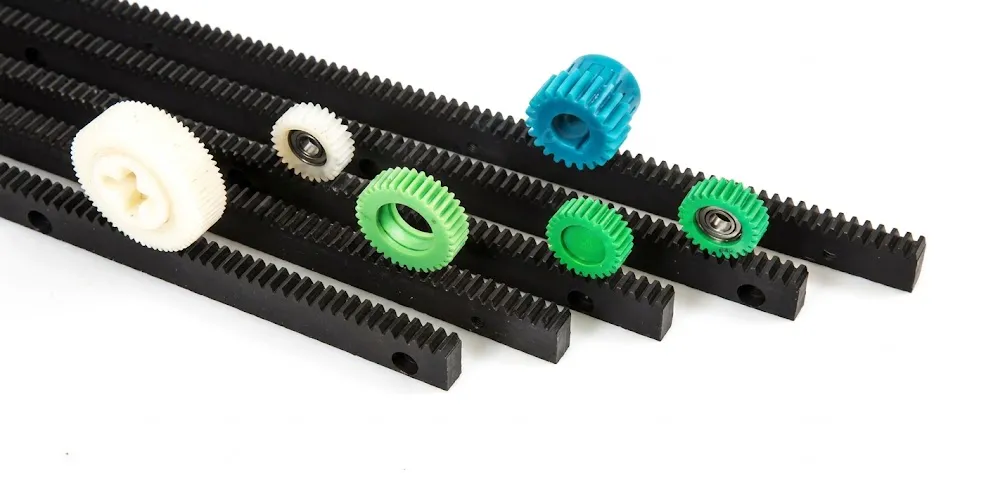
ของเรา plastic gear rack range is dimensionally compatible with the EP-S45C series at matching module sizes. Polymer racks suit applications where weight reduction, electrical isolation, or self-lubrication is more important than maximum load capacity. Designers running mixed-material rack systems — steel on heavy-load axes, polymer on lighter auxiliary axes — can source both types from a single product family, avoiding module-matching issues between suppliers. The plastic rack and pinion option is particularly common in laboratory automation, food packaging, and consumer equipment across European and North American markets.
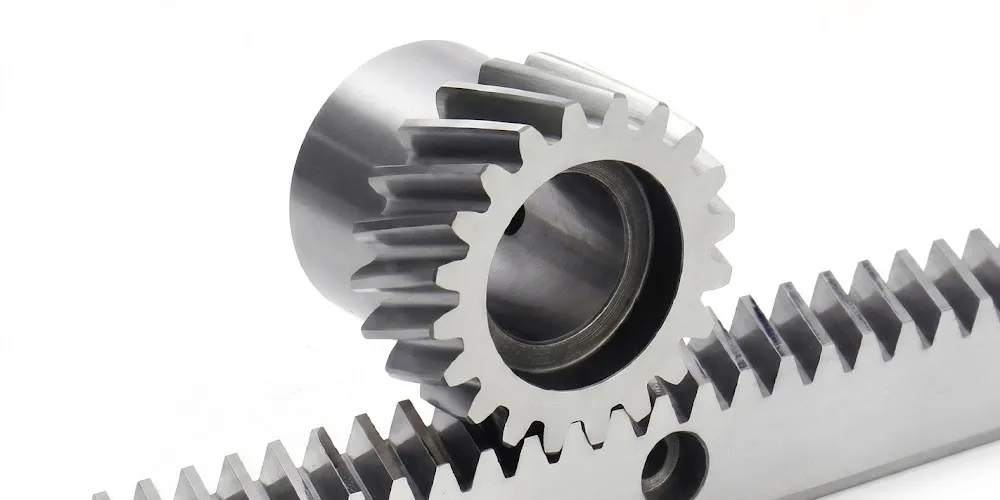
Although the EP-S45C is a straight-tooth spur gear rack, some engineers prefer to drive it with a Helical Gear pinion on axes where noise reduction is a priority. Our helical gear range spans the module sizes used in the EP-S45C series, covering a broad selection of tooth counts and bore sizes for direct servo or gearbox output shaft coupling. Sourcing both the gear rack and the drive pinion from the same supplier base eliminates module-mismatch risk and simplifies warranty management when the axis is part of a machine delivered to end customers in South Korea, Australia, or Canada.
About Our Production Facility
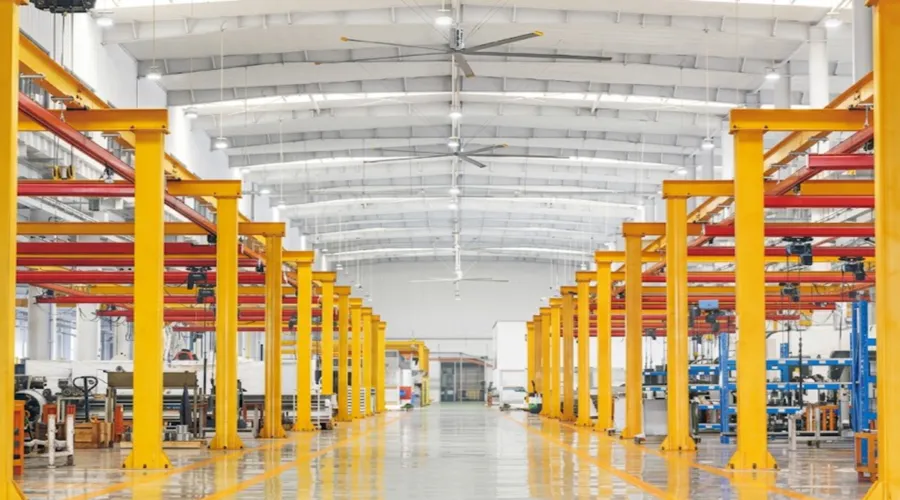
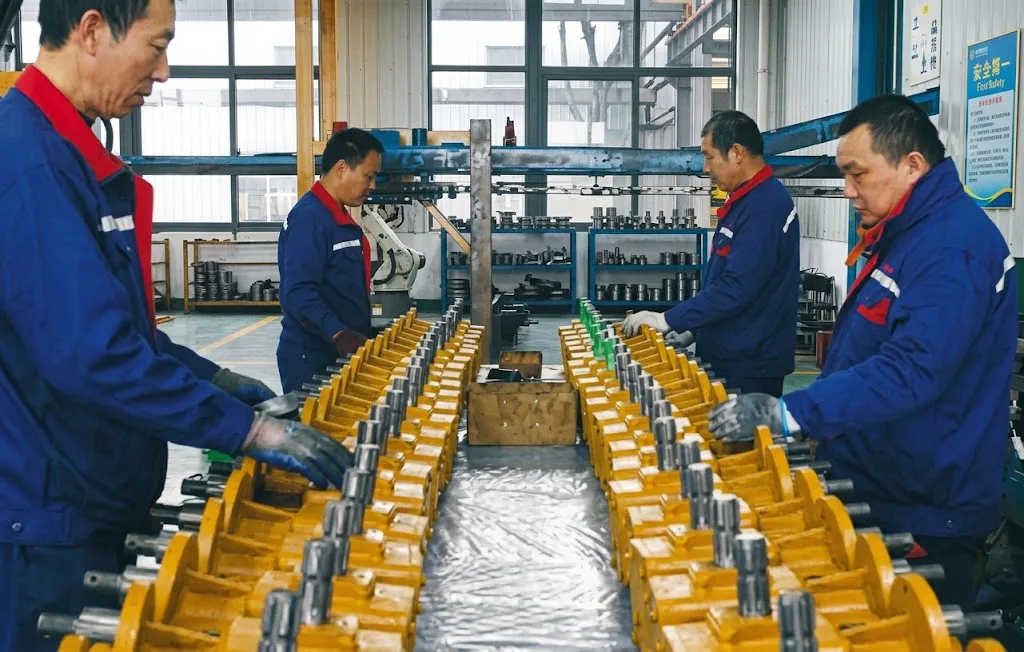
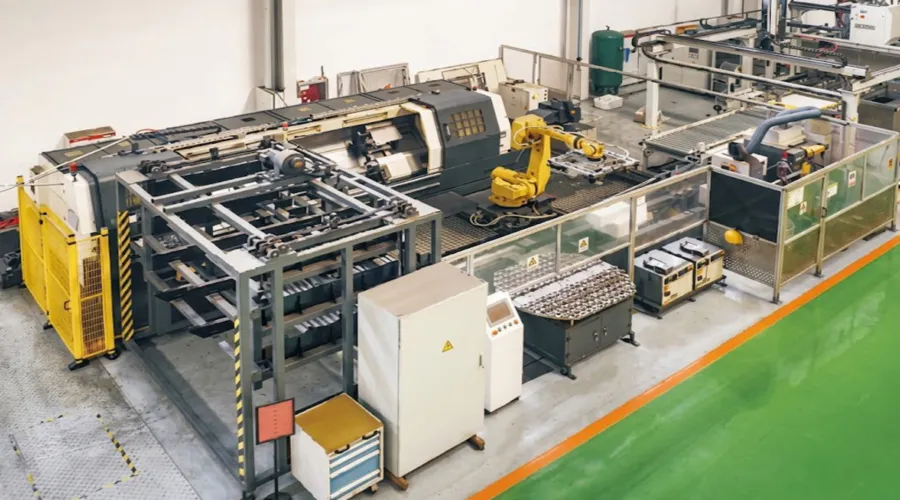
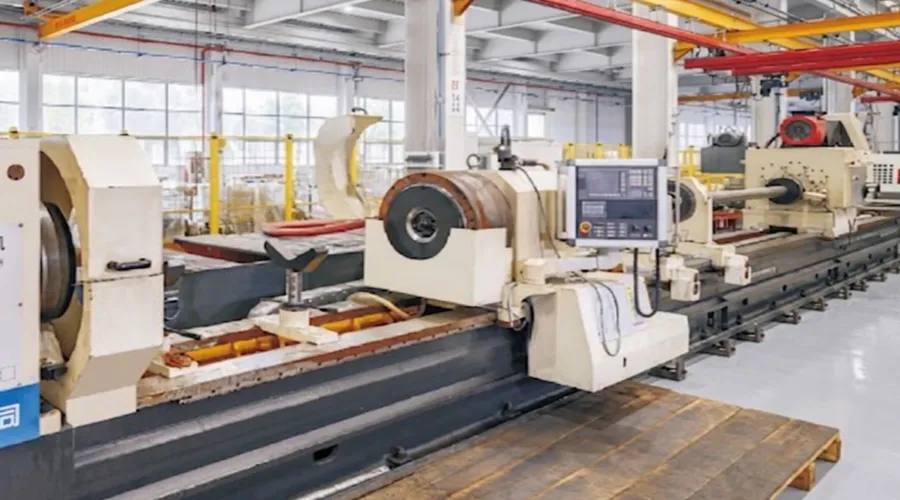
With more than a decade of accumulated experience in mechanical power transmission manufacturing, our facility produces precision components and drive assemblies for industrial buyers worldwide. The product program covers agricultural gearboxes, worm gear reducers, planetary gear drives, power take-off shafts, hydraulic cylinders, chains, and motors — all under one ISO 9001:2015 certified quality system that covers the full production chain from raw material to finished part.
We engineer and produce gearbox assemblies in ductile iron, cast iron, cast steel, precision cast steel, and cast aluminum. Our standard parts program includes gears, sprockets, worm gears, pulleys, worms, and shafts. Non-standard mechanical parts are produced to customer drawings — an option that is relevant for buyers sourcing a custom gear rack with non-standard cross-sections, longer lengths, or alternative materials outside the published catalogue.
เวิร์กช็อป
คำถามที่พบบ่อย
บรรณาธิการ: PXY