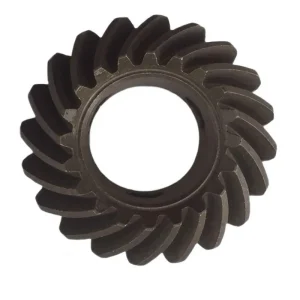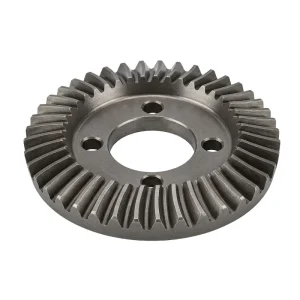
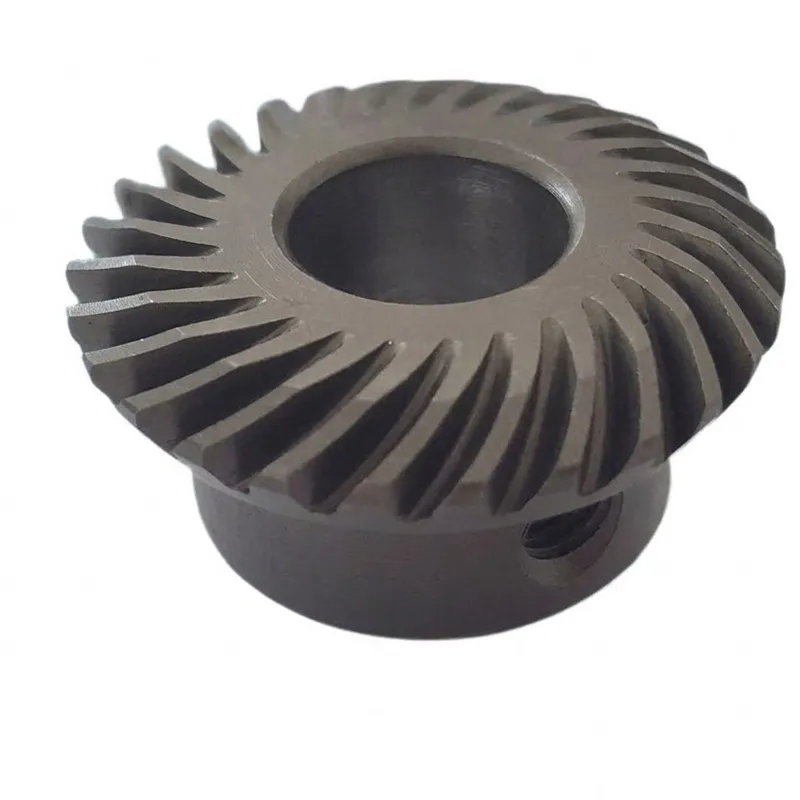
เฟืองเฉียงโลหะ EP
เดอะ เฟืองเฉียงโลหะ EP is a high-precision transmission component designed for intersecting shaft applications across diverse industries. Available in modules from M0.15 to M2.0 and diameters ranging from 3mm to 120mm, these gears are manufactured from a wide range of materials including Steel, Bronze, Aluminum, Brass, and Stainless Steel to meet specific load and environmental requirements. They achieve exceptional meshing grades of JGMA 1, JIS 6, DIN 6, and AGMA 12, ensuring smooth and efficient power transfer. Certified under ISO 9001:2008 and TS16949, each unit is vacuum-packed in plastic trays for superior protection during global shipping via DHL or UPS. Fully customizable via ODM/OEM services, EP delivers reliable metal bevel gears for automotive, aerospace, medical, and industrial machinery where precision and durability are critical.
Dimension: Ø3 mm – Ø120 mm | Module: M1.5 (Range: M0.15 – M2.0) | Material: Metal as customer required
Grades: JGMA 1 / JIS 6 / AGMA 13 / DIN 6 / Din5 / AGMA12 | ODM/OEM | Sample Available
ข้อกำหนดทางเทคนิค
The table below documents the full parameter range of the EP-Metal metal bevel gear. All values are configurable per customer requirement, with the reference model dimension of Ø8 mm representing a typical small-to-mid-range production configuration. Please provide drawings or operating parameters when enquiring for custom metal bevel gear specifications.
| พารามิเตอร์ | Standard / Reference Value | Customizable Range |
|---|---|---|
| ประเภทเกียร์ | Metal Bevel Gear | Straight / Spiral / Miter bevel |
| Dimension (OD) | Ø8 mm (reference) | Ø3 mm – Ø120 mm |
| โมดูล | M1.5 (standard) | M0.15 – M2.0 |
| Material Type | Steel / Alloy Steel | Metal, Bronze, POM, Zinc, Aluminum, Iron, Stainless, Brass, Copper |
| Meshing Grade | JGMA 1, JIS 6, AGMA 13 | DIN 6, Din5, AGMA12 |
| มุมแรงดัน | 20° | 14.5° on request |
| มุมเพลา | 90° | Other angles on request |
| การอบชุบด้วยความร้อน | Carburizing and quenching | HF quenching, Nitriding, Hardening & tempering |
| Tooth Form | Straight / Spiral | Zerol on request |
| แอปพลิเคชัน | Automotive, Military, Aircraft, Mechanical, Industrial, Medical | — |
| Customized | ODM / OEM | Drawing or sample accepted |
| Sample | Sample available | — |
| การบรรจุหีบห่อ | Vacuum-packed with Plastic Tray | Custom packing on request |
| Delivery | DHL & UPS | Freight forwarder accepted |
| Certificate | ISO 9001: 2008 / TS16949 | Material certs, inspection reports on request |
EP-Metal Bevel Gear — Industrial Strength Direction-Change Transmission
The EP-Metal metal bevel gear is a precision-machined conical gear purpose-built for transmitting torque and rotational motion between intersecting shafts. Unlike parallel-shaft gear stages — where spur or helical gears are the standard solution — the metal bevel gear addresses the mechanical challenge of changing drive direction, most commonly by 90° but also at other shaft angles depending on the cone geometry specified. This ability to redirect power between non-parallel shafts without intermediate linkages is what makes the metal bevel gear irreplaceable in automotive differentials, hand and power tools, industrial right-angle gearboxes, agricultural power take-off drives, and a wide range of precision instrument mechanisms. The EP-Metal variant is manufactured across a diameter range of Ø3 mm to Ø120 mm and a module range of M0.15 to M2.0, giving it coverage from miniature instrument drives through to robust mid-size industrial gear stages.
What distinguishes this product from lower-specification catalog bevel gears is the material flexibility and meshing grade commitment. The metal bevel gear range covers metal, bronze, steel, alloy steel, POM, zinc, aluminum, iron, stainless steel, brass, and copper — each grade matched to a specific cluster of application environments and load requirements. Meshing accuracy is certified to JGMA 1, JIS 6, AGMA 13, DIN 6, Din5, and AGMA12 — the standards required by automotive, aerospace, military, and medical program suppliers in Japan, Germany, North America, and globally. Both ODM and OEM customization paths are supported, samples are available before production commitment, and ISO 9001:2008 / TS16949 certification provides the quality framework for regulated industries. Delivery worldwide is via DHL and UPS, with vacuum-packed plastic tray packing protecting the precision tooth flanks during international transit.
Why Choose the EP-Gear — 5 Core Strengths
Full-Metal Construction for Demanding Loads
The defining attribute of the EP-Metal metal bevel gear is that it is manufactured entirely from metal stock — no polymer fillers, no sintered powder substitutes. Metal construction delivers the compressive strength, fatigue resistance, and thermal stability that plastic or zinc-die-cast gears cannot sustain under continuous heavy-duty or high-temperature service. For high power metal bevel gears in automotive rear axle drives, military vehicles, or heavy industrial machinery, the metallurgical properties of the chosen alloy are the foundation of the gear's load capacity — and those properties are preserved through the full manufacturing sequence, including heat treatment and precision grinding.
Ten Material Options — One Supplier
Specifying a metal bevel gear for a new design involves a material decision that significantly affects load capacity, corrosion behavior, weight, machinability, and cost. The EP-Metal range covers metal, bronze, steel, alloy steel, POM, zinc, aluminum, iron, stainless steel, brass, and copper — covering the majority of application environments from a single manufacturing source. Steel and alloy steel for automotive and industrial drives, bronze for marine and hydraulic applications, stainless steel for food processing and medical devices, aluminum and brass for lightweight precision instruments — all sourced and processed under the same ISO 9001 quality framework without the need to qualify multiple suppliers.
Global Accuracy Standards — JGMA / AGMA / DIN / JIS
เดอะ metal bevel gear is manufactured to JGMA 1, JIS 6, AGMA 13, DIN 6, Din5, and AGMA12 meshing accuracy grades, making this product acceptable to customer specifications written to any of the major international gear accuracy standards. Engineering teams in Japan (JIS/JGMA), Germany and the EU (DIN), the US and Canada (AGMA), and international programs can all reference their preferred standard and receive a metal bevel gear that complies. This eliminates the conversion and equivalence verification work that buying from a supplier who only certifies to a single standard requires.
Miniature to Mid-Size — Ø3 mm to Ø120 mm
The dimensional range of this metal bevel gear spans from Ø3 mm — the scale of miniature instrument drives in medical devices and precision optical equipment — through to Ø120 mm for solid industrial gearbox stages. Small metal bevel gears และ mini metal bevel gears in the Ø3 mm to Ø20 mm range serve RC hobby vehicles, miniature actuators, and electronic gadget drives; mid-range units from Ø20 mm to Ø80 mm cover the power tool, agricultural machinery, and general industrial segments; and the larger sizes address right-angle industrial gearboxes and vehicle axle drives. This breadth eliminates the need to source from different suppliers as a product scales in size.
TS16949 Certification & Documented Traceability
ISO 9001:2008 / TS16949 certification is more than a badge — it represents a documented, auditable manufacturing process with defined controls at every step from raw material receipt through to final inspection and shipment. For automotive, aerospace, and medical customers sourcing metal bevel gear components for regulated products, this certification is often a prerequisite for supplier approval. Our quality records include material heat certificates, hardness verification, dimensional inspection reports, and process control data — the documentation package that regulated-industry customers need for their own quality systems and, ultimately, for regulatory submissions.
How Does a Metal Bevel Gear Work?
The operating mechanism of a metal bevel gear is rooted in conical geometry. Each gear in a mating pair is cut on the surface of a cone — the pitch cone — and when the two cones roll against each other without slipping, they maintain a constant velocity ratio throughout the mesh cycle. The tooth flanks, machined to an involute or octoid profile, transmit the force between the gear pair. As the driving metal bevel gear rotates, contact pressure on the tooth flank of the mating gear generates a tangential force that drives the output shaft. Because the two pitch cones share a common apex point, the system is geometrically self-consistent: there is no sliding at the pitch point, and the velocity ratio remains constant regardless of where in the tooth cycle the contact is occurring.
In a straight-tooth metal bevel gear, each tooth lies along a radial line of the pitch cone. Contact begins simultaneously along the full tooth width, and ends the same way — an abrupt engagement that limits practical pitch-line velocity to roughly 5 m/s in well-made gears and produces more noise than curved-tooth alternatives. Spiral metal bevel gears cut the teeth along a curved path — typically an Archimedean or involute spiral — so contact progresses gradually from one end of the tooth to the other, increasing the contact ratio and producing smoother, quieter operation at higher speeds. The choice between straight and spiral tooth form in the EP-Metal metal bevel gear range is made based on the application's speed, noise requirement, and shaft thrust constraints, since spiral bevel gears generate higher axial forces that must be reacted by the bearing arrangement.
The gear ratio is fixed by the tooth count relationship between the two mating metal bevel gears: divide the number of teeth on the driven gear by the number on the driving gear. For a 90° shaft angle, the cone half-angles of the two gears are complementary, and the ratio is purely a tooth-count calculation — a straightforward relationship that makes bevel gear ratios easy to specify and verify. Miter gears are the special case where both gears have the same tooth count, giving a 1:1 ratio at 90° — a common configuration in right-angle drives where speed reduction is handled by a separate gear stage.
Metal Bevel Gear Material Types & Heat Treatment
The material selection for a metal bevel gear determines the ceiling on its mechanical performance. Steel and alloy steel grades — the most common choice for high power metal bevel gears in automotive and heavy-industrial applications — develop their full load capacity only after the appropriate heat treatment has been applied. Carburizing and quenching produces a hard, fatigue-resistant tooth surface (HRC 58–62) over a tough, shock-resistant core; this is the standard heat treatment for automotive differential bevel gears and military drivetrain components where the tooth must sustain both high sustained loads and intermittent impact. High-frequency (induction) quenching hardens only the tooth surface and immediate sub-surface zone, leaving the core at its pre-hardened toughness level — useful when the gear bore or hub must remain machinable after heat treatment, or when selective hardening of the tooth flanks only is required.
Nitriding produces an exceptionally hard surface layer — up to 1100 HV in some alloy steel grades — through nitrogen diffusion at relatively low temperatures (typically 480–560°C), which means dimensional distortion is minimal. This makes nitriding the preferred heat treatment for metal bevel gear parts where the tooth geometry cannot be corrected by grinding after hardening — for instance, because the tooth form is not accessible to standard grinding wheels or because the component is too large for the available grinding machine capacity.
Metal Bevel Gear Types & Selection Guide
เดอะ metal bevel gear types within the EP-Metal range reflect the main tooth-form variations that have evolved to meet different speed, noise, and load requirements. Understanding which type suits a given application avoids the common mistake of specifying a straight bevel gear for a high-speed drive, or over-engineering with a spiral bevel in a low-speed application where cost efficiency matters more than peak performance.
Straight-tooth metal bevel gears are the simplest and most economical to manufacture. Teeth run along straight radial lines of the pitch cone, contact initiates simultaneously across the full face width at tooth entry, and the absence of a helix angle means no axial thrust is generated beyond what the tooth geometry itself produces. These characteristics make straight bevel gears the practical choice for low-to-moderate pitch-line velocities — hand tools, agricultural machinery, simple industrial right-angle drives, and the metal bevel gear for RC car and hobby applications where cost, availability, and straightforward installation matter most. RC metal bevel gears in the Ø3 mm to Ø15 mm range for scale radio-controlled vehicles and hobby robotics are a significant niche within this straight-tooth category.
Spiral metal bevel gears carry curved teeth with a defined spiral angle — typically 25° to 35° — that causes tooth engagement to progress gradually across the face width. The higher contact ratio, lower dynamic mesh force, and reduced noise level at speed make spiral bevel gears the standard for automotive differentials, high-speed aircraft auxiliary gearboxes, and industrial right-angle drives operating above approximately 5 m/s pitch-line velocity. The trade-off is axial thrust loading on both shafts, which requires proper thrust bearing selection. Miter gears are the specific subtype of straight or spiral metal bevel gear where both mating gears have identical tooth counts, delivering a 1:1 ratio at the selected shaft angle — used when direction change is needed without speed reduction.
Metal Bevel Gear Application Scenarios
เดอะ metal bevel gear application range is among the broadest of any gear type. Wherever power must change direction between intersecting shafts — and where the mechanical strength, temperature resistance, or dimensional stability of metal is required — the metal bevel gear is the engineered solution. The following categories represent the most frequent application environments served by the EP-Metal range.
Automotive Drivetrain & Differentials
Automotive rear axle differentials, front axle differentials, and inter-axle differentials in four-wheel-drive vehicles all rely on metal bevel gear sets — typically four gears: two side gears and two spider pinions meshing at 90° within the differential housing. The EP-Metal range in alloy steel with carburized tooth flanks and TS16949 quality documentation directly serves Tier 1 and Tier 2 automotive supplier programs in Germany, Japan, the US, South Korea, and the UK. Alloy steel grades such as 8620 or 20CrMnTi are standard for these applications, delivering the high surface hardness and core toughness that automotive differential metal bevel gears require through carburizing and quenching.
Power Tools & Hand Tools
Angle grinders, right-angle drills, electric screwdrivers, and rotary hammers all incorporate a metal bevel gear stage to redirect the motor's rotational output through 90° to the tool spindle. The compactness of the bevel gear mesh — a matched pinion and wheel in a small housing — is central to the ergonomics of handheld power tools, and the metal construction withstands the shock loads and intermittent overloads that tool use generates. Steel metal bevel gear sets with induction-hardened tooth flanks are the standard in professional-grade power tools sold across North American, European, and Australian markets, where tool durability is a key brand differentiator.
RC Vehicles & Hobby Robotics
Metal bevel gear for RC car applications and hobby robotics represents a growing segment within the miniature metal bevel gear market. In RC touring cars, buggies, and crawlers, the front and rear differential gear sets use small metal bevel gears — typically Ø3 mm to Ø12 mm — to split the motor's torque between the left and right wheels. The hobby market distinguishes sharply between plastic and rc metal bevel gears: metal gears survive the impact of crashes, rough terrain, and high-torque brushless motor setups that strip plastic differentials within minutes.
เครื่องจักรกลการเกษตร
Agricultural PTO (power take-off) gearboxes, mower head drives, and harvesting machinery use metal bevel gear stages to redirect tractor engine power into the working implements. The field environment subjects these gears to dust, moisture, soil contamination, and sudden shock loads as the implement contacts rocks or hard ground — conditions that require tough, well-sealed gear sets with adequate hardness to resist abrasive wear. Steel or iron metal bevel gears with phosphated or blackened surfaces for basic corrosion protection serve the agricultural market in North America, the EU, Brazil, and Australia, where equipment must deliver reliable seasonal performance with minimal in-season maintenance intervention.
Medical & Laboratory Instruments
Stainless steel metal bevel gears in the Ø3 mm to Ø25 mm range serve precision instrument drives in surgical robots, imaging device positioners, and laboratory automation equipment. The combination of stainless steel's biocompatibility, autoclave resistance, and corrosion-free surface makes it the material of choice for any metal bevel gear used inside or adjacent to sterile medical environments. The JGMA 1 and AGMA 13 meshing accuracy grades available in this product ensure the tight backlash control that position-critical medical and laboratory drives require, where gear error translates directly into positional uncertainty in the instrument's output.
Military & Aerospace Equipment
Heavy metal bevel gears in military vehicle transfer cases, helicopter auxiliary gearboxes, and aircraft control surface actuators must sustain extreme loads, survive harsh environments, and maintain function under conditions that would disable civilian-grade components. High-alloy steel with carburized tooth flanks, documented to AGMA 13 or equivalent military specification, is the standard material and accuracy combination for these applications. The TS16949 and ISO 9001 certification framework that governs EP-Metal metal bevel gear production supports defense and aerospace supplier qualification in the US, UK, Germany, France, and allied nations, providing the process documentation and material traceability that these programs require.
Metal Bevel Gear Parts & Set Configuration
อย่างสมบูรณ์ metal bevel gear set typically consists of two mating gears: the pinion (smaller, driving gear) and the wheel (larger, driven gear). The pinion has fewer teeth and rotates faster; the wheel has more teeth and rotates more slowly, providing the speed reduction. In miter gear configurations both have equal tooth counts, giving a 1:1 ratio. The metal bevel gear parts that make up a set must be manufactured as a matched pair — their pitch cone angles, tooth profiles, and center distance are interdependent, and substituting one gear from one supplier into a set from another typically produces poor tooth contact and premature wear.
Our standard delivery format for high-precision metal bevel gear sets includes a tooth contact pattern report: after assembly of the pinion and wheel at the specified mounting distances, engineer's blue compound is applied and the contact pattern photographed and measured. A correctly adjusted metal bevel gear set shows a centered elliptical contact patch covering 50–70% of the tooth face width. This report accompanies the gear set and gives the customer's assembly team the reference pattern to verify correct installation in the gearbox housing. For OEM programs supplying the metal bevel gear set pre-assembled in a gearbox sub-assembly, this documentation simplifies incoming inspection and reduces the risk of field failures from incorrect mounting distance setup.
Related Products — System-Level Drivetrain Supply
เดอะ metal bevel gear typically operates as one stage within a larger drivetrain. The parallel-shaft stages upstream and downstream of the bevel drive — and any linear motion elements in the output — are all available from our manufacturing range, making system-level procurement straightforward and compatible.
เฟืองเกลียวคู่
In many industrial gearbox designs, a double helical gear provides the parallel-shaft speed reduction stage that feeds into or receives output from the metal bevel gear direction-change stage. Double helical gears eliminate net axial thrust on the shaft they drive, which simplifies the bearing arrangement in gearboxes where the bevel stage already introduces its own axial loading. Our double helical gears are manufactured to the same accuracy and material standards as the EP-Metal metal bevel gear range — DIN 6, AGMA 13, matched material grades and heat treatment documentation — so the complete gearbox assembly can be sourced and documented from a single quality system. Engineering support for combined bevel-plus-helical gearbox designs is available, including ratio selection and tooth geometry optimization for both stages together.
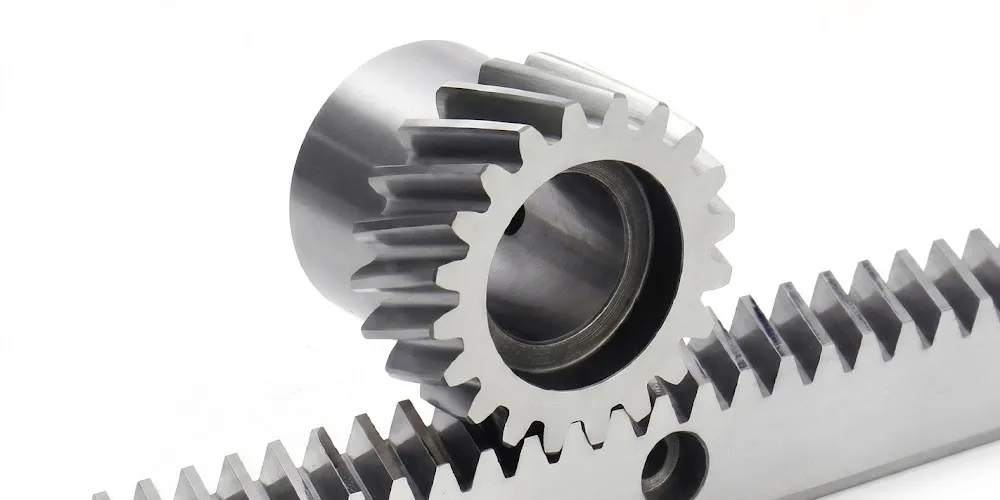
แร็คเกียร์
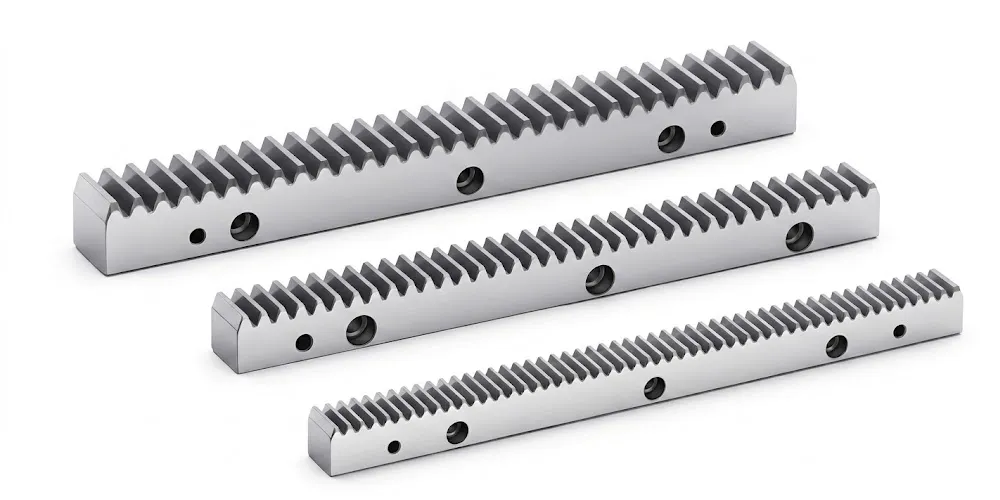
When a drivetrain converts the rotary output of a gearbox — which may include a metal bevel gear direction-change stage — into controlled linear motion, a precision gear rack paired with a pinion gear delivers the translation stage. Our gear rack range is produced in carbon steel and stainless steel, in metric module, with hobbed or ground tooth profiles designed to be compatible with our helical and spur pinion gear range. Applications include CNC machine tool axes, automated guided vehicles, linear actuators, and heavy-duty sliding gate drives in manufacturing facilities across Europe, North America, and the Asia-Pacific region. Sourcing the metal bevel gear and the downstream gear rack from a single manufacturer ensures consistent module, pressure angle, and material documentation across the complete power transmission chain — a practical advantage for OEM engineering and procurement teams who need to minimize supplier qualification overhead.
เกี่ยวกับโรงงานผลิตของเรา
With over ten years of engineering experience in precision mechanical power transmission, our facility has developed deep expertise in metal bevel gear manufacturing alongside a broad portfolio of complementary drivetrain components. Our product range spans agricultural gearboxes, worm gear reducers, planetary gear drives, power take-off shafts, hydraulic cylinders, gears, chains, and motors — a scope that covers the majority of industrial and agricultural power transmission requirements from a single source.
We design and produce industrial and agricultural gearbox assemblies in ductile iron, cast iron, cast steel, precision cast steel, and cast aluminum, together with machined gears, sprockets, worm gears, pulleys, worms, shafts, and an extensive range of standard and non-standard mechanical parts. ISO 9001:2015 certification governs our quality management system across all product lines, and TS16949 certification extends this framework to cover the automotive sector's specific process discipline and documentation requirements. Metal bevel gear production is carried out on dedicated CNC bevel gear cutting machines, with gear grinding available for the highest precision grades. All production batches are supported by material traceability records, hardness verification, and dimensional inspection reports. Customers across Germany, the US, Japan, Australia, the UK, the Middle East, and Southeast Asia rely on our factory-direct supply for metal bevel gear components that meet the demanding specifications of regulated industries.
คำถามที่พบบ่อย
บรรณาธิการ: PXY