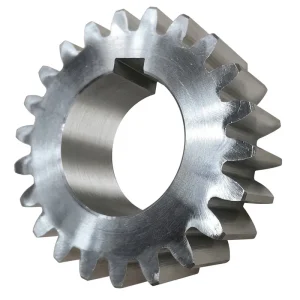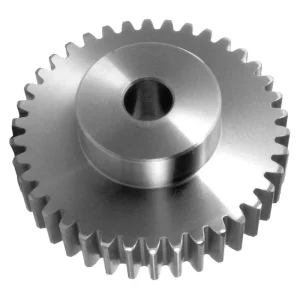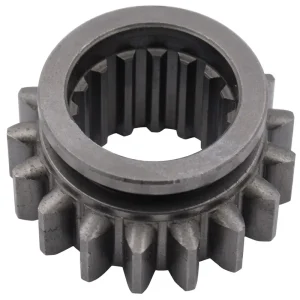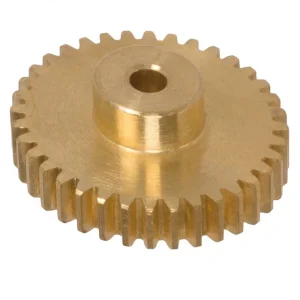
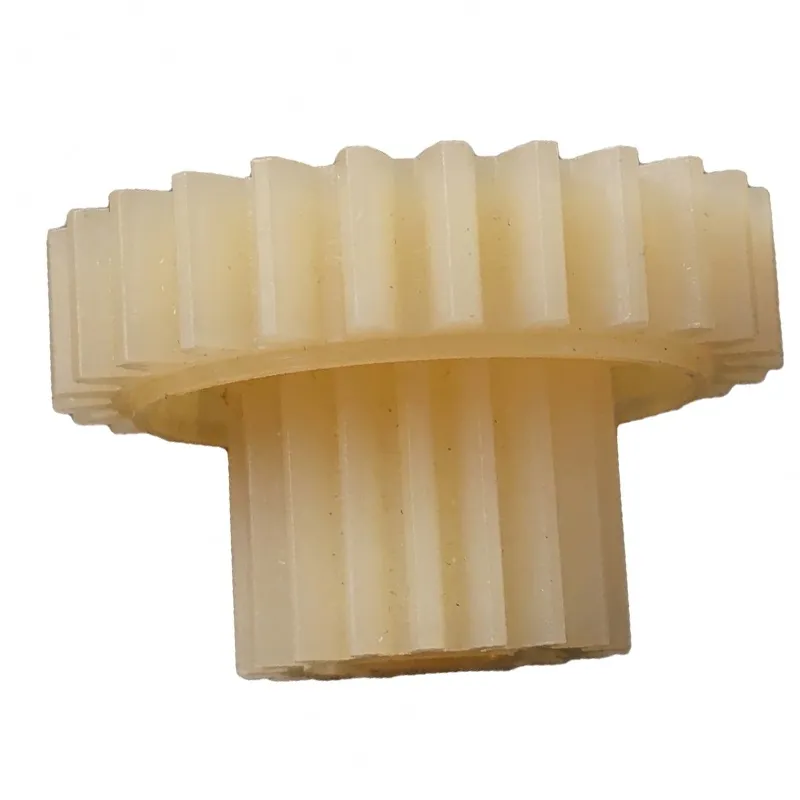
Engrenage à double denture droite en plastique EP
The EP-Plastic Double Spur Gear series offers high-precision, customizable transmission solutions engineered for demanding industrial applications. Available in a wide range of modules from M1 to M12, these gears are manufactured from advanced engineering plastics including PA, POM, UHMWPE, ABS, PTFE, PPS, and Peek, ensuring superior wear resistance and low friction. They adhere to international standards such as ISO, DIN, ANSI, JIS, and BS, with precision grades ranging from DIN6 to DIN9. Tolerances are tightly controlled between 0.001mm and 0.1mm. Teeth treatments include hardening, milling, or grinding to optimize performance. Surface finishes can be customized via shot blasting, polishing, anodizing, or zinc plating. Packaged in plastic bags with cartons or wooden cases, these gears support flexible payment terms (T/T, L/C) and are ideal for machinery requiring quiet, corrosion-resistant operation.
MULTI-STAGE POLYMER DRIVE COMPONENTS — SPUR GEAR SERIES
Engrenage à double denture droite en plastique EP
A precision-moulded plastic double spur gear series — two gear stages integrated on a single body, available in modules M1 through M12, engineered polymers PA, POM, UHMWPE, ABS, PTFE, PPS, and PEEK, and conforming to ISO, DIN, ANSI, JIS, and BS standards for global OEM and industrial drive applications.
Technical Specifications — EP-Plastic Double Spur Gear Series
Full parameter reference for the standard EP series. All custom spur gear configurations — non-standard modules, tooth counts, materials, or surface treatments — available through our OEM/ODM programme.
| Paramètre | EP Series Value | Notes |
|---|---|---|
| Product Type | Plastic Double Spur Gear | Double stage, single body |
| Module Numbers | M1, M1.5, M2, M2.5, M3, M4, M5, M8, M12 and more | Metric involute system |
| Matériel | PA, POM, UHMWPE, ABS, PTFE, PPS, PEEK | As customer specified |
| Standard | ISO, DIN, ANSI, JIS, BS, and Non-standard | Multi-standard certified |
| Qualité de précision | DIN6, DIN7, DIN8, DIN9 | DIN 3962 accuracy class |
| Teeth Treatment | Hardened, Milled, or Ground | Per application requirement |
| Tolerance Range | 0.001 mm – 0.01 mm – 0.1 mm | Three tolerance tiers |
| Surface Finish Options | Shot/sandblast, heat treatment, annealing, tempering, polishing, anodising, zinc-plated | As specified |
| Emballage | Plastic bag + Cartons or Wooden packing | Export-standard |
| Payment Terms | T/T, L/C | Standard international terms |
| Customisation | OEM / ODM | Drawing or sample accepted |
| Certification de qualité | ISO 9001:2015 | Factory-wide QMS |
What Is a Plastic Double Spur Gear?
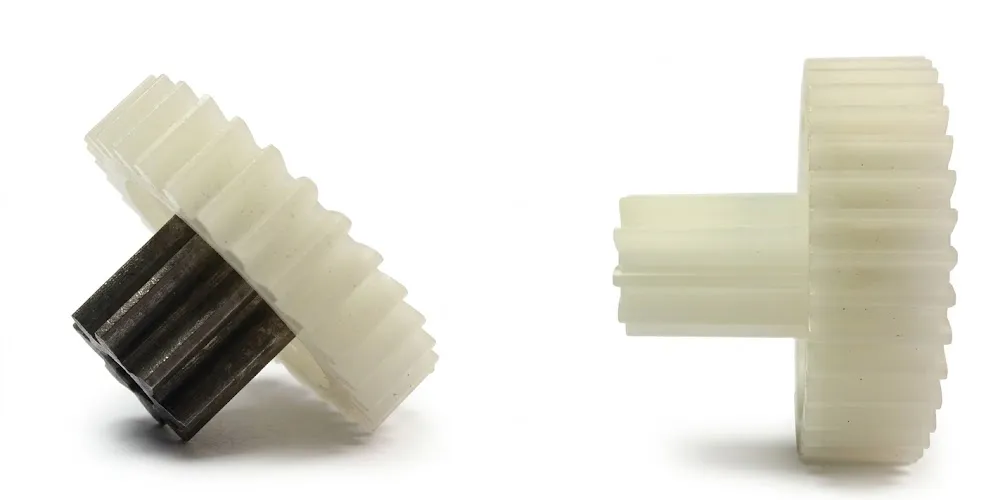
UN plastic double spur gear — sometimes referred to as a double stage spur gear or a double sided spur gear — is a single moulded or machined polymer component carrying two distinct spur gear tooth profiles on the same body, typically at different diameters, different numbers of teeth, or different face widths. This two-stage architecture allows a single component to serve as both the output gear of one mesh and the driving gear of the next, condensing what would otherwise be a two-piece gear stage into one part. The result is fewer assembly components, a smaller gear train envelope, reduced parts count in the bill of materials, and a more predictable tolerance stack-up across the transmission.
Notre série EP plastic double spur gear is manufactured in a broad range of engineering polymers — PA (polyamide/nylon), POM (polyacetal/Delrin), UHMWPE, ABS, PTFE, PPS, and PEEK — and covers modules from M1 up to M12, making it applicable from miniaturised instrument drives right through to mid-to-large load conveyor and automation gearboxes. Precision grades span DIN6 to DIN9, covering applications from precision robotics to standard industrial conveyor drives. Tooth treatment options include hardened, milled, and ground finishes, with tolerances achievable down to 0.001 mm for the most demanding applications. The standard multi-standard certification — ISO, DIN, ANSI, JIS, and BS — means the same physical component is directly specifiable into programmes in Europe, North America, Japan, and the UK without a material change or re-qualification process.
For engineers designing spur gears into compact multi-ratio drive trains — particularly in automation equipment, consumer electronics, and medical device actuators — the plastic double spur gear format eliminates a shaft, two bearings, and one assembly operation compared to a conventional two-gear layout. This level of parts reduction has measurable downstream effects on assembly yield, field reliability, and product lifetime cost.
Five Engineering Advantages of the Double Stage Format
① Parts Consolidation — One Component, Two Gear Stages
The defining advantage of a plastic double spur gear is the reduction of a two-component gear stage to a single part. In a conventional double reduction spur gear layout, this would require two separate gears, a shared shaft between them, and the bearings or bushings to support that shaft. The double stage spur gear integrates both gear profiles into a single moulded body, eliminating that entire intermediate assembly. For high-volume OEM production — particularly in consumer electronics and domestic appliances — the savings in component count, assembly time, and inventory management are significant over the product life cycle.
② Wide Polymer Material Choice for Specific Duty
No single polymer suits every application, which is why the EP series covers PA, POM, UHMWPE, ABS, PTFE, PPS, and PEEK — seven material families with distinct combinations of strength, chemical resistance, temperature rating, and tribological properties. A plastic double spur gear in PEEK operates continuously above 200 °C and resists aggressive solvents; one in PTFE offers the lowest friction coefficient of any engineering polymer; POM delivers the dimensional stability needed for tight-backlash instrument stages. Material selection is determined at the design stage to match the operating environment, not retrofitted after failure.
③ Multi-Standard Compliance for Global OEM Supply
ISO, DIN, ANSI, JIS, and BS compliance in a single product family means a plastic double spur gear from the EP series can be specified into OEM programmes for Europe (DIN/ISO), North America (ANSI), Japan (JIS), and the UK (BS) without requiring separate locally-qualified variants. This cross-standard capability is increasingly important for manufacturers running global platforms from a single bill of materials — a procurement model common among spur gear suppliers serving automotive and industrial automation customers in Canada, Germany, and Japan.
④ Sub-Micron Tolerance Option at DIN6 Precision
With tolerance capability down to 0.001 mm at DIN6 precision grade, the EP plastic double spur gear is not limited to coarse-tolerance conveyor or actuator applications. The highest precision grades in this series are relevant for medical device dosing mechanisms, laboratory positioning stages, and precision optical instrument drives — applications where tooth pitch error and involute profile deviation directly translate to functional performance error in the system output. Ground tooth treatment at DIN6 achieves this precision level in polymer with none of the weight or corrosion drawbacks of equivalent steel spur gears.
⑤ Surface Finish Options from Milled to Ground
Tooth treatment options — hardened, milled, or ground — give the EP series a flexibility in surface finish and fatigue performance that matches the duty cycle requirements of each specific application. Milled finish suits moderate-cycle general drives; ground finish at tight tolerance addresses high-cycle precision stages; surface treatments including shot blast, annealing, tempering, polishing, anodising, and zinc-plating expand the range further for specific environmental or aesthetic requirements. This finish breadth means one product family covers both a plastic spur gear for a household appliance and a precision drive for a semiconductor handling robot.
Material Selection — Seven Polymers for One Gear Family
What are plastic gears made of? The answer for the EP plastic double spur gear series is deliberately not a single material — it is a portfolio of seven engineering polymers, each selected for a distinct performance profile. Understanding which polymer to specify for a given application is as important as any dimensional specification, and our engineering support team provides material selection guidance as a standard part of the quotation process.
PA (Polyamide / Nylon)
Excellent impact resistance and toughness. Preferred for nylon spur gears in agricultural machinery, packaging automation, and high-cycle actuator drives. Absorbs slight moisture — bore fits should account for dimensional change.
POM (Polyacetal / Delrin)
Outstanding dimensional stability, stiffness, and low creep. The standard choice for delrin spur gears and acetal spur gears in precision instrument, robotics, and medical device stages where tight bore tolerance and backlash control are critical across the service life.
UHMWPE
Ultra-high molecular weight polyethylene — exceptional abrasion resistance and impact toughness at low weight. Used in food processing drives and conveyor applications where long wear life and FDA compliance are primary requirements.
ABS
Cost-effective, rigid, and easy to mould in complex geometry. Suitable for small plastic spur gears in consumer electronics, domestic appliances, and light-duty instrument drives where moderate load and ambient temperature conditions apply.
PTFE
The lowest friction coefficient of any engineering polymer — used in chemically aggressive or self-lubricating applications where contact with reactive solvents, acids, or oxidising agents rules out all other polymer families.
PPS
Polyphenylene sulphide — high continuous-use temperature (220 °C), excellent chemical resistance, and inherently flame-retardant. Specified in automotive under-bonnet, aerospace, and industrial process control drives where thermal cycling is a design factor.
PEEK
The highest-performance engineering polymer — continuous service above 250 °C, outstanding fatigue resistance, and biocompatibility for medical implant-adjacent applications. Significantly higher material cost than other options; specified only when no lower-grade polymer meets the operating requirements.
All material grades are processed under our ISO 9001:2015 certified quality management system, with material certificates available on request. For custom spur gears requiring a specific polymer grade not listed above, our engineering team can evaluate alternative or blended compound options based on the operating temperature, chemical exposure, load cycle, and dimensional tolerance requirements provided by the customer.
How a Plastic Double Spur Gear Works — Double Reduction Principle
Le plastic double spur gear operates on the same involute tooth mesh principle as any external spur gear, but extends it across two gear stages within one component body. In a typical double reduction spur gear arrangement, the input pinion meshes with the larger-diameter stage of the double gear; the smaller-diameter stage of the same double gear body then meshes with the output gear. The overall speed reduction ratio is the product of the two individual stage ratios — a 3:1 first stage and a 4:1 second stage yields a 12:1 overall reduction, for instance — without requiring an intermediate shaft, separate from the double gear body itself.
Because both gear profiles are formed in a single moulding or CNC machining operation, the concentricity between the large and small spur gear tooth profiles is controlled to machining tolerances rather than assembly tolerances. In a conventional two-gear layout, the eccentricity between each gear's bore and its pitch circle is additive at the intermediate shaft — two separate bore-to-pitch-circle runout values combine. In the plastic double spur gear, there is only one gear body and one set of concentricity tolerances, which is one reason precision-grade double stage gears achieve lower transmission error than equivalent two-gear assemblies at the same pitch diameter.
The straight tooth arrangement — the defining feature of the spur gear format — means no axial force is generated at either gear mesh. This significantly simplifies the bearing design for the shaft on which the plastic double spur gear rotates: plain bushings or simple radial bearings are typically sufficient, with no need for thrust-bearing provisions. The spur gear vs helical gear trade-off applies here as in any spur gear design — the straight tooth creates a slightly sharper load onset per tooth cycle than a helical form, but at the low to moderate speeds typical of polymer gear applications, this is rarely a limiting factor, and the axial simplicity of the spur gear format is the dominant engineering advantage.
Application Scenarios — Where Plastic Double Spur Gears Deliver
The double stage format of the EP series addresses a specific engineering problem: achieving a significant speed reduction in minimal axial space with the lowest possible parts count. The applications below represent the primary markets where this format's advantages — parts consolidation, compact envelope, and polymer material properties — combine to produce measurable product improvements.
Consumer Electronics & Domestic Appliances
Camera lens barrels, motorised window blinds, dishwasher wash-arm drives, and robotic vacuum wheel gearboxes all rely on compact polymer double stage gears to achieve high reduction ratios in minimal space. The plastic double spur gear in ABS or POM eliminates one shaft and bearing set from the gear train, directly reducing bill-of-materials complexity in products manufactured at volumes measured in the hundreds of thousands annually across markets in Canada, South Korea, and Germany.
Industrial Automation & Robotics
Collaborative robot wrist joints, conveyor indexing heads, and pick-and-place actuator drives benefit from the double reduction spur gear's ability to deliver a compound ratio in a single gear body. In PEEK or PPS grades, the plastic double spur gear handles the thermal demands of continuous-duty industrial automation without the corrosion risk associated with steel spur gears in wash-down production environments typical of food and pharmaceutical automation lines in the UK and Australia.
Medical Devices & Diagnostic Equipment
Infusion pump gear trains, diagnostic instrument carriage drives, and surgical tool actuators need compact, cleanable, non-magnetic drive stages. The plastic double spur gear in POM or PEEK satisfies all three requirements simultaneously. At DIN6 precision with ground teeth, the double stage can achieve the positioning accuracy required for dosing mechanisms where each motor step must translate to a precise, repeatable fluid displacement or probe movement — a specification that applies to buyers across European and North American medical device markets.
Automotive Instrument & Actuator Systems
HVAC blend door actuators, throttle position sub-assemblies, and dashboard instrument drives commonly use double stage polymer gears to achieve the required reduction ratio in the minimal package space available behind an instrument panel. PPS or glass-filled nylon spur gears are the typical material choice at this application, combining the elevated temperature tolerance needed in engine-adjacent installations with the dimensional stability that maintains gear mesh backlash across a full automotive temperature cycle from −40 °C to +125 °C.
Agricultural & Outdoor Power Equipment
Seed metering drives, small implement actuators, and irrigation valve sub-assemblies use nylon spur gears or UHMWPE spur gears in the plastic double spur gear format to achieve high torque multiplication in a sealed or semi-sealed gear housing. The polymer material resists fertiliser chemicals and mud contamination without requiring the protective coatings that short the service life of steel spur gears in wet-field environments. Buyers across the agricultural equipment supply chain in Canada, Brazil, and Australia regularly source this format for compact OEM actuator designs.
Scientific Instruments & Precision Positioning
Telescope focuser drives, spectrometer stage actuators, and coordinate measuring machine probe carriage mechanisms specify the plastic double spur gear in POM or PEEK at DIN6 precision with ground tooth treatment. At this accuracy level, the double stage spur gear provides a compact, thermally stable reduction stage with sub-micron positional repeatability — a requirement that cannot be met by the coarser tolerance grades used in general-purpose drives.
Double Helical Gear vs Spur Gear — Understanding the Trade-Off
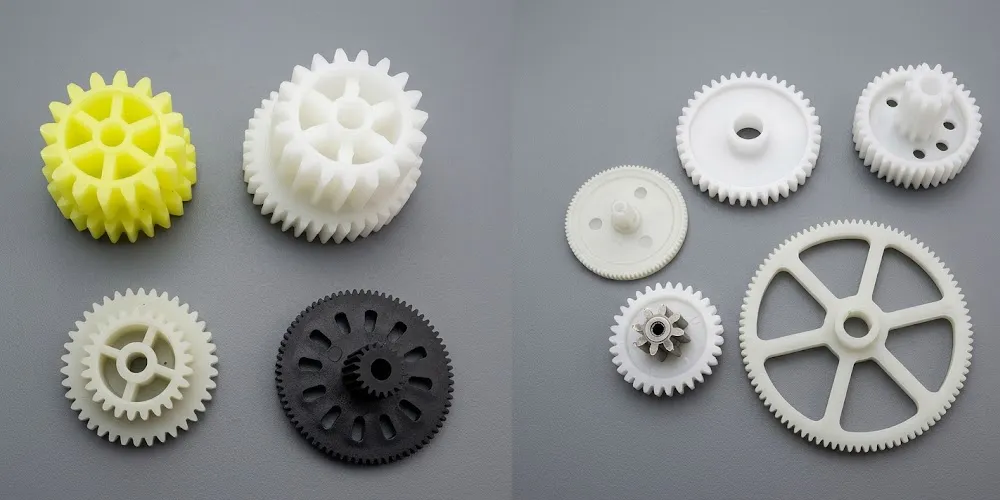
A question that often arises when specifying a plastic double spur gear is how it compares to a double helical spur gear configuration — sometimes also called a herringbone gear. What is another name for double helical gears? The herringbone designation describes a gear with two opposing helix angles formed into a single gear body, creating a visual resemblance to a herringbone pattern. The distinction from a plastic double spur gear is fundamental: a double helical gear carries two opposing helical tooth regions on the same pitch diameter to cancel axial thrust; a double stage spur gear carries two spur gear stages at different pitch diameters to achieve a compound gear ratio. They solve different engineering problems and should not be confused in a gear specification.
The difference between spur gear and helical gear performance has been well established in mechanical engineering for over a century. Helical gears engage progressively across the helix angle, spreading the load over a longer tooth contact path and producing lower mesh noise at high speeds. The straight spur gear engages all at once across the face width, producing a slightly more abrupt load transition but generating zero axial thrust and requiring simpler bearing support. In polymer plastic double spur gear applications — which typically operate below 1,000 RPM — the noise advantage of helical gears is largely irrelevant, and the axial simplicity of the spur gear format is a genuine design advantage. The choice between the formats comes down to speed, load, and shaft arrangement, not a universal preference for one over the other.
For the double reduction spur gear layout specifically, the straight tooth has one additional practical advantage: it is easier and cheaper to mould or machine to tight tolerances in engineering polymers at small module sizes than a helical tooth profile. This keeps the per-unit cost of a precision polymer double stage gear substantially lower than a helical equivalent at the same DIN precision grade — a meaningful factor when designing spur gears into cost-sensitive consumer or industrial products manufactured at scale.
Related Products — Sourcing a Complete Drive Train
The EP plastic double spur gear integrates into a broader drive system. To support customers who prefer a single-source supply chain for all gear train components, we produce the complementary products below — each dimensionally compatible with the EP spur gear series.
Engrenage à double hélice
Where the output stage of a drive using a plastic double spur gear intermediate reduction must handle higher load or deliver quieter operation at elevated speed, our double helical gear series provides the step up in performance. The opposing helix geometry eliminates net axial thrust while delivering wider tooth contact — practical for final reduction stages connected to the driven load, especially in precision machinery where vibration and acoustic output are design criteria alongside gear ratio and load capacity.
Porte-bagages
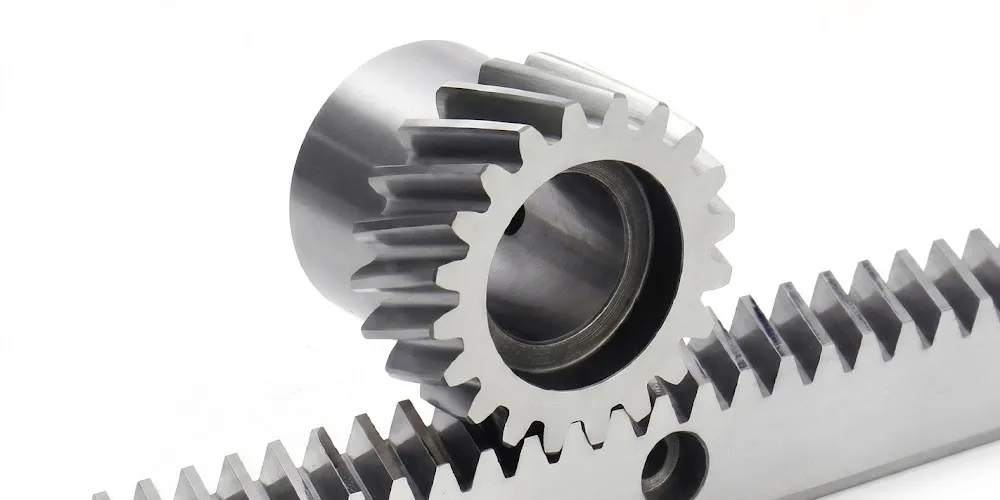
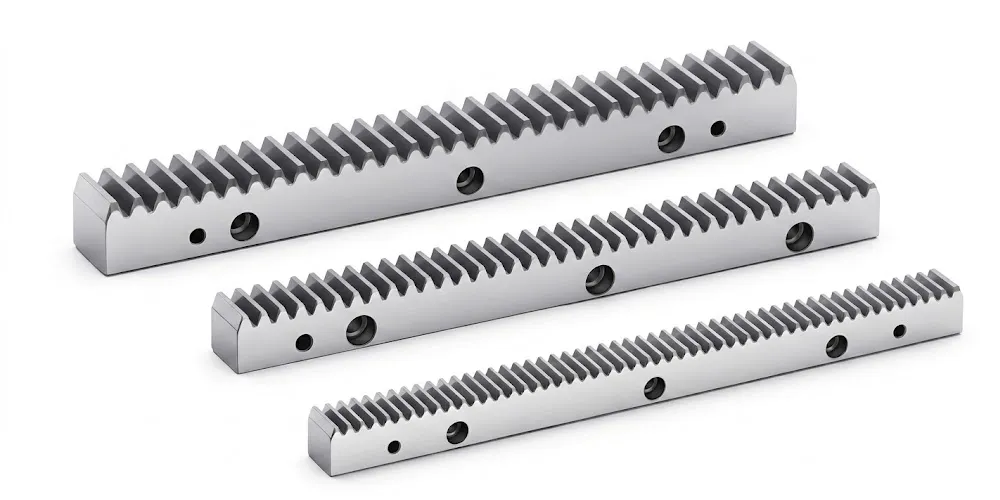
In drive systems where a plastic double spur gear reduction feeds a final linear-motion output stage, our gear rack series provides the matched pinion-to-rack interface. Metric module racks from M1 upward are available in steel, stainless steel, and polymer grades, with involute tooth profiles that mesh directly with the output stage pinion spur gear of any EP series double stage gear. Sourcing both reduction stage and linear stage from the same supplier eliminates the module-matching risk of multi-source procurement and simplifies the incoming inspection process.
Order & Trade Information
Minimum Order Quantity
Standard plastic double spur gears carry a baseline MOQ. Mixed module sizes, materials, and tooth count configurations can be combined into a single shipment totalling approximately USD 1,500. For design evaluation, 1–5 pcs samples are available at sample pricing. Orders of 1–2 pcs for urgent replacement requirements can be assessed on a case-by-case basis, though unit pricing will be higher at very small quantities.
Lead Time
Standard catalogued configurations: 10–25 working days. Bore modification or keyway machining on standard parts: 15–35 working days. Custom OEM/ODM plastic double spur gears from customer drawing or sample: 20–45 working days. Sample and first-article orders (1–5 pcs): 7–25 working days, with complex material/geometry combinations assessed individually.
Incoterms & Payment
Standard component orders: EXW, FOB, CIF, and DAP. Sample and urgent spare parts: EXW / FCA / DAP / courier service. FCA, CFR, CPT, CIP, and DDP negotiable for specific import programmes. Payment terms: T/T (bank transfer) and L/C (letter of credit) both accepted. Packing: plastic bag + cartons for standard orders; wooden packing available for heavy or fragile configurations on request.
OEM / ODM Custom Programme
Full OEM and ODM custom spur gear production is a core capability of this series. Customers may submit 2D drawings, 3D models, or physical samples for reverse engineering. MOQ for custom configurations depends on material grade, module, precision class, and tooth treatment. A drawing approval step precedes production release for all custom orders, with full material and dimensional certification at delivery. Non-standard modules and compound tooth count ratios are both supported.
About Our Manufacturing Capability
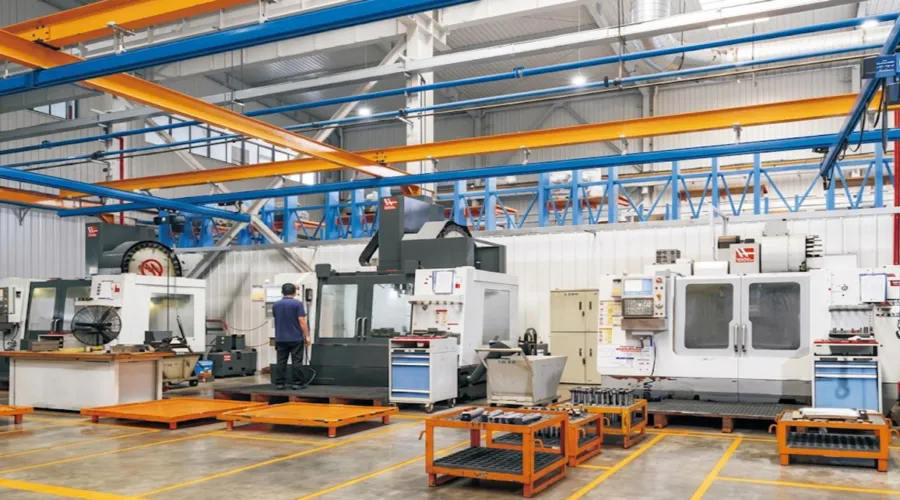
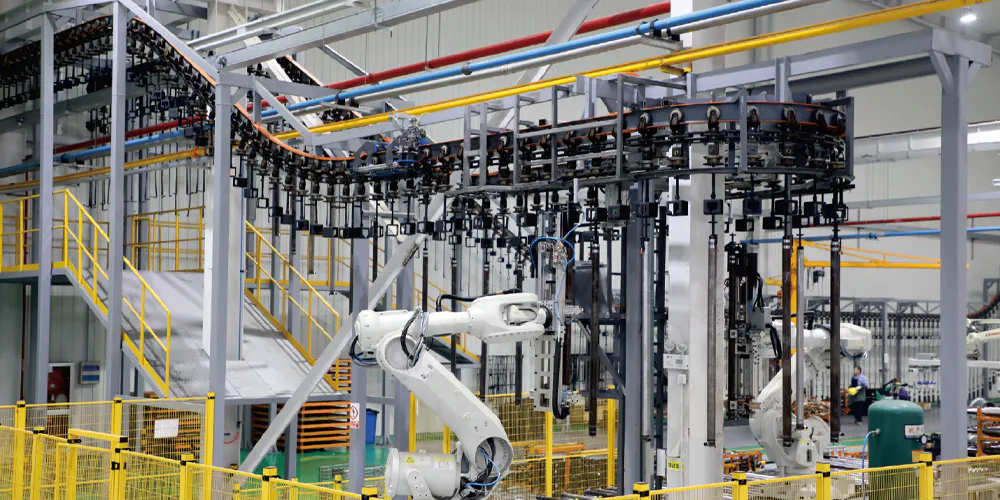
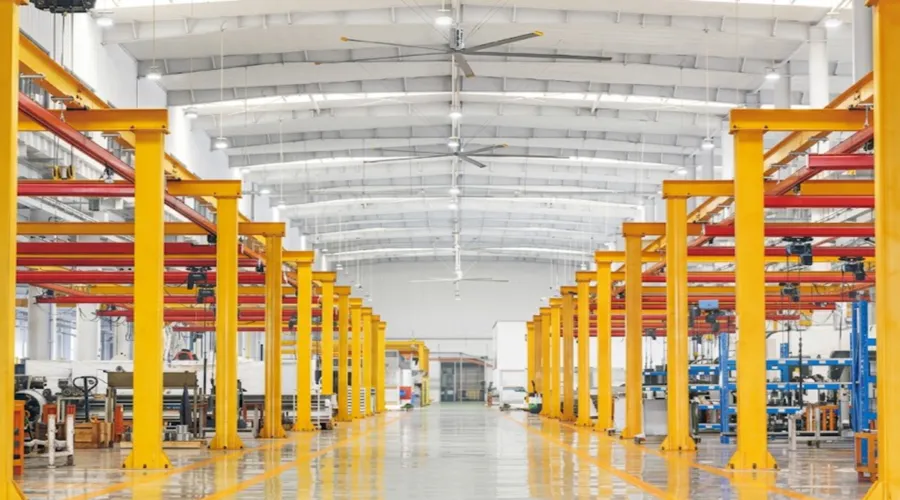
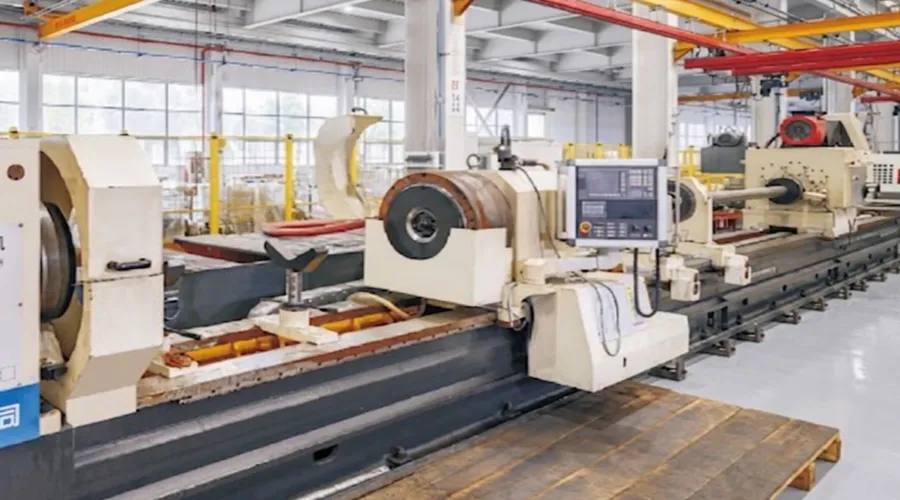
Our facility brings over ten years of focused experience in precision mechanical power transmission to every component we produce. The manufacturing scope spans agricultural gearboxes, worm gear reducers, planetary drive systems, power take-off shafts, hydraulic cylinders, drive chains, gears of every type, and electric motors — all developed in-house and produced under a unified ISO 9001:2015 certified quality management framework.
We design and manufacture industrial and agricultural gearboxes and assemblies in ductile iron, grey cast iron, cast steel, precision cast steel, and cast aluminium. Our broader component range covers gears, sprockets, worm gears, pulleys, shafts, worms, and the full spectrum of standard and non-standard mechanical parts — including every variant of the plastic double spur gear in the EP series, from miniature M1 instrument gears in POM through to large M12 polymer double stage gears in UHMWPE for conveyor and material handling applications.
We serve OEM procurement teams and industrial buyers directly — no trading intermediary — which keeps supply lead times competitive and documentation comprehensive for customers requiring certified components in Canada, Australia, the UK, Germany, Japan, and across Southeast Asia. Our spur gear manufacturer capability extends to custom spur gears from customer drawing, with full engineering review, first-article inspection, and series production under a single ISO-certified roof.
Atelier
Foire aux questions
Éditeur : PXY