
HAY SEASON GUIDE
Everything operators need to know about selecting, maintaining, and replacing a round baler PTO shaft before the cutting season opens — from driveline construction to field-side torque management.
The round baler PTO shaft is the first mechanical link between the tractor and the baler, and it is the component that absorbs every shock load generated when the pickup reel strikes a dense windrow or the bale chamber begins a new compression cycle. During hay season — particularly in the high-output windows between first and second cuts — that shaft cycles continuously for hours at a stretch. Downtime caused by a failed driveline at the wrong moment can cost a full cutting cycle, which is why understanding exactly how a PTO shaft for round baler applications is constructed, specified, and maintained matters before the first swath is raked.
This guide covers the engineering fundamentals, material choices, overload protection strategies, and model-specific considerations that affect round baler PTO shaft selection for tractors operating at 540 RPM and 1000 RPM outputs. It draws on verified cross-references for John Deere 469 / 569 and CASE IH round baler platforms — two of the most widely serviced baler families in North America, Europe, and Australia.
การผลิตและการก่อสร้าง
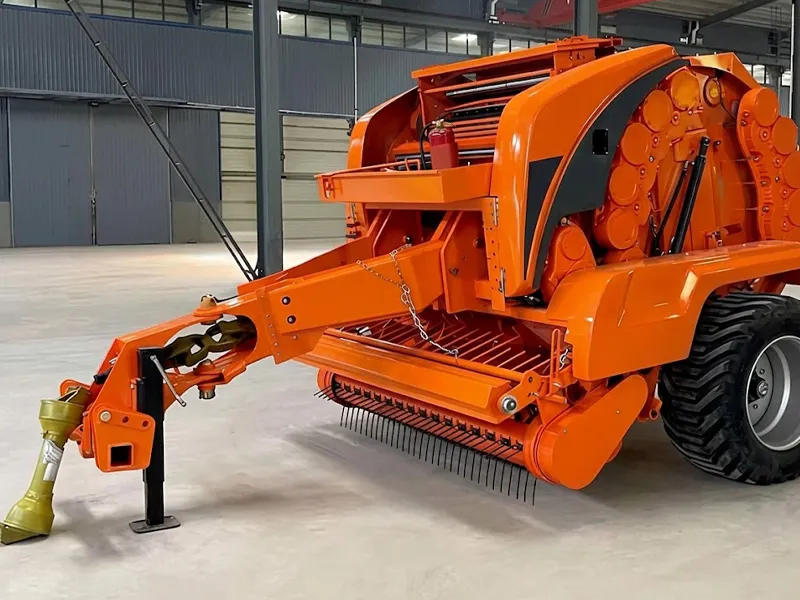
A round baler PTO shaft is a telescoping assembly made up of two overlapping steel tubes joined at each end by a universal joint — or, in constant-velocity designs, a wide-angle CV joint head. The telescoping section allows the shaft to extend and compress as the tractor pitches over uneven ground or turns at row ends, accommodating the relative movement between tractor and implement without binding the driveline. On Series 6 shafts used in high-torque baler applications, the inner and outer profiles are typically lemon-shaped or star-shaped cross-sections machined to tight sliding tolerances, which reduces play and keeps power transfer smooth across the full articulation range.
The universal joints at each end transmit torque through pairs of bearing cups mounted on a hardened steel cross. On standard 80° wide-angle slip-clutch configurations — common on John Deere 469 and 569 round balers — the front joint is a constant-velocity equalizer that keeps rotational speed consistent through operating angles up to 80°, preventing the velocity fluctuation that damages gearbox input bearings over time. The rear connection mates with the baler’s input shaft using a quick-release lockback collar, allowing the operator to disengage without tools. Guard tubes and cones — typically injection-moulded HDPE — enclose the rotating assembly to meet CE and ASABE safety standards.
ระบบวัสดุ
| ส่วนประกอบ | วัสดุ | Treatment | Purpose |
|---|---|---|---|
| ท่อยืดหดได้ | Q345 cold-drawn steel | Hot-dip galvanised or epoxy-coated | Corrosion resistance, dimensional stability |
| Universal Joint Cross | 20CrMnTi carburised steel | Case-hardened, ground | High fatigue strength, bearing surface hardness |
| Bearing Cups | 52100 bearing steel | Through-hardened, precision ground | Long service life under cyclic load |
| Yokes & Flanges | SAE 1045 forged steel | Normalised, zinc-plated | High torque transfer, connection strength |
| อุปกรณ์ป้องกันความปลอดภัย | High-density polyethylene (HDPE) | UV-stabilised | Operator protection, CE/ASABE compliance |
| Slip Clutch Friction Discs | Sintered bronze or organic composite | Precision stack-assembled | Torque limitation, overload protection |
The choice of 20CrMnTi carburised steel for the universal joint cross is deliberate. This alloy develops a hard outer case — typically 58–62 HRC — over a tough, ductile core after carburising and quenching, giving it the fatigue resistance necessary for the rapid load reversals that happen each time a bale completes a compression cycle. Cheaper plain-carbon crosses fail earlier in these conditions because the surface hardens uniformly, making the cross brittle across its entire section rather than just at the wear surfaces.
How a PTO Shaft Works in a Round Baler
The tractor PTO stub — running at either 540 RPM or 1000 RPM depending on the baler model and crop throughput requirement — connects to the driveshaft’s front yoke via a splined engagement. The 540 RPM output is standard on older and smaller balers, while 1000 RPM is preferred on high-capacity platforms because the higher input speed allows the baler gearbox to step down torque more efficiently and drive the pickup, rotor, and wrapping mechanism at their designed speeds. Most CASE IH and John Deere 9-Series round balers specify 1000 RPM operation; the actual PTO tractor shaft at the implement end will be 1-3/8 in. with either 6 or 21 splines depending on the model year and output speed.
Inside the shaft, the two telescoping tubes slide freely to compensate for distance changes as the tractor steers. The universal joints convert this rotary motion around changing angles, though they introduce a cyclic velocity variation when operating at articulation angles above approximately 5°. The constant-velocity joint head — fitted on Series 4 and Series 6 agricultural PTO driveshafts — corrects this variation by equalising the velocity through a secondary ball-joint arrangement, protecting the baler gearbox input bearing from the pulsing that would otherwise degrade its service life over a season.
Featured: EP Round Baler PTO Shaft for John Deere 469 / 569 Series
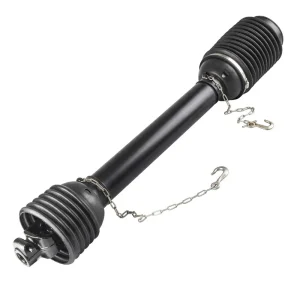
EP Round Baler PTO Shaft — John Deere 469 / 569
Built as a direct-fit replacement for John Deere 9-Series round baler PTO shaft applications. Engineered to the CAT4 / CAT5 constant-velocity driveline specification used by John Deere on the 469 and 569 platforms, with front yoke compatibility for 1-3/8 in. × 6 spline and 1-3/8 in. × 21 spline tractor outputs. Overload protection is delivered through an 80° wide-angle friction slip clutch, which releases cleanly at set torque limits to protect both the driveline and the baler gearbox input during slug feeding or blockage events.
Overload Protection: Slip Clutch vs Shear Bolt
Friction Slip Clutch
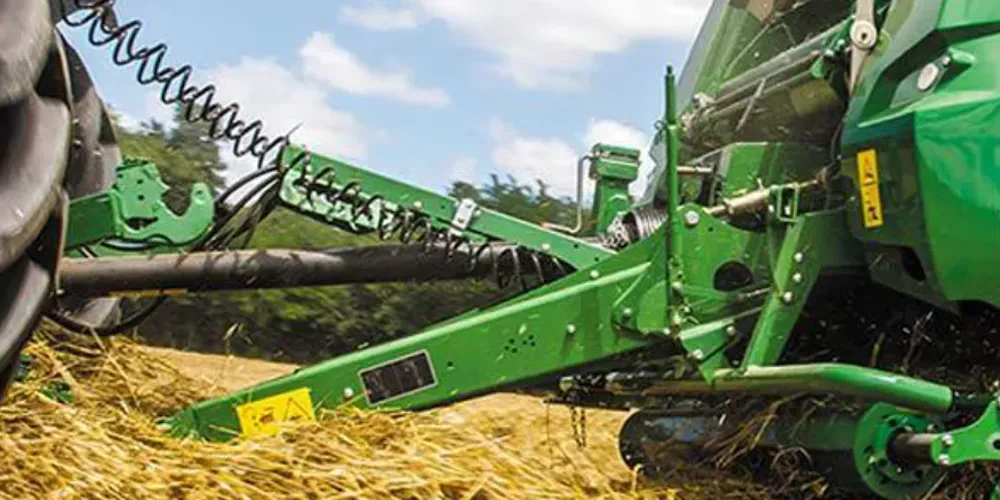
The slip clutch is the dominant protection device on modern round baler PTO shaft assemblies. A spring-loaded pack of friction discs transmits torque normally up to a calibrated threshold — typically set between 800 Nm and 2,000 Nm depending on baler class. When an obstruction stalls the baler rotor, the clutch slips continuously rather than transmitting a shock peak into the gearbox. The operator can resume operation immediately after the blockage clears. Clutch torque setting is adjusted by tightening or loosening the compression spring stack on the collar. The friction discs require periodic inspection; worn or glazed discs produce inconsistent release behaviour and should be replaced before the season opens.
Shear Bolt Device
The shear bolt is a simpler, lower-cost alternative fitted to smaller and older round baler drivelines. A soft steel bolt is installed across the yoke; when torque exceeds the bolt’s shear rating, it breaks cleanly, disconnecting the shaft from the implement. Recovery requires the operator to stop, exit the cab, remove the broken bolt, and install a replacement — meaning each blockage event costs several minutes of downtime. Shear bolts are entirely effective at preventing catastrophic gearbox damage, but they penalise throughput in conditions — heavy, damp windrows in spring — where blockages are frequent. Carrying a supply of correctly rated replacements in the cab is essential when operating a shear-bolt equipped pto shaft for round baler work.
Round Baler PTO Speed and Torque Requirements
Understanding what round baler PTO requirements actually mean in practice prevents both under-specifying and over-specifying the driveshaft. Torque, not just power, is the relevant load quantity. A baler that nominally draws 80 PTO horsepower at 1000 RPM produces a mean shaft torque of approximately 570 Nm. During peak loads — such as when the pickup draws a dense clump of lodged grass — instantaneous torque can spike to two or three times this figure before the slip clutch releases. The shaft series rating must cover the peak, not the mean.
| PTO Speed | Typical Baler Class | Mean Torque at 80 PTO HP | Recommended Shaft Series |
|---|---|---|---|
| 540 รอบต่อนาที | Small to mid-size round balers | ~1,050 Nm | Series 6 (rated to 2,000+ Nm peak) |
| 1000 RPM | JD 469 / 569, CASE IH large balers | ~570 Nm | Series 4–6 with CV head |
| 1000 RPM (Heavy Duty) | High-output / silage baler variants | ~800–1,100 Nm | Series 6 wide-angle with friction clutch |
These figures reflect continuous operating loads. The slip clutch is typically set to release at 1.5–2.5× the mean torque, providing a safety margin without triggering unnecessarily on normal crop variation. Getting this calibration right is one of the adjustments most commonly skipped during pre-season preparation — a clutch set too loose slips under normal load and causes premature friction disc wear; one set too tight transfers damaging peaks to the gearbox.
How to Measure a Round Baler PTO Shaft for Replacement
Ordering the wrong collapsed or extended length is one of the most common mistakes when sourcing a round baler PTO shaft replacement. An undersized shaft fully collapses at the working drawbar length and binds; an oversized shaft operates at too-short a telescoping overlap, reducing tube contact area and risking buckling under load. The following four measurements determine the correct shaft specification:
1 — Collapsed Length
Measure the shaft at the shortest working distance between tractor PTO stub and baler input — typically when the tractor is fully turned or at minimum hitch extension. Allow 10 mm additional clearance to prevent metal-on-metal contact inside the tube.
2 — Extended Length
Measure at the longest working distance — usually at full drawbar extension with the tractor driving straight. At full extension the tube overlap should be no less than 1/3 of the inner tube length to maintain adequate torque transmission and shaft stiffness.
3 — Spline Count and Diameter
Tractor output shafts are 1-3/8 in. with 6 splines at 540 RPM, or 1-3/8 in. with 21 splines or 1-3/4 in. with 20 splines at 1000 RPM. Verify against the tractor operator’s manual and the baler input shaft specification — mismatched splines cannot be installed and a collar adapter does not correct a torque capacity shortfall.
4 — Shaft Series
The series (4, 6, 8) defines the outer tube diameter, torque rating, and U-joint cross size. Matching the series to the existing driveshaft ensures that replacement slip clutch components, guards, and repair kits remain interchangeable without modification.
Pre-Season Inspection and Maintenance
A round baler PTO shaft that has sat through winter will almost always need attention before it goes back into service. Cold temperatures cause grease to harden and migrate away from bearing surfaces; UV exposure degrades the HDPE guard material; and any surface rust on the telescoping tubes tightens the sliding action, increasing the effective operating angle by restricting shaft articulation. The following checks take less than thirty minutes and substantially reduce mid-season failure risk:
Universal Joint Play: Grip each U-joint cross and check for radial play in the bearing cups. Any detectable movement — even 0.5 mm — indicates cup wear and imminent failure. Replace the cross kit before the season; a U-joint that fails under load usually damages the yoke ears as well, converting a low-cost cross replacement into a complete shaft assembly replacement.
Telescoping Action: Lubricate the inner/outer tube surfaces with EP grease and work the shaft through its full range of travel. Stiff or binding action under light hand pressure suggests corrosion build-up on the spline profiles. Clean and regrease; if the binding persists, replace the inner tube before corrosion compromises the tube wall thickness.
Slip Clutch Engagement: Disengage the clutch by hand and check for smooth, consistent disc separation. Re-assemble and test the release torque against the baler operator’s manual specification. Many clutches ship from the factory on the lower end of the adjustment range and need to be stepped up for high-crop-throughput conditions.
Guard Integrity: Inspect both end cones and the full guard tube for cracks, broken retaining rings, or missing end caps. A damaged guard does not protect the operator; it also collects crop material against the rotating shaft, creating a fire risk during dry hay conditions.
Compatible Driveline Components
The round baler PTO shaft sits within a wider driveline system. Sourcing the shaft and its adjacent components from a single supplier removes compatibility uncertainty and simplifies warranty and technical support. Two additional product lines are particularly relevant for operators building or servicing a complete baler drivetrain:
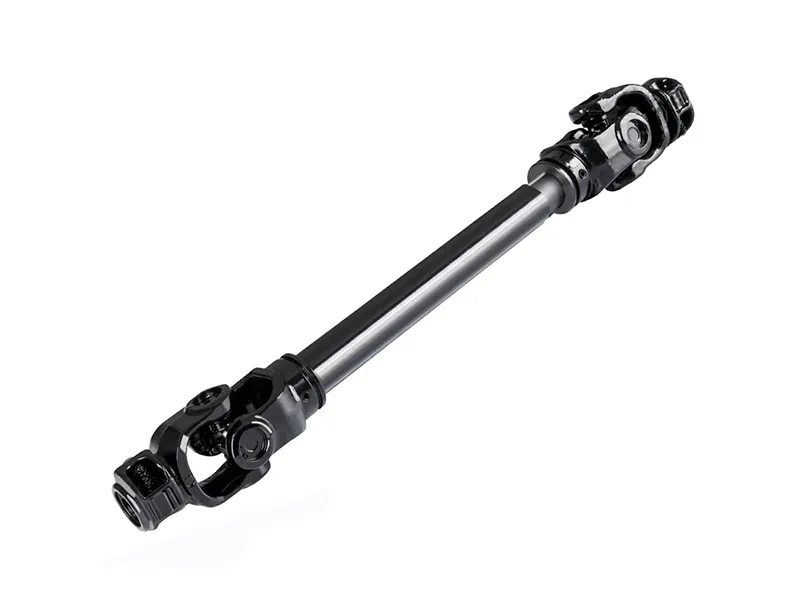
Multi-series driveshafts covering a broad range of implement categories and tractor output types. When balers are rotated between tractor models across a season, a universal configuration reduces the need for multiple dedicated shafts in the parts inventory. Cross-series repair components — bearing cups, guard tubes, slip clutch kits — remain fully interchangeable within the same series group.
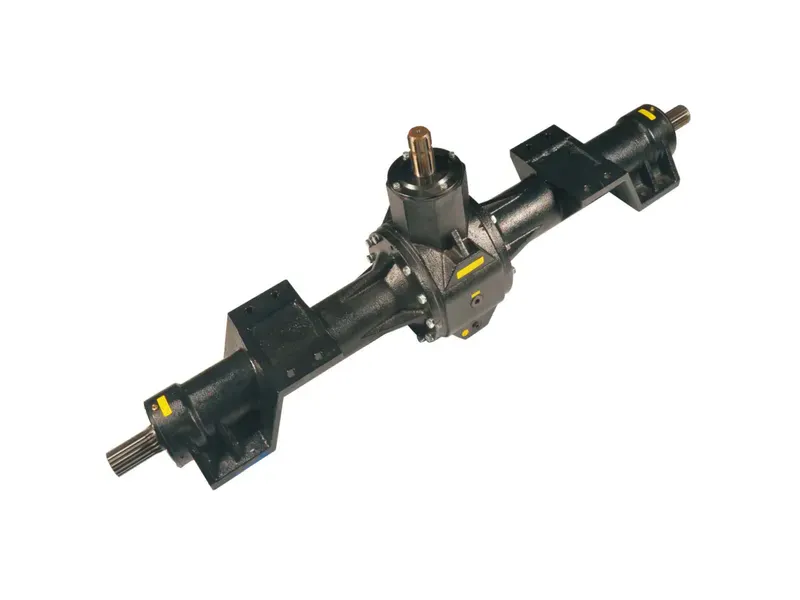
The round baler gearbox receives power from the PTO shaft and distributes it to the pickup rotor, bale formation rollers, and wrapping mechanism through a set of bevel and spur gear stages. Matching the gearbox and driveshaft from the same supply chain means input shaft splines, torque ratings, and housing flange dimensions are already coordinated — avoiding the trial-and-error fitting that often occurs when these components are sourced separately across different suppliers.
About This Manufacturer
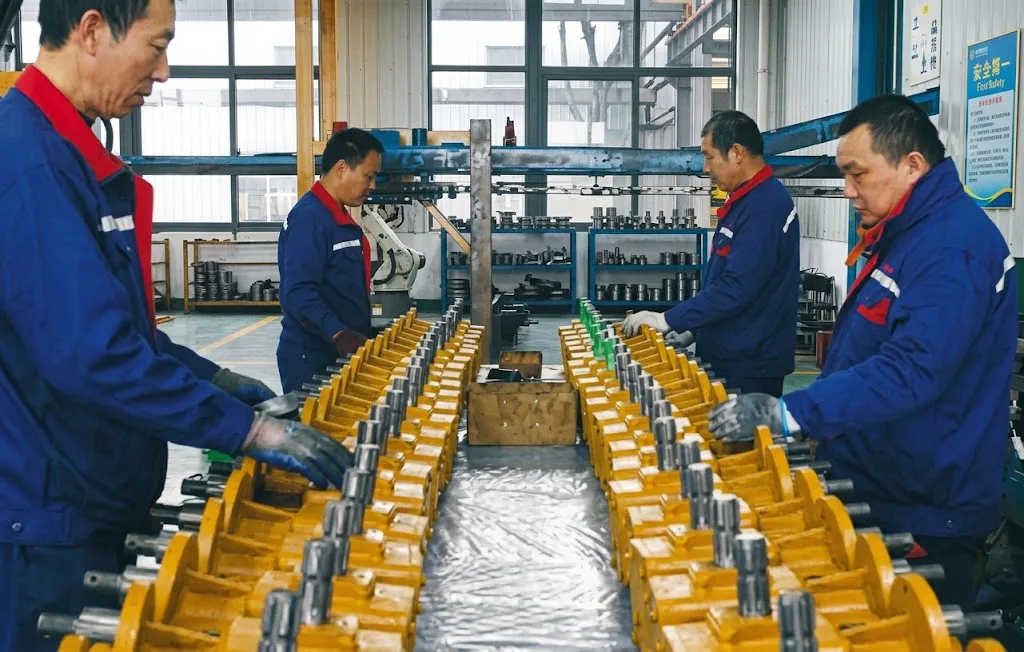
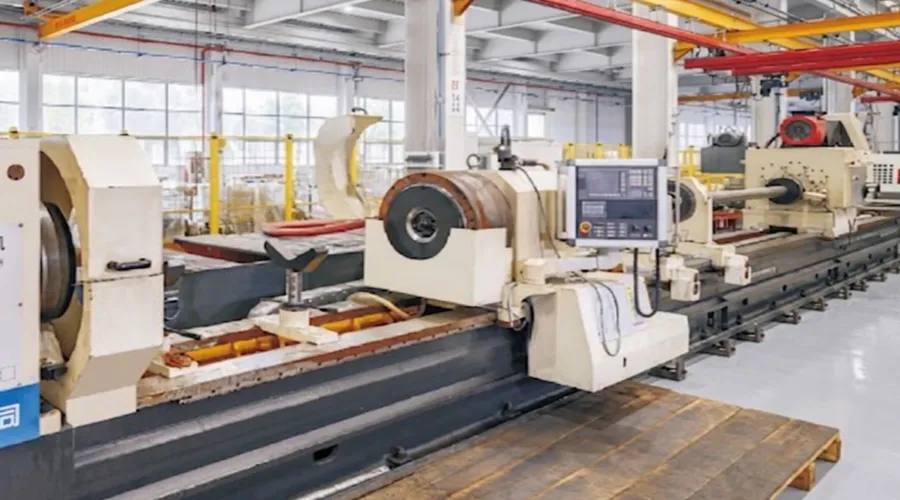
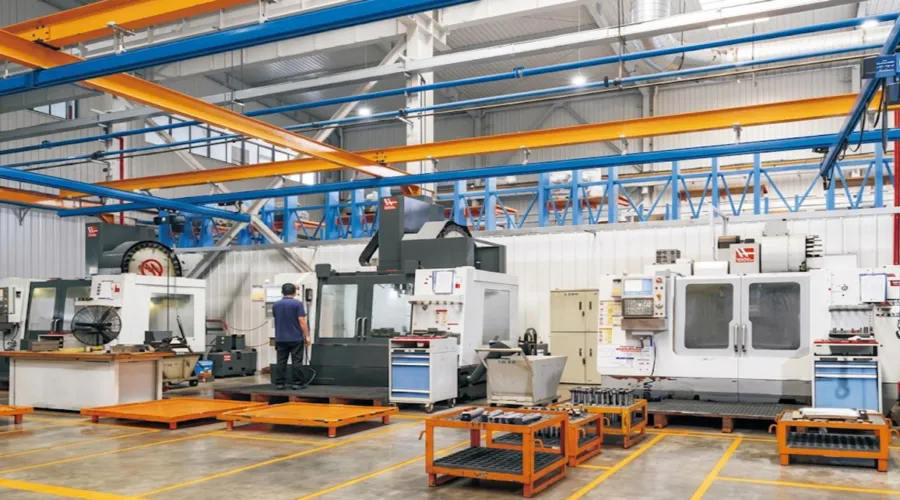
The product range extends across agricultural gearboxes, worm gear reducers, planetary gear drives, power take-off shafts, hydraulic cylinders, gears, chains, and motors. Manufacturing is conducted under ISO 9001:2015 certification, covering all production stages from raw material inspection through final assembly and pressure testing. Gearbox housings and mechanical assemblies are available in ductile iron, cast iron, cast steel, precision cast steel, and cast aluminium — selected based on the weight, thermal, and structural demands of each application. In addition to standard catalogue products, the engineering team designs and manufactures non-standard mechanical components — sprockets, worm gears, pulleys, precision shafts, and custom assemblies — to customer-supplied drawings or application descriptions.
เวิร์คช็อป

คำถามที่พบบ่อย
บรรณาธิการ: PXY