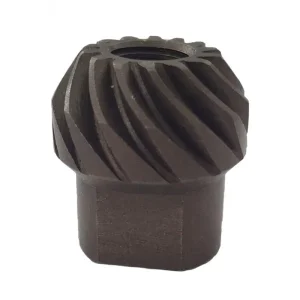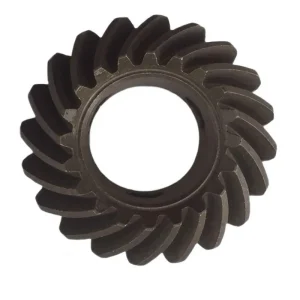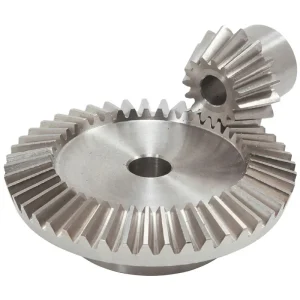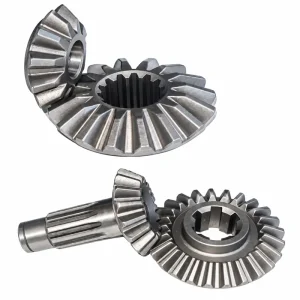
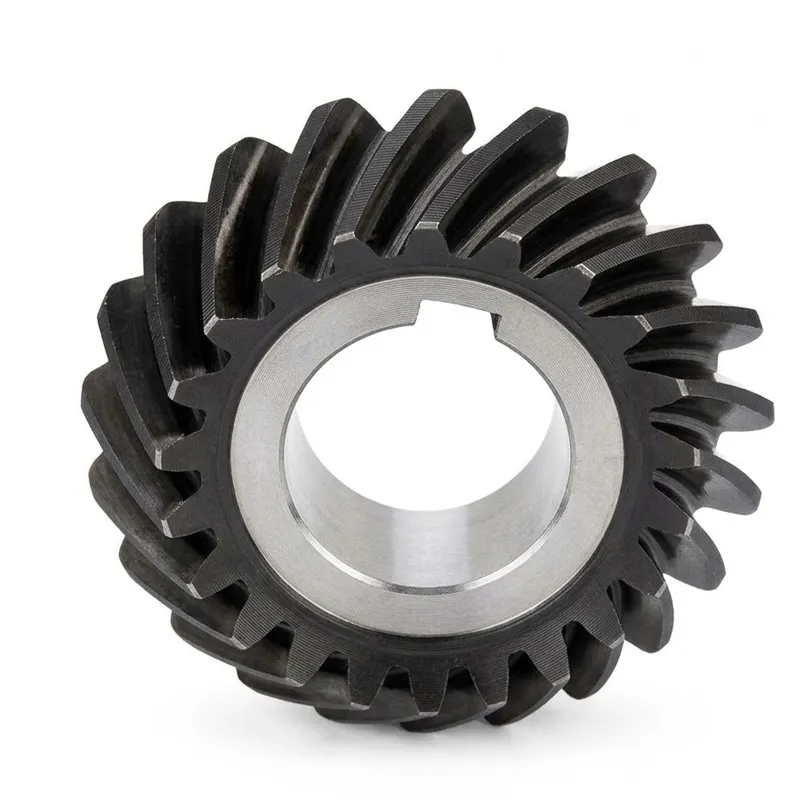
EP-Industrial Bevel Gear
The EP-Industrial Bevel Gear is a heavy-duty straight bevel wheel engineered for industrial reducers, oil machinery, construction equipment, trucks, agricultural machinery, and marine drives. Manufactured from alloy steels including 20CrMnTi, 20CrMnMo, 42CrMo, 45# steel, 40Cr, and 20CrNi2MoA, these gears cover a module range of M3–M20 with outside diameters up to Φ1200 mm. Tooth surfaces are hardened to 58–62 HRC through carburizing & quenching, tempering, nitriding, carbonitriding, or induction hardening, ensuring exceptional wear resistance under high load. Produced by CNC grinding to GB, DIN, JIS, and AGMA quality standards, the series achieves accuracy classes 5–8 for precise torque transmission across intersecting shafts.
EP-Industrial Bevel Gear — Heavy-Duty Angular Power Transmission for Global Industry
Industrial machinery, marine drives, construction equipment, and agricultural power trains all share one common demand: a reliable, high-load bevel gear that transfers torque smoothly across intersecting shaft axes without compromise. Our EP-Industrial series answers that call with alloy-steel bevel wheels precision-ground to GB, DIN, JIS, and AGMA standards, covering module range M3 through M20 and outside diameters up to Φ1200 mm.
Whether your application is a heavy reducer gearbox, an oil-field pump drive, a construction machinery final drive, or a truck axle sub-assembly, the EP-Industrial bevel gear is engineered to sustain the tooth contact pressure, thermal load, and shock cycling that separates genuine industrial service from laboratory conditions. This page covers product specifications, material choices, heat treatment data, working principle, and application guidance so you can make a fully informed sourcing decision.
Product Specification — EP-Industrial Bevel Gear
The following table summarizes the core technical parameters of the EP-Industrial straight bevel gear series. All values represent standard capability; custom parameters are available on request.
| Parameter | Spezifikation |
|---|---|
| Product Type | Industrial Straight Bevel Gear (Bevel Wheel) |
| Modulbereich | M3 – M20 |
| Diameter Range | Within Φ1200 mm |
| Gear Position | External Gear |
| Toothed Portion Shape | Bevel Wheel |
| Manufacturing Method | Grinding Gear (CNC Machine) |
| Material Options | 20CrMnTi / 20CrMnMo / 42CrMo / 45# steel / 40Cr / 20CrNi2MoA |
| Hardness | 58–62 HRC (Hardened Tooth Surface) |
| Wärmebehandlung | Carburizing & Quenching / Tempering / Nitriding / Carbonitriding / Induction Hardening |
| Qualitätsstandard | GB / DIN / JIS / AGMA |
| Accuracy Class | Class 5–8 |
| Gear Shaft Model | Customized to customer sample or drawing |
| Anwendung | Reducer / Oil Machinery / Construction Machinery / Truck / Agricultural Machinery / Marine |
| Shipping | Sea shipping / Air shipping / Express |
| Standard Delivery Time | 30 days |
How Does a Bevel Gear Work? The Engineering Behind Angular Drives
A bevel gear is a conical gear machined so that its pitch surface forms the frustum of a cone. When two bevel gears are mounted so their pitch cones share the same apex, the cone surfaces roll against each other without slipping, transmitting rotational motion and torque between shafts that intersect at an angle — most commonly 90°, though other intersection angles are achievable by varying the cone angles of the mating pair. This fundamental geometry is what separates the bevel gear from a spur or helical gear, which only works between parallel shafts.
In the EP-Industrial series, the tooth form is cut as a straight bevel (also called a Gleason straight bevel in some regional standards), meaning the tooth edges converge toward the common apex. The driving pinion engages the driven wheel progressively along the tooth face, distributing contact stress over a finite face width rather than a single line. This distributed contact, combined with the hardened tooth surface produced by carburizing and quenching, is what allows the EP-Industrial bevel gear to survive the impact loads seen in agricultural PTO drives, construction machinery travel systems, and marine thruster reversals.
Der gear ratio of bevel gear sets is determined entirely by the tooth count relationship: a pinion with 15 teeth driving a wheel with 45 teeth produces a 3:1 output speed reduction with a corresponding 3:1 torque multiplication (minus friction losses). Because the cone geometry constrains how teeth are proportioned, the practical range of ratio achievable in a single stage is roughly 1:1 through 6:1 — beyond that, efficiency and tooth strength make multi-stage arrangements preferable.
das Verständnis des difference between helical and bevel gear configurations is essential when specifying a gearbox. Helical gears change speed and torque between parallel shafts with gradual tooth engagement that minimizes noise; bevel gears achieve the same result while simultaneously changing the drive axis. When both axis change and low noise are needed, spiral bevel gears (not covered in this product line) add tooth helix angle to the conical form. The EP-Industrial straight bevel gear is the right choice where robust, high-torque right-angle drives are the priority and where noise is managed at the system level through casing design and damping.
Five Key Advantages of the EP-Industrial Bevel Gear
High-Load Alloy Steel Construction
Grade-specific alloys — 20CrMnTi, 20CrMnMo, 42CrMo, 45# steel, 40Cr, and 20CrNi2MoA — are selected to match the duty cycle of each application. These alloy steels provide the core toughness needed to absorb shock loads in construction and agricultural machinery while supporting the case hardness that resists pitting fatigue at the tooth flank surface.
Hardened Tooth Surface — 58–62 HRC
Tooth flanks are processed through carburizing and quenching, tempering, nitriding, carbonitriding, or induction hardening depending on the application requirement. The resulting surface hardness of 58–62 HRC gives the bevel gear exceptional wear resistance under sustained contact stress, directly extending service life in reducer and oil-machine drivetrains compared to through-hardened alternatives.
Multi-Standard Accuracy Compliance
Accuracy class 5–8 conformance to GB, DIN, JIS, and AGMA standards means the EP-Industrial bevel gear integrates into gearboxes designed to any major regional specification. For global OEM programs assembling equipment in Europe, North America, and Asia from a common parts list, this multi-standard compliance eliminates the costly re-qualification work that comes with single-standard sourcing.
CNC Ground to Φ1200 mm — Large-Scale Capability
The ability to produce precision bevel gear components up to Φ1200 mm in diameter places this product line in a category few suppliers can match. Large-diameter bevel wheels for marine gearboxes, mining hoists, cement mixer drive heads, and heavy-construction swing drives are all within scope, ground on CNC gear-grinding machines for consistent tooth geometry across the full face width.
Full ODM Customization from Drawing to Delivery
Every geometric parameter — module, tooth count, pressure angle, face width, bore profile, keyway, and shaft fit — is customizable against customer sample or 2D/3D drawing. The 30-day standard production lead time covers drawing review, material procurement, CNC machining, heat treatment, grinding, and dimensional inspection. This end-to-end service model reduces supply chain complexity for buyers who need tailored bevel gear configurations not available off the shelf.
Material Selection for EP-Industrial Bevel Gears
Material choice is the single biggest lever available to the designer when sizing a bevel gear for a given duty cycle. An undersized tooth in a soft material fails within hours under full load; an overspecified material in a low-load application adds unnecessary cost and weight. Our EP-Industrial line uses six alloy steel grades, each matched to a class of operating conditions, so engineers can request the precise combination of core toughness and surface hardness their application demands rather than accepting a one-size-fits-all approach.
20CrMnTi is the most widely used grade in this product family. It is a carburizing steel that achieves high case hardness after carburizing and quenching while retaining a tough, impact-resistant core. This combination — hard outside, tough inside — is exactly what an industrial bevel gear needs when handling the shock loads of a construction machinery drive or agricultural gearbox. 20CrMnTi is also cost-effective, which makes it the default recommendation for volume production.
20CrMnMo adds molybdenum to the chromium-manganese base, improving hardenability in larger cross-sections and providing better resistance to temper brittleness during heat treatment. It is the preferred grade when the bevel gear body diameter exceeds approximately 200 mm and uniform hardness through the case depth is critical. 42CrMo is a through-hardening grade used when the application requires high strength throughout the gear body rather than just at the tooth surface — gearboxes operating under continuous heavy torque in oil-field pumps and marine drive systems are common use cases.
45# steel is a medium-carbon steel selected for cost-sensitive applications where surface hardness requirements are moderate — typically induction-hardened rather than carburized, achieving localized tooth hardening without the longer thermal cycle of case carburizing. 40Cr offers improved hardenability over plain 45# steel and is commonly specified for truck axle bevel pinions where both core strength and surface wear resistance are needed. 20CrNi2MoA is the premium option: nickel-chromium-molybdenum alloying provides the highest combination of toughness, hardenability, and fatigue strength, making it appropriate for precision forged bevel gears operating under peak loads in demanding environments.
All heat treatment processes — carburizing and quenching, tempering, nitriding, carbonitriding, and induction hardening — are performed in-house with controlled atmosphere furnaces and logged process records. The target hardness range of 58–62 HRC covers the majority of industrial applications and is verified by Rockwell hardness testing on representative sample pieces from each production batch before shipment.
Bevel Gear vs Spur Gear — Technical Comparison
Der bevel gear vs spur gear question comes up frequently in reducer and gearbox design. A spur gear is the simpler component — straight teeth on a cylinder — and it is the most cost-effective solution for parallel shaft arrangements. The moment the drive axis must change direction, however, a spur gear cannot do the job. That is precisely where the bevel gear excels: it changes the axis of rotation at the mesh while simultaneously stepping the speed and torque to the required ratio.
Der bevel gear pressure angle used in the EP-Industrial series follows the 20° standard recommended by AGMA and DIN for general industrial drives. A 20° pressure angle produces a reasonable balance between tooth strength (favored by higher pressure angles) and smooth engagement (favored by lower pressure angles). For applications requiring higher tooth load capacity at the expense of slightly higher bearing radial loads, a 22.5° or 25° pressure angle can be machined against a customer specification.
Among the recognized bevel gear advantages over alternative angle-drive mechanisms such as crossed-helical gears or worm sets is efficiency: a well-aligned straight bevel pair typically achieves 97–99% mechanical efficiency at rated load, compared to 50–90% for worm gear arrangements in similar ratios. This matters in energy-intensive applications like pumps, compressors, and agricultural equipment where drivetrain losses multiply across the working day.
Where EP-Industrial Bevel Gears Are Used
Der bevel gear is found wherever rotating machinery must redirect its drive axis. Below are the primary sectors served by the EP-Industrial series, each with distinct load, speed, and environmental requirements that guided our engineering choices.
⚙ Industrial Reducers
Right-angle reducer gearboxes are among the most common bevel gear examples in manufacturing. The pinion-and-wheel pair at the input or output stage redirects the motor axis to suit the machine layout while stepping the speed down to the process requirement. Our M3–M20 range covers the full spectrum from compact conveyor reducers to large rolling mill auxiliary drives, with accuracy class 5 available for low-backlash positioning stages.
🛢 Oil & Gas Machinery
Pump jacks, mud circulation drives, and wellhead rotary tables all use heavy-duty bevel gear sets to redirect the prime mover axis into the well or pump head. The demanding duty cycles in this sector — high continuous torque, abrasive environments, and remote location service intervals — make surface hardness and core toughness non-negotiable. 42CrMo and 20CrNi2MoA grades are specified by default for oil-field bevel gear applications.
🏗 Construction Machinery
Excavator swing drives, crane travel gearboxes, and concrete mixer drum drives rely on large-diameter bevel wheels to transmit high torques under shock conditions. EP-Industrial bevel gear sets in 20CrMnTi and 42CrMo grade, heat-treated to 58–62 HRC, withstand the pulsating torque profiles generated by bucket digging cycles and full-load swing reversals that would quickly fatigue lower-specification gears.
🚜 Agricultural Machinery
Combine harvesters, tractor PTO gearboxes, and irrigation pump drives use bevel gear sets at their axis-change points because the working environments combine sustained high torque with dirt, moisture, and temperature cycling. The carburizing-and-quenching route applied to 20CrMnTi in this product line is directly matched to the load spectra of field machinery running at seasonal peak output for extended daily hours.
🚢 Marine Propulsion Auxiliaries
Bow thruster drives, windlass gearboxes, and steering gear assemblies aboard commercial vessels use right-angle bevel drive stages to suit hull geometry constraints. Marine environments impose severe corrosion exposure on top of high mechanical loads; our EP-Industrial units are supplied with surface protection options and use 20CrMnMo or 42CrMo grades that maintain mechanical properties even after exposure to salt-air operating conditions across multi-year deployment cycles.
🚛 Truck & Commercial Vehicles
Truck rear-axle differential carriers, transfer box bevel sets, and auxiliary PTO drives in utility vehicles demand compact, high-torque bevel gear designs that survive hundreds of thousands of kilometers. 40Cr and 20CrNi2MoA grades combined with induction hardening or carbonitriding deliver the surface durability and fatigue resistance that fleet operators and commercial vehicle OEMs specify in their supplier quality requirements.
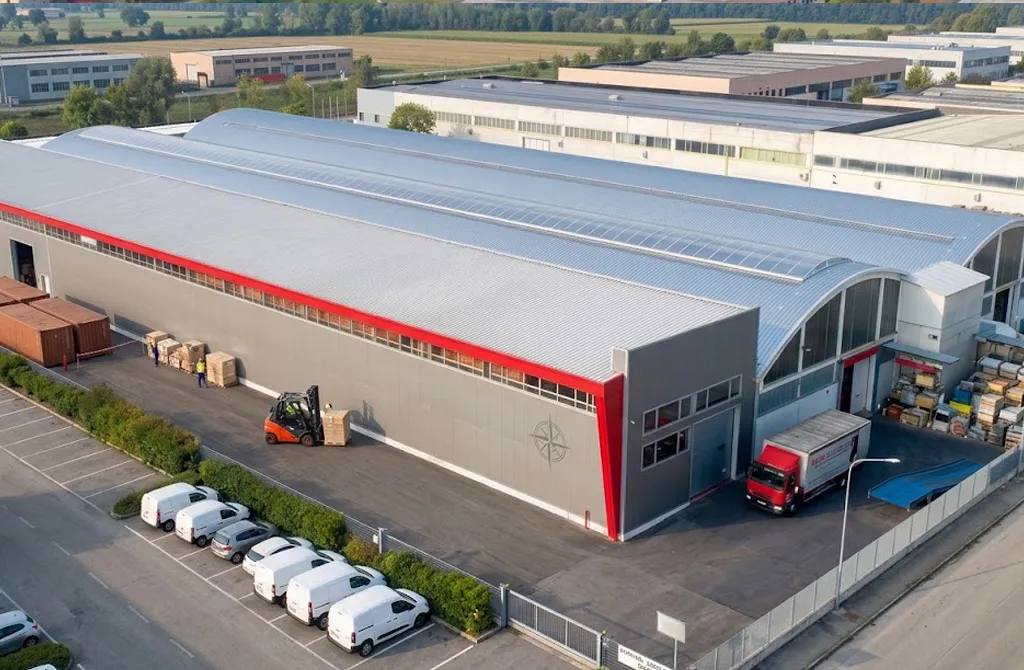
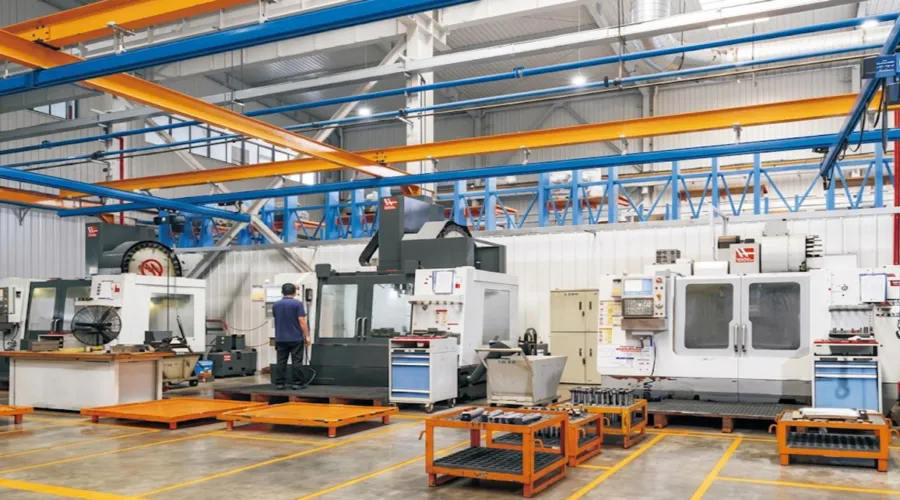
About Our Manufacturing Facility — 10+ Years of Gear Engineering Experience
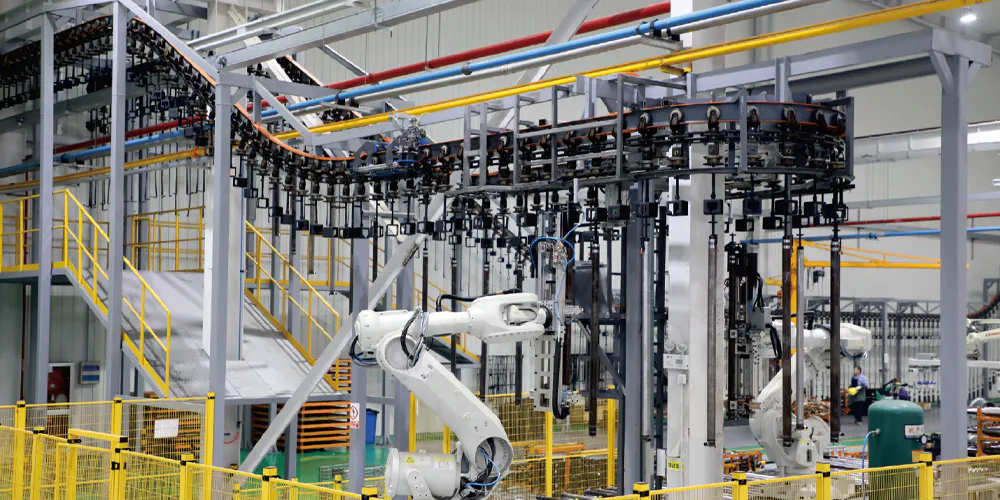
Our gear production facility brings over a decade of mechanical transmission engineering to every bevel gear we ship. The product portfolio spans agricultural gearboxes, worm gear reducers, planetary gear drives, power take-off shafts, hydraulic cylinders, transmission gears, roller chains, and electric motors — a scope broad enough that our engineering team encounters nearly every category of drivetrain challenge across the industrial sectors we serve.
Operations run under ISO 9001:2015 quality management certification, covering the full production process from raw material chemical composition testing through in-process dimensional checks to final hardness verification before packing. Beyond standard catalogue items, we design and produce custom gearboxes and assemblies in ductile iron, cast iron, cast steel, precision-cast steel, and cast aluminum. Sprockets, worm gears, pulleys, worm shafts, and other standard and non-standard mechanical parts are all within our manufacturing scope, supporting buyers who prefer consolidated supply from a single technically capable source.
For buyers in Australia, Canada, Germany, the UK, and other mature industrial markets seeking verified precision bevel gear manufacturers who can provide documentation, drawing-based customization, and reliable logistics, we offer sea, air, and express shipping with standard 30-day lead times on custom configurations. Technical consultation and drawing review before order commitment are available at no charge.
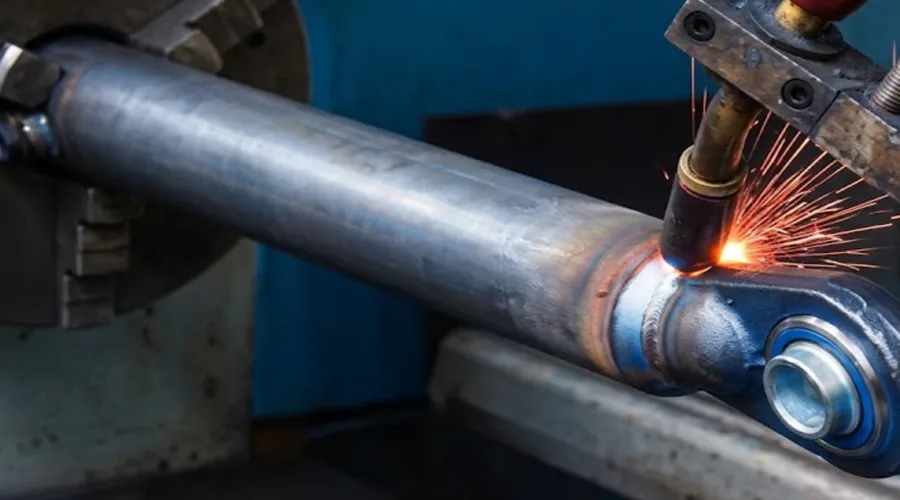
Werkstatt
Compatible Products — One-Stop Drivetrain Supply
A bevel gear stage rarely operates alone. We produce the following complementary gear types to the same quality standard, enabling full drivetrain sourcing from a single supplier and guaranteeing module and pressure angle compatibility across the assembly.
Doppel-Schrägverzahnung
Where your drivetrain includes parallel-shaft stages adjacent to the bevel pair, double helical gears eliminate the axial thrust force that single-helix designs impose on bearings. Specifying the bevel gear and double helical stages together through one source ensures matched tooth parameters, coordinated heat treatment records, and a single point of accountability if dimensional issues arise during assembly. The combined system also demonstrates the one-stop supply advantage that reduces procurement complexity for global equipment builders.
Zahnstange
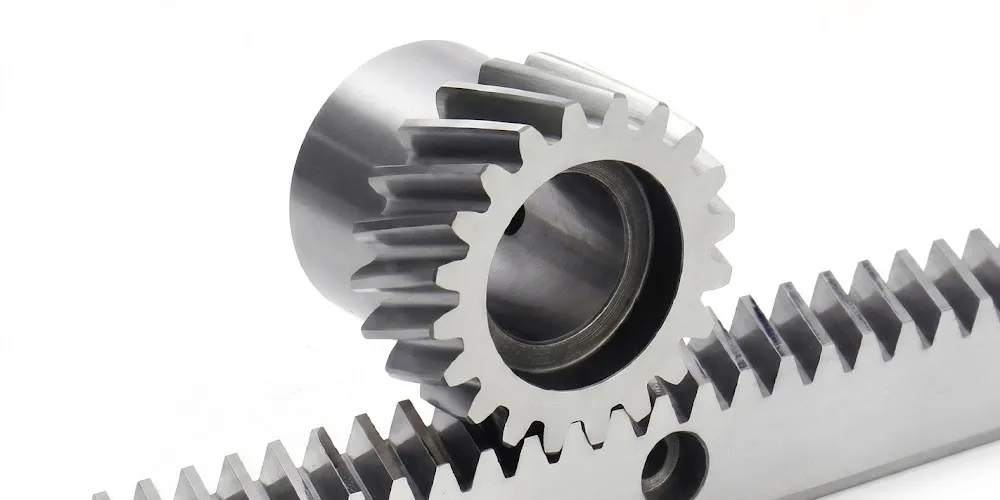
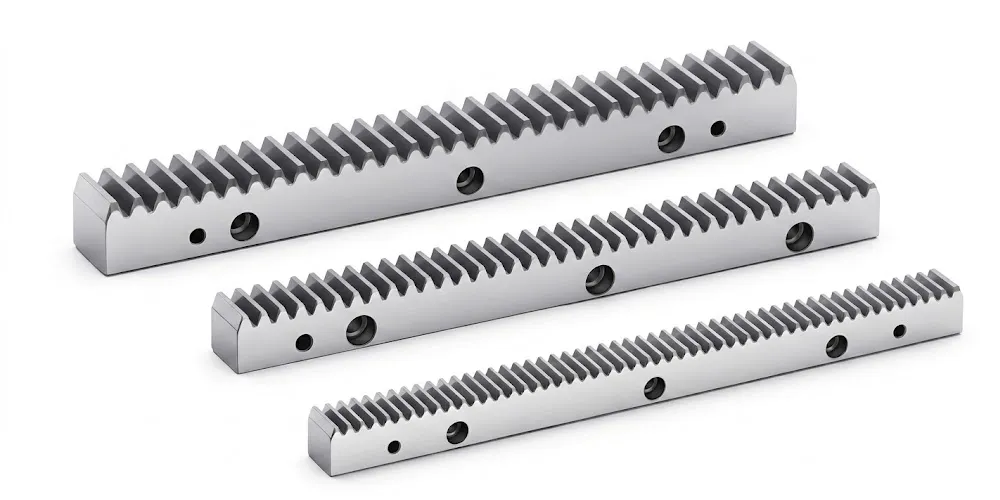
Linear actuation stages that feed into or receive output from a bevel gear drive require a gear rack matched in module and pressure angle to the associated pinion. Our gear rack range covers the standard modules used throughout the EP-Industrial bevel gear series, supporting applications in CNC axis drives, heavy lifting systems, automated gate mechanisms, and industrial positioning stages. Supplying both the rack and the bevel gear set from one source removes the tolerance mismatch risk that arises when rack and gear come from separate suppliers with different manufacturing practices.
Trade & Delivery Information — Gear Products
The following trade terms, lead times, and MOQ policies are specifically mapped to gear-type products (gears, pinions, worm gears, bevel gears, helical gears, ground gears) based on our general trading framework. Only clauses directly referencing gear products have been extracted from the full terms library.
Lead Time
Based on the standardisation level, machining complexity, and processing requirements of gear products:
| Gear Products — Lead Time Reference | |
|---|---|
| Product Category | Estimated Lead Time |
| Standard Transmission Gears | 10–25 working days |
| Standard Gears + Simple Processing | 15–35 working days |
| Custom Machined Gears | 20–45 working days |
| High-Precision / Heat-Treated Gears | 30–60 working days |
Trade Types
Recommended Incoterms based on product volume, weight, value, and urgency for gear products:
| Gear Products — Recommended Trade Terms | |
|---|---|
| Product Type | Recommended Terms |
| Standard Gears | EXW / FOB / CIF / DAP |
| Custom / OEM Gears | EXW / FOB / CIF / DAP |
FCA, CFR, CPT, CIP and DDP terms are also available upon specific request and subject to negotiation.
MOQ
Minimum order quantities for gear products are determined by product type, material, processing requirements, and batch size:
| Gear Products — MOQ Guidelines | |
|---|---|
| Product Category | MOQ Policy |
| Custom Gears | MOQ depends on drawing, material, tolerance, machining process and batch size. |
| Heat Treatment / Surface Treatment | Special processing may be limited by process batch size. |
General Terms
The following baseline terms apply to all gear product orders:
| General Trading Terms | |
|---|---|
| Term | Policy |
| MOQ Principle | Flexible based on product type and order value. |
| Sample Policy | New customers may apply for 1–5 samples where suitable. |
| Mixed Orders (Consolidation) | Combination of different models supported; total order value should reach approximately USD 1,500. |
| Small Orders | 1–2 pcs orders supported, but unit price may be relatively higher. |
| Overall Delivery Time | Standard parts: 10–25 working days | Custom components: 20–45 working days | Project equipment: 45–120 working days |
| Overall Trade Terms | EXW, FOB, CIF, DAP supported as standard; FCA, CFR, CPT, CIP and DDP available upon specific negotiation. |
Frequently Asked Questions — Industrial Bevel Gear
Q1. What alloy steel grade should heavy construction equipment engineers in North America specify when sourcing a large-diameter bevel gear for a concrete mixer drive?
For large-diameter bevel gear applications in concrete mixer drives, 42CrMo is the grade most commonly specified. Its through-hardenability in thick sections ensures that the full gear body reaches target hardness — typically 58–62 HRC at the tooth surface — without the hardness gradient drop that limits 20CrMnTi in very large diameters. The chromium-molybdenum alloying also gives 42CrMo good resistance to temper brittleness, which matters when the gear experiences thermal cycling during normal mixer operation. If fatigue life at the tooth root is the dominant failure mode, specifying carbonitriding as the heat treatment route adds a thin nitrogen-enriched diffusion layer on top of the carburized case, further improving fatigue strength at the critical root radius. Our EP-Industrial series covers diameters to Φ1200 mm in this grade with standard 30-day delivery on custom-drawing orders.
Q2. How does a precision bevel gear differ from a standard industrial bevel gear in terms of accuracy class and what does that mean for European gearbox manufacturers?
The distinction lies in the tolerance band applied to tooth profile error, pitch error, and runout. A standard bevel gear in the EP-Industrial range is produced to accuracy class 7 or 8 per DIN standards, which is appropriate for most heavy-load applications where tooth deflection under load is many times larger than the gear's own geometric error. A precision bevel gear graded at class 5 or 6 has tighter tolerances on all those parameters, resulting in lower vibration, smoother torque transmission, and more predictable noise levels — qualities that European gearbox manufacturers subject to machinery directive noise emission limits routinely specify. We supply both accuracy levels from the same alloy steel blank stock; the difference is in the grinding pass count and the measurement protocol applied before dispatch.
Q3. How do I correctly install a bevel gear pair in an industrial reducer to achieve the right tooth contact pattern and what are the most common alignment mistakes?
Correct installation of an industrial bevel gear pair starts with verifying that the shaft intersection angle in the housing matches the gear cone angle — any angular error here shifts the contact patch toward one end of the tooth face and concentrates stress. After assembling the pair, rotate slowly by hand and apply marking compound to the pinion teeth, then inspect the contact pattern on the wheel: the mark should fall centrally along the tooth height and cover approximately half the face width under no-load conditions, migrating toward the full face under load. The most common alignment errors are incorrect axial positioning of either the pinion or the wheel, which shifts the apex of one cone away from the shared apex point. Shim adjustment under the bearing housings corrects axial position; re-boring the housing is required if angular intersection error is found. Never use contact pattern alone to judge a gear that has already run under load — the pattern will shift under torque and should be re-checked at operating load.
Which heat treatment process is best for bevel gears used in agricultural machinery across high-humidity regions like Southeast Asia or Brazil?
Für bevel gear sets deployed in high-humidity agricultural environments, carburizing and quenching combined with tempering is the recommended heat treatment route. This sequence produces a hard, wear-resistant case — 58–62 HRC — over a tough core, and the subsequent tempering step relieves quench stresses that could otherwise initiate surface cracks when the gear encounters impact loads from uneven field terrain. Carbonitriding is an alternative that adds nitrogen to the surface diffusion layer, providing an additional corrosion-resistance contribution useful in tropical climates where condensation cycles occur inside gearbox housings even with adequate sealing. Where the gearbox is filled with EP gear oil and sealed, the oil film largely manages corrosion; in vented or splash-lubricated housings exposed to field contamination, the carbonitrided surface provides a useful extra margin.
Where can industrial buyers in Australia or the UK source custom bevel gears in M3–M20 with full material certifications and OEM drawing support?
Buyers in Australia, the UK, and other export markets can source custom EP-Industrial bevel gear sets directly through our export program. We accept customer 2D/3D drawings in standard formats and can also produce a custom gear from a physical sample if no drawing exists. Material mill certificates, heat treatment process records, and dimensional inspection reports are provided with each order on request. Shipments to Australia and the UK are routed via sea freight for bulk orders and via air express for urgent sample consignments, with DHL and FedEx accounts integrated into our logistics workflow. Standard delivery from order confirmation to shipment is 30 days for custom configurations. A pre-order drawing review at no charge helps confirm that module, pressure angle, accuracy class, and material grade are correctly specified before production begins.
Herausgeber: PXY